
Inverse Trig Functions
Inverse trig functions undo sine, cosine and tangent: they take a ratio and give back an angle. Because trig functions repeat, each inverse uses a restricted range. Arcsine and arctangent give angles from -\frac{\pi}{2} to \frac{\pi}{2}, and arccosine gives angles from 0 to \pi. For example, \arcsin \frac{1}{2} = \frac{\pi}{6}.
Before this lesson: You should know Inverse Functions, The Unit Circle and Graphs of Sine and Cosine.
Why the Range Must Be Restricted
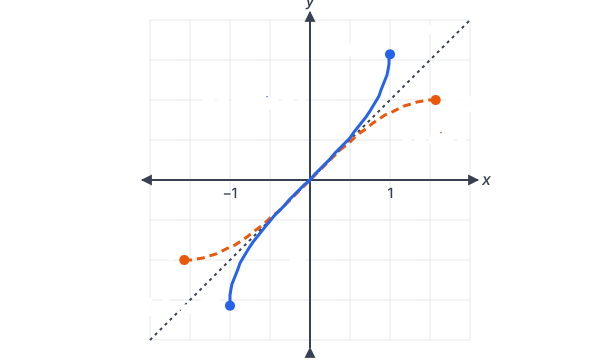
The equation \sin \theta = \frac{1}{2} has many answers: \frac{\pi}{6}, \frac{5\pi}{6}, \frac{13\pi}{6} and more. A function can give only one output for each input. So sine, as it is, has no inverse function. It fails the horizontal line test from inverse functions.
The fix is to use just one piece of the sine graph that goes through every value from −1 to 1 exactly once. For sine, that piece runs from -\frac{\pi}{2} to \frac{\pi}{2}. The inverse of that piece is arcsine, written \arcsin x or \sin^{-1} x.
Definitions, Domains and Ranges
| Function | Meaning | Domain (input) | Range (output angle) |
|---|---|---|---|
| y = \arcsin x | \sin y = x | -1 \le x \le 1 | -\frac{\pi}{2} \le y \le \frac{\pi}{2} |
| y = \arccos x | \cos y = x | -1 \le x \le 1 | 0 \le y \le \pi |
| y = \arctan x | \tan y = x | All real numbers | -\frac{\pi}{2} \lt y \lt \frac{\pi}{2} |
The notation \sin^{-1} x means arcsine, not \frac{1}{\sin x}. The reciprocal of sine is cosecant. On a calculator, the inverse keys are usually SIN⁻¹, COS⁻¹ and TAN⁻¹ (press 2nd, then SIN, and so on).
- Ask: what angle in the restricted range has this sine, cosine or tangent?
- Use the unit circle to find the reference angle.
- Pick the quadrant allowed by the range. For arcsine and arctangent, a negative input gives a negative angle in Quadrant IV. For arccosine, a negative input gives an angle in Quadrant II.
- Check that your answer is in the range.
Worked Examples
Example 1: Arcsine of a special value
Find \arcsin \frac{\sqrt{3}}{2}.
Ask: which angle from -\frac{\pi}{2} to \frac{\pi}{2} has sine \frac{\sqrt{3}}{2}?
\sin \frac{\pi}{3} = \frac{\sqrt{3}}{2}From the unit circle.
Check the range: -\frac{\pi}{2} \le \frac{\pi}{3} \le \frac{\pi}{2}
Answer: \arcsin \frac{\sqrt{3}}{2} = \frac{\pi}{3}, or 60°. The angle \frac{2\pi}{3} has the same sine, but it is outside the range.
Example 2: Arccosine of a negative value
Find \arccos(-\frac{1}{2}).
Ask: which angle from 0 to \pi has cosine -\frac{1}{2}?
The reference angle with cosine \frac{1}{2} is \frac{\pi}{3} (see reference angles)
\pi - \frac{\pi}{3} = \frac{2\pi}{3}Cosine is negative in Quadrant II, which is inside the range.
Check: \cos \frac{2\pi}{3} = -\frac{1}{2}
Answer: \arccos(-\frac{1}{2}) = \frac{2\pi}{3}, or 120°
Example 3: Arctangent of a negative value
Find \arctan(-1).
Ask: which angle between -\frac{\pi}{2} and \frac{\pi}{2} has tangent −1?
The reference angle with tangent 1 is \frac{\pi}{4}
-\frac{\pi}{4}A negative input gives a negative angle in Quadrant IV.
Check: \tan(-\frac{\pi}{4}) = -1
Answer: \arctan(-1) = -\frac{\pi}{4}, or −45°
Example 4: Use a calculator
Find \sin^{-1}(0.3) in radians and in degrees, to the nearest hundredth.
\sin^{-1}(0.3) \approx 0.3047Set the calculator to radian mode and press 2nd, SIN, 0.3, ENTER.
0.3047 \approx 0.30
Round to the nearest hundredth of a radian.
\sin^{-1}(0.3) \approx 17.4576^\circSet the calculator to degree mode and repeat.
17.46^\circ
Round.
Answer: about 0.30 radians, or about 17.46°
Example 5: Word problem with a ladder
A 20-foot ladder leans against a wall, with its base 5 feet from the wall. What angle does the ladder make with the ground?
\cos \theta = \frac{5}{20} = 0.25The base is adjacent to the angle and the ladder is the hypotenuse, so use cosine.
\theta = \cos^{-1}(0.25)Undo cosine with arccosine.
\theta \approx 75.52^\circ
Evaluate in degree mode.
Answer: about 75.52°. This is the same inverse-ratio step used in solving right triangles.
Common Mistakes
| Mistake | Example of the error | Fix |
|---|---|---|
| Treating the -1 as an exponent | \sin^{-1} x = \frac{1}{\sin x} | \sin^{-1} x is arcsine. The reciprocal of sine is \csc x. |
| Giving an angle outside the range | \arcsin \frac{1}{2} = \frac{5\pi}{6} | Arcsine outputs are between -\frac{\pi}{2} and \frac{\pi}{2}, so the answer is \frac{\pi}{6}. |
| Using a negative angle for arccosine | \arccos(-\frac{1}{2}) = -\frac{\pi}{3} | Arccosine outputs are from 0 to \pi: \frac{2\pi}{3}. |
| Input outside the domain | \arcsin 2 \approx 1.57 | Sine is never 2, so \arcsin 2 is undefined. |
| Wrong calculator mode | Getting 17.46 when the problem wants radians | Check radian or degree mode before you press ENTER. |
Related Methods
Think in degrees first
If radians feel unfamiliar, find the angle in degrees and convert at the end with radians. For \arccos(-\frac{1}{2}), think 120°, then convert: 120^\circ \cdot \frac{\pi}{180^\circ} = \frac{2\pi}{3}.
Inverses of the reciprocal functions
Arcsecant, arccosecant and arccotangent exist too. For example, \text{arcsec}\, 2 = \arccos \frac{1}{2} = \frac{\pi}{3}, because secant is the reciprocal of cosine.
All solutions of an equation
An inverse trig function gives one angle. The equation \sin \theta = \frac{1}{2} has more solutions, which you will find in the trig equations unit.
Practice Problems
- Find \arcsin 1.
- Find \arccos 0.
- Find \arctan \sqrt{3}.
- Find \arcsin(-\frac{\sqrt{2}}{2}).
- Find \arccos(-\frac{\sqrt{3}}{2}).
- Find \arctan(-\frac{\sqrt{3}}{3}).
- Find \arcsin 2.
- Find \cos^{-1}(0.8) in radians and degrees, to the nearest hundredth.
- Find \tan^{-1}(5) in radians and degrees, to the nearest hundredth.
- A kite flies on a 60-meter string, 45 meters above the ground. Assume the string is straight. Find the angle the string makes with the ground.
Show answers
1.
Which angle in the range has sine 1? \sin \frac{\pi}{2} = 1
Answer: \frac{\pi}{2}
2.
Which angle from 0 to \pi has cosine 0? \cos \frac{\pi}{2} = 0
Answer: \frac{\pi}{2}
3.
Which angle in the range has tangent \sqrt{3}? \tan \frac{\pi}{3} = \sqrt{3}
Answer: \frac{\pi}{3}
4.
The reference angle with sine \frac{\sqrt{2}}{2} is \frac{\pi}{4}
-\frac{\pi}{4}A negative input gives a Quadrant IV angle.
Answer: -\frac{\pi}{4}
5.
The reference angle with cosine \frac{\sqrt{3}}{2} is \frac{\pi}{6}
\pi - \frac{\pi}{6} = \frac{5\pi}{6}Use Quadrant II.
Answer: \frac{5\pi}{6}
6.
The reference angle with tangent \frac{\sqrt{3}}{3} is \frac{\pi}{6}
-\frac{\pi}{6}A negative input gives a negative angle.
Answer: -\frac{\pi}{6}
7.
Sine is never greater than 1, so 2 is not in the domain
Answer: undefined
8.
\cos^{-1}(0.8) \approx 0.6435In radian mode, find the inverse cosine.
\cos^{-1}(0.8) \approx 36.8699^\circIn degree mode, find the inverse cosine.
Answer: about 0.64 radians, or 36.87°
9.
\tan^{-1}(5) \approx 1.3734In radian mode, find the inverse tangent.
\tan^{-1}(5) \approx 78.6901^\circIn degree mode, find the inverse tangent.
Answer: about 1.37 radians, or 78.69°
10.
\sin \theta = \frac{45}{60} = 0.75The height is opposite the angle and the string is the hypotenuse.
\theta = \sin^{-1}(0.75)Undo sine.
\theta \approx 48.59^\circ
Evaluate in degree mode.
Answer: about 48.59°
FAQ
What are inverse trig functions?
They are arcsine, arccosine and arctangent. Each one takes a value of sine, cosine or tangent and returns the angle in a set range that has that value.
What is the range of arcsin, arccos and arctan?
Arcsine: [-\frac{\pi}{2}, \frac{\pi}{2}]. Arccosine: [0, \pi]. Arctangent: (-\frac{\pi}{2}, \frac{\pi}{2}).
Is sin⁻¹ x the same as 1/sin x?
No. \sin^{-1} x is the inverse function, arcsine. \frac{1}{\sin x} is the reciprocal, cosecant.
Why is arcsin 2 undefined?
Sine values are always between −1 and 1. No angle has a sine of 2, so 2 is outside the domain of arcsine.
Summary
- Inverse trig functions take a ratio and return an angle.
- Arcsine and arctangent give angles from -\frac{\pi}{2} to \frac{\pi}{2}; arccosine gives angles from 0 to \pi.
- Arcsine and arccosine only accept inputs from −1 to 1.
- \sin^{-1} x means arcsine, not \frac{1}{\sin x}.
- Use reference angles and the range rules to pick the right quadrant.
Previous lesson: Sinusoidal Models
Next lesson: Compositions of Inverse Trig Functions
Back to the Trigonometry Index