
Solving Right Triangles
Solving a right triangle means finding all of its missing sides and angles. If you know two sides, or one side and one acute angle, you can solve it. Solving right triangles uses trig ratios for sides, inverse trig for angles, and the Pythagorean theorem or the angle sum to finish.
Before this lesson: You should know Trigonometric Ratios, the Pythagorean Theorem and the Triangle Angle Sum Theorem.
What It Means to Solve a Right Triangle
A right triangle has three sides and three angles. One angle is always 90°. To solve the triangle, you find the other two angles and all three sides.
You need two facts besides the right angle, and at least one of them must be a side. Two sides work. One side and one acute angle also work. Two angles alone do not work, because similar triangles of any size have the same angles.
Finding an Angle with Inverse Trig
Trigonometric ratios turn an angle into a ratio. Inverse trig functions go the other way. They turn a ratio back into an angle.
\text{If } \sin A = r, \text{ then } A = \sin^{-1}(r)The same idea works for cosine and tangent. Read \sin^{-1} as “inverse sine.” The -1 is not an exponent here. It does not mean 1 divided by sine.
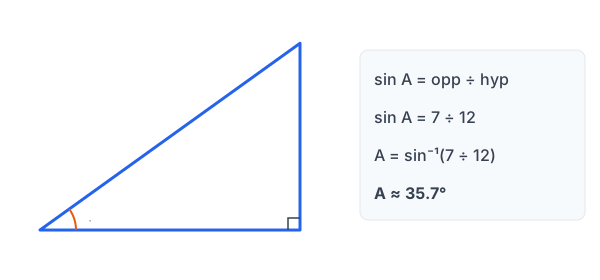
Calculator note: Use degree mode. To find \sin^{-1}(7 \div 12), press 2nd, then SIN, then type 7 ÷ 12 and press Enter. The same keys work with COS and TAN.
The Tools for Solving Right Triangles
| What you know | What you want | Tool |
|---|---|---|
| Two sides | The third side | Pythagorean theorem: a^2 + b^2 = c^2 |
| Two sides | An acute angle | Inverse trig: \sin^{-1}, \cos^{-1} or \tan^{-1} |
| One side and an acute angle | Another side | A trig ratio: sine, cosine or tangent |
| One acute angle | The other acute angle | Subtract from 90° |
The two acute angles always add to 90°, because all three angles add to 180°.
How to Solve a Right Triangle
- Draw the triangle and label what you know.
- If you know two sides, use inverse trig for one angle and the Pythagorean theorem for the third side.
- If you know one side and one angle, use trig ratios for the other two sides.
- Subtract the known acute angle from 90° to get the other one.
- Use the given numbers, not your rounded answers, whenever you can. Round sides to the nearest hundredth and angles to the nearest tenth of a degree.
Worked Examples
Example 1: Two sides given (opposite and hypotenuse)
Right △ABC has a right angle at C. BC = 7 and AB = 12. Find angle A, angle B and side AC.
- From angle A, BC is opposite and AB is the hypotenuse, so use sine: \sin A = \frac{7}{12}
- Use inverse sine: A = \sin^{-1}\left(\frac{7}{12}\right)
- Use a calculator: A \approx 35.7^\circ
- Subtract from 90° to find B: B = 90^\circ - 35.7^\circ
- Subtract: B \approx 54.3^\circ
- Write the Pythagorean theorem: AC^2 + 7^2 = 12^2
- Square the numbers: AC^2 + 49 = 144
- Subtract 49 from both sides: AC^2 = 95
- Take the positive square root: AC = \sqrt{95} \approx 9.75
Answer: A \approx 35.7^\circ, B \approx 54.3^\circ, AC \approx 9.75
Example 2: Two legs given
A right triangle has legs 9 and 14. Find both acute angles and the hypotenuse. Call the angle opposite the leg of 9 angle A.
- From angle A, 9 is opposite and 14 is adjacent, so use tangent: \tan A = \frac{9}{14}
- Use inverse tangent: A = \tan^{-1}\left(\frac{9}{14}\right)
- Use a calculator: A \approx 32.7^\circ
- Subtract from 90° to find B: B = 90^\circ - 32.7^\circ
- Subtract: B \approx 57.3^\circ
- Write the Pythagorean theorem: c^2 = 9^2 + 14^2
- Square each leg: c^2 = 81 + 196
- Add: c^2 = 277
- Take the positive square root: c = \sqrt{277} \approx 16.64
Answer: The angles are about 32.7° and 57.3°. The hypotenuse is about 16.64.
Example 3: One angle and the hypotenuse
A right triangle has a 38° angle, and its hypotenuse is 20. Find the other acute angle and both legs.
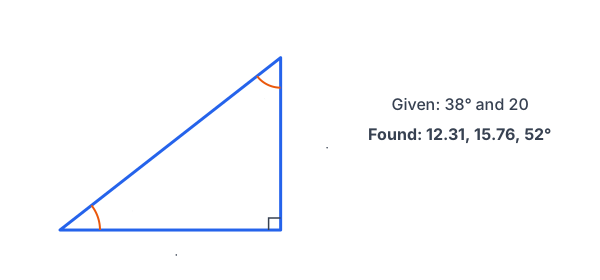
- Subtract from 90° to find the other angle: 90^\circ - 38^\circ = 52^\circ
- The leg opposite 38° uses sine: \sin 38^\circ = \frac{a}{20}
- Multiply both sides by 20: a = 20 \sin 38^\circ
- Use a calculator: a \approx 12.31
- The leg adjacent to 38° uses cosine: \cos 38^\circ = \frac{b}{20}
- Multiply both sides by 20: b = 20 \cos 38^\circ
- Use a calculator: b \approx 15.76
- Check with the Pythagorean theorem: 12.31^2 + 15.76^2 \approx 151.54 + 248.38 = 399.92 \approx 400 = 20^2
Answer: The other angle is 52°. The legs are about 12.31 and 15.76.
Example 4: One angle and the adjacent leg
A right triangle has a 55° angle. The leg next to that angle is 8. Find the other leg, the hypotenuse and the other acute angle.
- Subtract from 90°: 90^\circ - 55^\circ = 35^\circ
- The opposite leg and the adjacent leg use tangent: \tan 55^\circ = \frac{a}{8}
- Multiply both sides by 8: a = 8 \tan 55^\circ
- Use a calculator: a \approx 11.43
- The adjacent leg and the hypotenuse use cosine: \cos 55^\circ = \frac{8}{c}
- Multiply both sides by c: c \cos 55^\circ = 8
- Divide both sides by \cos 55^\circ: c = \frac{8}{\cos 55^\circ}
- Use a calculator: c \approx 13.95
Answer: The other leg is about 11.43, the hypotenuse is about 13.95, and the other angle is 35°. Both sides came from the given 8 and 55°, so no rounding error builds up.
Example 5: Word problem with a ramp
A ramp rises 2.5 ft over a level distance of 30 ft. What angle does the ramp make with the ground? How long is the ramp’s surface? Round the angle to the nearest tenth of a degree.
- The rise is opposite the angle and the level distance is adjacent, so use tangent: \tan A = \frac{2.5}{30}
- Use inverse tangent: A = \tan^{-1}\left(\frac{2.5}{30}\right)
- Use a calculator: A \approx 4.8^\circ
- The surface is the hypotenuse. Write the Pythagorean theorem: L^2 = 30^2 + 2.5^2
- Square each leg: L^2 = 900 + 6.25
- Add: L^2 = 906.25
- Take the positive square root: L \approx 30.10
Answer: The ramp makes an angle of about 4.8° with the ground. Its surface is about 30.10 ft long.
Common Mistakes
| Mistake | Example of the error | Fix |
|---|---|---|
| Reading \sin^{-1} as 1 over sine | \sin^{-1}(0.5) = \frac{1}{\sin 0.5} | \sin^{-1} gives the angle whose sine is 0.5: \sin^{-1}(0.5) = 30^\circ. |
| Using the regular trig key for an angle | A = \sin\left(\frac{7}{12}\right) | To find an angle, use the inverse key (2nd, then SIN). |
| Building on rounded answers | Finding the hypotenuse from a leg you rounded twice | Use the numbers you were given whenever you can. |
| Forgetting the other acute angle | Stopping after finding one angle | Subtract from 90°: the acute angles add to 90°. |
| Pairing sides with the wrong angle | \tan A = \frac{14}{9} when 9 is opposite A | Opposite goes on top in tangent: \tan A = \frac{9}{14}. |
Checking Your Answers
- The two acute angles should add to 90°.
- The hypotenuse should be the longest side.
- The largest acute angle should be across from the longer leg.
- Your sides should fit the Pythagorean theorem, allowing for small rounding errors.
Trig ratios are one way to find missing sides. For a 30-60-90 or 45-45-90 triangle, the special right triangles rules give exact answers without a calculator. When the altitude to the hypotenuse is drawn, the similar right triangles rules also help.
Practice Problems
Round sides to the nearest hundredth and angles to the nearest tenth of a degree.
- Find angle A if \sin A = 0.4.
- Find angle B if \cos B = \frac{5}{13}.
- Find angle A if \tan A = 1.
- A right triangle has legs 5 and 12. Find both acute angles and the hypotenuse.
- A right triangle has hypotenuse 15 and one leg 9. Find the other leg and both acute angles.
- A right triangle has a 27° angle and hypotenuse 40. Solve the triangle.
- A right triangle has a 64° angle. The leg opposite that angle is 10. Solve the triangle.
- A right triangle has a 41° angle. The leg adjacent to that angle is 18. Solve the triangle.
- A 20-foot ladder leans against a wall. Its base is 6 ft from the wall. What angle does the ladder make with the ground? How high up the wall does it reach?
- A rectangle is 15 cm long and 8 cm wide. What angle does its diagonal make with the longer side? How long is the diagonal?
Show answers
- Use inverse sine: A = \sin^{-1}(0.4)
Use a calculator: A \approx 23.6^\circ - Use inverse cosine: B = \cos^{-1}\left(\frac{5}{13}\right)
Use a calculator: B \approx 67.4^\circ - Use inverse tangent: A = \tan^{-1}(1)
Evaluate: A = 45^\circ. The legs are equal, so this is a 45-45-90 triangle. - Let A be opposite the leg of 5. Use tangent: \tan A = \frac{5}{12}
Use inverse tangent: A = \tan^{-1}\left(\frac{5}{12}\right)
Use a calculator: A \approx 22.6^\circ
Subtract from 90°: B \approx 90^\circ - 22.6^\circ = 67.4^\circ
Write the Pythagorean theorem: c^2 = 5^2 + 12^2
Square each leg: c^2 = 25 + 144
Add: c^2 = 169
Take the positive square root: c = 13 - Write the Pythagorean theorem: b^2 + 9^2 = 15^2
Square the numbers: b^2 + 81 = 225
Subtract 81 from both sides: b^2 = 144
Take the positive square root: b = 12
Let A be opposite the leg of 9. Use sine: \sin A = \frac{9}{15}
Simplify: \sin A = 0.6
Use inverse sine: A = \sin^{-1}(0.6)
Use a calculator: A \approx 36.9^\circ
Subtract from 90°: B \approx 90^\circ - 36.9^\circ = 53.1^\circ - Subtract from 90°: 90^\circ - 27^\circ = 63^\circ
Use sine for the opposite leg: \sin 27^\circ = \frac{a}{40}
Multiply both sides by 40: a = 40 \sin 27^\circ
Use a calculator: a \approx 18.16
Use cosine for the adjacent leg: \cos 27^\circ = \frac{b}{40}
Multiply both sides by 40: b = 40 \cos 27^\circ
Use a calculator: b \approx 35.64 - Subtract from 90°: 90^\circ - 64^\circ = 26^\circ
Use tangent for the adjacent leg: \tan 64^\circ = \frac{10}{b}
Multiply both sides by b: b \tan 64^\circ = 10
Divide both sides by \tan 64^\circ: b = \frac{10}{\tan 64^\circ}
Use a calculator: b \approx 4.88
Use sine for the hypotenuse: \sin 64^\circ = \frac{10}{c}
Multiply both sides by c: c \sin 64^\circ = 10
Divide both sides by \sin 64^\circ: c = \frac{10}{\sin 64^\circ}
Use a calculator: c \approx 11.13 - Subtract from 90°: 90^\circ - 41^\circ = 49^\circ
Use tangent for the opposite leg: \tan 41^\circ = \frac{a}{18}
Multiply both sides by 18: a = 18 \tan 41^\circ
Use a calculator: a \approx 15.65
Use cosine for the hypotenuse: \cos 41^\circ = \frac{18}{c}
Multiply both sides by c: c \cos 41^\circ = 18
Divide both sides by \cos 41^\circ: c = \frac{18}{\cos 41^\circ}
Use a calculator: c \approx 23.85 - The base distance is adjacent to the angle and the ladder is the hypotenuse, so use cosine: \cos A = \frac{6}{20}
Use inverse cosine: A = \cos^{-1}(0.3)
Use a calculator: A \approx 72.5^\circ
Write the Pythagorean theorem: h^2 + 6^2 = 20^2
Square the numbers: h^2 + 36 = 400
Subtract 36 from both sides: h^2 = 364
Take the positive square root: h \approx 19.08 ft - The width is opposite the angle and the length is adjacent, so use tangent: \tan A = \frac{8}{15}
Use inverse tangent: A = \tan^{-1}\left(\frac{8}{15}\right)
Use a calculator: A \approx 28.1^\circ
Write the Pythagorean theorem: d^2 = 15^2 + 8^2
Square each side: d^2 = 225 + 64
Add: d^2 = 289
Take the positive square root: d = 17 cm
FAQ
What does it mean to solve a right triangle?
It means finding every missing side and angle. When you finish, you know all three sides and all three angles.
How do you find a missing angle in a right triangle?
Pick two sides you know and write the trig ratio that uses them. Then use the inverse key on your calculator. For example, if \tan A = \frac{9}{14}, then A = \tan^{-1}\left(\frac{9}{14}\right) \approx 32.7^\circ.
What is the difference between sin and sin⁻¹?
Sine takes an angle and gives a ratio. Inverse sine takes a ratio and gives an angle. For example, \sin 30^\circ = 0.5 and \sin^{-1}(0.5) = 30^\circ.
Can you solve a right triangle with only the angles?
No. Triangles with the same angles can be any size, so you need at least one side length.
Summary
- To solve a right triangle, find all missing sides and angles.
- Use trig ratios (SOH CAH TOA) to find missing sides from an angle and a side.
- Use \sin^{-1}, \cos^{-1} or \tan^{-1} to find an angle from two sides.
- Use the Pythagorean theorem for a third side, and subtract from 90° for the other acute angle.
- Use the given numbers whenever you can, and round at the end.
Previous lesson: Trigonometric Ratios
Next lesson: Angles of Elevation and Depression
Back to the Geometry Index