
Special Right Triangles
Special right triangles are 45-45-90 and 30-60-90 triangles, named for their angles. Their sides always follow fixed ratios. In a 45-45-90 triangle, the sides are x, x and x\sqrt{2}. In a 30-60-90 triangle, they are x, x\sqrt{3} and 2x. Use these patterns to find missing sides quickly.
Before this lesson: You should know the Pythagorean Theorem, Isosceles and Equilateral Triangles and Simplifying Square Roots.
Where the Special Right Triangles Come From
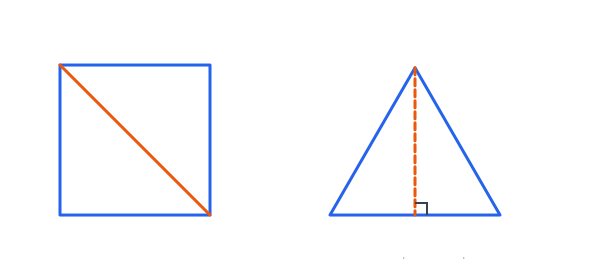
Cut a square along its diagonal, and you get two 45-45-90 triangles. If the square’s sides are 1, the Pythagorean theorem gives a diagonal of \sqrt{1^2 + 1^2} = \sqrt{2}.
Cut an equilateral triangle in half with its altitude, and you get two 30-60-90 triangles. If the sides are 2, the base splits into two parts of 1. The altitude is \sqrt{2^2 - 1^2} = \sqrt{3}.
The Special Right Triangle Ratios
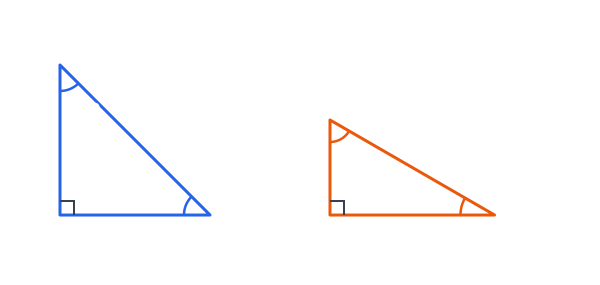
45-45-90 triangle: the two legs are equal, and the hypotenuse is a leg times \sqrt{2}.
\text{leg} : \text{leg} : \text{hypotenuse} = x : x : x\sqrt{2}30-60-90 triangle: the short leg is across from the 30° angle. The hypotenuse is twice the short leg, and the long leg is the short leg times \sqrt{3}.
\text{short leg} : \text{long leg} : \text{hypotenuse} = x : x\sqrt{3} : 2xHow to Solve Special Right Triangles
- Decide which special triangle you have from its angles.
- Label the side you know with its part of the ratio: x, x\sqrt{2}, x\sqrt{3} or 2x.
- Solve for x.
- Use x to find the other sides.
- Simplify radicals, and rationalize any denominator.
Worked Examples
Example 1: 45-45-90 triangle, given a leg
A 45-45-90 triangle has a leg of 7. Find the other leg and the hypotenuse.
- The legs are equal: the other leg is 7.
- The hypotenuse is a leg times \sqrt{2}: 7\sqrt{2}
- Use a calculator and round: 7\sqrt{2} \approx 9.90
Answer: The other leg is 7, and the hypotenuse is 7\sqrt{2} \approx 9.90.
Example 2: 45-45-90 triangle, given the hypotenuse
A 45-45-90 triangle has a hypotenuse of 10. Find each leg.
- Set the hypotenuse equal to x\sqrt{2}: x\sqrt{2} = 10
- Divide both sides by \sqrt{2}: x = \tfrac{10}{\sqrt{2}}
- Multiply the top and bottom by \sqrt{2} (see rationalizing the denominator): x = \tfrac{10\sqrt{2}}{2}
- Simplify: x = 5\sqrt{2}
- Use a calculator and round: 5\sqrt{2} \approx 7.07
Answer: Each leg is 5\sqrt{2} \approx 7.07.
Example 3: 30-60-90 triangle, given the short leg
A 30-60-90 triangle has a short leg of 5. Find the long leg and the hypotenuse.
- The short leg is x: x = 5
- The hypotenuse is 2x: 2 \cdot 5 = 10
- The long leg is x\sqrt{3}: 5\sqrt{3}
- Use a calculator and round: 5\sqrt{3} \approx 8.66
Answer: The hypotenuse is 10, and the long leg is 5\sqrt{3} \approx 8.66.
Example 4: 30-60-90 triangle, given the long leg
A 30-60-90 triangle has a long leg of 9. Find the short leg and the hypotenuse.
- Set the long leg equal to x\sqrt{3}: x\sqrt{3} = 9
- Divide both sides by \sqrt{3}: x = \tfrac{9}{\sqrt{3}}
- Multiply the top and bottom by \sqrt{3}: x = \tfrac{9\sqrt{3}}{3}
- Simplify: x = 3\sqrt{3}
- The hypotenuse is 2x: 2 \cdot 3\sqrt{3} = 6\sqrt{3}
Answer: The short leg is 3\sqrt{3} \approx 5.20, and the hypotenuse is 6\sqrt{3} \approx 10.39.
Example 5: Word problem with a yield sign
A yield sign is an equilateral triangle with 30-inch sides. How tall is the sign?
- The altitude splits the sign into two 30-60-90 triangles.
- The hypotenuse of each half is a side of the sign: 2x = 30
- Divide both sides by 2: x = 15
- The height is the long leg, x\sqrt{3}: 15\sqrt{3}
- Use a calculator and round: 15\sqrt{3} \approx 25.98
Answer: The sign is 15\sqrt{3} \approx 26 inches tall. Its area, from area of triangles, is \tfrac{1}{2} \cdot 30 \cdot 15\sqrt{3} = 225\sqrt{3} \approx 389.7 square inches.
Common Mistakes
| Mistake | Example of the error | Fix |
|---|---|---|
| Mixing up the long leg and the hypotenuse | Short leg 5, so “hypotenuse = 5\sqrt{3}” | The hypotenuse is the longest side, 2x = 10. The long leg is 5\sqrt{3} \approx 8.66. |
| Putting x across from the 60° angle | Calling the side across from 60° the short leg | The short leg is always across from the 30° angle. |
| Doubling the long leg | Long leg 5\sqrt{3}, so hypotenuse = 10\sqrt{3} | Double the short leg, not the long leg: 2 \cdot 5 = 10. |
| Using 2x for a 45-45-90 hypotenuse | Leg 7, so hypotenuse = 14 | In a 45-45-90 triangle, the hypotenuse is x\sqrt{2}: 7\sqrt{2}. |
| Leaving a radical in the denominator | Leg = \tfrac{10}{\sqrt{2}} | Rationalize: \tfrac{10}{\sqrt{2}} = 5\sqrt{2}. |
Special Right Triangles at a Glance
| Triangle | Given | To find the others |
|---|---|---|
| 45-45-90 | A leg x | Other leg x, hypotenuse x\sqrt{2} |
| 45-45-90 | Hypotenuse h | Each leg \tfrac{h}{\sqrt{2}} = \tfrac{h\sqrt{2}}{2} |
| 30-60-90 | Short leg x | Long leg x\sqrt{3}, hypotenuse 2x |
| 30-60-90 | Hypotenuse h | Short leg \tfrac{h}{2}, long leg \tfrac{h}{2}\sqrt{3} |
| 30-60-90 | Long leg L | Short leg \tfrac{L}{\sqrt{3}} = \tfrac{L\sqrt{3}}{3}, hypotenuse twice that |
You can always check an answer with the Pythagorean theorem. These ratios also give the exact values of the trig ratios for 30°, 45° and 60°.
Practice Problems
- A 45-45-90 triangle has a leg of 4. Find the hypotenuse.
- A 45-45-90 triangle has a hypotenuse of 6\sqrt{2}. Find each leg.
- A 45-45-90 triangle has a hypotenuse of 8. Find each leg in simplest radical form.
- A 30-60-90 triangle has a short leg of 3. Find the long leg and the hypotenuse.
- A 30-60-90 triangle has a hypotenuse of 20. Find the short leg and the long leg.
- A 30-60-90 triangle has a long leg of 6\sqrt{3}. Find the short leg and the hypotenuse.
- A 30-60-90 triangle has a long leg of 12. Find the short leg and the hypotenuse in simplest radical form.
- A square has sides of 9 cm. How long is its diagonal? Give the exact answer and round to the nearest hundredth.
- An equilateral triangle has sides of 10. Find its height and its area in simplest radical form.
- A 16-foot ladder leans against a wall and makes a 60° angle with the ground. How high up the wall does it reach, and how far is its base from the wall?
Show answers
- Hypotenuse is a leg times \sqrt{2}: 4\sqrt{2}
- Set up: x\sqrt{2} = 6\sqrt{2}
Divide by \sqrt{2}: x = 6
Each leg is 6. - Set up: x\sqrt{2} = 8
Divide by \sqrt{2}: x = \tfrac{8}{\sqrt{2}}
Rationalize: x = \tfrac{8\sqrt{2}}{2}
Simplify: x = 4\sqrt{2} - Short leg: x = 3
Hypotenuse: 2 \cdot 3 = 6
Long leg: 3\sqrt{3} - Set up: 2x = 20
Divide by 2: x = 10
Short leg is 10.
Long leg: 10\sqrt{3} - Set up: x\sqrt{3} = 6\sqrt{3}
Divide by \sqrt{3}: x = 6
Short leg is 6.
Hypotenuse: 2 \cdot 6 = 12 - Set up: x\sqrt{3} = 12
Divide by \sqrt{3}: x = \tfrac{12}{\sqrt{3}}
Rationalize: x = \tfrac{12\sqrt{3}}{3}
Simplify: x = 4\sqrt{3}
Hypotenuse: 2 \cdot 4\sqrt{3} = 8\sqrt{3} - The diagonal cuts the square into two 45-45-90 triangles with legs of 9.
Diagonal: 9\sqrt{2}
Round: 9\sqrt{2} \approx 12.73 cm - Each half is a 30-60-90 triangle with hypotenuse 10.
Set up: 2x = 10
Divide by 2: x = 5
Height is the long leg: 5\sqrt{3}
Area: \tfrac{1}{2} \cdot 10 \cdot 5\sqrt{3}
Multiply: 25\sqrt{3} \approx 43.30 - The ladder is the hypotenuse: 2x = 16
Divide by 2: x = 8
The base is across from the 30° angle at the top, so it is the short leg: 8 ft.
The height is across from the 60° angle, so it is the long leg: 8\sqrt{3} \approx 13.86 ft.
FAQ
What are special right triangles?
They are right triangles with angles of 45°, 45°, 90° or 30°, 60°, 90°. Their sides always follow fixed ratios, so you can find missing sides without the Pythagorean theorem.
What is the ratio of a 45-45-90 triangle?
The sides are in the ratio x : x : x\sqrt{2}. The two legs are equal, and the hypotenuse is a leg times \sqrt{2}.
What is the ratio of a 30-60-90 triangle?
The sides are in the ratio x : x\sqrt{3} : 2x. These are the short leg, the long leg and the hypotenuse.
How do you find the legs of a 45-45-90 triangle from the hypotenuse?
Divide the hypotenuse by \sqrt{2}, then rationalize. For a hypotenuse of 10, each leg is \tfrac{10}{\sqrt{2}} = 5\sqrt{2}.
Summary
- 45-45-90: x : x : x\sqrt{2}. It is half a square.
- 30-60-90: x : x\sqrt{3} : 2x. It is half an equilateral triangle.
- The short leg of a 30-60-90 triangle is across from the 30° angle.
- Solve for x first, then find the other sides.
- Rationalize when you divide by \sqrt{2} or \sqrt{3}.
Previous lesson: Converse of the Pythagorean Theorem
Next lesson: Similar Right Triangles
Back to the Geometry Index