
Converse of the Pythagorean Theorem
The converse of the Pythagorean theorem says that if the square of a triangle’s longest side equals the sum of the squares of the other two sides, the triangle is a right triangle. So if c^2 = a^2 + b^2, the angle across from c is 90°. Comparing c^2 with a^2 + b^2 also tells you if a triangle is acute or obtuse.
Before this lesson: You should know the Pythagorean Theorem, the Triangle Inequality Theorem and Exponents.
What the Converse Means
The Pythagorean theorem starts with a right triangle and gives you an equation. The converse goes the other way. It starts with three side lengths and tells you whether the triangle has a right angle.
Picture two sides of 3 and 4 joined by a hinge. If the third side is exactly 5, the hinge opens to 90°. A shorter third side squeezes the angle smaller, and a longer one pushes it wider. This is the same idea as the hinge theorem.
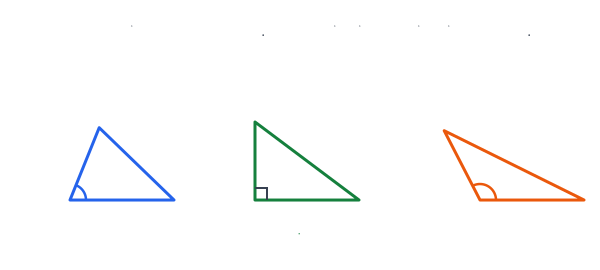
The Converse and the Triangle Classification Rules
\text{If } c^2 = a^2 + b^2, \text{ then the triangle is a right triangle.}Here c is the longest side. If c^2 is not equal to a^2 + b^2, compare them to classify the triangle.
| Compare c^2 with a^2 + b^2 | Type of triangle |
|---|---|
| c^2 \lt a^2 + b^2 | Acute: all angles are less than 90° |
| c^2 = a^2 + b^2 | Right: one angle is 90° |
| c^2 \gt a^2 + b^2 | Obtuse: one angle is more than 90° |
How to Tell if a Triangle Is Right, Acute or Obtuse
- Check that the three sides make a triangle: the two shorter sides must add to more than the longest side.
- Call the longest side c.
- Find c^2.
- Find a^2 + b^2 using the other two sides.
- Compare: equal means right, c^2 smaller means acute, c^2 bigger means obtuse.
Worked Examples
Example 1: Is the triangle right?
A triangle has sides 9, 40 and 41. Is it a right triangle?
- Check the triangle inequality: 9 + 40 = 49 and 49 \gt 41, so the sides make a triangle.
- The longest side is 41, so c = 41.
- Square it (see exponents): 41^2 = 1681
- Square the other two sides: 9^2 + 40^2 = 81 + 1600
- Add: 81 + 1600 = 1681
- Compare: 1681 = 1681
Answer: Yes. c^2 = a^2 + b^2, so the triangle is a right triangle.
Example 2: An acute triangle
A triangle has sides 6, 7 and 9. Is it acute, right or obtuse?
- Check the triangle inequality: 6 + 7 = 13 and 13 \gt 9.
- The longest side is 9: 9^2 = 81
- Square the other two sides: 6^2 + 7^2 = 36 + 49
- Add: 36 + 49 = 85
- Compare: 81 \lt 85
Answer: c^2 \lt a^2 + b^2, so the triangle is acute.
Example 3: An obtuse triangle
A triangle has sides 5, 8 and 11. Is it acute, right or obtuse?
- Check the triangle inequality: 5 + 8 = 13 and 13 \gt 11.
- The longest side is 11: 11^2 = 121
- Square the other two sides: 5^2 + 8^2 = 25 + 64
- Add: 25 + 64 = 89
- Compare: 121 \gt 89
Answer: c^2 \gt a^2 + b^2, so the triangle is obtuse.
Example 4: Sides with a square root
A triangle has sides 2, \sqrt{5} and 3. Is it a right triangle?
- Estimate to find the longest side: \sqrt{5} \approx 2.24, so the longest side is 3.
- Check the triangle inequality: 2 + 2.24 = 4.24 and 4.24 \gt 3.
- Square the longest side: 3^2 = 9
- Square the other sides exactly (see square root): 2^2 + (\sqrt{5})^2 = 4 + 5
- Add: 4 + 5 = 9
- Compare: 9 = 9
Answer: Yes, it is a right triangle. Square \sqrt{5} exactly to get 5. Squaring the rounded value 2.24 gives 5.0176, which would hide the right angle.
Example 5: Word problem with a square corner
A builder wants a deck corner to be exactly 90°. She marks one board 6 ft from the corner and the other board 8 ft from the corner. The distance between the marks is 10.2 ft. Is the corner square?
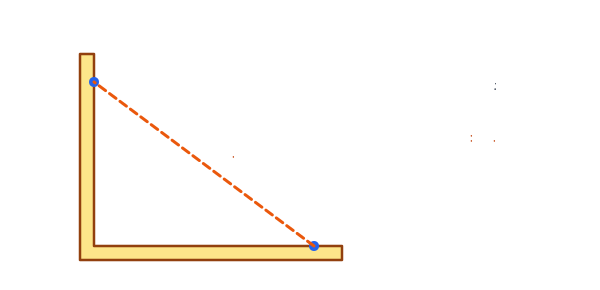
- The two boards and the diagonal form a triangle. The diagonal is the longest side: c = 10.2.
- Square it: 10.2^2 = 104.04
- Square the other two sides: 6^2 + 8^2 = 36 + 64
- Add: 36 + 64 = 100
- Compare: 104.04 \gt 100
Answer: No. c^2 \gt a^2 + b^2, so the corner is a little more than 90°. The builder should push the boards closer together until the diagonal reads 10 ft.
Why the Converse Works
Suppose a triangle has sides a, b and c, with c^2 = a^2 + b^2. Build a second triangle with legs a and b and a right angle between them.
- By the Pythagorean theorem, the new triangle’s hypotenuse x fits x^2 = a^2 + b^2.
- Substitute c^2 for a^2 + b^2: x^2 = c^2
- Lengths are positive, so take the square root: x = c
- The two triangles have all three sides equal, so they are congruent by SSS (see SSS and SAS congruence).
- Matching angles of congruent triangles are congruent, so the original triangle also has a 90° angle.
Common Mistakes
| Mistake | Example of the error | Fix |
|---|---|---|
| Not using the longest side as c | For 9, 40, 41: 40^2 vs 9^2 + 41^2 | Always put the longest side alone: 41^2 vs 9^2 + 40^2. |
| Comparing sides instead of squares | 6 + 7 \gt 9, so “acute” | Compare squares: 81 \lt 85, so acute. Adding sides only checks that a triangle exists. |
| Flipping acute and obtuse | 121 \gt 89, so “acute” | A longer longest side means a wider angle: c^2 bigger means obtuse. |
| Skipping the triangle inequality | Sides 3, 4, 8: 64 \gt 25, so “obtuse” | 3 + 4 = 7 is less than 8, so these sides do not make a triangle at all. |
| Rounding square roots before squaring | 2.24^2 = 5.0176, so “not right” | Square exactly: (\sqrt{5})^2 = 5. |
Pythagorean Theorem vs. Its Converse
| Statement | You know | You find |
|---|---|---|
| Pythagorean theorem | The triangle is right | A missing side |
| Converse | All three sides | Whether the triangle is right |
| Classification rules | All three sides | Whether it is acute, right or obtuse |
Practice Problems
- A triangle has sides 8, 15 and 17. Is it acute, right or obtuse?
- A triangle has sides 7, 8 and 10. Is it acute, right or obtuse?
- A triangle has sides 4, 6 and 9. Is it acute, right or obtuse?
- A triangle has sides 10, 24 and 26. Is it acute, right or obtuse?
- Do the lengths 3, 4 and 8 make a triangle? If so, classify it.
- A triangle has sides 5, 12 and 14. Is it acute, right or obtuse?
- A triangle has sides 1, \sqrt{3} and 2. Is it a right triangle?
- A triangle has sides 11, 60 and 61. Is it a right triangle?
- A sail has sides of 7 ft, 9 ft and 12 ft. Is the angle between the 7 ft and 9 ft sides acute, right or obtuse?
- A triangle has sides 6, 8 and x, where x is the longest side. For what values of x is the triangle obtuse?
Show answers
- Longest side: 17^2 = 289
Square the other sides: 8^2 + 15^2 = 64 + 225
Add: 64 + 225 = 289
289 = 289, so it is right. - Longest side: 10^2 = 100
Square the other sides: 7^2 + 8^2 = 49 + 64
Add: 49 + 64 = 113
100 \lt 113, so it is acute. - Triangle inequality: 4 + 6 = 10 and 10 \gt 9
Longest side: 9^2 = 81
Square the other sides: 4^2 + 6^2 = 16 + 36
Add: 16 + 36 = 52
81 \gt 52, so it is obtuse. - Longest side: 26^2 = 676
Square the other sides: 10^2 + 24^2 = 100 + 576
Add: 100 + 576 = 676
676 = 676, so it is right. - Triangle inequality: 3 + 4 = 7
7 \lt 8, so the lengths do not make a triangle. There is nothing to classify. - Longest side: 14^2 = 196
Square the other sides: 5^2 + 12^2 = 25 + 144
Add: 25 + 144 = 169
196 \gt 169, so it is obtuse. - Longest side is 2, since \sqrt{3} \approx 1.73
2^2 = 4
Square the other sides: 1^2 + (\sqrt{3})^2 = 1 + 3
Add: 1 + 3 = 4
4 = 4, so yes, it is right. - Longest side: 61^2 = 3721
Square the other sides: 11^2 + 60^2 = 121 + 3600
Add: 121 + 3600 = 3721
3721 = 3721, so yes, it is right. - The angle between the 7 ft and 9 ft sides is across from the 12 ft side.
12^2 = 144
Square the other sides: 7^2 + 9^2 = 49 + 81
Add: 49 + 81 = 130
144 \gt 130, so the angle is obtuse. - Obtuse: x^2 \gt 6^2 + 8^2
Square and add: x^2 \gt 100
Side lengths are positive, so x \gt 10
Triangle inequality: x \lt 6 + 8, so x \lt 14
The triangle is obtuse when 10 \lt x \lt 14.
FAQ
What is the converse of the Pythagorean theorem?
If the square of the longest side of a triangle equals the sum of the squares of the other two sides, then the triangle is a right triangle.
How do you know if a triangle is acute, right or obtuse from its sides?
Compare the square of the longest side with the sum of the squares of the other two. Smaller means acute, equal means right and larger means obtuse.
Which side is c in the converse?
c is always the longest side. In a right triangle, it is the hypotenuse, across from the right angle.
What is the difference between the Pythagorean theorem and its converse?
The theorem starts with a right triangle and finds a missing side. The converse starts with three sides and tells you whether the triangle is right.
Summary
- If c^2 = a^2 + b^2, where c is the longest side, the triangle is right.
- If c^2 \lt a^2 + b^2, the triangle is acute.
- If c^2 \gt a^2 + b^2, the triangle is obtuse.
- First check that the sides make a triangle.
- Square radicals exactly, not after rounding.
Previous lesson: Pythagorean Theorem
Next lesson: Special Right Triangles
Back to the Geometry Index