
Triangle Inequality Theorem
The triangle inequality theorem says the sum of any two side lengths of a triangle must be greater than the third side length. So 3, 4 and 8 can’t form a triangle, because 3 + 4 is less than 8. A related rule says the longest side of a triangle is always across from its largest angle.
Before this lesson: You should know the Triangle Angle Sum Theorem, Measuring and Classifying Angles and Compound Inequalities.
Why Some Lengths Can’t Make a Triangle
Take a stick 8 inches long and two short sticks, 3 inches and 4 inches. Put the short sticks at the ends of the long one and try to make their tips meet. They can’t. Even laid flat, they only reach 7 inches, which is less than 8.
Now swap the long stick for one that is 6 inches. The 3-inch and 4-inch sticks can reach past 6, so they tip up and meet. That makes a triangle.
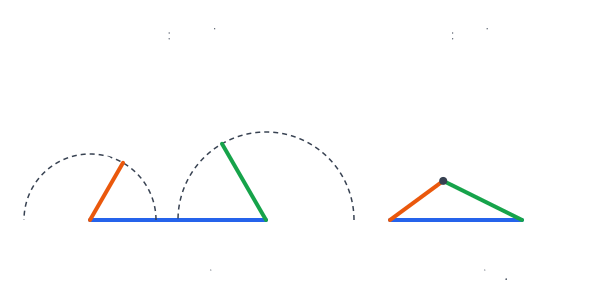
Another way to see it: the shortest path between two points is a straight line. Going around through a third point is always longer.
The Triangle Inequality Theorem
For a triangle with side lengths a, b and c:
a + b \gt c, \qquad a + c \gt b, \qquad b + c \gt a
- Shortcut: you only need to check one inequality. If the two shorter sides add to more than the longest side, the other two inequalities are automatically true.
- Equal is not enough: if the two shorter sides add to exactly the longest side, the pieces lie flat in a line. There is no triangle.
- Third side range: if two sides are a and b with a \gt b, the third side x must satisfy a - b \lt x \lt a + b.
Sides and angles
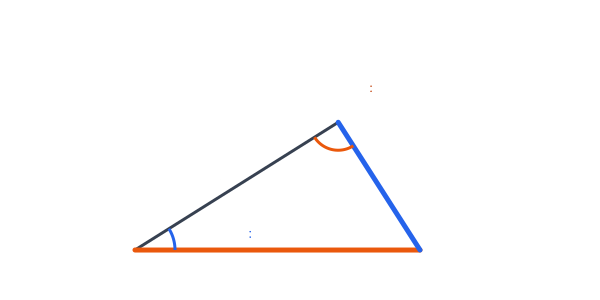
In any triangle, the longest side is across from the largest angle, and the shortest side is across from the smallest angle. The middle side is across from the middle angle. This works both ways.
How to Use the Triangle Inequality
- To test three lengths, add the two shorter ones.
- If the sum is greater than the longest length, they form a triangle. If not, they don’t.
- To find the range for a third side, subtract the two known sides and add them.
- The third side is between the difference and the sum, but equal to neither.
- To order angles, order the sides first. Each angle sits across from its matching side.
Worked Examples
Example 1: Can these lengths form a triangle?
Decide whether each set of lengths can form a triangle: (a) 5, 7, 11 (b) 4, 6, 10.
- (a) The two shorter sides are 5 and 7. Add them: 5 + 7 = 12
- Compare with the longest side: 12 \gt 11, so 5, 7 and 11 form a triangle.
- (b) The two shorter sides are 4 and 6. Add them: 4 + 6 = 10
- Compare with the longest side: 10 is not greater than 10. The sides would lie flat, so there is no triangle.
Answer: (a) Yes. (b) No.
Example 2: Range for the third side
Two sides of a triangle are 9 and 14. What lengths are possible for the third side x?
- Subtract the known sides: 14 - 9 = 5
- Add the known sides: 14 + 9 = 23
- The third side is between them, but not equal to either (see compound inequalities): 5 \lt x \lt 23
- Check a value inside, like 10: 9 + 10 = 19 \gt 14. It works.
- Check the edge, 5: 9 + 5 = 14, which is not greater than 14. It fails, so 5 is not allowed.
Answer: 5 \lt x \lt 23.
Example 3: Order the angles from the sides
In \triangle ABC, AB = 8, BC = 11 and AC = 6. List the angles from smallest to largest. This is the second picture above.
- Order the sides from shortest to longest: AC = 6, AB = 8, BC = 11.
- The angle across from AC is \angle B. It is the smallest.
- The angle across from AB is \angle C. It is in the middle.
- The angle across from BC is \angle A. It is the largest.
Answer: \angle B, \angle C, \angle A.
Example 4: Order the sides from the angles
In \triangle PQR, m\angle P = 52^\circ and m\angle Q = 71^\circ. List the sides from shortest to longest.
- Add the known angles: 52^\circ + 71^\circ = 123^\circ
- Subtract from 180° to find the third angle (see triangle angle sum theorem): 180^\circ - 123^\circ = 57^\circ, so m\angle R = 57^\circ.
- Order the angles: \angle P (52°), \angle R (57°), \angle Q (71°).
- The side across from \angle P is QR, so QR is the shortest.
- The side across from \angle R is PQ, so PQ is in the middle.
- The side across from \angle Q is PR, so PR is the longest.
Answer: QR, PQ, PR.
Example 5: Word problem with a garden
Nia is building a triangular garden bed. Two of the boards are 6 m and 9 m long. The third board must be a whole number of meters. Which lengths can she use?
- Subtract the two boards: 9 - 6 = 3
- Add the two boards: 9 + 6 = 15
- The third board x must satisfy 3 \lt x \lt 15.
- The whole numbers between 3 and 15 are 4, 5, 6, 7, 8, 9, 10, 11, 12, 13 and 14.
- Count them: there are 11 choices.
Answer: Any whole number from 4 m to 14 m works. That is 11 possible lengths.
Common Mistakes
| Mistake | Example of the error | Fix |
|---|---|---|
| Checking only one pair, but the wrong one | For 4, 5, 12: “5 + 12 \gt 4, so yes” | Add the two shorter sides and compare with the longest: 4 + 5 = 9, which is less than 12. |
| Allowing the sum to equal the third side | Saying 4, 6 and 10 form a triangle | The sum must be greater. Equal means the sides lie flat. |
| Including the endpoints of the range | Writing 5 \le x \le 23 | Use strict inequalities: 5 \lt x \lt 23. |
| Matching an angle to a side next to it | Saying the largest angle touches the longest side | The largest angle is across from the longest side. |
| Ordering angles without finding the third one | Ordering only the two given angles | Find the third angle with the angle sum first. |
Using the Theorem in Other Problems
- Isosceles triangles: with two legs of length \ell, the base must be less than 2\ell (see isosceles and equilateral triangles).
- Distances on a map: the straight-line distance between two places is never more than a route through a third place.
- Comparing two triangles: the next lesson, the hinge theorem, compares sides and angles in two different triangles.
Practice Problems
- Can 6, 8 and 13 form a triangle?
- Can 2, 9 and 12 form a triangle?
- Can 7, 7 and 14 form a triangle?
- Two sides of a triangle are 5 and 12. Find the range of possible lengths for the third side.
- The sides of a triangle are 7, 10 and x + 1. Find the possible values of x.
- In \triangle DEF, DE = 15, EF = 9 and DF = 12. List the angles from smallest to largest.
- In \triangle JKL, m\angle J = 40^\circ, m\angle K = 65^\circ and m\angle L = 75^\circ. List the sides from shortest to longest.
- Town A is 18 km from town B and 25 km from town C. The three towns are not in a straight line. What are the possible distances from B to C?
- An isosceles triangle has two legs that are each 5 cm long. What lengths are possible for the base?
- Two sides of a triangle are 3 and 8, and the third side is a whole number. How many lengths are possible for the third side?
Show answers
- Add the two shorter sides: 6 + 8 = 14
Compare: 14 \gt 13
Yes, they form a triangle. - Add the two shorter sides: 2 + 9 = 11
Compare: 11 is less than 12
No triangle. - Add the two shorter sides: 7 + 7 = 14
Compare: 14 is not greater than 14
No triangle (the sides lie flat). - Subtract: 12 - 5 = 7
Add: 12 + 5 = 17
The third side is between them: 7 \lt x \lt 17 - The third side is between 10 - 7 and 10 + 7: 3 \lt x + 1 \lt 17
Subtract 1 from all three parts: 2 \lt x \lt 16 - Order the sides: EF = 9, DF = 12, DE = 15
Across from EF is \angle D; across from DF is \angle E; across from DE is \angle F
Smallest to largest: \angle D, \angle E, \angle F - Across from \angle J (40°) is KL; across from \angle K (65°) is JL; across from \angle L (75°) is JK
Shortest to longest: KL, JL, JK - Subtract: 25 - 18 = 7
Add: 25 + 18 = 43
The distance from B to C is between 7 km and 43 km. - The base b must be less than the sum of the legs: b \lt 5 + 5 = 10
The base must also be greater than 5 - 5 = 0
So 0 \lt b \lt 10 cm. - Subtract: 8 - 3 = 5
Add: 8 + 3 = 11
So 5 \lt x \lt 11
Whole numbers: 6, 7, 8, 9 and 10
There are 5 possible lengths.
FAQ
What is the triangle inequality theorem?
The sum of the lengths of any two sides of a triangle is greater than the length of the third side. If that fails for any pair, the lengths can’t form a triangle.
How do you find the range of the third side of a triangle?
Subtract the two known sides to get the lower limit, and add them to get the upper limit. The third side is strictly between those two numbers.
Can a triangle have sides 1, 2 and 3?
No. 1 + 2 = 3, and the sum must be greater than the third side, not equal. The three pieces would lie flat in a line.
Which angle is across from the longest side?
The largest angle. In any triangle, bigger sides are across from bigger angles, and smaller sides are across from smaller angles.
Summary
- The sum of any two sides of a triangle is greater than the third side.
- To test three lengths, add the two shorter ones and compare with the longest.
- If the sum equals the longest side, there is no triangle.
- The third side is between the difference and the sum of the other two sides.
- The longest side is across from the largest angle, and the shortest side is across from the smallest angle.
Previous lesson: Triangle Midsegment Theorem
Next lesson: Hinge Theorem
Back to the Geometry Index