
Triangle Midsegment Theorem
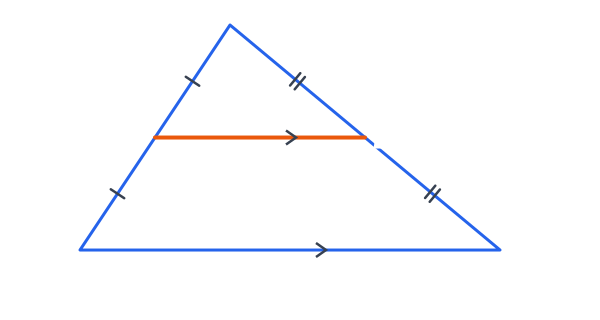
A midsegment of a triangle is a segment that joins the midpoints of two sides. The triangle midsegment theorem says a midsegment is parallel to the third side and half as long. So if the third side is 14 cm, the midsegment is 7 cm. Every triangle has three midsegments.
Before this lesson: You should know the Midpoint Formula, Parallel Lines and Transversals and Medians and Altitudes of Triangles.
What a Midsegment Does
Mark the middle of two sides of a triangle and connect the marks. The new segment runs exactly the same direction as the third side, so the two never meet. It also covers exactly half the distance.
A midsegment is different from a median. A median goes from a vertex to a midpoint. A midsegment goes from one midpoint to another midpoint.
The Triangle Midsegment Theorem
If D is the midpoint of \overline{AB} and E is the midpoint of \overline{AC}, then:
\overline{DE} \parallel \overline{BC} \qquad \text{and} \qquad DE = \tfrac{1}{2}BC- Going the other way, the third side is twice the midsegment: BC = 2 \cdot DE.
- Because \overline{DE} \parallel \overline{BC}, the corresponding angles match: \angle ADE \cong \angle B and \angle AED \cong \angle C.
- The three midsegments form a smaller triangle, the midsegment triangle. Its perimeter is half the perimeter of the big triangle.
How to Use the Midsegment Theorem
- Check that both endpoints of the segment are midpoints.
- Find the third side, the side the midsegment does not touch.
- To find the midsegment, halve the third side. To find the third side, double the midsegment.
- With variables, write 2(\text{midsegment}) = \text{third side} and solve.
- Use the parallel lines to find matching angles.
Worked Examples
Example 1: Halve and double
In \triangle ABC, D and E are the midpoints of AB and AC. (a) If BC = 14, find DE. (b) If another midsegment is 9, how long is the side it is parallel to?
- (a) DE is half of BC: DE = \tfrac{1}{2}(14) = 7
- (b) The third side is twice the midsegment: 2 \times 9 = 18
Answer: (a) DE = 7 (b) The side is 18.
Example 2: Solve for x
D and E are the midpoints of two sides of \triangle ABC. DE = 2x + 1 and the third side is BC = 5x - 4. Find x, DE and BC.
- The third side is twice the midsegment: 2(2x + 1) = 5x - 4
- Distribute (see distributive property): 4x + 2 = 5x - 4
- Subtract 4x from both sides (see equations with variables on both sides): 2 = x - 4
- Add 4 to both sides: 6 = x
- Find DE: 2(6) + 1 = 12 + 1 = 13
- Find BC: 5(6) - 4 = 30 - 4 = 26
- Check: 26 is twice 13.
Answer: x = 6, DE = 13 and BC = 26.
Example 3: Check the theorem on a grid
\triangle ABC has vertices A(2, 8), B(0, 2) and C(8, 0). D is the midpoint of AB and E is the midpoint of AC. Show that DE is parallel to BC and half as long.
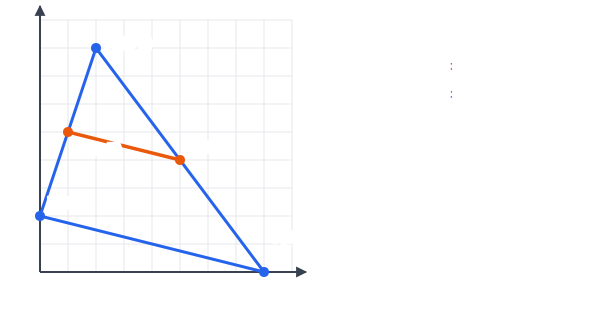
- Find D (see midpoint formula): \left(\tfrac{2 + 0}{2}, \tfrac{8 + 2}{2}\right) = (1, 5)
- Find E: \left(\tfrac{2 + 8}{2}, \tfrac{8 + 0}{2}\right) = (5, 4)
- Slope of DE (see slope formula): \tfrac{4 - 5}{5 - 1} = -\tfrac{1}{4}
- Slope of BC: \tfrac{0 - 2}{8 - 0} = -\tfrac{2}{8} = -\tfrac{1}{4}
- The slopes are equal, so \overline{DE} \parallel \overline{BC}.
- Length of DE (see distance formula): \sqrt{(5 - 1)^2 + (4 - 5)^2} = \sqrt{16 + 1} = \sqrt{17}
- Length of BC: \sqrt{(8 - 0)^2 + (0 - 2)^2} = \sqrt{64 + 4} = \sqrt{68}
- Simplify (see simplifying square roots): \sqrt{68} = \sqrt{4 \cdot 17} = 2\sqrt{17}
Answer: Both slopes are -\tfrac{1}{4}, so DE is parallel to BC. BC = 2\sqrt{17} is twice DE = \sqrt{17}.
Example 4: Word problem across a pond
Leo needs the distance between two points, A and B, on opposite sides of a pond. He stands at point C, where he can walk straight to both A and B. He marks M, the midpoint of CA, and N, the midpoint of CB. He measures MN and gets 45 m. How far is it from A to B?
- M and N are midpoints of two sides of \triangle ABC, so MN is a midsegment.
- The third side of the triangle is AB.
- The third side is twice the midsegment: AB = 2 \times 45 = 90
Answer: The distance across the pond from A to B is 90 m.
Example 5: Angles and the midsegment triangle
In \triangle ABC, D is the midpoint of AB and E is the midpoint of AC. m\angle B = 64^\circ. The sides of \triangle ABC are 10, 14 and 18. Find m\angle ADE and the perimeter of the midsegment triangle.
- By the theorem, \overline{DE} \parallel \overline{BC}, with AB as a transversal.
- \angle ADE and \angle B are corresponding angles, so they are congruent (see parallel lines and transversals): m\angle ADE = 64^\circ
- Each side of the midsegment triangle is half of a side of \triangle ABC: \tfrac{1}{2}(10) = 5, \tfrac{1}{2}(14) = 7 and \tfrac{1}{2}(18) = 9
- Add the sides: 5 + 7 + 9 = 21
Answer: m\angle ADE = 64^\circ, and the midsegment triangle has a perimeter of 21. That is half of 10 + 14 + 18 = 42.
Common Mistakes
| Mistake | Example of the error | Fix |
|---|---|---|
| Doubling the midsegment to get itself | Third side 14, so “the midsegment is 28” | The midsegment is the shorter one: half of 14 is 7. |
| Setting the midsegment equal to the third side | 2x + 1 = 5x - 4 | Use 2(2x + 1) = 5x - 4, because the third side is twice as long. |
| Using a segment with only one midpoint | A segment from the midpoint of AB to some other point on AC | Both endpoints must be midpoints. Otherwise the theorem doesn’t apply. |
| Pairing the midsegment with the wrong side | Comparing DE with AB when D is on AB | The midsegment is parallel to the side it does not touch. |
| Mixing up a midsegment and a median | Calling the segment from A to the midpoint of BC a midsegment | A median starts at a vertex. A midsegment joins two midpoints. |
Why the Theorem Is True
Place the triangle on a grid with B(0, 0), C(2c, 0) and A(2a, 2b). Using even numbers keeps the midpoints simple.
- The midpoint of AB is D(a, b), and the midpoint of AC is E(a + c, b).
- D and E have the same y-coordinate, so DE is horizontal, like BC. The slopes are both 0, so the segments are parallel.
- DE has length (a + c) - a = c, and BC has length 2c. So DE is half of BC.
This method is called a coordinate proof. You’ll write more of them in Unit 7.
Practice Problems
- A midsegment of a triangle is parallel to a side of length 22. Find the length of the midsegment.
- A midsegment of a triangle is 8.5 cm. How long is the side it is parallel to?
- D and E are midpoints of two sides of \triangle ABC. DE = 3x - 1 and the third side is BC = 4x + 8. Find x, DE and BC.
- A triangle has sides of 12, 16 and 20. Find the perimeter of its midsegment triangle.
- In \triangle ABC, D is the midpoint of AB and E is the midpoint of AC. If m\angle C = 47^\circ, find m\angle AED.
- \triangle ABC has vertices A(-4, 2), B(2, 6) and C(4, -2). Find the midpoints D of AB and E of AC. Show that DE is parallel to BC and half as long.
- D is the midpoint of AB, and F is a point on AC that is not its midpoint. Is DF a midsegment? Explain.
- A roof truss is a triangle with a 9 m base. A crossbeam joins the midpoints of the two rafters. How long is the crossbeam?
- The three midsegments of a triangle are 5, 6 and 7. Find the perimeter of the original triangle.
- Explain why the three midsegments split a triangle into four congruent triangles.
Show answers
- Halve the side: \tfrac{1}{2}(22) = 11
The midsegment is 11. - Double the midsegment: 2 \times 8.5 = 17
The side is 17 cm. - The third side is twice the midsegment: 2(3x - 1) = 4x + 8
Distribute: 6x - 2 = 4x + 8
Subtract 4x: 2x - 2 = 8
Add 2: 2x = 10
Divide by 2: x = 5
DE: 3(5) - 1 = 15 - 1 = 14
BC: 4(5) + 8 = 20 + 8 = 28
Check: 28 is twice 14. - Halve each side: 6, 8 and 10
Add: 6 + 8 + 10 = 24
The perimeter is 24. - DE is parallel to BC, with AC as a transversal
\angle AED and \angle C are corresponding angles
m\angle AED = 47^\circ - D: \left(\tfrac{-4 + 2}{2}, \tfrac{2 + 6}{2}\right) = (-1, 4)
E: \left(\tfrac{-4 + 4}{2}, \tfrac{2 + (-2)}{2}\right) = (0, 0)
Slope of DE: \tfrac{0 - 4}{0 - (-1)} = \tfrac{-4}{1} = -4
Slope of BC: \tfrac{-2 - 6}{4 - 2} = \tfrac{-8}{2} = -4
Equal slopes, so DE is parallel to BC
DE: \sqrt{(0 + 1)^2 + (0 - 4)^2} = \sqrt{1 + 16} = \sqrt{17}
BC: \sqrt{(4 - 2)^2 + (-2 - 6)^2} = \sqrt{4 + 64} = \sqrt{68} = 2\sqrt{17}
BC is twice DE. - No. A midsegment must join two midpoints. F is not the midpoint of AC, so DF is not a midsegment.
- The crossbeam is a midsegment, parallel to the base
Halve the base: \tfrac{1}{2}(9) = 4.5
The crossbeam is 4.5 m long. - Each side of the original triangle is twice a midsegment
Double each: 10, 12 and 14
Add: 10 + 12 + 14 = 36
The perimeter is 36. - Each midsegment is half of a side, and each half-side of the big triangle is also half of that side
So every small triangle has sides equal to half of each side of the big triangle
All four small triangles have the same three side lengths, so they are congruent by SSS.
FAQ
What is the triangle midsegment theorem?
A segment joining the midpoints of two sides of a triangle is parallel to the third side and half as long. It is also called the midline theorem.
How many midsegments does a triangle have?
Three. Each pair of sides gives one midsegment, and the three midsegments form a smaller triangle inside.
How do you find the length of a midsegment?
Find the side of the triangle that the midsegment does not touch. The midsegment is half that length.
Is a midsegment the same as a median?
No. A median joins a vertex to the midpoint of the opposite side. A midsegment joins the midpoints of two sides.
Summary
- A midsegment joins the midpoints of two sides of a triangle.
- It is parallel to the third side.
- It is half as long as the third side, so the third side is twice the midsegment.
- Parallel lines give matching corresponding angles.
- The midsegment triangle has half the perimeter of the original triangle.
- On a grid, check with equal slopes and the distance formula.
Previous lesson: Medians and Altitudes of Triangles
Next lesson: Triangle Inequality Theorem
Back to the Geometry Index