
Coordinate Proofs
A coordinate proof proves a geometry fact by placing a figure on the coordinate plane. You use the distance formula to compare lengths, the slope formula to check for parallel or perpendicular sides, and the midpoint formula to find midpoints. Placing the figure carefully, often with one vertex at the origin, keeps the algebra simple.
Before this lesson: You should know the Distance Formula, the Midpoint Formula and Parallel and Perpendicular Lines.
Proving with Coordinates
A two-column proof uses theorems about angles and triangles. A coordinate proof uses algebra instead. Once the points have coordinates, you can measure lengths and slopes exactly, without a ruler or protractor.
There are two kinds of coordinate proofs. Some use specific numbers, like A(1, 2), to prove a fact about one figure. Others use letters, like (a, 0), to prove a fact about every figure of that kind. The letters stand for any positive numbers, so one proof covers all cases.
The Tools of a Coordinate Proof
| To show | Use | Test |
|---|---|---|
| Two segments are congruent | Distance formula | Equal lengths |
| Two lines are parallel | Slope formula | Equal slopes |
| Two lines are perpendicular | Slope formula | Slopes multiply to −1 (or one is horizontal and one is vertical) |
| A point is a midpoint | Midpoint formula | Same coordinates |
| Diagonals bisect each other | Midpoint formula | Both diagonals have the same midpoint |
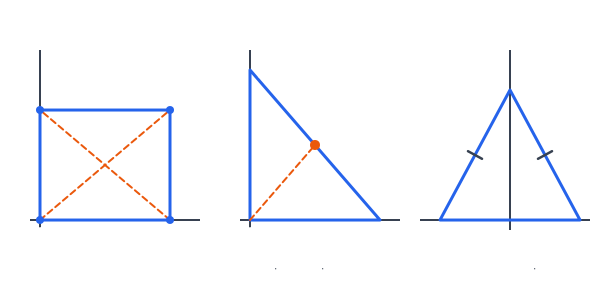
Here are good ways to place common figures. Put a vertex at the origin and a side on the x-axis. Use 2a and 2b when you will need midpoints, so the midpoints have no fractions.
How to Write a Coordinate Proof
- Draw the figure on the coordinate plane. Use the origin and the axes when you can.
- Label every vertex with coordinates, using numbers or letters.
- Decide what you need to show: equal lengths, equal slopes, slopes that multiply to −1, or matching midpoints.
- Do the calculations, one formula at a time.
- Write a closing sentence that states what the calculations prove.
Worked Examples
Example 1: Word problem with a triangular fence
A surveyor marks the three corner posts of a triangular fence at A(1, 1), B(7, 1) and C(4, 5) on a map grid, where each unit is 1 meter. Prove that the fence is an isosceles triangle, and find its perimeter.
- Find AB. The points are on a horizontal line: AB = 7 - 1 = 6
- Find AC with the distance formula: \sqrt{(4 - 1)^2 + (5 - 1)^2} = \sqrt{9 + 16} = \sqrt{25} = 5
- Find BC: \sqrt{(4 - 7)^2 + (5 - 1)^2} = \sqrt{9 + 16} = \sqrt{25} = 5
- AC = BC, so the triangle has two congruent sides (see isosceles and equilateral triangles).
- Add the sides for the perimeter: 6 + 5 + 5 = 16
Answer: The fence is isosceles, with AC = BC = 5 m, and its perimeter is 16 m.
Example 2: Prove a quadrilateral is a rectangle
Prove that A(1, 2), B(5, 0), C(7, 4) and D(3, 6) form a rectangle.
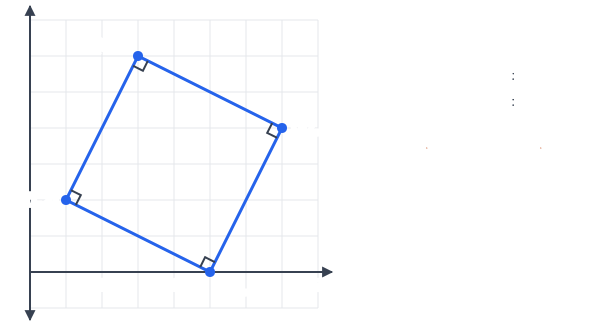
- Slope of AB (see slope formula): \tfrac{0 - 2}{5 - 1} = \tfrac{-2}{4} = -\tfrac{1}{2}
- Slope of DC: \tfrac{4 - 6}{7 - 3} = \tfrac{-2}{4} = -\tfrac{1}{2}
- Slope of BC: \tfrac{4 - 0}{7 - 5} = \tfrac{4}{2} = 2
- Slope of AD: \tfrac{6 - 2}{3 - 1} = \tfrac{4}{2} = 2
- Opposite sides have equal slopes, so ABCD is a parallelogram.
- Multiply the slopes of next-door sides: \left(-\tfrac{1}{2}\right)(2) = -1. So AB is perpendicular to BC, and each corner is a right angle.
Answer: ABCD is a parallelogram with right angles, so it is a rectangle (see rectangles, rhombuses and squares).
Example 3: Place a figure on the plane
Place a rectangle with width a and height b on the coordinate plane, and give the coordinates of its vertices.
- Put one corner at the origin: (0, 0).
- Put the bottom side along the x-axis. The next corner is a units to the right: (a, 0).
- Put the left side along the y-axis. That corner is b units up: (0, b).
- The last corner is a right and b up: (a, b).
Answer: The vertices are A(0, 0), B(a, 0), C(a, b) and D(0, b). This is the rectangle in the first picture.
Example 4: The diagonals of any rectangle are congruent
Use the rectangle from Example 3 to prove that the diagonals of every rectangle are congruent.
- Diagonal AC runs from (0, 0) to (a, b): AC = \sqrt{(a - 0)^2 + (b - 0)^2}
- Simplify: AC = \sqrt{a^2 + b^2}
- Diagonal BD runs from (a, 0) to (0, b): BD = \sqrt{(0 - a)^2 + (b - 0)^2}
- Simplify: (0 - a)^2 = a^2, so BD = \sqrt{a^2 + b^2}
- The two lengths are the same.
Answer: AC = BD = \sqrt{a^2 + b^2}. Because a and b can be any widths and heights, the diagonals of every rectangle are congruent.
Example 5: The midpoint of a hypotenuse
Prove that the midpoint of the hypotenuse of a right triangle is the same distance from all three vertices. Use A(0, 0), B(2a, 0) and C(0, 2b).
- Find the midpoint M of hypotenuse BC: \left(\tfrac{2a + 0}{2}, \tfrac{0 + 2b}{2}\right) = (a, b)
- Find MA: \sqrt{(a - 0)^2 + (b - 0)^2} = \sqrt{a^2 + b^2}
- Find MB: \sqrt{(2a - a)^2 + (0 - b)^2} = \sqrt{a^2 + b^2}
- Find MC: \sqrt{(0 - a)^2 + (2b - b)^2} = \sqrt{a^2 + b^2}
- All three distances are equal.
Answer: MA = MB = MC = \sqrt{a^2 + b^2}. This is why the circumcenter of a right triangle is the midpoint of its hypotenuse (see circumcenter and incenter).
Common Mistakes
| Mistake | Example of the error | Fix |
|---|---|---|
| Proving a general fact with one example | Showing one rectangle has congruent diagonals and saying all do | Use letters like (a, 0) and (a, b) to cover every case. |
| Placing a figure so it is no longer general | Using (0, 0), (a, 0), (a, a), (0, a) for any rectangle | That is a square. Use different letters for width and height. |
| Mixing up the perpendicular test | Saying slopes 2 and 2 are perpendicular | Equal slopes mean parallel. Perpendicular slopes multiply to −1. |
| Sign errors with letters | Writing (0 - a)^2 = -a^2 | A negative squared is positive: (0 - a)^2 = a^2. |
| Forgetting the closing statement | Ending with AC = \sqrt{a^2 + b^2} | Finish by saying what the numbers prove, like “the diagonals are congruent.” |
More Facts You Can Prove with Coordinates
- The diagonals of a parallelogram bisect each other: both midpoints come out the same.
- The triangle midsegment theorem: the midsegment has the same slope as the third side and half its length.
- The diagonals of a rhombus are perpendicular: their slopes multiply to −1.
- A triangle is a right triangle when two of its sides have slopes that multiply to −1.
Practice Problems
- Prove that the triangle with vertices A(0, 0), B(4, 0) and C(2, 5) is isosceles.
- Classify the triangle with vertices P(1, 1), Q(4, 5) and R(8, 2) by its sides and angles.
- Prove that A(0, 0), B(3, 1), C(4, 4) and D(1, 3) form a rhombus. Is it a square?
- Place a square with side length s on the coordinate plane, with one vertex at the origin. Give its vertices.
- Find the midpoint of the segment from (0, 0) to (2a, 2b).
- Use the square from Problem 4 to prove that the diagonals of a square are perpendicular.
- A parallelogram has vertices (0, 0), (a, 0), (a + b, c) and (b, c). Prove that its diagonals bisect each other.
- ABCD is a parallelogram with A(1, 2), B(5, 3) and C(7, 7). Find D.
- Complete the coordinate proof. An isosceles triangle has vertices A(-a, 0), B(a, 0) and C(0, b). Show that AC = BC by finding each length.
- On a town map, the library is at (0, 0), the school at (6, 0) and the park at (0, 8). A café opens at the midpoint of the school and the park. Show that the café is the same distance from all three places.
Show answers
- AC: \sqrt{(2 - 0)^2 + (5 - 0)^2} = \sqrt{4 + 25} = \sqrt{29}
BC: \sqrt{(2 - 4)^2 + (5 - 0)^2} = \sqrt{4 + 25} = \sqrt{29}
AC = BC, so the triangle is isosceles. - PQ: \sqrt{(4 - 1)^2 + (5 - 1)^2} = \sqrt{9 + 16} = 5
QR: \sqrt{(8 - 4)^2 + (2 - 5)^2} = \sqrt{16 + 9} = 5
Slope PQ: \tfrac{4}{3}; slope QR: \tfrac{-3}{4}
\tfrac{4}{3} \cdot \left(-\tfrac{3}{4}\right) = -1, so angle Q is a right angle
It is an isosceles right triangle. - AB: \sqrt{3^2 + 1^2} = \sqrt{10}; BC: \sqrt{1^2 + 3^2} = \sqrt{10}; CD: \sqrt{3^2 + 1^2} = \sqrt{10}; DA: \sqrt{1^2 + 3^2} = \sqrt{10}
All four sides are congruent, so it is a rhombus
Slope AB: \tfrac{1}{3}; slope BC: \tfrac{3}{1} = 3; their product is 1, not −1
The angles are not right angles, so it is not a square. - (0, 0), (s, 0), (s, s) and (0, s)
- \left(\tfrac{0 + 2a}{2}, \tfrac{0 + 2b}{2}\right) = (a, b)
- Diagonal from (0, 0) to (s, s): slope \tfrac{s - 0}{s - 0} = 1
Diagonal from (s, 0) to (0, s): slope \tfrac{s - 0}{0 - s} = -1
(1)(-1) = -1, so the diagonals are perpendicular. - Midpoint of the diagonal from (0, 0) to (a + b, c): \left(\tfrac{a + b}{2}, \tfrac{c}{2}\right)
Midpoint of the diagonal from (a, 0) to (b, c): \left(\tfrac{a + b}{2}, \tfrac{c}{2}\right)
The midpoints are the same, so the diagonals bisect each other. - In a parallelogram, the diagonals share a midpoint, so D = A + C - B
x: 1 + 7 - 5 = 3
y: 2 + 7 - 3 = 6
D is (3, 6). Check: slope AB = \tfrac{1}{4} = slope DC, and slope BC = 2 = slope AD. - AC: \sqrt{(0 - (-a))^2 + (b - 0)^2} = \sqrt{a^2 + b^2}
BC: \sqrt{(0 - a)^2 + (b - 0)^2} = \sqrt{a^2 + b^2}
The lengths are equal, so AC = BC. - Café: \left(\tfrac{6 + 0}{2}, \tfrac{0 + 8}{2}\right) = (3, 4)
To the library: \sqrt{3^2 + 4^2} = \sqrt{25} = 5
To the school: \sqrt{(6 - 3)^2 + (0 - 4)^2} = \sqrt{25} = 5
To the park: \sqrt{(0 - 3)^2 + (8 - 4)^2} = \sqrt{25} = 5
The café is 5 units from all three places.
FAQ
What is a coordinate proof?
It is a proof that places a figure on the coordinate plane and uses the distance, slope and midpoint formulas to show that a fact is true.
How do you place a figure for a coordinate proof?
Put a vertex at the origin and a side along the x-axis when you can. Use letters for the other coordinates, and use 2a and 2b if you will need midpoints.
How do you prove lines are perpendicular with coordinates?
Find their slopes. If the slopes multiply to −1, the lines are perpendicular. A horizontal line and a vertical line are also perpendicular.
Why use variables instead of numbers in a coordinate proof?
Numbers prove a fact for only one figure. Variables like a and b stand for any lengths, so the proof works for every figure of that kind.
Summary
- A coordinate proof uses algebra on the coordinate plane.
- Distance formula: congruent segments. Slope formula: parallel or perpendicular lines. Midpoint formula: midpoints and bisected diagonals.
- Place figures with a vertex at the origin and sides on the axes.
- Use letters to prove facts about every figure of a kind.
- End with a sentence that says what the calculations prove.
Previous lesson: Trapezoids and Kites
Next lesson: Similar Polygons, the first lesson of Unit 8
Back to the Geometry Index