
Circumcenter and Incenter
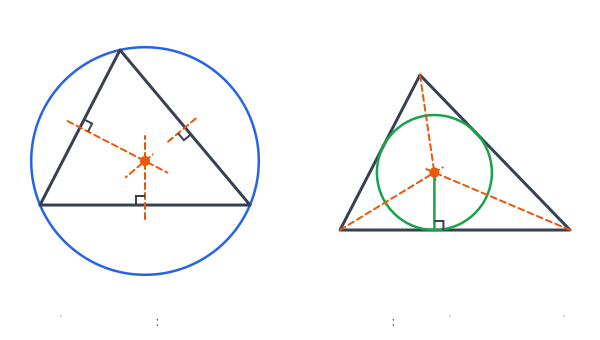
The circumcenter of a triangle is the point where its three perpendicular bisectors meet. It is the same distance from all three vertices. The incenter is the point where the three angle bisectors meet. It is the same distance from all three sides. Each point is the center of a special circle.
Before this lesson: You should know Perpendicular and Angle Bisectors, the Midpoint Formula and the Distance Formula.
Where Bisectors Meet
Lines are concurrent when three or more of them pass through one point. That point is the point of concurrency. A triangle has three perpendicular bisectors and three angle bisectors, and each set is concurrent.
Think about the perpendicular bisectors first. Every point on the bisector of AB is equally far from A and B. Every point on the bisector of BC is equally far from B and C. Where the two lines cross, the point is equally far from all three vertices. So a circle centered there passes through A, B and C. That circle is the circumscribed circle.
The angle bisectors work the same way with the sides. Their meeting point is equally far from all three sides, so a circle centered there just touches each side. That circle is the inscribed circle.
The Circumcenter and Incenter Theorems
- Circumcenter theorem: The perpendicular bisectors of a triangle’s sides meet at a point that is equidistant from the vertices: PA = PB = PC.
- Incenter theorem: The angle bisectors of a triangle meet at a point that is equidistant from the sides. That distance is the radius of the inscribed circle.
| Point | Lines that meet there | Equally far from | Where it lies |
|---|---|---|---|
| Circumcenter | Perpendicular bisectors of the sides | The three vertices | Inside an acute triangle, at the midpoint of the hypotenuse of a right triangle, outside an obtuse triangle |
| Incenter | Angle bisectors | The three sides | Always inside the triangle |
A memory tip: the circumcenter’s circle goes around the triangle, and the incenter’s circle is inside it.
How to Find and Use These Points
- Decide what you need: equal distances to the vertices (circumcenter) or to the sides (incenter).
- Circumcenter: set the distances to two vertices equal, or find where two perpendicular bisectors cross.
- Incenter: set the distances to two sides equal, or use the fact that each angle is cut in half.
- With variables, write an equation, solve it, and substitute back.
- On a grid, find two perpendicular bisectors and solve for their crossing point.
Worked Examples
Example 1: Distances to the vertices
P is the circumcenter of \triangle ABC. PA = 3x + 2 and PB = 5x - 6. Find x, PA and PC.
- The circumcenter is equidistant from the vertices, so PA = PB.
- Set the distances equal: 3x + 2 = 5x - 6
- Subtract 3x from both sides (see equations with variables on both sides): 2 = 2x - 6
- Add 6 to both sides: 8 = 2x
- Divide both sides by 2: 4 = x
- Find PA: 3(4) + 2 = 12 + 2 = 14
- Check with PB: 5(4) - 6 = 20 - 6 = 14
- PC equals PA too, because all three distances are equal: PC = 14
Answer: x = 4 and PA = PB = PC = 14.
Example 2: Distances to the sides and half angles
I is the incenter of \triangle ABC. The distance from I to side AB is 2y + 1, and the distance from I to side BC is 4y - 7. Also, m\angle IAB = 25^\circ and m\angle ABC = 70^\circ. Find y, the distance, m\angle BAC and m\angle IBC.
- The incenter is equidistant from the sides, so set the distances equal: 2y + 1 = 4y - 7
- Subtract 2y from both sides: 1 = 2y - 7
- Add 7 to both sides: 8 = 2y
- Divide both sides by 2: 4 = y
- Find the distance: 2(4) + 1 = 8 + 1 = 9
- Check: 4(4) - 7 = 16 - 7 = 9
- AI bisects angle A, so double the half angle: 2 \times 25^\circ = 50^\circ
- BI bisects angle B, so halve angle B: 70^\circ \div 2 = 35^\circ
Answer: y = 4, the distance to each side is 9, m\angle BAC = 50^\circ and m\angle IBC = 35^\circ.
Example 3: Word problem with a shared well
Three houses sit at A(0, 0), B(8, 0) and C(0, 6) on a map, where each unit is 1 km. The owners want to dig one well that is the same distance from all three houses. Where should it go, and how far is it from each house?
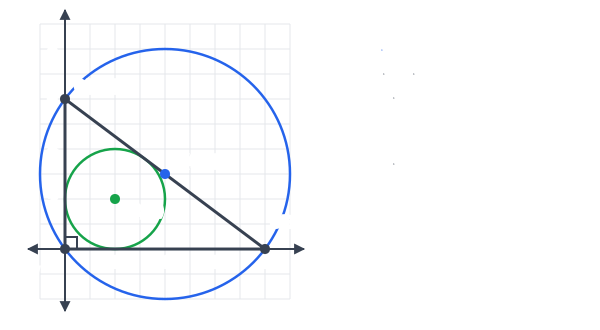
- The point equally far from three vertices is the circumcenter.
- Find the midpoint of AB (see midpoint formula): \left(\tfrac{0 + 8}{2}, \tfrac{0 + 0}{2}\right) = (4, 0)
- AB is horizontal, so its perpendicular bisector is the vertical line x = 4.
- Find the midpoint of AC: \left(\tfrac{0 + 0}{2}, \tfrac{0 + 6}{2}\right) = (0, 3)
- AC is vertical, so its perpendicular bisector is the horizontal line y = 3.
- The two lines cross at P(4, 3).
- Find PA (see distance formula): \sqrt{(4 - 0)^2 + (3 - 0)^2} = \sqrt{16 + 9} = \sqrt{25} = 5
- Find PB: \sqrt{(8 - 4)^2 + (0 - 3)^2} = \sqrt{16 + 9} = \sqrt{25} = 5
- Find PC: \sqrt{(0 - 4)^2 + (6 - 3)^2} = \sqrt{16 + 9} = \sqrt{25} = 5
Answer: The well goes at (4, 3), 5 km from each house. Notice that (4, 3) is the midpoint of BC. The triangle has a right angle at A, and the circumcenter of a right triangle is always the midpoint of the hypotenuse.
Example 4: Radius of the inscribed circle
A right triangle has legs of 6 and 8 and a hypotenuse of 10. Find the radius r of its inscribed circle.
- Lines from the incenter to the three vertices split the triangle into three smaller triangles. Each one has a side of the big triangle as its base and height r.
- So the area is \tfrac{1}{2}r(\text{sum of the sides}), or half of r times the perimeter.
- Find the area from the legs (see area of triangles): \tfrac{1}{2}(6)(8) = 24
- Find the perimeter: 6 + 8 + 10 = 24
- Write the equation: 24 = \tfrac{1}{2}r(24)
- Simplify the right side: 24 = 12r
- Divide both sides by 12: r = 2
Answer: The inscribed circle has radius 2. In the grid above, this is the green circle centered at I(2, 2).
Example 5: Why the perpendicular bisectors meet at one point
Given: \triangle ABC. The perpendicular bisectors of \overline{AB} and \overline{BC} meet at P.
Prove: P is on the perpendicular bisector of \overline{AC}, and PA = PB = PC.
Paragraph proof: P is on the perpendicular bisector of \overline{AB}, so PA = PB by the perpendicular bisector theorem. P is also on the perpendicular bisector of \overline{BC}, so PB = PC by the same theorem. By the transitive property, PA = PC. So P is equidistant from A and C, and by the converse of the perpendicular bisector theorem, P is on the perpendicular bisector of \overline{AC}. All three bisectors pass through P, and PA = PB = PC.
Common Mistakes
| Mistake | Example of the error | Fix |
|---|---|---|
| Mixing up the two centers | Using angle bisectors to find the point equally far from three towns | Equal distance to the vertices means the circumcenter (perpendicular bisectors). |
| Measuring the incenter to a vertex | Setting IA equal to IB | The incenter is equally far from the sides, not the vertices. Use perpendicular distances to the sides. |
| Thinking the circumcenter is always inside | Placing it inside an obtuse triangle | It lies outside an obtuse triangle and on the hypotenuse of a right triangle. |
| Halving or doubling the wrong way | m\angle IAB = 25^\circ, so “m\angle BAC = 12.5^\circ” | The bisector splits the angle in half, so the whole angle is 2 \times 25^\circ = 50^\circ. |
| Using a perpendicular through a vertex | Drawing the perpendicular from C to AB and calling it a bisector | A perpendicular bisector goes through the midpoint of a side, not a vertex. |
Other Points of Concurrency
- A triangle has two more famous centers: the centroid, where the medians meet, and the orthocenter, where the altitudes meet. They are the topic of the next lesson.
- The circumcenter and incenter are both found by construction with a compass and straightedge (see basic constructions).
- In an equilateral triangle, all four centers are the same point.
Practice Problems
- P is the circumcenter of \triangle ABC, and PA = 11. Find PC.
- I is the incenter of \triangle DEF. The distance from I to side DE is 4. Find the distance from I to side EF.
- P is the circumcenter of \triangle ABC. PA = 2x + 9 and PC = 4x - 1. Find x and PA.
- I is the incenter of \triangle ABC, and m\angle ICB = 31^\circ. Find m\angle ACB.
- Where is the circumcenter of a right triangle? Of an obtuse triangle?
- Find the circumcenter of the triangle with vertices A(2, 1), B(10, 1) and C(2, 7), and its distance from each vertex.
- A right triangle has legs of 5 and 12 and a hypotenuse of 13. Find the radius of its inscribed circle.
- In \triangle ABC, m\angle A = 60^\circ and m\angle B = 80^\circ. I is the incenter. Find m\angle IAB, m\angle IBA and m\angle AIB.
- A park ranger wants a station the same distance from three campsites. A town wants the largest possible circular pond inside a triangular park. Which point of concurrency does each one need?
- Complete the proof. Given: I is on the bisectors of \angle A and \angle B in \triangle ABC. Prove: I is on the bisector of \angle C. Statements: (1) I is on the bisector of \angle A. (2) I is equidistant from \overline{AB} and \overline{AC}. (3) I is on the bisector of \angle B. (4) I is equidistant from \overline{BA} and \overline{BC}. (5) I is equidistant from \overline{AC} and \overline{BC}. (6) I is on the bisector of \angle C. Give a reason for each statement.
Show answers
- The circumcenter is equidistant from the vertices
PC = PA = 11 - The incenter is equidistant from the sides
The distance to EF is 4. - Set the distances equal: 2x + 9 = 4x - 1
Subtract 2x: 9 = 2x - 1
Add 1: 10 = 2x
Divide by 2: x = 5
Find PA: 2(5) + 9 = 10 + 9 = 19
Check: 4(5) - 1 = 20 - 1 = 19 - CI bisects angle C, so double the half: 2 \times 31 = 62
m\angle ACB = 62^\circ - Right triangle: at the midpoint of the hypotenuse
Obtuse triangle: outside the triangle - The right angle is at A, so the circumcenter is the midpoint of hypotenuse BC
Midpoint: \left(\tfrac{10 + 2}{2}, \tfrac{1 + 7}{2}\right) = (6, 4)
Distance to A: \sqrt{(6 - 2)^2 + (4 - 1)^2} = \sqrt{16 + 9} = \sqrt{25} = 5
The circumcenter is (6, 4), 5 units from each vertex. - Area: \tfrac{1}{2}(5)(12) = 30
Perimeter: 5 + 12 + 13 = 30
Equation: 30 = \tfrac{1}{2}r(30)
Simplify: 30 = 15r
Divide by 15: r = 2 - AI bisects angle A: 60 \div 2 = 30, so m\angle IAB = 30^\circ
BI bisects angle B: 80 \div 2 = 40, so m\angle IBA = 40^\circ
Add: 30 + 40 = 70
Subtract from 180 (triangle AIB): 180 - 70 = 110, so m\angle AIB = 110^\circ - Ranger station: circumcenter (equally far from the three vertices)
Largest pond: incenter (the inscribed circle touches all three sides) - (1) Given
(2) Angle bisector theorem
(3) Given
(4) Angle bisector theorem
(5) Transitive property of equality
(6) Converse of the angle bisector theorem
FAQ
What is the difference between the circumcenter and the incenter?
The circumcenter is where the perpendicular bisectors of the sides meet, and it is equally far from the vertices. The incenter is where the angle bisectors meet, and it is equally far from the sides.
Is the circumcenter always inside the triangle?
No. It is inside an acute triangle, on the hypotenuse of a right triangle, and outside an obtuse triangle. The incenter is always inside.
How do you find the circumcenter on a coordinate plane?
Find the perpendicular bisectors of two sides. Solve for the point where they cross. That point is the circumcenter.
What is the inscribed circle of a triangle?
It is the largest circle that fits inside the triangle. Its center is the incenter, and it touches each side at exactly one point.
Summary
- Perpendicular bisectors of the sides meet at the circumcenter.
- The circumcenter is equidistant from the vertices and is the center of the circumscribed circle.
- Angle bisectors meet at the incenter.
- The incenter is equidistant from the sides and is the center of the inscribed circle.
- The circumcenter of a right triangle is the midpoint of the hypotenuse.
- Area = half the inradius times the perimeter gives the radius of the inscribed circle.
Previous lesson: Perpendicular and Angle Bisectors
Next lesson: Medians and Altitudes of Triangles
Back to the Geometry Index