
Basic Constructions
Basic constructions (geometric constructions) are exact drawings made with only a compass and a straightedge. The four basic constructions are copying a segment, copying an angle, bisecting a segment (its perpendicular bisector) and bisecting an angle. They work because every point on a compass arc is the same distance from its center.
Before this lesson: You should know the Midpoint Formula, Measuring and Classifying Angles and the Distance Formula.
Tools and the Big Idea
A straightedge draws straight lines. It has no marks, so you can’t measure with it. A compass draws circles and arcs. An arc is part of a circle.
Here is the big idea. Set the compass to some opening and put its point on A. Every point on the arc you draw is that same distance from A. So a compass copies lengths without numbers.
Construction steps never use a ruler’s marks or a protractor. You measure nothing. You only copy and match.
| Construction | What it makes | Main use |
|---|---|---|
| Copy a segment | A new segment congruent to the first one | Build shapes with equal sides |
| Copy an angle | A new angle congruent to the first one | Build equal angles and parallel lines |
| Perpendicular bisector | A line through the midpoint, at a right angle to the segment | Find a midpoint exactly |
| Angle bisector | A ray that splits an angle into two congruent angles | Split an angle in half |
The Four Basic Constructions
Copy a segment
- Draw a ray with endpoint C.
- Put the compass point on A and open it to B.
- Keep that opening. Put the point on C and draw an arc across the ray. Label the crossing D.
- Now \overline{CD} \cong \overline{AB}.
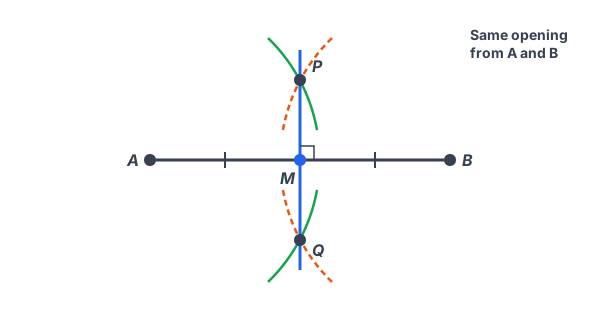
Construct a perpendicular bisector
- Open the compass to more than half of AB.
- Put the point on A. Draw an arc above and below the segment.
- Keep the same opening. Put the point on B and draw two arcs that cross the first ones.
- Draw a line through the two crossing points. It is the perpendicular bisector. It meets \overline{AB} at the midpoint.
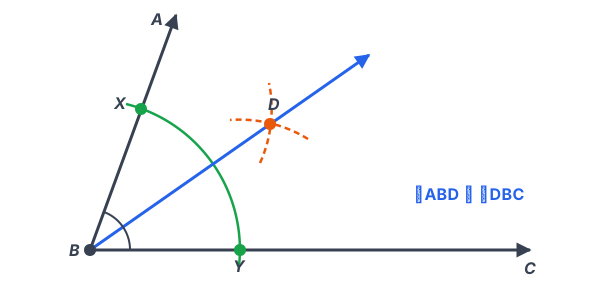
Bisect an angle
- Put the compass point on the vertex B. Draw an arc that crosses both sides. Label the crossings X and Y.
- Put the point on X and draw an arc inside the angle.
- Keep the same opening. Put the point on Y and draw an arc that crosses the last one. Label the crossing D.
- Draw \overrightarrow{BD}. It bisects the angle.
Copy an angle
- Draw a ray with endpoint E.
- On the original angle, put the point on the vertex B and draw an arc across both sides. Label the crossings X and Y.
- Keep that opening. Put the point on E and draw the same arc across the new ray. Label the crossing F.
- Set the compass to the distance from X to Y. Put the point on F and draw an arc that crosses the big arc at G.
- Draw \overrightarrow{EG}. The new angle is congruent to \angle B.
Worked Examples
In the examples, coordinates let us check that the constructions really work. On paper, you would use only the compass and straightedge.
Example 1: Copy a segment
AB = 7 cm. You copy it onto a ray that starts at C. How long is the new segment, and why?
Step 1: You open the compass from A to B. The opening is the length AB.
Step 2: You keep the opening and draw an arc from C. Every point on that arc is the same distance from C.
Step 3: The arc crosses the ray at D, so CD equals the opening.
CD = AB = 7
The new segment is 7 cm long, and \overline{CD} \cong \overline{AB}.
Example 2: Check a perpendicular bisector with coordinates
Points A(1, 2) and B(9, 2) are 8 units apart. With the compass opened to 5 units, the arcs from A and B cross at P(5, 5) and Q(5, -1). Show that line PQ is the perpendicular bisector.
Step 1: Check that P is 5 units from A (see the distance formula).
PA = \sqrt{(5 - 1)^2 + (5 - 2)^2} = \sqrt{16 + 9} = \sqrt{25} = 5Step 2: Check that P is 5 units from B.
PB = \sqrt{(5 - 9)^2 + (5 - 2)^2} = \sqrt{16 + 9} = \sqrt{25} = 5Step 3: P and Q both have x-coordinate 5, so line PQ is the vertical line x = 5.
Step 4: Find the midpoint of \overline{AB} (see the midpoint formula).
M = \left(\frac{1 + 9}{2}, \frac{2 + 2}{2}\right) = (5, 2)Step 5: The line x = 5 passes through M(5, 2).
Step 6: \overline{AB} is horizontal and PQ is vertical, so they meet at a right angle (see horizontal and vertical lines).
So line PQ passes through the midpoint at a right angle. It is the perpendicular bisector.
Example 3: Bisect an angle
You bisect \angle ABC, which measures 118^\circ. What is the measure of each new angle?
Step 1: The angle bisector makes two congruent angles. Divide by 2.
118 \div 2 = 59
Step 2: Check: the two halves add up to the whole angle.
59 + 59 = 118
Each new angle measures 59^\circ.
Example 4: Why the opening must be more than half
Points A and B are 10 cm apart. Will arcs with a 4 cm opening, one from A and one from B, cross?
Step 1: Each arc reaches 4 cm from its center. Together they reach this far along \overline{AB}:
4 + 4 = 8
Step 2: Compare with the distance between the centers.
8 \lt 10
No. The arcs fall 2 cm short and never cross. The opening must be more than 10 \div 2 = 5 cm.
Example 5: Word problem
Two sprinklers sit at (2, 1) and (8, 1) in a yard, measured in meters. A tree must be planted the same distance from both sprinklers and exactly 5 meters from each. Where can it go?
Step 1: Points the same distance from both sprinklers lie on the perpendicular bisector. The midpoint’s x-coordinate is \frac{2 + 8}{2} = 5, so the bisector is x = 5.
Step 2: Call the tree’s spot (5, y). Its distance to (2, 1) must be 5.
(5 - 2)^2 + (y - 1)^2 = 5^2
Step 3: Square the numbers.
9 + (y - 1)^2 = 25
Step 4: Subtract 9 from both sides.
(y - 1)^2 = 16
Step 5: A number squared is 16 when the number is 4 or -4.
y - 1 = 4 \text{ or } y - 1 = -4Step 6: Add 1 to both sides of each.
y = 5 \text{ or } y = -3The tree can go at (5, 5) or (5, -3). Both are 5 m from each sprinkler.
Common Mistakes
| Mistake | Example of the error | Fix |
|---|---|---|
| Changing the compass opening | Opening wider for the arc from B than for the arc from A | Keep the same opening for both arcs, or the crossing points won’t be on the bisector. |
| Opening too small | Using 4 cm for a 10 cm segment | Open the compass to more than half the segment so the arcs cross. |
| Measuring with a ruler or protractor | Measuring 3.5 cm to find the midpoint | Constructions use only a compass and a straightedge. The arcs do the measuring. |
| Drawing the bisector through only one crossing point | Drawing a line from one arc crossing to the midpoint by eye | Use both crossing points. Two points fix one line. |
| Using the wrong center when copying an angle | Drawing the second arc from the vertex instead of from F | Follow the steps in order. The second arc is centered where the first arc crossed the new ray. |
More Constructions You Can Build
- Midpoint: the perpendicular bisector crosses the segment at its midpoint. This is the compass version of the midpoint formula.
- Perpendicular through a point on a line: draw arcs from the point that cross the line on both sides, then build the perpendicular bisector of that new segment.
- A 45^\circ angle: construct a perpendicular to make 90^\circ, then bisect it.
- Parallel lines: copy an angle at a second point on a crossing line. You will see why this works in Unit 3.
Many geometry apps also do constructions on screen. The steps are the same: circles and lines only.
Practice Problems
- What two tools are used for constructions, and what does each one do?
- Put these steps for copying \overline{AB} in order: (a) draw an arc from C across the ray; (b) open the compass from A to B; (c) draw a ray from C.
- You bisect a 74^\circ angle. What is the measure of each new angle?
- Find the perpendicular bisector of the segment from A(2, 3) to B(10, 3).
- Find the perpendicular bisector of the segment from A(-1, 4) to B(-1, -6).
- Points A and B are 12 cm apart. Which compass openings will make the arcs cross: 5 cm, 6 cm or 8 cm?
- \overrightarrow{BD} bisects \angle ABC. Each half measures (3x + 4)^\circ, and m\angle ABC = 98^\circ. Find x.
- Point P is on the perpendicular bisector of \overline{AB}. PA = 2y + 3 and PB = 5y - 9. Find PA.
- You copy a 52^\circ angle. What is the measure of the copy? What word describes the two angles?
- Two houses are at (1, 2) and (7, 2) on a map. A mailbox must be the same distance from both houses and sit on the x-axis. Where is it? Check that it is the same distance from both.
Show answers
- A straightedge draws straight lines. It has no marks. A compass draws circles and arcs, which copy lengths.
- (c), then (b), then (a). Draw the ray, set the compass to AB, then mark the same length from C.
- Divide by 2: 74 \div 2 = 37. Each new angle is 37^\circ.
- Find the midpoint: \left(\frac{2 + 10}{2}, \frac{3 + 3}{2}\right) = (6, 3). The segment is horizontal, so the perpendicular bisector is vertical through the midpoint: x = 6. The perpendicular bisector is the line x = 6.
- Find the midpoint: \left(\frac{-1 + (-1)}{2}, \frac{4 + (-6)}{2}\right) = (-1, -1). The segment is vertical, so the perpendicular bisector is horizontal through the midpoint: y = -1. The perpendicular bisector is the line y = -1.
- Half of the distance: 12 \div 2 = 6. The opening must be more than 6: 8 \gt 6. Only 8 cm works. At 6 cm the arcs just touch at one point, so they don’t give two crossing points.
- The two halves add up to the whole: (3x + 4) + (3x + 4) = 98. Combine like terms: 6x + 8 = 98. Subtract 8 from both sides: 6x = 90. Divide both sides by 6: x = 15. So x = 15, and each half is 3(15) + 4 = 49^\circ.
- Points on the perpendicular bisector are the same distance from A and B: 2y + 3 = 5y - 9. Subtract 2y from both sides: 3 = 3y - 9. Add 9 to both sides: 12 = 3y. Divide both sides by 3: y = 4. Find PA: 2(4) + 3 = 11. So PA = 11. Check: PB = 5(4) - 9 = 11.
- The copy measures 52^\circ. The two angles are congruent.
- Find the midpoint: \left(\frac{1 + 7}{2}, \frac{2 + 2}{2}\right) = (4, 2). The perpendicular bisector is: x = 4. It meets the x-axis where y = 0: (4, 0). Distance to the first house: \sqrt{(4 - 1)^2 + (0 - 2)^2} = \sqrt{9 + 4} = \sqrt{13}. Distance to the second house: \sqrt{(4 - 7)^2 + (0 - 2)^2} = \sqrt{9 + 4} = \sqrt{13}. The mailbox is at (4, 0), and it is \sqrt{13} units from each house.
FAQ
Why can’t you use a ruler in constructions?
You can use a straightedge to draw lines, but not its marks to measure. Constructions show that a figure is exact, without depending on how carefully someone reads a scale.
Why does the perpendicular bisector construction work?
Each crossing point is the same distance from A and B, because both arcs had the same opening. Every point that is equally far from A and B lies on the perpendicular bisector.
What is the difference between a segment bisector and a perpendicular bisector?
Any line through the midpoint is a segment bisector. A perpendicular bisector also meets the segment at a right angle.
Can you trisect an angle with a compass and straightedge?
Not in general. Mathematicians proved that splitting every angle into three equal parts is impossible with only these tools. Bisecting always works.
Summary
- Constructions use only a compass and a straightedge. A compass copies lengths with arcs.
- The four basic constructions: copy a segment, copy an angle, perpendicular bisector, angle bisector.
- For a perpendicular bisector, use the same opening, more than half the segment, from both endpoints.
- The perpendicular bisector crosses the segment at its midpoint, at a right angle.
- An angle bisector splits an angle into two congruent angles.
Previous lesson: Angle Pairs
Next lesson: Conditional Statements
Back to the Geometry Index