
Perpendicular and Angle Bisectors
A perpendicular bisector is a line that crosses a segment at its midpoint and at a right angle. The perpendicular bisector theorem says every point on it is the same distance from the segment’s endpoints. An angle bisector splits an angle into two equal angles, and every point on it is the same distance from the angle’s sides.
Before this lesson: You should know Basic Constructions, the Distance Formula and CPCTC.
What It Means to Be Equidistant
Equidistant means “the same distance.” Imagine two friends live at points A and B. You want a meeting spot that is just as far from one house as from the other. Every spot that works lies on one line: the perpendicular bisector of segment AB.
Angle bisectors work the same way for lines. Picture two straight fences that meet at a corner. Every spot the same distance from both fences lies on the ray that splits the corner in half.
The distance from a point to a line is measured along the perpendicular segment, the shortest path (see proofs with perpendicular lines).
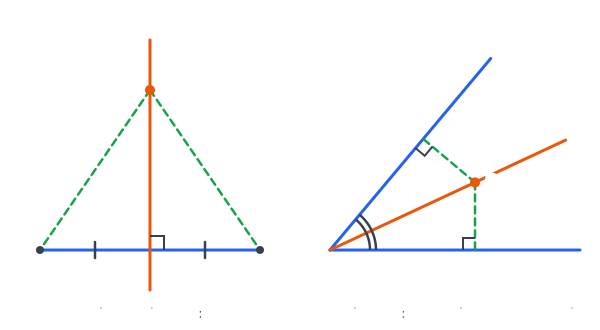
The Bisector Theorems
- Perpendicular bisector theorem: If a point is on the perpendicular bisector of a segment, then it is equidistant from the endpoints of the segment.
- Converse: If a point is equidistant from the endpoints of a segment, then it is on the perpendicular bisector of the segment.
- Angle bisector theorem: If a point is on the bisector of an angle, then it is equidistant from the two sides of the angle.
- Converse: If a point inside an angle is equidistant from the two sides, then it is on the bisector of the angle.
\text{P on the perpendicular bisector of } \overline{AB} \iff PA = PBThe symbol ⇔ means the statement works both ways: the theorem and its converse are both true.
How to Use the Bisector Theorems
- Decide which bisector you have: a perpendicular bisector of a segment, or a bisector of an angle.
- For a perpendicular bisector, set the distances to the two endpoints equal.
- For an angle bisector, set the perpendicular distances to the two sides equal.
- Solve the equation, then substitute to find the lengths.
- On a grid, the perpendicular bisector passes through the midpoint with the opposite reciprocal slope.
Worked Examples
Example 1: Use the perpendicular bisector theorem
Line \ell is the perpendicular bisector of \overline{AB}. Point P is on \ell. PA = 4x - 5 and PB = 2x + 7. Find x and PA.
- P is on the perpendicular bisector, so PA = PB.
- Set the distances equal: 4x - 5 = 2x + 7
- Subtract 2x from both sides (see equations with variables on both sides): 2x - 5 = 7
- Add 5 to both sides: 2x = 12
- Divide both sides by 2: x = 6
- Find PA: 4(6) - 5 = 24 - 5 = 19
- Check with PB: 2(6) + 7 = 12 + 7 = 19
Answer: x = 6 and PA = 19.
Example 2: Use the angle bisector theorem
Ray BD bisects \angle ABC. Point P is on ray BD. The perpendicular distance from P to side BA is 3y + 2, and the perpendicular distance from P to side BC is 5y - 8. Also, m\angle ABD = 34^\circ. Find y, the distance, and m\angle ABC.
- P is on the angle bisector, so its distances to the two sides are equal: 3y + 2 = 5y - 8
- Subtract 3y from both sides: 2 = 2y - 8
- Add 8 to both sides: 10 = 2y
- Divide both sides by 2: 5 = y
- Find the distance: 3(5) + 2 = 15 + 2 = 17
- Check: 5(5) - 8 = 25 - 8 = 17
- The bisector splits the angle into two equal halves, so double the half: 2 \times 34^\circ = 68^\circ
Answer: y = 5, the distance to each side is 17, and m\angle ABC = 68^\circ.
Example 3: Find a perpendicular bisector on a grid
Find the equation of the perpendicular bisector of the segment from A(2, 1) to B(8, 5). Then show that P(1, 9) is the same distance from A and B.
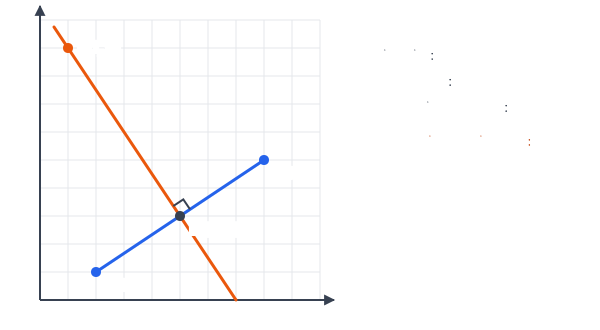
- Find the midpoint (see midpoint formula): M = \left(\tfrac{2 + 8}{2}, \tfrac{1 + 5}{2}\right) = (5, 3)
- Find the slope of AB (see slope formula): m = \tfrac{5 - 1}{8 - 2} = \tfrac{4}{6} = \tfrac{2}{3}
- Take the opposite reciprocal for the perpendicular slope (see parallel and perpendicular lines): -\tfrac{3}{2}
- Write the line in point-slope form through M (see point-slope form): y - 3 = -\tfrac{3}{2}(x - 5)
- Distribute: y - 3 = -\tfrac{3}{2}x + \tfrac{15}{2}
- Add 3 to both sides: y = -\tfrac{3}{2}x + \tfrac{21}{2}
- Check P on the line: -\tfrac{3}{2}(1) + \tfrac{21}{2} = \tfrac{18}{2} = 9, so P is on it.
- Find PA with the distance formula: \sqrt{(2 - 1)^2 + (1 - 9)^2} = \sqrt{1 + 64} = \sqrt{65}
- Find PB: \sqrt{(8 - 1)^2 + (5 - 9)^2} = \sqrt{49 + 16} = \sqrt{65}
Answer: The perpendicular bisector is y = -\tfrac{3}{2}x + \tfrac{21}{2}. Point P is on it, and PA = PB = \sqrt{65}, as the theorem says.
Example 4: Word problem with two roads
Two straight roads meet at a junction at a 70° angle. A town wants to build a water tower that is the same distance from both roads. The tower will be 150 m from the first road. Where should it go, and how far will it be from the second road?
- A point the same distance from two sides of an angle lies on the angle bisector (converse of the angle bisector theorem).
- The bisector splits the 70° angle in half: 70^\circ \div 2 = 35^\circ
- So the tower goes on the ray from the junction that makes a 35° angle with each road.
- Points on the bisector are equidistant from the sides, so the distance to the second road equals the distance to the first: 150 m.
Answer: The tower goes on the bisector of the junction angle, 35° from each road. It will be 150 m from the second road too.
Example 5: Prove the perpendicular bisector theorem
Given: Line PM is perpendicular to \overline{AB} at M, and M is the midpoint of \overline{AB}. Use the left figure above.
Prove: PA = PB
| Statements | Reasons |
|---|---|
| 1. M is the midpoint of \overline{AB} | Given |
| 2. \overline{AM} \cong \overline{BM} | Definition of midpoint |
| 3. \overline{PM} \perp \overline{AB} | Given |
| 4. \angle PMA and \angle PMB are right angles | Definition of perpendicular lines |
| 5. \angle PMA \cong \angle PMB | All right angles are congruent |
| 6. \overline{PM} \cong \overline{PM} | Reflexive property of congruence |
| 7. \triangle PMA \cong \triangle PMB | SAS (steps 2, 5 and 6) (see SSS and SAS congruence) |
| 8. \overline{PA} \cong \overline{PB}, so PA = PB | CPCTC |
Common Mistakes
| Mistake | Example of the error | Fix |
|---|---|---|
| Using a bisector that is not perpendicular | A line through the midpoint at a slant, with PA = PB assumed | The theorem needs the perpendicular bisector: it must pass through the midpoint at a right angle. |
| Measuring a slanted distance to a side | Using any segment from P to the side of the angle | Distance to a side is the perpendicular segment. Look for the right-angle mark. |
| Using the original slope for the perpendicular bisector | Writing y - 3 = \tfrac{2}{3}(x - 5) | Use the opposite reciprocal slope: -\tfrac{3}{2}. |
| Forgetting the midpoint | Writing the perpendicular line through point A | The perpendicular bisector passes through the midpoint of the segment. |
| Halving when you should double | m\angle ABD = 34^\circ, so “m\angle ABC = 17^\circ” | The bisector makes two halves, so the whole angle is 2 \times 34^\circ = 68^\circ. |
Where These Theorems Lead
- Circumcenter: the three perpendicular bisectors of a triangle’s sides meet at one point, equally far from all three vertices.
- Incenter: the three angle bisectors of a triangle meet at one point, equally far from all three sides.
- Constructions: the compass method for a perpendicular bisector works because both arc crossings are equidistant from the endpoints (see basic constructions).
The next lesson, on the circumcenter and incenter, puts these ideas together.
Practice Problems
- Point P is on the perpendicular bisector of \overline{AB}, and PA = 12. Find PB.
- Point P is on the perpendicular bisector of \overline{AB}. PA = 3x + 1 and PB = 5x - 9. Find x and PA.
- Ray BD bisects \angle ABC, and m\angle ABD = 41^\circ. Find m\angle ABC.
- Point P is on the bisector of an angle. Its distances to the two sides are 2y + 6 and 4y - 4. Find y and the distance.
- Point Q has QA = 7 and QB = 9. Is Q on the perpendicular bisector of \overline{AB}? Explain.
- Find the equation of the perpendicular bisector of the segment from A(-2, 3) to B(4, -1).
- Ray BD bisects \angle ABC. m\angle ABC = (7x + 2)^\circ and m\angle ABD = (3x + 9)^\circ. Find x and m\angle ABC.
- Complete the proof of the angle bisector theorem. Given: \overrightarrow{BD} bisects \angle ABC. P is on \overrightarrow{BD}, \overline{PE} \perp \overline{BA} at E, and \overline{PF} \perp \overline{BC} at F. Prove: \overline{PE} \cong \overline{PF}. Statements: (1) \overrightarrow{BD} bisects \angle ABC. (2) \angle EBP \cong \angle FBP. (3) \overline{PE} \perp \overline{BA} and \overline{PF} \perp \overline{BC}. (4) \angle BEP and \angle BFP are right angles. (5) \angle BEP \cong \angle BFP. (6) \overline{BP} \cong \overline{BP}. (7) \triangle BEP \cong \triangle BFP. (8) \overline{PE} \cong \overline{PF}. Give a reason for each statement.
- Two cell towers stand 10 km apart. A repair hut must be the same distance from both towers. The hut is 13 km from the first tower. Where can the hut be, and how far is it from the second tower?
- True or false: every point on any line through the midpoint of a segment is equidistant from the endpoints. Explain.
Show answers
- By the perpendicular bisector theorem, PB = PA
PB = 12 - Set the distances equal: 3x + 1 = 5x - 9
Subtract 3x: 1 = 2x - 9
Add 9: 10 = 2x
Divide by 2: x = 5
Find PA: 3(5) + 1 = 15 + 1 = 16
Check: 5(5) - 9 = 25 - 9 = 16 - Double the half: 2 \times 41 = 82
m\angle ABC = 82^\circ - Set the distances equal: 2y + 6 = 4y - 4
Subtract 2y: 6 = 2y - 4
Add 4: 10 = 2y
Divide by 2: y = 5
Find the distance: 2(5) + 6 = 10 + 6 = 16
Check: 4(5) - 4 = 20 - 4 = 16 - No. Q is not the same distance from A and B (7 ≠ 9), so by the converse of the perpendicular bisector theorem, Q is not on it.
- Midpoint: \left(\tfrac{-2 + 4}{2}, \tfrac{3 + (-1)}{2}\right) = (1, 1)
Slope of AB: \tfrac{-1 - 3}{4 - (-2)} = \tfrac{-4}{6} = -\tfrac{2}{3}
Perpendicular slope: \tfrac{3}{2}
Point-slope form: y - 1 = \tfrac{3}{2}(x - 1)
Distribute: y - 1 = \tfrac{3}{2}x - \tfrac{3}{2}
Add 1: y = \tfrac{3}{2}x - \tfrac{1}{2} - The whole angle is twice the half: 7x + 2 = 2(3x + 9)
Distribute (see distributive property): 7x + 2 = 6x + 18
Subtract 6x: x + 2 = 18
Subtract 2: x = 16
Find the angle: 7(16) + 2 = 112 + 2 = 114, so m\angle ABC = 114^\circ
Check: 3(16) + 9 = 57, and 2 \times 57 = 114 - (1) Given
(2) Definition of angle bisector
(3) Given
(4) Definition of perpendicular lines
(5) All right angles are congruent
(6) Reflexive property of congruence
(7) AAS (steps 2, 5 and 6)
(8) CPCTC - Points equidistant from the two towers lie on the perpendicular bisector of the segment joining them
So the hut is somewhere on that perpendicular bisector
By the perpendicular bisector theorem, it is the same distance from both towers: 13 km from the second tower. - False. Only the perpendicular bisector works. A slanted line through the midpoint has points that are closer to one endpoint than the other.
FAQ
What is the perpendicular bisector theorem?
Any point on the perpendicular bisector of a segment is the same distance from both endpoints of the segment. The converse is also true.
What is the angle bisector theorem in geometry?
Any point on the bisector of an angle is the same distance from the two sides of the angle. The distances are measured along perpendicular segments.
How do you find the equation of a perpendicular bisector?
Find the midpoint of the segment and the slope of the segment. Use the opposite reciprocal slope and the midpoint in point-slope form.
What is the difference between a bisector and a perpendicular bisector?
A segment bisector is any line, ray or segment through the midpoint. A perpendicular bisector also meets the segment at a 90° angle.
Summary
- A perpendicular bisector passes through a segment’s midpoint at a right angle.
- Points on the perpendicular bisector are equidistant from the endpoints, and only those points are.
- An angle bisector splits an angle into two congruent angles.
- Points on an angle bisector are equidistant from the sides, measured along perpendiculars.
- On a grid, the perpendicular bisector uses the midpoint and the opposite reciprocal slope.
- The perpendicular bisector theorem is proved with SAS and CPCTC.
Previous lesson: Isosceles and Equilateral Triangles
Next lesson: Circumcenter and Incenter
Back to the Geometry Index