
SSS and SAS Congruence
SSS and SAS congruence are two shortcuts for proving that triangles are congruent. By SSS (side-side-side), if three sides of one triangle are congruent to three sides of another, the triangles are congruent. By SAS (side-angle-side), two sides and the angle between them are enough.
Before this lesson: You should know Congruent Figures, Two-Column Proofs and the Distance Formula.
Why Three Parts Are Enough
Congruent triangles have six pairs of congruent parts: three pairs of sides and three pairs of angles. Checking all six takes a long time. Luckily, some sets of three parts lock the triangle’s shape in place.
Try it with three straws cut to fixed lengths. However you join their ends, you always get the same triangle. You can flip it or turn it, but you can’t change its shape. That is the idea behind SSS.
Now take two straws and tape them at a fixed angle, like a hinge that can’t move. The gap between the loose ends has only one possible length. So the third side is fixed too. That is the idea behind SAS.
The SSS and SAS Congruence Postulates
A postulate is a statement we accept without proof. These two postulates are the starting tools for triangle proofs.
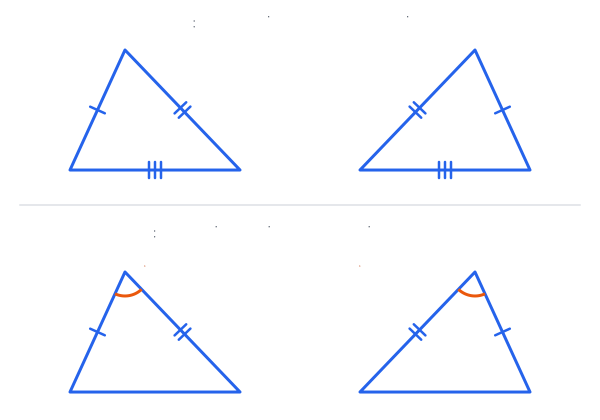
- SSS congruence postulate: If three sides of one triangle are congruent to three sides of another triangle, then the triangles are congruent.
- SAS congruence postulate: If two sides and the included angle of one triangle are congruent to two sides and the included angle of another triangle, then the triangles are congruent.
The included angle is the angle formed by the two sides. In \triangle ABC, the angle included between \overline{AB} and \overline{BC} is \angle B, the vertex the two sides share.
Helpful facts for proofs
- Reflexive property: a side shared by both triangles is congruent to itself, like \overline{BD} \cong \overline{BD}.
- Vertical angles are congruent. They often give the angle you need for SAS (see proving angle relationships).
- A midpoint splits a segment into two congruent segments (see midpoint formula).
- An angle bisector splits an angle into two congruent angles (see basic constructions).
How to Prove Triangles Congruent by SSS or SAS
- Mark the figure with everything you are given.
- Add facts you can see: shared sides, vertical angles and midpoints.
- Count what you have. Three pairs of sides means SSS.
- For SAS, check that the angle sits between the two sides.
- Write the congruence statement with matching vertices in the same order.
- Give a reason for every statement. The last reason is SSS or SAS.
Worked Examples
Example 1: SSS, SAS or not enough?
For each set of facts, decide whether \triangle ABC \cong \triangle DEF by SSS, by SAS, or whether there is not enough information.
- (a) \overline{AB} \cong \overline{DE}, \overline{BC} \cong \overline{EF} and \overline{AC} \cong \overline{DF}. All three pairs of sides match, so the triangles are congruent by SSS.
- (b) \overline{AB} \cong \overline{DE}, \angle B \cong \angle E and \overline{BC} \cong \overline{EF}. Angle B is between sides AB and BC, and angle E is between DE and EF. So the angle is included, and the triangles are congruent by SAS.
- (c) \overline{AB} \cong \overline{DE}, \overline{BC} \cong \overline{EF} and \angle A \cong \angle D. Angle A is not between AB and BC. This is side-side-angle, which is not a congruence test. There is not enough information.
Answer: (a) SSS, (b) SAS, (c) not enough information.
Example 2: Word problem with shelf brackets
A carpenter builds two triangular shelf brackets. On each bracket, two sides meet at a right angle. Bracket 1 has sides of 30 cm and (2x + 4) cm at the right angle. Bracket 2 has sides of 30 cm and (3x - 8) cm at the right angle. What value of x makes the brackets congruent by SAS?
- Both right angles are 90°, so the included angles are congruent.
- The 30 cm sides are congruent.
- For SAS, the other sides must also be equal: 2x + 4 = 3x - 8
- Subtract 2x from both sides (see equations with variables on both sides): 4 = x - 8
- Add 8 to both sides: 12 = x
- Find the side on bracket 1: 2(12) + 4 = 24 + 4 = 28
- Check with bracket 2: 3(12) - 8 = 36 - 8 = 28
Answer: x = 12. Each bracket has sides of 30 cm and 28 cm around a 90° angle, so the brackets are congruent by SAS.
Example 3: SSS on the coordinate plane
\triangle ABC has vertices A(0, 0), B(4, 0) and C(1, 2). \triangle DEF has vertices D(6, 1), E(6, 5) and F(4, 2). Show that \triangle ABC \cong \triangle DEF.
- Find AB. The points are on a horizontal line, so subtract the x-coordinates: AB = 4 - 0 = 4
- Find DE. The points are on a vertical line, so subtract the y-coordinates: DE = 5 - 1 = 4
- Find BC with the distance formula (see distance formula): BC = \sqrt{(1 - 4)^2 + (2 - 0)^2}
- Simplify inside the root: BC = \sqrt{9 + 4} = \sqrt{13}
- Find EF: EF = \sqrt{(4 - 6)^2 + (2 - 5)^2}
- Simplify inside the root: EF = \sqrt{4 + 9} = \sqrt{13}
- Find AC: AC = \sqrt{(1 - 0)^2 + (2 - 0)^2} = \sqrt{1 + 4} = \sqrt{5}
- Find DF: DF = \sqrt{(4 - 6)^2 + (2 - 1)^2} = \sqrt{4 + 1} = \sqrt{5}
- Compare: AB = DE = 4, BC = EF = \sqrt{13} and AC = DF = \sqrt{5}.
Answer: All three pairs of sides are congruent, so \triangle ABC \cong \triangle DEF by SSS.
Example 4: Two-column proof with SSS
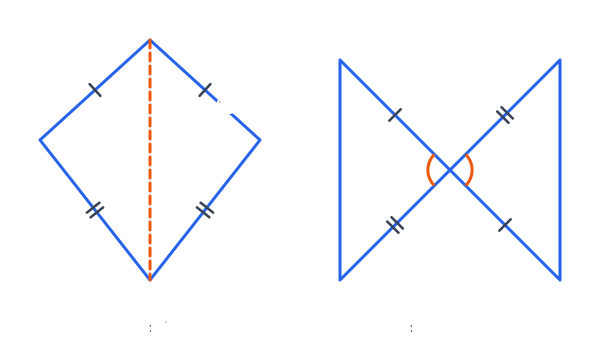
Given: \overline{AB} \cong \overline{CB} and \overline{AD} \cong \overline{CD}
Prove: \triangle ABD \cong \triangle CBD
| Statements | Reasons |
|---|---|
| 1. \overline{AB} \cong \overline{CB} | Given |
| 2. \overline{AD} \cong \overline{CD} | Given |
| 3. \overline{BD} \cong \overline{BD} | Reflexive property of congruence |
| 4. \triangle ABD \cong \triangle CBD | SSS (steps 1, 2 and 3) |
The key step is step 3. Side BD belongs to both triangles, so it gives the third pair of sides with no extra facts needed.
Example 5: Two-column proof with SAS
Given: M is the midpoint of \overline{AD} and of \overline{BC}
Prove: \triangle AMB \cong \triangle DMC
| Statements | Reasons |
|---|---|
| 1. M is the midpoint of \overline{AD} | Given |
| 2. \overline{AM} \cong \overline{DM} | Definition of midpoint |
| 3. M is the midpoint of \overline{BC} | Given |
| 4. \overline{BM} \cong \overline{CM} | Definition of midpoint |
| 5. \angle AMB \cong \angle DMC | Vertical angles theorem |
| 6. \triangle AMB \cong \triangle DMC | SAS (steps 2, 5 and 4) |
Check the order: angle AMB sits between sides AM and BM, and angle DMC sits between DM and CM. So the angle is included, and SAS applies. In the statement, A matches D, M matches M and B matches C.
Common Mistakes
| Mistake | Example of the error | Fix |
|---|---|---|
| Using an angle that is not included | Using AB, BC and \angle A for SAS | The angle must be between the two sides. For AB and BC, that is \angle B. |
| Using SSA or AAA as a test | “Two sides and a non-included angle match, so the triangles are congruent” | SSA and AAA do not prove congruence. Use SSS, SAS or the tests in the next lesson. |
| Forgetting the shared side | Stopping a proof with only two pairs of sides | Look for a side both triangles share. It is congruent by the reflexive property. |
| Mixing up the vertex order | Writing \triangle AMB \cong \triangle CMD in Example 5 | Match each vertex to its partner: A with D and B with C, so \triangle AMB \cong \triangle DMC. |
| Skipping the reason for a midpoint | Writing \overline{AM} \cong \overline{DM} with the reason “Given” | The given fact is the midpoint. The congruent segments come from the definition of midpoint. |
Why SSA and AAA Don’t Work
- SSA (side-side-angle): if the angle is not between the two sides, the third side can swing to two different places. You can get two different triangles from the same facts. (One special case, the right triangle, does work. It is called HL, in the next lesson.)
- AAA (angle-angle-angle): triangles with the same three angles have the same shape, but one can be bigger, like a figure and its dilation. They are similar, not always congruent.
- A quick memory tip: the letters must spell a real test. SSS and SAS work. ASA, AAS and HL also work, and you’ll learn them next.
Practice Problems
- \overline{PQ} \cong \overline{XY}, \overline{QR} \cong \overline{YZ} and \overline{PR} \cong \overline{XZ}. Which postulate proves the triangles congruent? Write the congruence statement.
- \overline{JK} \cong \overline{MN}, \angle K \cong \angle N and \overline{KL} \cong \overline{NO}. Which postulate proves the triangles congruent? Write the congruence statement.
- \overline{GH} \cong \overline{ST}, \overline{HI} \cong \overline{TU} and \angle G \cong \angle S. Can you prove \triangle GHI \cong \triangle STU by SSS or SAS? Explain.
- Name the angle included between \overline{AB} and \overline{BC} in \triangle ABC.
- \triangle ABC has sides 7, 10 and 2x + 3. \triangle DEF has sides 7, 10 and 15, with the sides in matching order. Find x so the triangles are congruent by SSS.
- In \triangle ABC and \triangle DEF, \angle C \cong \angle F and \overline{CA} \cong \overline{FD}. Also CB = 4x - 1 and FE = 2x + 9. Find x so the triangles are congruent by SAS, and find CB.
- \triangle RST has vertices R(1, 1), S(4, 1) and T(1, 5). \triangle UVW has vertices U(-2, 0), V(-2, 3) and W(-6, 0). Show that the triangles are congruent, and write the congruence statement.
- Complete the proof. Given: \overline{AB} \cong \overline{CB}, and \overline{BD} bisects \angle ABC. Prove: \triangle ABD \cong \triangle CBD. Statements: (1) \overline{AB} \cong \overline{CB}. (2) \overline{BD} bisects \angle ABC. (3) \angle ABD \cong \angle CBD. (4) \overline{BD} \cong \overline{BD}. (5) \triangle ABD \cong \triangle CBD. Give a reason for each statement.
- A roof truss has two rafters, AB and CB, each 5 m long. A post BD runs from the peak B straight down to D, the midpoint of the beam AC. Which postulate shows that \triangle ABD \cong \triangle CBD? List the three pairs of parts.
- \triangle ABC has AB = 8, BC = 6 and m\angle B = 50^\circ. \triangle XYZ has XY = 8, YZ = 6 and m\angle Y = 50^\circ. Are the triangles congruent? If so, by which postulate?
Show answers
- SSS, because all three pairs of sides are congruent
\triangle PQR \cong \triangle XYZ - \angle K is between JK and KL, and \angle N is between MN and NO, so the angle is included
SAS: \triangle JKL \cong \triangle MNO - No. \angle G is not between GH and HI, so this is SSA. SSS and SAS do not apply.
- \angle B, because B is the vertex shared by the two sides.
- The third sides must be equal: 2x + 3 = 15
Subtract 3: 2x = 12
Divide by 2: x = 6
Check: 2(6) + 3 = 15 - Angle C is between CA and CB, and angle F is between FD and FE, so CB must equal FE: 4x - 1 = 2x + 9
Subtract 2x: 2x - 1 = 9
Add 1: 2x = 10
Divide by 2: x = 5
Find CB: 4(5) - 1 = 20 - 1 = 19
Check: 2(5) + 9 = 10 + 9 = 19 - RS is horizontal: RS = 4 - 1 = 3
UV is vertical: UV = 3 - 0 = 3
RT is vertical: RT = 5 - 1 = 4
UW is horizontal: UW = -2 - (-6) = 4
ST: \sqrt{(1 - 4)^2 + (5 - 1)^2} = \sqrt{9 + 16} = \sqrt{25} = 5
VW: \sqrt{(-6 - (-2))^2 + (0 - 3)^2} = \sqrt{16 + 9} = \sqrt{25} = 5
All three pairs match, so by SSS, \triangle RST \cong \triangle UVW. - (1) Given
(2) Given
(3) Definition of angle bisector
(4) Reflexive property of congruence
(5) SAS (steps 1, 3 and 4) - SSS
\overline{AB} \cong \overline{CB}: both rafters are 5 m
\overline{AD} \cong \overline{CD}: D is the midpoint of AC
\overline{BD} \cong \overline{BD}: the post is a shared side (reflexive property) - Yes. \angle B is between AB and BC, and \angle Y is between XY and YZ. Two sides and the included angle match, so \triangle ABC \cong \triangle XYZ by SAS.
FAQ
What is the SSS congruence postulate?
If all three sides of one triangle are congruent to all three sides of another triangle, the triangles are congruent. You don’t need to check any angles.
What is the SAS congruence postulate?
If two sides and the angle between them in one triangle are congruent to two sides and the angle between them in another triangle, the triangles are congruent.
Why is SSA not a congruence theorem?
When the known angle is not between the two known sides, the facts can fit two different triangles. So SSA does not prove congruence, except for right triangles (HL).
What is an included angle?
An included angle is the angle formed by two sides of a triangle. It sits at the vertex the two sides share. For sides AB and BC, the included angle is \angle B.
Summary
- SSS: three pairs of congruent sides prove two triangles congruent.
- SAS: two pairs of congruent sides and the included angle prove two triangles congruent.
- The included angle is at the vertex shared by the two sides.
- Shared sides (reflexive property), vertical angles and midpoints often supply the missing parts.
- SSA and AAA are not congruence tests.
- Write the congruence statement with matching vertices in the same order.
Previous lesson: Congruent Figures
Next lesson: ASA, AAS and HL Congruence
Back to the Geometry Index