
Proving Angle Relationships
Proving angle relationships means using two-column proofs to show that certain angle pairs are always congruent. The key theorems are the vertical angles theorem, the right angles congruence theorem, and the congruent supplements and congruent complements theorems. Once proved, each one can be a reason in later proofs.
Before this lesson: You should know Angle Pairs and Two-Column Proofs.
Why Prove What You Already Know?
In the angle pairs lesson, you saw that vertical angles match. You checked it with numbers. That is inductive reasoning. A proof shows the fact holds for every pair of vertical angles, not just the ones you measured.
Proved facts are called theorems. After you prove a theorem, you can use it as a reason, just like a postulate.
Angle Relationship Theorems
| Theorem or postulate | What it says |
|---|---|
| Linear pair postulate | If two angles form a linear pair, then they are supplementary. |
| Vertical angles theorem | Vertical angles are congruent. |
| Right angles congruence theorem | All right angles are congruent. |
| Congruent supplements theorem | If two angles are supplementary to the same angle (or to congruent angles), then they are congruent. |
| Congruent complements theorem | If two angles are complementary to the same angle (or to congruent angles), then they are congruent. |
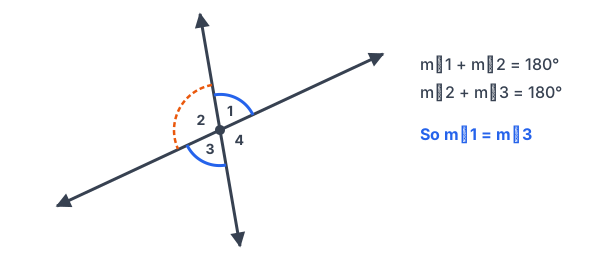
Steps to prove an angle relationship
- Mark the diagram with the given facts.
- Find the angle pairs: linear pairs, right angles, complements or supplements.
- Write the sums as equations, like m\angle 1 + m\angle 2 = 180^\circ.
- Use substitution and the properties of equality to get the angles equal.
- Finish with the definition of congruent angles.
Worked Examples
Example 1: Prove the vertical angles theorem
Given: \angle 1 and \angle 3 are vertical angles, as in the picture above. Prove: \angle 1 \cong \angle 3
| Statement | Reason |
|---|---|
| \angle 1 \text{ and } \angle 3 \text{ are vertical angles} | Given |
| \angle 1 \text{ and } \angle 2 \text{ form a linear pair; } \angle 2 \text{ and } \angle 3 \text{ form a linear pair} | Definition of linear pair (from the diagram) |
| m\angle 1 + m\angle 2 = 180^\circ | Linear pair postulate |
| m\angle 2 + m\angle 3 = 180^\circ | Linear pair postulate |
| m\angle 1 + m\angle 2 = m\angle 2 + m\angle 3 | Substitution property (both sums equal 180°) |
| m\angle 1 = m\angle 3 | Subtraction property of equality (subtract m\angle 2) |
| \angle 1 \cong \angle 3 | Definition of congruent angles |
Example 2: Prove the right angles congruence theorem
Given: \angle A and \angle B are right angles. Prove: \angle A \cong \angle B
| Statement | Reason |
|---|---|
| \angle A \text{ and } \angle B \text{ are right angles} | Given |
| m\angle A = 90^\circ, \; m\angle B = 90^\circ | Definition of right angle |
| m\angle A = m\angle B | Transitive property of equality |
| \angle A \cong \angle B | Definition of congruent angles |
Example 3: Prove the congruent supplements theorem
Given: \angle 1 and \angle 2 are supplementary, and \angle 3 and \angle 2 are supplementary. Prove: \angle 1 \cong \angle 3
| Statement | Reason |
|---|---|
| \angle 1 \text{ and } \angle 2 \text{ are supplementary; } \angle 3 \text{ and } \angle 2 \text{ are supplementary} | Given |
| m\angle 1 + m\angle 2 = 180^\circ | Definition of supplementary angles |
| m\angle 3 + m\angle 2 = 180^\circ | Definition of supplementary angles |
| m\angle 1 + m\angle 2 = m\angle 3 + m\angle 2 | Substitution property |
| m\angle 1 = m\angle 3 | Subtraction property of equality (subtract m\angle 2) |
| \angle 1 \cong \angle 3 | Definition of congruent angles |
The congruent complements theorem has the same proof with 90^\circ in place of 180^\circ.
Example 4: Use a theorem to find angles
Two lines cross. Two vertical angles measure (3x + 15)^\circ and (5x - 21)^\circ. Find x and all four angles. Name the theorem for each step.
Step 1: Vertical angles theorem: the angles are congruent, so their measures are equal.
3x + 15 = 5x - 21
Step 2: Subtract 3x from both sides (subtraction property of equality; see equations with variables on both sides).
15 = 2x - 21
Step 3: Add 21 to both sides (addition property of equality).
36 = 2x
Step 4: Divide both sides by 2 (division property of equality).
18 = x
Step 5: Substitute 18 to find the vertical angles.
3(18) + 15 = 54 + 15 = 69
Step 6: Linear pair postulate: the angle next to it is its supplement.
180 - 69 = 111
Step 7: Vertical angles theorem again: the fourth angle matches the third.
111
So x = 18, and the angles are 69^\circ, 111^\circ, 69^\circ and 111^\circ.
Example 5: Word problem
A carpenter cuts two corner braces. Each brace makes a right angle with a shelf, split into two parts. In the first corner, the parts are \angle 1 and \angle 2. In the second, they are \angle 3 and \angle 4. The carpenter makes \angle 2 \cong \angle 4, with m\angle 2 = 34^\circ. Show that \angle 1 \cong \angle 3 and find their measures.
Step 1: Each corner is a right angle, so \angle 1 and \angle 2 are complementary, and so are \angle 3 and \angle 4.
Step 2: Since \angle 2 \cong \angle 4, the congruent complements theorem says \angle 1 \cong \angle 3.
Step 3: Find m\angle 1. Complementary angles add to 90^\circ.
m\angle 1 = 90 - 34 = 56
Step 4: Congruent angles have equal measures.
m\angle 3 = m\angle 1 = 56
Both \angle 1 and \angle 3 measure 56^\circ, so the two braces match.
Common Mistakes
| Mistake | Example of the error | Fix |
|---|---|---|
| Using the theorem to prove itself | Writing “vertical angles theorem” as a reason while proving the vertical angles theorem | Use only the given facts, definitions, postulates and earlier theorems. |
| Assuming adjacent angles are a linear pair | Calling two angles a linear pair because they touch | A linear pair must form a straight line. Check that the outer sides are opposite rays. |
| Mixing complements and supplements | Using 180^\circ for angles that make a right angle | Complements add to 90^\circ. Supplements add to 180^\circ. |
| Ending with = instead of ≅ | Stopping at m\angle 1 = m\angle 3 when asked to prove \angle 1 \cong \angle 3 | Add the last step: definition of congruent angles. |
| Thinking all supplementary angles are congruent | Saying 70^\circ and 110^\circ are congruent because they are supplementary | Supplementary angles add to 180^\circ. They are congruent only when both are 90^\circ. |
Using These Theorems in Later Proofs
- When lines cross, use the vertical angles theorem to match the opposite angles. You will use this with parallel lines and transversals in Unit 3.
- When two lines are perpendicular, all four angles are right angles, so all four are congruent.
- When two angles share a supplement or complement, use the congruent supplements or complements theorem instead of solving for each angle.
- Every theorem here can be written as a conditional, like the ones in conditional statements.
Practice Problems
- Name the theorem: If \angle 5 and \angle 7 are vertical angles, then \angle 5 \cong \angle 7.
- Name the theorem: If \angle P and \angle Q are right angles, then \angle P \cong \angle Q.
- \angle 1 and \angle 2 are complementary, and \angle 3 and \angle 2 are complementary. If m\angle 1 = 27^\circ, find m\angle 3. Which theorem did you use?
- Two lines cross. One angle is (2x + 40)^\circ and its vertical angle is (4x - 10)^\circ. Find all four angles.
- Two lines cross. One angle is (6x + 8)^\circ and the angle next to it is (3x + 19)^\circ. Find both angles.
- Complete the proof. Given: \angle 1 \cong \angle 3. \angle 1 and \angle 2 form a linear pair, and \angle 3 and \angle 4 form a linear pair. Prove: \angle 2 \cong \angle 4. Statements: (1) the given facts (2) \angle 1 and \angle 2 are supplementary; \angle 3 and \angle 4 are supplementary (3) \angle 2 \cong \angle 4. Give the reasons.
- Complete the proof of the congruent complements theorem. Given: \angle A and \angle B are complementary; \angle C and \angle B are complementary. Prove: \angle A \cong \angle C. Write the statements and reasons.
- Two perpendicular lines cross. What do you know about the four angles? Which theorems tell you?
- Find the error: “\angle 1 and \angle 2 are supplementary, so \angle 1 \cong \angle 2 by the congruent supplements theorem.”
- Two straight streets cross at an intersection. One corner angle measures 58^\circ. Find the other three corner angles and name the theorem or postulate for each.
Show answers
- Vertical angles theorem.
- Right angles congruence theorem.
- Both are complementary to the same angle, so the congruent complements theorem says: \angle 3 \cong \angle 1. Congruent angles have equal measures: m\angle 3 = 27^\circ. So m\angle 3 = 27^\circ. (Check: m\angle 2 = 90 - 27 = 63, and 27 + 63 = 90.)
- Vertical angles are congruent: 2x + 40 = 4x - 10. Subtract 2x from both sides: 40 = 2x - 10. Add 10 to both sides: 50 = 2x. Divide both sides by 2: x = 25. Find the vertical angles: 2(25) + 40 = 90. Find the angles next to them: 180 - 90 = 90. All four angles are 90^\circ. The lines are perpendicular.
- The angles form a linear pair, so they add to 180: (6x + 8) + (3x + 19) = 180. Combine like terms: 9x + 27 = 180. Subtract 27 from both sides: 9x = 153. Divide both sides by 9: x = 17. Find the first angle: 6(17) + 8 = 110. Find the second angle: 3(17) + 19 = 70. The angles are 110^\circ and 70^\circ. Check: 110 + 70 = 180.
- (1) Given. (2) Linear pair postulate. (3) Congruent supplements theorem (the angles are supplementary to congruent angles).
- (1) \angle A and \angle B are complementary; \angle C and \angle B are complementary, Given. (2) m\angle A + m\angle B = 90^\circ, Definition of complementary angles. (3) m\angle C + m\angle B = 90^\circ, Definition of complementary angles. (4) m\angle A + m\angle B = m\angle C + m\angle B, Substitution property. (5) m\angle A = m\angle C, Subtraction property of equality. (6) \angle A \cong \angle C, Definition of congruent angles.
- All four angles are right angles, so all four are congruent. The definition of perpendicular lines gives one right angle. The linear pair postulate and the vertical angles theorem give the other three. The right angles congruence theorem says they are all congruent.
- The congruent supplements theorem needs two angles that are each supplementary to the same angle. Two angles that are supplementary to each other are congruent only if both are 90^\circ.
- Vertical angles theorem: the opposite corner: 58. Linear pair postulate: the corner next to it: 180 - 58 = 122. Vertical angles theorem: the last corner: 122. The corners are 58^\circ, 122^\circ, 58^\circ and 122^\circ.
FAQ
What is the vertical angles theorem?
It says vertical angles, the opposite angles formed by two crossing lines, are congruent. It is proved with the linear pair postulate and the subtraction property of equality.
What is the difference between a postulate and a theorem here?
The linear pair postulate is accepted without proof. The vertical angles theorem, the right angles congruence theorem and the congruent supplements and complements theorems are all proved.
When do I use the congruent supplements theorem?
Use it when two angles are each supplementary to the same angle, or to two angles you already know are congruent.
Are all right angles congruent?
Yes. Every right angle measures 90^\circ, so any two right angles have equal measures and are congruent.
Summary
- Linear pair postulate: angles that form a linear pair are supplementary.
- Vertical angles theorem: vertical angles are congruent.
- Right angles congruence theorem: all right angles are congruent.
- Congruent supplements and complements theorems: angles supplementary (or complementary) to the same angle are congruent.
- End an angle proof with the definition of congruent angles to go from = to ≅.
Previous lesson: Two-Column Proofs
Next lesson: Parallel Lines and Transversals (coming soon)
Back to the Geometry Index