
Conditional Statements
A conditional statement is an if-then statement, like “If an angle measures 30^\circ, then it is acute.” The part after “if” is the hypothesis, and the part after “then” is the conclusion. Switching or negating those parts gives the converse, inverse and contrapositive.
Before this lesson: You should know Measuring and Classifying Angles and Angle Pairs. This is the first lesson in Unit 2, Reasoning and Proof.
What Is a Conditional Statement?
A conditional statement makes a promise: when one thing happens, another thing follows. “If you score 90 or more, then you get an A” is a conditional. It says nothing about scores below 90.
We write a conditional as p \rightarrow q, read “if p, then q.”
- The hypothesis, p, is the “if” part.
- The conclusion, q, is the “then” part.
- The negation of a statement means its opposite. We write “not p” as \sim p.
A conditional is true if the conclusion always holds when the hypothesis does. It is false if you can find one counterexample: a case where the hypothesis is true but the conclusion is false.
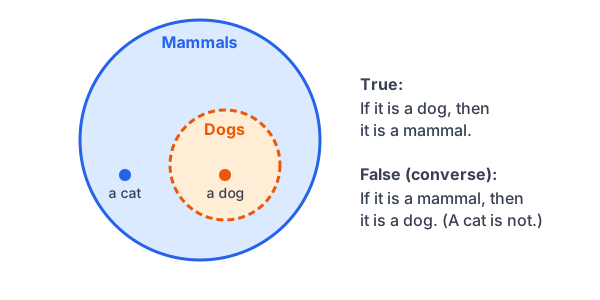
The picture shows why order matters. Every dog is a mammal. But a cat is a mammal that is not a dog. So “If it is a mammal, then it is a dog” is false.
Converse, Inverse and Contrapositive
Start with p \rightarrow q. You can switch the parts, negate them, or do both.
| Statement | Form | Example |
|---|---|---|
| Conditional | p \rightarrow q | If an angle measures 30^\circ, then it is acute. |
| Converse | q \rightarrow p | If an angle is acute, then it measures 30^\circ. |
| Inverse | \sim p \rightarrow \sim q | If an angle does not measure 30^\circ, then it is not acute. |
| Contrapositive | \sim q \rightarrow \sim p | If an angle is not acute, then it does not measure 30^\circ. |
A conditional and its contrapositive are always both true or both false. The converse and the inverse are also a matched pair. Statements that are always true or false together are called equivalent statements.
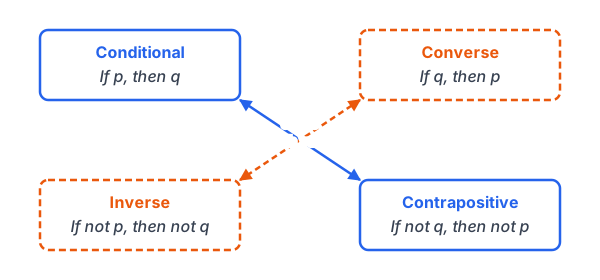
Steps to write the related statements
- Find the hypothesis p and the conclusion q. Rewrite the sentence in if-then form if needed.
- Converse: switch them. If q, then p.
- Inverse: negate both. If not p, then not q.
- Contrapositive: switch and negate. If not q, then not p.
- Decide each truth value. Give a counterexample for any false statement.
Biconditionals
When a conditional and its converse are both true, you can join them with “if and only if.” This is a biconditional, written p \leftrightarrow q. Every good definition is a biconditional. For example, an angle is right if and only if it measures 90^\circ.
Worked Examples
Example 1: Write a statement in if-then form
Rewrite “Vertical angles are congruent” as a conditional. Name the hypothesis and the conclusion.
Step 1: Ask what the statement is about. It is about two angles that are vertical angles. That is the hypothesis.
Step 2: Ask what it says about them. They are congruent. That is the conclusion.
Step 3: Write the if-then form.
If two angles are vertical angles, then they are congruent. The hypothesis is “two angles are vertical angles,” and the conclusion is “they are congruent.” It is true by the vertical angles theorem from angle pairs.
Example 2: Converse, inverse and contrapositive
Write the converse, inverse and contrapositive of “If an angle measures 30^\circ, then it is acute.” Decide whether each is true.
Step 1: The conditional is true. Any 30^\circ angle is less than 90^\circ.
Step 2: Converse: “If an angle is acute, then it measures 30^\circ.” False. Counterexample: a 50^\circ angle is acute.
Step 3: Inverse: “If an angle does not measure 30^\circ, then it is not acute.” False. The same 50^\circ angle works as a counterexample.
Step 4: Contrapositive: “If an angle is not acute, then it does not measure 30^\circ.” True, just like the conditional.
The conditional and contrapositive are true. The converse and inverse are false.
Example 3: Find a counterexample
Is this conditional true? “If x^2 = 25, then x = 5.”
Step 1: Look for a number that makes the hypothesis true but the conclusion false. Try x = -5.
Step 2: Check the hypothesis.
(-5)^2 = (-5)(-5) = 25
Step 3: The hypothesis is true, but -5 \ne 5, so the conclusion is false.
The conditional is false. The counterexample is x = -5. One counterexample is enough.
Example 4: Is it a biconditional?
Can “If 2x + 3 = 11, then x = 4” be written as a biconditional?
Step 1: Check the conditional. Subtract 3 from both sides (see two-step equations).
2x = 8
Step 2: Divide both sides by 2.
x = 4
Step 3: So the conditional is true. Now check the converse: “If x = 4, then 2x + 3 = 11.” Substitute 4.
2(4) + 3 = 8 + 3 = 11
Step 4: The converse is true too.
Both directions are true, so it is a biconditional: 2x + 3 = 11 if and only if x = 4.
Example 5: Word problem
A coach says, “If it rains, then practice is canceled.” Assume the coach is right. Today practice was not canceled. What can you conclude? And if practice was canceled, did it rain?
Step 1: Name the parts. p: it rains. q: practice is canceled.
Step 2: Practice was not canceled. That is \sim q.
Step 3: The contrapositive is “If practice is not canceled, then it did not rain.” It is equivalent to the true conditional, so it is true.
Step 4: So it did not rain today.
Step 5: Now suppose practice was canceled. That is q. Concluding “it rained” would use the converse, which might be false. Practice could be canceled for another reason, like a field repair.
If practice was not canceled, it did not rain. If practice was canceled, you can’t be sure why.
Common Mistakes
| Mistake | Example of the error | Fix |
|---|---|---|
| Assuming the converse is true | “All squares are rectangles, so all rectangles are squares.” | Check the converse on its own. A 2 by 5 rectangle is not a square. |
| Mixing up the inverse and the contrapositive | Writing “If not p, then not q” as the contrapositive | The contrapositive switches and negates: if not q, then not p. |
| Using a counterexample that misses the hypothesis | Using x = 3 to disprove “If x^2 = 25, then x = 5“ | A counterexample must make the hypothesis true and the conclusion false. x = -5 works. |
| Thinking examples prove a conditional | “It works for 2, 4 and 6, so it is always true.” | Examples can’t prove a conditional. One counterexample can disprove it. |
| Calling a one-way statement a definition | “An angle is acute if and only if it measures 30°.” | A biconditional needs both directions true. Check the converse first. |
Truth Values in a Table
A truth table lists every combination of true (T) and false (F). A conditional is false in only one case: a true hypothesis with a false conclusion.
| p | q | p \rightarrow q | Contrapositive \sim q \rightarrow \sim p |
|---|---|---|---|
| T | T | T | T |
| T | F | F | F |
| F | T | T | T |
| F | F | T | T |
The last two columns match in every row. That is why a conditional and its contrapositive are equivalent. You will use this idea in the next lesson on deductive reasoning and later in proofs. Postulates like the ones in points, lines and planes can all be written as conditionals.
Practice Problems
- Name the hypothesis and conclusion: “If two angles form a linear pair, then they are supplementary.”
- Rewrite in if-then form: “A right angle measures 90^\circ.”
- Write the converse of “If two angles form a linear pair, then they are supplementary.” Is it true?
- Write the inverse and contrapositive of “If a number is divisible by 4, then it is even.” Which are true?
- Find a counterexample: “If |x| = 7, then x = 7.”
- Find a counterexample: “If a number is prime, then it is odd.”
- Is this a biconditional? “If 3x - 5 = 10, then x = 5.”
- Is this true? “If x \gt 3, then x^2 \gt 9.” What about its converse?
- Write as a biconditional: “Two angles are complementary if their measures add up to 90^\circ, and if two angles are complementary, their measures add up to 90^\circ.”
- A store sign says, “If you spend $50 or more, then shipping is free.” Mia’s shipping was not free. What can you conclude?
Show answers
- Hypothesis: two angles form a linear pair. Conclusion: they are supplementary.
- If an angle is a right angle, then it measures 90^\circ.
- Converse: “If two angles are supplementary, then they form a linear pair.” False. Counterexample: two angles of 100^\circ and 80^\circ in different places are supplementary but not a linear pair.
- Inverse: “If a number is not divisible by 4, then it is not even.” False, since 6 is even but not divisible by 4. Contrapositive: “If a number is not even, then it is not divisible by 4.” True. The original is true, and so is its contrapositive.
- Try x = −7. Check the hypothesis: |-7| = 7. The hypothesis is true, but -7 \ne 7. So x = -7 is a counterexample, and the statement is false (see absolute value equations).
- 2 is prime but not odd. So 2 is a counterexample, and the statement is false.
- Check the conditional. Add 5 to both sides: 3x = 15. Divide both sides by 3: x = 5. Check the converse. Substitute 5: 3(5) - 5 = 15 - 5 = 10. Both directions are true, so it is a biconditional: 3x - 5 = 10 if and only if x = 5.
- The conditional is true: if x is more than 3, then x^2 is more than 9. The converse, “If x^2 \gt 9, then x \gt 3,” is false. Counterexample: x = -4 gives (-4)^2 = 16 \gt 9, but -4 is not more than 3.
- Two angles are complementary if and only if their measures add up to 90^\circ.
- Use the contrapositive: “If shipping is not free, then you did not spend $50 or more.” So Mia spent less than $50.
FAQ
What is the difference between the converse and the contrapositive?
The converse only switches the hypothesis and conclusion. The contrapositive switches them and negates both. The contrapositive always has the same truth value as the original. The converse may not.
If a statement is true, is its converse true?
Not always. “If an animal is a dog, then it is a mammal” is true, but “If an animal is a mammal, then it is a dog” is false.
How many counterexamples do you need to prove a statement false?
Just one. A single case where the hypothesis is true and the conclusion is false is enough.
What does “if and only if” mean?
It means the statement works in both directions. “p if and only if q” means p \rightarrow q and q \rightarrow p are both true.
Summary
- A conditional is an if-then statement, p \rightarrow q. The hypothesis is p and the conclusion is q.
- Converse: q \rightarrow p. Inverse: \sim p \rightarrow \sim q. Contrapositive: \sim q \rightarrow \sim p.
- A conditional and its contrapositive always have the same truth value. So do the converse and the inverse.
- One counterexample, with a true hypothesis and a false conclusion, shows a conditional is false.
- A biconditional, p \leftrightarrow q, is true when the conditional and its converse are both true.
Previous lesson: Basic Constructions
Next lesson: Inductive and Deductive Reasoning
Back to the Geometry Index