
Points, Lines and Planes
Points, lines and planes are the three building blocks of geometry. A point is an exact spot with no size. A line is straight, has no thickness, and goes on forever in both directions. A plane is a flat surface that goes on forever. Every other shape is built from these three.
Before this lesson: You should know the Coordinate Plane and Slope. This is the first lesson in Geometry.
What Are Points, Lines and Planes?
Think of a sheet of paper that never ends. That is a plane. A pencil dot on it is a point. A ruler line drawn across it, going on forever both ways, is a line.
Real dots and lines have some width. In geometry, we pretend they don’t. A point has no size at all. A line has length but no width.
These three ideas are called undefined terms. We don’t define them with other words. We describe them and draw them. Every other figure is defined using them.
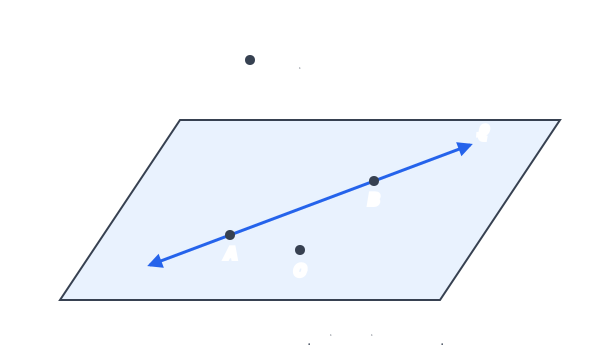
How to Name Points, Lines and Planes
| Figure | How to draw it | How to name it | Symbol |
|---|---|---|---|
| Point | A dot | One capital letter: point A | A |
| Line | Arrowheads at both ends | Two points on it, or one small letter: line AB or line \ell | \overleftrightarrow{AB} |
| Plane | A slanted four-sided shape | Three points not on one line, or one capital letter: plane ABC or plane M | plane M |
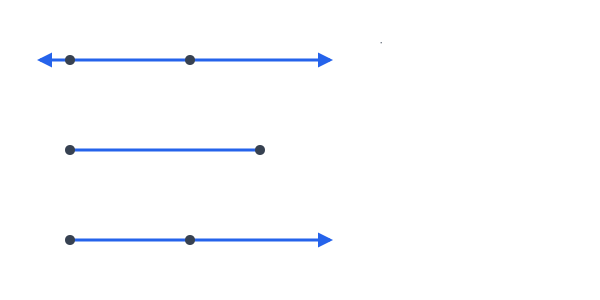
| Segment | Dots at both ends | Its two endpoints: segment AB | \overline{AB} |
| Ray | A dot at one end, an arrowhead at the other | Its endpoint first, then one more point: ray AB | \overrightarrow{AB} |
A segment is the part of a line between two endpoints. A ray is part of a line that starts at one endpoint and goes on forever in one direction.
Key words
- Collinear points lie on the same line. Points that don’t are noncollinear.
- Coplanar points lie in the same plane. Points that don’t are noncoplanar.
- The intersection of two figures is the set of points they share.
- Opposite rays share an endpoint and point in opposite directions. Together they make a line.
The Basic Rules (Postulates)
A postulate is a rule we accept as true without proof. These five describe how points, lines and planes fit together.
- Through any two points, there is exactly one line.
- Through any three noncollinear points, there is exactly one plane.
- If two lines intersect, they meet in exactly one point.
- If two planes intersect, they meet in exactly one line.
- If two points are in a plane, the whole line through them is in that plane.
Steps for naming a figure
- Decide what it is: point, line, segment, ray or plane.
- Pick the right points. A ray must start with its endpoint. A plane needs three points that are not on one line.
- Write the symbol over the letters, or write the word in front.
Worked Examples
Example 1: Naming a line
Points P, Q and R lie on line m. Give all the names for this line.
Step 1: Any two of the three points name the line. The order of the two letters doesn’t matter.
Step 2: List the pairs: \overleftrightarrow{PQ}, \overleftrightarrow{QP}, \overleftrightarrow{PR}, \overleftrightarrow{RP}, \overleftrightarrow{QR} and \overleftrightarrow{RQ}.
Step 3: Add the small letter: line m. That makes 7 names for the same line.
Example 2: Rays and opposite rays
Points A, B and C are on a line in that order. Which rays are opposite rays? Is \overrightarrow{AB} the same ray as \overrightarrow{AC}?
Step 1: Opposite rays share an endpoint and point in opposite directions. B is between A and C. So \overrightarrow{BA} and \overrightarrow{BC} are opposite rays.
Step 2: \overrightarrow{AB} starts at A and goes through B. \overrightarrow{AC} starts at A and goes through C. Both start at A and point the same way.
Step 3: So \overrightarrow{AB} and \overrightarrow{AC} are the same ray. But \overrightarrow{AB} and \overrightarrow{BA} are not. They have different endpoints.
Example 3: Collinear points on a graph
Are the points A(1, 2), B(3, 6) and C(5, 10) collinear? What about D(4, 7)?
Points are collinear when the slope between each pair is the same.
Step 1: Find the slope from A to B (see the slope formula).
m = \frac{6 - 2}{3 - 1} = \frac{4}{2} = 2Step 2: Find the slope from B to C.
m = \frac{10 - 6}{5 - 3} = \frac{4}{2} = 2Step 3: The slopes match and the pairs share point B. So A, B and C are collinear.
Step 4: Find the slope from B to D.
m = \frac{7 - 6}{4 - 3} = \frac{1}{1} = 1Step 5: 1 is not 2. So D is not on the line. A, B and D are noncollinear.
Example 4: Planes in a box
Use the box below. Its bottom is ABCD and its top is EFGH.
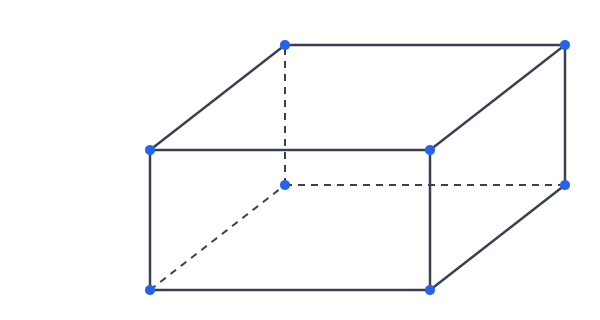
(a) What is the intersection of plane ABCD and plane BCGF?
Step 1: Find the points the two faces share: B and C.
Step 2: Two planes meet in a line. So the intersection is \overleftrightarrow{BC}.
(b) Are A, B, C and G coplanar?
Step 1: A, B and C are noncollinear, so they make exactly one plane: the bottom, plane ABCD.
Step 2: G is on the top of the box, not the bottom. So the four points are not coplanar.
(c) Name a plane that holds A, C and E.
Step 1: E is right above A, and G is right above C. So A, C, G and E make a flat rectangle that cuts through the box.
Step 2: Name it with its corners: plane ACGE.
Example 5: Word problem
A delivery company serves 6 towns. No three of the towns are on one straight line. The company wants a straight road between every pair of towns. How many roads does it need?
Step 1: Through any two points there is exactly one line. So each pair of towns gets exactly one road.
Step 2: Each town connects to the other 5 towns.
6 \cdot 5 = 30
Step 3: That counts every road twice, once from each end. Divide by 2.
30 \div 2 = 15
The company needs 15 roads.
Common Mistakes
| Mistake | Example of the error | Fix |
|---|---|---|
| Writing a ray with the endpoint second | Calling the ray that starts at B and goes through A \overrightarrow{AB} | The endpoint comes first: \overrightarrow{BA}. |
| Mixing up the symbols | Writing \overleftrightarrow{AB} for a segment | A segment has a bar: \overline{AB}. A line has two arrowheads: \overleftrightarrow{AB}. |
| Thinking any three points are collinear | Saying A(1, 2), B(3, 6), D(4, 7) are on one line | Check the slopes. They are 2 and 1, so the points are not collinear. |
| Naming a plane with points on one line | Plane PQR when P, Q, R are collinear | Use three noncollinear points. Many planes pass through one line. |
| Thinking any four points are coplanar | Saying A, B, C, G in the box are coplanar | Three points always make a plane. A fourth point may be outside it. |
Points, Lines and Planes on the Coordinate Plane
On a graph, two lines can meet in one point, never meet, or be the same line. Lines that never meet are parallel lines. Finding where two lines meet is what systems of equations do.
| How two lines relate | On a graph | Points in common |
|---|---|---|
| Intersecting | They cross once | Exactly 1 |
| Parallel | Same slope, never meet | 0 |
| Same line | One line drawn twice | Every point |
For example, the x-axis and the y-axis are two lines that meet at one point, the origin (0, 0). See horizontal and vertical lines for more lines like these.
Practice Problems
- Points J and K are on line n. Give three names for the line.
- Write the symbols for segment XY and ray XY.
- Points R, S and T are on a line in that order. Name the two opposite rays with endpoint S.
- Are \overrightarrow{PQ} and \overrightarrow{QP} the same ray? Explain.
- Are (0, 1), (2, 5) and (4, 9) collinear?
- Are (-1, 3), (1, 0) and (3, -2) collinear?
- In the box above, what is the intersection of plane EFGH and plane ADHE?
- In the box above, are A, B, G and H coplanar?
- Five points lie in a plane, and no three are collinear. How many lines can you draw through pairs of them?
- Seven friends stand in a field so that no three are in a line. Each pair holds one straight string between them. How many strings are there?
Show answers
- Any two of these: \overleftrightarrow{JK}, \overleftrightarrow{KJ}, line n.
- Segment XY is \overline{XY}. Ray XY is \overrightarrow{XY}.
- S is between R and T. So the opposite rays are \overrightarrow{SR} and \overrightarrow{ST}.
- No. \overrightarrow{PQ} starts at P. \overrightarrow{QP} starts at Q and points the other way.
- Slope from (0, 1) to (2, 5): \frac{5 - 1}{2 - 0} = \frac{4}{2} = 2. Slope from (2, 5) to (4, 9): \frac{9 - 5}{4 - 2} = \frac{4}{2} = 2. The slopes match, so yes, they are collinear.
- Slope from (-1, 3) to (1, 0): \frac{0 - 3}{1 - (-1)} = \frac{-3}{2}. Slope from (1, 0) to (3, -2): \frac{-2 - 0}{3 - 1} = \frac{-2}{2} = -1. The slopes are different, so no, they are not collinear.
- The two faces share points E and H. Two planes meet in a line, so the intersection is \overleftrightarrow{EH}.
- Yes. H is right above D, and G is right above C. So A, B, G and H make a slanted rectangle through the box. It is plane ABGH.
- Each point pairs with 4 others: 5 \cdot 4 = 20. Each line is counted twice: 20 \div 2 = 10. There are 10 lines.
- Each friend pairs with 6 others: 7 \cdot 6 = 42. Each string is counted twice: 42 \div 2 = 21. There are 21 strings.
FAQ
Why are point, line and plane undefined terms?
Every definition uses other words. We have to start somewhere, so these three are described, not defined. Every other figure is defined using them.
What is the difference between a line, a segment and a ray?
A line goes on forever both ways. A segment has two endpoints. A ray has one endpoint and goes on forever one way.
Can two lines intersect in more than one point?
No. Two different lines meet in at most one point. If they share two points, they are the same line.
Why doesn’t a three-legged stool wobble?
The ends of its three legs are three noncollinear points, and they always make exactly one plane. A four-legged chair can wobble, because four points don’t have to be coplanar.
Summary
- Points, lines and planes are the undefined terms of geometry.
- A line \overleftrightarrow{AB} goes on forever. A segment \overline{AB} has two endpoints. A ray \overrightarrow{AB} starts at A.
- Collinear points are on one line. Coplanar points are in one plane.
- Two points make exactly one line. Three noncollinear points make exactly one plane.
- Two lines meet in one point. Two planes meet in one line.
Previous course: Algebra 1 Index
Next lesson: Segment Addition Postulate (coming soon)
Back to the Geometry Index