
Segment Addition Postulate
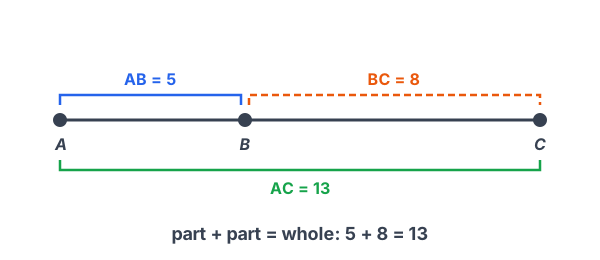
The segment addition postulate says that if point B is between points A and C on a segment, then AB + BC = AC. The two smaller pieces add up to the whole segment. You use it to find a missing length or to solve for x.
Before this lesson: You should know Points, Lines and Planes and how to solve multi-step equations.
What Is the Segment Addition Postulate?
Think of a straight road from town A to town C. Town B is on the road between them. Drive from A to B, then from B to C. The two trips add up to the whole trip.
A segment works the same way. Put a point between the endpoints. It cuts the segment into two pieces. The lengths of the pieces add up to the length of the whole segment.
Length and the ruler postulate
The length of \overline{AB} is the distance between A and B. We write it as AB, with no bar. So \overline{AB} is the segment, and AB is a number.
The ruler postulate says you can put any line on a number line. Then the length of a segment is the distance between its endpoints’ numbers. If A is at a and B is at b, then AB = |a - b|.
Between and congruent
- Point B is between A and C when all three points are on one line and B sits on the segment from A to C.
- Congruent segments have the same length. We write \overline{AB} \cong \overline{CD}. On a drawing, matching tick marks show congruent segments.
- If \overline{AB} \cong \overline{CD}, then AB = CD. Congruence is about the segments. Equal is about their lengths.
Segment Addition Postulate Formula
If B is between A and C, then:
AB + BC = AC
It also works the other way. If AB + BC = AC for three points on a line, then B is between A and C.
Steps to use the segment addition postulate
- Draw the segment and mark the point that is between the endpoints.
- Write the equation: part + part = whole.
- Put in the lengths you know.
- Solve the equation.
- If you solved for x, put it back in to find each length.
- Check that the parts add up to the whole.
Worked Examples
Example 1: Find the whole length
Point B is between A and C. AB = 7 and BC = 12. Find AC.
Step 1: Write the segment addition postulate.
AB + BC = AC
Step 2: Put in the two lengths.
7 + 12 = AC
Step 3: Add.
19 = AC
So AC = 19.
Example 2: Find a missing piece
Point Q is between P and R. PR = 30 and PQ = 11. Find QR.
Step 1: Write the segment addition postulate.
PQ + QR = PR
Step 2: Put in the lengths you know.
11 + QR = 30
Step 3: Subtract 11 from both sides.
QR = 30 - 11
Step 4: Subtract.
QR = 19
Step 5: Check: the parts add up to the whole.
11 + 19 = 30
So QR = 19.
Example 3: Solve for x
Point B is between A and C. AB = 2x + 3, BC = 4x - 1 and AC = 32. Find x, AB and BC.
Step 1: Write the segment addition postulate.
AB + BC = AC
Step 2: Put in the expressions.
(2x + 3) + (4x - 1) = 32
Step 3: Combine like terms: 2x + 4x = 6x and 3 - 1 = 2 (see combining like terms).
6x + 2 = 32
Step 4: Subtract 2 from both sides.
6x = 30
Step 5: Divide both sides by 6.
x = 5
Step 6: Find AB. Put 5 in for x.
AB = 2(5) + 3 = 10 + 3 = 13
Step 7: Find BC. Put 5 in for x.
BC = 4(5) - 1 = 20 - 1 = 19
Step 8: Check: the parts add up to the whole.
13 + 19 = 32
So x = 5, AB = 13 and BC = 19.
Example 4: Congruent segments
Point M is between L and N, and \overline{LM} \cong \overline{MN}. LM = 3x - 4 and MN = x + 10. Find LN.
Step 1: Congruent segments have equal lengths. Set the lengths equal.
3x - 4 = x + 10
Step 2: Subtract x from both sides (see equations with variables on both sides).
2x - 4 = 10
Step 3: Add 4 to both sides.
2x = 14
Step 4: Divide both sides by 2.
x = 7
Step 5: Find LM.
LM = 3(7) - 4 = 21 - 4 = 17
Step 6: Find MN.
MN = 7 + 10 = 17
Step 7: Use the segment addition postulate.
LN = LM + MN
Step 8: Put in the lengths and add.
LN = 17 + 17 = 34
So LN = 34. The two halves match, as they should.
Example 5: Word problem
Three towns sit in this order on a straight highway: Ashford, Brookline and Carver. Ashford to Carver is 84 miles. Ashford to Brookline is 3 times as far as Brookline to Carver. How far is it from Ashford to Brookline?
Step 1: Name the unknown. Let d be the miles from Brookline to Carver. Then Ashford to Brookline is 3d.
Step 2: Brookline is between the other two towns. Write part + part = whole.
3d + d = 84
Step 3: Combine like terms.
4d = 84
Step 4: Divide both sides by 4.
d = 21
Step 5: Find Ashford to Brookline.
3d = 3(21) = 63
Step 6: Check: the parts add up to the whole.
63 + 21 = 84
Ashford to Brookline is 63 miles.
Common Mistakes
| Mistake | Example of the error | Fix |
|---|---|---|
| Setting the two parts equal | Writing 2x + 3 = 4x - 1 in Example 3 | Parts are equal only for congruent segments. Otherwise, part + part = whole. |
| Stopping at x | Answering x = 5 when the question asks for AB | Put x back in: AB = 2(5) + 3 = 13. |
| Sign errors when combining | Writing (2x + 3) + (4x - 1) = 6x + 4 | 3 - 1 = 2, so the sum is 6x + 2. |
| Using the wrong point as the middle | Writing AB + AC = BC when B is between A and C | The point in the middle appears in both parts: AB + BC = AC. |
| Mixing up a segment and its length | Writing \overline{AB} = 5 | A length has no bar: AB = 5. |
| Keeping a negative length | Getting AB = -3 and moving on | Lengths are never negative. Recheck the equation. |
Segment Addition on a Number Line
On a number line, find each length with the ruler postulate. Subtract the numbers and take the absolute value. Then the parts still add up to the whole.
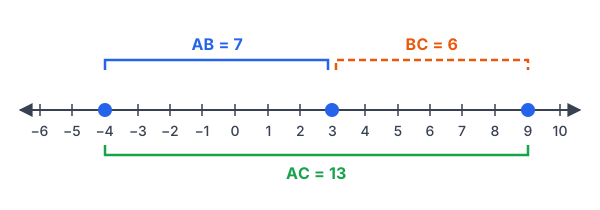
For A at -4, B at 3 and C at 9:
AB = |3 - (-4)| = |7| = 7
BC = |9 - 3| = |6| = 6
AC = |9 - (-4)| = |13| = 13
And 7 + 6 = 13, so AB + BC = AC. Subtracting a negative is the same as adding (see adding and subtracting integers).
More than one point between
The postulate works for more pieces too. If A, B, C and D are on a line in that order, then AB + BC + CD = AD. You will use this idea again with the midpoint formula and the distance formula later in this unit.
Practice Problems
- Point B is between A and C. AB = 9 and BC = 14. Find AC.
- Point B is between A and C. AC = 41 and BC = 17. Find AB.
- Point Q is between P and R. PQ = x + 4, QR = 2x and PR = 25. Find x, PQ and QR.
- Point K is between J and L. JK = 3x - 2, KL = 5x + 6 and JL = 52. Find JK and KL.
- On a number line, D is at -7 and E is at 2. Find DE.
- On a number line, R is at -5, S is at 1 and T is at 10. Find RS, ST and RT, and show that RS + ST = RT.
- Point M is between L and N, and \overline{LM} \cong \overline{MN}. LM = 4x + 1 and MN = 6x - 7. Find LN.
- Point B is between A and C. AB = 2x + 5, BC = 3x - 4 and AC = 7x - 15. Find AB, BC and AC.
- Points A, B, C and D are on a line in that order. AB = 6, BC = 10 and AD = 25. Find CD.
- A 120 cm board is cut into two pieces. One piece is 18 cm longer than the other. How long is each piece?
Show answers
- Write the postulate: AB + BC = AC. Put in the lengths: 9 + 14 = AC. Add: AC = 23. So AC = 23.
- Write the postulate: AB + BC = AC. Put in the lengths: AB + 17 = 41. Subtract 17 from both sides: AB = 41 - 17. Subtract: AB = 24. Check: 24 + 17 = 41.
- Write the postulate: (x + 4) + 2x = 25. Combine like terms: 3x + 4 = 25. Subtract 4 from both sides: 3x = 21. Divide both sides by 3: x = 7. Find PQ: PQ = 7 + 4 = 11. Find QR: QR = 2(7) = 14. Check: 11 + 14 = 25. So x = 7, PQ = 11 and QR = 14.
- Write the postulate: (3x - 2) + (5x + 6) = 52. Combine like terms: 8x + 4 = 52. Subtract 4 from both sides: 8x = 48. Divide both sides by 8: x = 6. Find JK: JK = 3(6) - 2 = 18 - 2 = 16. Find KL: KL = 5(6) + 6 = 30 + 6 = 36. Check: 16 + 36 = 52. So JK = 16 and KL = 36.
- Subtract the numbers: DE = |2 - (-7)|. Subtracting a negative means adding: DE = |2 + 7|. Add: DE = |9| = 9. So DE = 9.
- Find RS: RS = |1 - (-5)| = |6| = 6. Find ST: ST = |10 - 1| = |9| = 9. Find RT: RT = |10 - (-5)| = |15| = 15. Add the parts: 6 + 9 = 15. The parts add up to RT, so RS + ST = RT.
- Congruent segments have equal lengths: 4x + 1 = 6x - 7. Subtract 4x from both sides: 1 = 2x - 7. Add 7 to both sides: 8 = 2x. Divide both sides by 2: x = 4. Find LM: LM = 4(4) + 1 = 17. Find MN: MN = 6(4) - 7 = 24 - 7 = 17. Add the parts: LN = 17 + 17 = 34. So LN = 34.
- Write the postulate: (2x + 5) + (3x - 4) = 7x - 15. Combine like terms: 5x + 1 = 7x - 15. Subtract 5x from both sides: 1 = 2x - 15. Add 15 to both sides: 16 = 2x. Divide both sides by 2: x = 8. Find AB: AB = 2(8) + 5 = 21. Find BC: BC = 3(8) - 4 = 20. Find AC: AC = 7(8) - 15 = 56 - 15 = 41. Check: 21 + 20 = 41. So AB = 21, BC = 20 and AC = 41.
- Write the postulate for four points: AB + BC + CD = AD. Put in the lengths: 6 + 10 + CD = 25. Add 6 and 10: 16 + CD = 25. Subtract 16 from both sides: CD = 9. So CD = 9.
- Let the short piece be x. The long piece is x + 18. Write part + part = whole: x + (x + 18) = 120. Combine like terms: 2x + 18 = 120. Subtract 18 from both sides: 2x = 102. Divide both sides by 2: x = 51. Find the long piece: 51 + 18 = 69. Check: 51 + 69 = 120. The pieces are 51 cm and 69 cm.
FAQ
What is the segment addition postulate in simple terms?
If a point sits between the two ends of a segment, the two pieces add up to the whole. In symbols, AB + BC = AC.
Why is it a postulate and not a theorem?
A postulate is a rule we accept without proof. A theorem is proved from postulates. Segment addition is one of the starting rules that later proofs use.
How do you know which point is in the middle?
Use the drawing or the words “between” or “in that order.” The middle point is the letter that appears in both parts, like B in AB + BC = AC.
What is the difference between AB and segment AB?
\overline{AB} with a bar is the segment itself, a set of points. AB with no bar is its length, a number.
Summary
- If B is between A and C, then AB + BC = AC.
- Write part + part = whole, solve, then put x back in to find each length.
- Congruent segments have equal lengths, so you can set their expressions equal.
- On a number line, a length is the absolute value of the difference: AB = |a - b|.
- Lengths are never negative. Always check that the parts add up to the whole.
Previous lesson: Points, Lines and Planes
Next lesson: Midpoint Formula
Back to the Geometry Index