
Midpoint Formula
The midpoint formula finds the point exactly halfway between two points. For endpoints (x_1, y_1) and (x_2, y_2), the midpoint is \left(\frac{x_1 + x_2}{2}, \frac{y_1 + y_2}{2}\right). In words, average the x-coordinates and average the y-coordinates.
Before this lesson: You should know the Coordinate Plane and the Segment Addition Postulate.
What Is a Midpoint?
The midpoint of a segment is the point that splits it into two equal parts. If M is the midpoint of \overline{AB}, then AM = MB. Each half is half of the whole.
Think of two friends who want to meet halfway. One lives at 2nd Street and the other at 8th Street. They meet at 5th Street. That is the average of 2 and 8. The midpoint formula does the same thing, once for x and once for y.
A line, ray or segment that passes through the midpoint is called a segment bisector. It cuts the segment into two congruent halves.
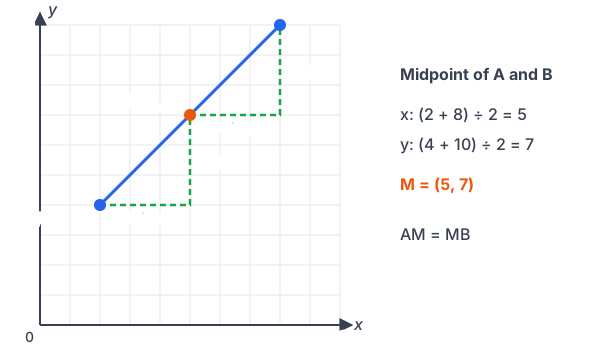
The Midpoint Formula
M = \left(\frac{x_1 + x_2}{2}, \frac{y_1 + y_2}{2}\right)Add the two x-coordinates and divide by 2. Then add the two y-coordinates and divide by 2. That is the average of each pair.
On a number line, there is only one coordinate. The midpoint of a and b is \frac{a + b}{2}.
Steps to find a midpoint
- Label the points (x_1, y_1) and (x_2, y_2). Either point can be first.
- Add the x-coordinates. Divide by 2.
- Add the y-coordinates. Divide by 2.
- Write the answer as an ordered pair.
- Check: the midpoint should sit between the two points on a graph.
Worked Examples
Example 1: Two positive points
Find the midpoint of A(2, 4) and B(8, 10).
Step 1: Label the points: x_1 = 2, y_1 = 4, x_2 = 8, y_2 = 10.
Step 2: Add the x-coordinates.
2 + 8 = 10
Step 3: Divide by 2.
10 \div 2 = 5
Step 4: Add the y-coordinates.
4 + 10 = 14
Step 5: Divide by 2.
14 \div 2 = 7
Step 6: Write the ordered pair.
M = (5, 7)
The midpoint is (5, 7). The graph above shows it.
Example 2: Negative coordinates
Find the midpoint of P(-3, 5) and Q(7, -1).
Step 1: Add the x-coordinates (see adding and subtracting integers).
-3 + 7 = 4
Step 2: Divide by 2.
4 \div 2 = 2
Step 3: Add the y-coordinates.
5 + (-1) = 4
Step 4: Divide by 2.
4 \div 2 = 2
Step 5: Write the ordered pair.
M = (2, 2)
The midpoint is (2, 2).
Example 3: A fraction answer
Find the midpoint of C(1, -4) and D(6, 3).
Step 1: Add the x-coordinates.
1 + 6 = 7
Step 2: Divide by 2. 7 is odd, so leave it as a fraction (see improper fractions).
7 \div 2 = \frac{7}{2}Step 3: Add the y-coordinates.
-4 + 3 = -1
Step 4: Divide by 2.
-1 \div 2 = -\frac{1}{2}Step 5: Write the ordered pair.
M = \left(\frac{7}{2}, -\frac{1}{2}\right)The midpoint is \left(\frac{7}{2}, -\frac{1}{2}\right), which is (3.5, -0.5) as decimals.
Example 4: Find a missing endpoint
The midpoint of \overline{AB} is M(4, -1). One endpoint is A(1, 3). Find B.
Step 1: Call the missing endpoint B(x, y). Use the formula for the x-coordinate.
\frac{1 + x}{2} = 4Step 2: Multiply both sides by 2 (see two-step equations).
1 + x = 8
Step 3: Subtract 1 from both sides.
x = 7
Step 4: Use the formula for the y-coordinate.
\frac{3 + y}{2} = -1Step 5: Multiply both sides by 2.
3 + y = -2
Step 6: Subtract 3 from both sides.
y = -5
Step 7: Write the endpoint.
B = (7, -5)
Step 8: Check: find the midpoint of (1, 3) and (7, -5).
\left(\frac{1 + 7}{2}, \frac{3 + (-5)}{2}\right) = \left(\frac{8}{2}, \frac{-2}{2}\right) = (4, -1)So B = (7, -5).
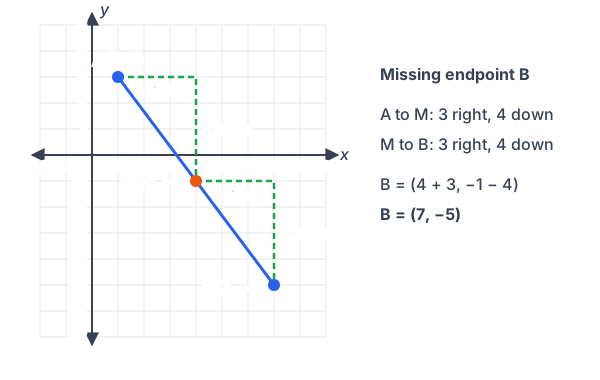
The picture shows a shortcut. From A to M you move 3 right and 4 down. Make the same move from M and you land on B.
Example 5: Word problem
On a town map, each unit is one block. Maya’s house is at (-2, 6) and Leo’s house is at (10, 2). They want to meet exactly halfway. Where should they meet?
Step 1: Add the x-coordinates.
-2 + 10 = 8
Step 2: Divide by 2.
8 \div 2 = 4
Step 3: Add the y-coordinates.
6 + 2 = 8
Step 4: Divide by 2.
8 \div 2 = 4
Step 5: Write the ordered pair.
M = (4, 4)
They should meet at (4, 4) on the map.
Common Mistakes
| Mistake | Example of the error | Fix |
|---|---|---|
| Subtracting instead of adding | Using \frac{8 - 2}{2} = 3 for (2, 4) and (8, 10) | The midpoint uses a sum: \frac{2 + 8}{2} = 5. Subtracting is for slope and distance. |
| Mixing x and y | Adding x_1 + y_1 | Add the two x-coordinates together, then the two y-coordinates together. |
| Forgetting to divide by 2 | Answering (10, 14) in Example 1 | The sum is twice the midpoint. Divide each sum by 2. |
| Sign errors | Writing -3 + 7 = -4 | -3 + 7 = 4. Use the integer rules carefully. |
| Using the midpoint as an endpoint | Averaging A(1, 3) and M(4, -1) to find B | Set the formula equal to M and solve for the missing endpoint. |
Midpoints on a Number Line and with Algebra
On a number line, the midpoint of -6 and 10 is \frac{-6 + 10}{2} = \frac{4}{2} = 2. Each half is 8 units long.
Sometimes the lengths are given as expressions. If M is the midpoint of \overline{AB}, set the two halves equal. For example, say AM = 3x + 2 and MB = 5x - 6.
\begin{aligned} 3x + 2 &= 5x - 6 && \text{set the halves equal} \\ 2 &= 2x - 6 && \text{subtract } 3x \\ 8 &= 2x && \text{add 6} \\ x &= 4 && \text{divide by 2} \end{aligned}Then AM = 3(4) + 2 = 14 and MB = 5(4) - 6 = 14. By the segment addition postulate, AB = 14 + 14 = 28.
The midpoint formula is close to the slope formula, but it adds and does not subtract. Both use the same two points. The next lessons use them again for lengths and ratios.
Practice Problems
- Find the midpoint of (0, 0) and (6, 8).
- Find the midpoint of (3, 7) and (9, 1).
- Find the midpoint of (-4, -2) and (2, -8).
- Find the midpoint of (-5, 3) and (-1, 3).
- Find the midpoint of (2, 5) and (7, -2).
- On a number line, find the midpoint of -9 and 5.
- The midpoint of \overline{AB} is M(5, 1). One endpoint is A(2, 6). Find B.
- The midpoint of \overline{PQ} is M(1, 0). One endpoint is P(-3, 4). Find Q.
- M is the midpoint of \overline{AB}. AM = 2x + 7 and MB = 4x - 3. Find AM and AB.
- On a park map, the fountain is at (-6, 1) and the gate is at (4, 9). A bench goes exactly halfway between them. Where is the bench?
Show answers
- Add the x-coordinates: 0 + 6 = 6. Divide by 2: 6 \div 2 = 3. Add the y-coordinates: 0 + 8 = 8. Divide by 2: 8 \div 2 = 4. The midpoint is (3, 4).
- Add the x-coordinates: 3 + 9 = 12. Divide by 2: 12 \div 2 = 6. Add the y-coordinates: 7 + 1 = 8. Divide by 2: 8 \div 2 = 4. The midpoint is (6, 4).
- Add the x-coordinates: -4 + 2 = -2. Divide by 2: -2 \div 2 = -1. Add the y-coordinates: -2 + (-8) = -10. Divide by 2: -10 \div 2 = -5. The midpoint is (-1, -5).
- Add the x-coordinates: -5 + (-1) = -6. Divide by 2: -6 \div 2 = -3. Add the y-coordinates: 3 + 3 = 6. Divide by 2: 6 \div 2 = 3. The midpoint is (-3, 3).
- Add the x-coordinates: 2 + 7 = 9. Divide by 2: 9 \div 2 = \frac{9}{2}. Add the y-coordinates: 5 + (-2) = 3. Divide by 2: 3 \div 2 = \frac{3}{2}. The midpoint is \left(\frac{9}{2}, \frac{3}{2}\right).
- Add the two numbers: -9 + 5 = -4. Divide by 2: -4 \div 2 = -2. The midpoint is -2.
- Set up the x-coordinate: \frac{2 + x}{2} = 5. Multiply both sides by 2: 2 + x = 10. Subtract 2: x = 8. Set up the y-coordinate: \frac{6 + y}{2} = 1. Multiply both sides by 2: 6 + y = 2. Subtract 6: y = -4. So B = (8, -4). Check: \left(\frac{2 + 8}{2}, \frac{6 + (-4)}{2}\right) = (5, 1).
- Set up the x-coordinate: \frac{-3 + x}{2} = 1. Multiply both sides by 2: -3 + x = 2. Add 3: x = 5. Set up the y-coordinate: \frac{4 + y}{2} = 0. Multiply both sides by 2: 4 + y = 0. Subtract 4: y = -4. So Q = (5, -4). Check: \left(\frac{-3 + 5}{2}, \frac{4 + (-4)}{2}\right) = (1, 0).
- The halves are equal: 2x + 7 = 4x - 3. Subtract 2x from both sides: 7 = 2x - 3. Add 3 to both sides: 10 = 2x. Divide both sides by 2: x = 5. Find AM: AM = 2(5) + 7 = 17. Find MB: MB = 4(5) - 3 = 17. Add the halves: AB = 17 + 17 = 34. So AM = 17 and AB = 34.
- Add the x-coordinates: -6 + 4 = -2. Divide by 2: -2 \div 2 = -1. Add the y-coordinates: 1 + 9 = 10. Divide by 2: 10 \div 2 = 5. The midpoint is (-1, 5).
FAQ
What is the midpoint formula?
It is M = \left(\frac{x_1 + x_2}{2}, \frac{y_1 + y_2}{2}\right). It gives the point halfway between two points.
Does it matter which point is first?
No. Addition works in any order, so you get the same midpoint either way.
How do you find an endpoint from the midpoint?
Set each part of the formula equal to the midpoint’s coordinate and solve. Or use the shortcut: the move from the first endpoint to the midpoint, done again, reaches the other endpoint.
Can a midpoint have fractions?
Yes. If a sum is odd, the coordinate is a half, like \frac{7}{2}. Leave it as a fraction or write it as a decimal, 3.5.
Summary
- The midpoint splits a segment into two equal halves: AM = MB.
- Midpoint formula: M = \left(\frac{x_1 + x_2}{2}, \frac{y_1 + y_2}{2}\right). Average the x’s and average the y’s.
- On a number line, the midpoint of a and b is \frac{a + b}{2}.
- To find a missing endpoint, set the formula equal to the midpoint and solve, or repeat the move from the endpoint to the midpoint.
- The midpoint formula adds. The slope and distance formulas subtract.
Previous lesson: Segment Addition Postulate
Next lesson: Distance Formula
Back to the Geometry Index