
Partitioning a Line Segment
Partitioning a line segment means finding the point that splits a segment into two parts with a given ratio. To split \overline{AB} in the ratio a:b from A, find the fraction k = \frac{a}{a + b}. Then move that fraction of the way from A to B.
Before this lesson: You should know the Midpoint Formula, Ratios and Slope.
What Does It Mean to Partition a Segment?
A midpoint splits a segment into two equal parts. That is the ratio 1:1. But you can split a segment in other ratios too.
Say point P splits \overline{AB} in the ratio 1:3. Then AP is 1 part and PB is 3 parts. The whole segment is 1 + 3 = 4 parts. So P is \frac{1}{4} of the way from A to B.
A segment with a starting point and an ending point is called a directed segment. The order matters. The ratio 1:3 from A lands near A. From B, it lands near B.
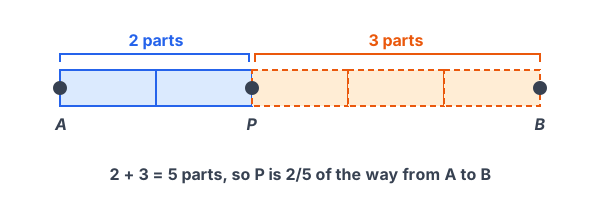
Partitioning a Line Segment Formula
To split the segment from A(x_1, y_1) to B(x_2, y_2) in the ratio a:b, first find k.
k = \frac{a}{a + b}Then move k of the run and k of the rise from A.
P = \big(x_1 + k(x_2 - x_1),\ y_1 + k(y_2 - y_1)\big)
The run is x_2 - x_1 and the rise is y_2 - y_1, the same parts you use for slope.
Steps to partition a segment
- Find the total number of parts: a + b.
- Find the fraction k = \frac{a}{a + b}.
- Find the run, x_2 - x_1, and the rise, y_2 - y_1.
- Multiply the run and the rise by k.
- Add the results to the coordinates of A.
- Check: P should sit on the segment, closer to A when a is less than b.
Worked Examples
Example 1: Ratio 2:3
Find the point P that partitions \overline{AB} in the ratio 2:3, with A(0, 0) and B(10, 5).
Step 1: Find the total number of parts.
2 + 3 = 5
Step 2: Find the fraction.
k = \frac{2}{5}Step 3: Find the run.
10 - 0 = 10
Step 4: Find the rise.
5 - 0 = 5
Step 5: Multiply the run by k (see multiplying fractions).
\frac{2}{5} \cdot 10 = 4Step 6: Multiply the rise by k.
\frac{2}{5} \cdot 5 = 2Step 7: Add to the coordinates of A.
P = (0 + 4,\ 0 + 2) = (4, 2)
So P = (4, 2).
Example 2: Ratio 1:3
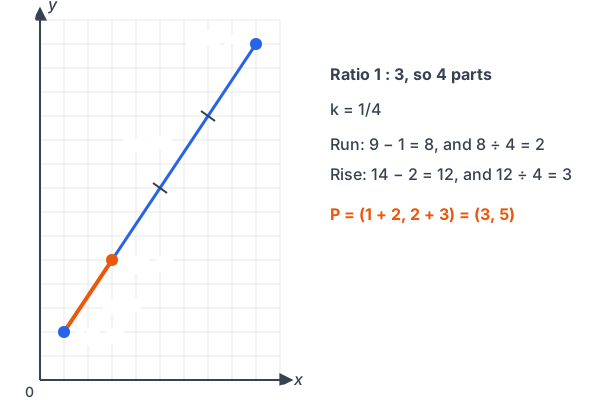
Find the point P that partitions \overline{AB} in the ratio 1:3, with A(1, 2) and B(9, 14).
Step 1: Find the total number of parts.
1 + 3 = 4
Step 2: Find the fraction.
k = \frac{1}{4}Step 3: Find the run.
9 - 1 = 8
Step 4: Find the rise.
14 - 2 = 12
Step 5: Multiply the run by k.
\frac{1}{4} \cdot 8 = 2Step 6: Multiply the rise by k.
\frac{1}{4} \cdot 12 = 3Step 7: Add to the coordinates of A.
P = (1 + 2,\ 2 + 3) = (3, 5)
So P = (3, 5). The graph below shows P one quarter of the way from A.
Example 3: Negative coordinates
Find the point P that partitions \overline{AB} in the ratio 2:1, with A(-4, 6) and B(5, -3).
Step 1: Find the total number of parts.
2 + 1 = 3
Step 2: Find the fraction.
k = \frac{2}{3}Step 3: Find the run. Subtracting a negative means adding (see adding and subtracting integers).
5 - (-4) = 9
Step 4: Find the rise.
-3 - 6 = -9
Step 5: Multiply the run by k.
\frac{2}{3} \cdot 9 = 6Step 6: Multiply the rise by k.
\frac{2}{3} \cdot (-9) = -6Step 7: Add to the coordinates of A.
P = (-4 + 6,\ 6 + (-6)) = (2, 0)
So P = (2, 0). It is closer to B, because the first part is the bigger one.
Example 4: A fraction answer
Find the point P that partitions \overline{AB} in the ratio 3:2, with A(2, -1) and B(7, 3).
Step 1: Find the total number of parts.
3 + 2 = 5
Step 2: Find the fraction.
k = \frac{3}{5}Step 3: Find the run.
7 - 2 = 5
Step 4: Find the rise.
3 - (-1) = 4
Step 5: Multiply the run by k.
\frac{3}{5} \cdot 5 = 3Step 6: Multiply the rise by k.
\frac{3}{5} \cdot 4 = \frac{12}{5}Step 7: Add the x-values.
2 + 3 = 5
Step 8: Add the y-values. Write -1 as -\frac{5}{5} (see adding and subtracting fractions).
-\frac{5}{5} + \frac{12}{5} = \frac{7}{5}Step 9: Write the point.
P = \left(5, \frac{7}{5}\right)So P = \left(5, \frac{7}{5}\right), or (5, 1.4).
Example 5: Word problem
A hiking trail runs straight from a parking lot at (-2, 1) to a lookout at (10, 9) on a map. Each unit is 1 kilometer. A rest stop sits \frac{3}{4} of the way from the parking lot to the lookout. Where is it?
Step 1: The fraction is given, so k = \frac{3}{4}. (This is the ratio 3:1.)
Step 2: Find the run.
10 - (-2) = 12
Step 3: Find the rise.
9 - 1 = 8
Step 4: Multiply the run by k.
\frac{3}{4} \cdot 12 = 9Step 5: Multiply the rise by k.
\frac{3}{4} \cdot 8 = 6Step 6: Add to the parking lot’s coordinates.
P = (-2 + 9,\ 1 + 6) = (7, 7)
The rest stop is at (7, 7) on the map.
Common Mistakes
| Mistake | Example of the error | Fix |
|---|---|---|
| Using \frac{a}{b} as the fraction | Ratio 2:3 gives k = \frac{2}{3} | Divide by the total parts: k = \frac{2}{2 + 3} = \frac{2}{5}. |
| Starting from the wrong end | Moving \frac{1}{4} of the way from B when the ratio is from A | Start at the first point named. “From A to B” means start at A. |
| Forgetting to add A‘s coordinates | Answering (2, 3) in Example 2 | That is only the move. Add it to A(1, 2) to get (3, 5). |
| Multiplying the coordinates instead of the run and rise | Using \frac{1}{4} \cdot 9 for B(9, 14) | Multiply the run, 9 - 1 = 8, not the coordinate 9. |
| Sign errors in the rise | Writing -3 - 6 = 3 | -3 - 6 = -9. A negative rise means P is lower than A. |
Partitioning on a Number Line and the Midpoint
On a number line, use the same idea with one coordinate. To split the segment from -3 to 12 in the ratio 1:2:
k = \frac{1}{1 + 2} = \frac{1}{3}12 - (-3) = 15
\frac{1}{3} \cdot 15 = 5-3 + 5 = 2
The point is at 2. It is 5 units from -3 and 10 units from 12, and 5:10 = 1:2.
The ratio 1:1 gives k = \frac{1}{2}, which is the midpoint. So the midpoint formula is a special case of partitioning. You can also check a partition point with the distance formula: the two parts should have lengths in the ratio a:b.
Practice Problems
- Partition \overline{AB} in the ratio 1:2 with A(0, 0) and B(6, 9).
- Partition \overline{AB} in the ratio 2:3 with A(2, 1) and B(12, 6).
- Partition \overline{AB} in the ratio 3:1 with A(-5, -2) and B(3, 10).
- Partition \overline{AB} in the ratio 1:2 with A(4, 7) and B(-2, -2).
- On a number line, find the point that splits the segment from -8 to 16 in the ratio 3:5.
- Partition \overline{AB} in the ratio 1:3 with A(1, -3) and B(9, 1).
- Partition \overline{AB} in the ratio 2:3 with A(-1, 2) and B(4, 4).
- Partition \overline{AB} in the ratio 1:1 with A(-6, 4) and B(2, -8). What is another name for this point?
- Point P(2, 1) partitions \overline{AB} in the ratio 1:3. If A is (0, 0), find B.
- A straight road runs from town A(-3, -4) to town B(9, 12) on a map. A gas station is \frac{1}{4} of the way from A to B. Where is it?
Show answers
- Total parts: 1 + 2 = 3. Fraction: k = \frac{1}{3}. Run: 6 - 0 = 6. Rise: 9 - 0 = 9. Multiply the run: \frac{1}{3} \cdot 6 = 2. Multiply the rise: \frac{1}{3} \cdot 9 = 3. Add to A: (0 + 2,\ 0 + 3) = (2, 3). So P = (2, 3).
- Total parts: 2 + 3 = 5. Fraction: k = \frac{2}{5}. Run: 12 - 2 = 10. Rise: 6 - 1 = 5. Multiply the run: \frac{2}{5} \cdot 10 = 4. Multiply the rise: \frac{2}{5} \cdot 5 = 2. Add to A: (2 + 4,\ 1 + 2) = (6, 3). So P = (6, 3).
- Total parts: 3 + 1 = 4. Fraction: k = \frac{3}{4}. Run: 3 - (-5) = 8. Rise: 10 - (-2) = 12. Multiply the run: \frac{3}{4} \cdot 8 = 6. Multiply the rise: \frac{3}{4} \cdot 12 = 9. Add to A: (-5 + 6,\ -2 + 9) = (1, 7). So P = (1, 7).
- Total parts: 1 + 2 = 3. Fraction: k = \frac{1}{3}. Run: -2 - 4 = -6. Rise: -2 - 7 = -9. Multiply the run: \frac{1}{3} \cdot (-6) = -2. Multiply the rise: \frac{1}{3} \cdot (-9) = -3. Add to A: (4 + (-2),\ 7 + (-3)) = (2, 4). So P = (2, 4).
- Total parts: 3 + 5 = 8. Fraction: k = \frac{3}{8}. Length: 16 - (-8) = 24. Multiply: \frac{3}{8} \cdot 24 = 9. Add to the start: -8 + 9 = 1. The point is at 1.
- Total parts: 1 + 3 = 4. Fraction: k = \frac{1}{4}. Run: 9 - 1 = 8. Rise: 1 - (-3) = 4. Multiply the run: \frac{1}{4} \cdot 8 = 2. Multiply the rise: \frac{1}{4} \cdot 4 = 1. Add to A: (1 + 2,\ -3 + 1) = (3, -2). So P = (3, -2).
- Total parts: 2 + 3 = 5. Fraction: k = \frac{2}{5}. Run: 4 - (-1) = 5. Rise: 4 - 2 = 2. Multiply the run: \frac{2}{5} \cdot 5 = 2. Multiply the rise: \frac{2}{5} \cdot 2 = \frac{4}{5}. Add the x-values: -1 + 2 = 1. Add the y-values: \frac{10}{5} + \frac{4}{5} = \frac{14}{5}. So P = \left(1, \frac{14}{5}\right).
- Total parts: 1 + 1 = 2. Fraction: k = \frac{1}{2}. Run: 2 - (-6) = 8. Rise: -8 - 4 = -12. Multiply the run: \frac{1}{2} \cdot 8 = 4. Multiply the rise: \frac{1}{2} \cdot (-12) = -6. Add to A: (-6 + 4,\ 4 + (-6)) = (-2, -2). So P = (-2, -2). This point is the midpoint of \overline{AB}.
- The fraction is: k = \frac{1}{1 + 3} = \frac{1}{4}. The move from A to P is: (2 - 0,\ 1 - 0) = (2, 1). That move is one quarter of the run and rise, so multiply it by 4: (4 \cdot 2,\ 4 \cdot 1) = (8, 4). Add to A: B = (0 + 8,\ 0 + 4) = (8, 4). So B = (8, 4). Check: \frac{1}{4} \cdot 8 = 2 and \frac{1}{4} \cdot 4 = 1.
- Fraction: k = \frac{1}{4}. Run: 9 - (-3) = 12. Rise: 12 - (-4) = 16. Multiply the run: \frac{1}{4} \cdot 12 = 3. Multiply the rise: \frac{1}{4} \cdot 16 = 4. Add to A: (-3 + 3,\ -4 + 4) = (0, 0). The gas station is at (0, 0).
FAQ
What does it mean to partition a line segment?
It means finding the point that splits the segment into two parts with a given ratio, like 2:3.
Why is the fraction a over a + b and not a over b?
The ratio a:b compares the two parts to each other. To find how far along the whole segment to go, compare the first part to all the parts: \frac{a}{a + b}.
Does the order of the points matter?
Yes. Splitting from A to B in the ratio 1:3 lands near A. Splitting from B to A lands near B.
How is this related to the midpoint formula?
The midpoint is the partition with ratio 1:1. Then k = \frac{1}{2}, and the formula gives the average of the coordinates.
Summary
- To split \overline{AB} in the ratio a:b from A, use k = \frac{a}{a + b}.
- Move k of the run and k of the rise from A: P = \big(x_1 + k(x_2 - x_1),\ y_1 + k(y_2 - y_1)\big).
- The order of the points matters. Always start at the first point named.
- The ratio 1:1 gives the midpoint.
- Check that the point sits on the segment, on the correct side.
Previous lesson: Distance Formula
Next lesson: Measuring and Classifying Angles
Back to the Geometry Index