
Measuring and Classifying Angles
Measuring and classifying angles means finding an angle’s size in degrees and naming its type. An angle less than 90^\circ is acute, exactly 90^\circ is right, between 90^\circ and 180^\circ is obtuse, and exactly 180^\circ is straight. You measure angles with a protractor.
Before this lesson: You should know Points, Lines and Planes (rays) and the Segment Addition Postulate.
What Is an Angle?
An angle is made of two rays that share an endpoint. The shared endpoint is the vertex. The two rays are the sides of the angle.
Think of a door opening. The hinge is the vertex. The wall and the door are the sides. The wider the door opens, the bigger the angle.
How to name an angle
- Use three points, with the vertex in the middle: \angle ABC or \angle CBA.
- Use the vertex alone, if only one angle is at that point: \angle B.
- Use a number written inside the angle: \angle 1.
The measure of \angle ABC is written m\angle ABC. If it is 40 degrees, write m\angle ABC = 40^\circ. Angles with the same measure are congruent angles, written \angle A \cong \angle B. Matching arcs mark them on a drawing.
Types of Angles
| Type | Measure | Picture it |
|---|---|---|
| Acute | More than 0^\circ and less than 90^\circ | A slice of pizza |
| Right | Exactly 90^\circ | The corner of a sheet of paper |
| Obtuse | More than 90^\circ and less than 180^\circ | A reclining chair |
| Straight | Exactly 180^\circ | A flat line through the vertex |
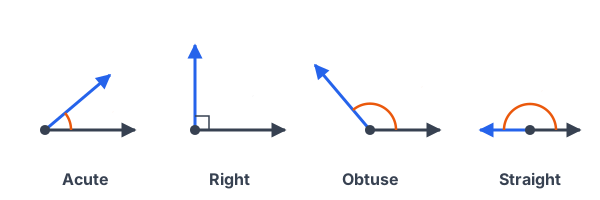
A small square at the vertex means the angle is exactly 90^\circ. You don’t need to see a number.
Measuring Angles and the Angle Addition Postulate
A protractor has two scales, from 0 to 180 in each direction. Put its center on the vertex. Line up one side with 0 on one scale. Read the other side on that same scale.
This is the protractor postulate: if the sides of an angle cross the scale at a and b, the angle measures |a - b| degrees. It works like the ruler postulate for segments.
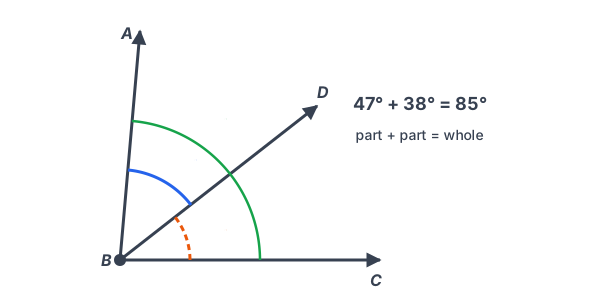
The angle addition postulate says that if point D is in the interior of \angle ABC, then:
m\angle ABD + m\angle DBC = m\angle ABC
It is the same idea as the segment addition postulate: part + part = whole.
Steps to measure and classify an angle
- Put the protractor’s center on the vertex.
- Line up one side with 0 on a scale.
- Read where the other side crosses that scale. (Or subtract the two readings.)
- Compare the measure with 90^\circ and 180^\circ to name the type.
Worked Examples
Example 1: Classify angles
Classify angles that measure 35^\circ, 90^\circ, 128^\circ and 180^\circ.
Step 1: 35^\circ is less than 90^\circ, so it is acute.
Step 2: 90^\circ is exactly a right angle.
Step 3: 128^\circ is between 90^\circ and 180^\circ, so it is obtuse.
Step 4: 180^\circ is a straight angle.
Example 2: Read a protractor
On a protractor, ray OA crosses the scale at 20^\circ and ray OB crosses the same scale at 105^\circ. Find m\angle AOB and classify it.
Step 1: Use the protractor postulate. Subtract the readings.
m\angle AOB = |105 - 20|
Step 2: Subtract.
m\angle AOB = 85^\circ
Step 3: Compare with 90^\circ. 85 is less than 90.
So m\angle AOB = 85^\circ, an acute angle.
Example 3: Add two angles
Point D is in the interior of \angle ABC. m\angle ABD = 47^\circ and m\angle DBC = 38^\circ. Find m\angle ABC.
Step 1: Write the angle addition postulate.
m\angle ABD + m\angle DBC = m\angle ABC
Step 2: Put in the measures.
47^\circ + 38^\circ = m\angle ABC
Step 3: Add.
85^\circ = m\angle ABC
So m\angle ABC = 85^\circ. The picture above shows this angle.
Example 4: Solve for x
Point D is in the interior of \angle ABC. m\angle ABD = (3x + 5)^\circ, m\angle DBC = (2x - 10)^\circ and m\angle ABC = 120^\circ. Find x and both angle measures.
Step 1: Write the angle addition postulate.
(3x + 5) + (2x - 10) = 120
Step 2: Combine like terms: 3x + 2x = 5x and 5 - 10 = -5 (see combining like terms).
5x - 5 = 120
Step 3: Add 5 to both sides.
5x = 125
Step 4: Divide both sides by 5.
x = 25
Step 5: Find m\angle ABD.
3(25) + 5 = 75 + 5 = 80
Step 6: Find m\angle DBC.
2(25) - 10 = 50 - 10 = 40
Step 7: Check: the parts add up to the whole.
80 + 40 = 120
So x = 25, m\angle ABD = 80^\circ and m\angle DBC = 40^\circ. Both parts are acute, and the whole angle is obtuse.
Example 5: Word problem
Two streets meet at a corner that makes a 140^\circ angle. A straight bike path starts at the corner and splits the angle into two parts. One part is 26^\circ more than the other. Find both angles.
Step 1: Let the smaller angle be x degrees. The larger angle is x + 26.
Step 2: Write part + part = whole.
x + (x + 26) = 140
Step 3: Combine like terms.
2x + 26 = 140
Step 4: Subtract 26 from both sides.
2x = 114
Step 5: Divide both sides by 2.
x = 57
Step 6: Find the larger angle.
57 + 26 = 83
Step 7: Check: the parts add up to the whole.
57 + 83 = 140
The angles are 57^\circ and 83^\circ. Both are acute.
Common Mistakes
| Mistake | Example of the error | Fix |
|---|---|---|
| Reading the wrong scale | Reading 95^\circ for an angle that is clearly acute | Start from the 0 that one side lines up with, and use that scale. Check: does the answer match the look of the angle? |
| Putting the vertex in the wrong place in the name | Calling the angle at B \angle BAC | The vertex goes in the middle: \angle ABC. |
| Using \angle B when several angles share B | Writing \angle B when \angle ABD, \angle DBC and \angle ABC all have vertex B | Use three letters so the reader knows which angle you mean. |
| Stopping at x | Answering x = 25 in Example 4 | Put x back in to find each angle: 80^\circ and 40^\circ. |
| Calling 90^\circ obtuse or acute | Saying a right angle is acute | Exactly 90^\circ is right. Acute is less, and obtuse is more. |
Angle Bisectors
An angle bisector is a ray that splits an angle into two congruent angles. It does for angles what a midpoint does for segments.
Say \overrightarrow{BD} bisects \angle ABC, with m\angle ABD = (4x - 6)^\circ and m\angle DBC = (2x + 18)^\circ. The two halves are equal.
\begin{aligned} 4x - 6 &= 2x + 18 && \text{the halves are equal} \\ 2x - 6 &= 18 && \text{subtract } 2x \\ 2x &= 24 && \text{add 6} \\ x &= 12 && \text{divide by 2} \end{aligned}Each half is 4(12) - 6 = 42^\circ, so m\angle ABC = 42^\circ + 42^\circ = 84^\circ. To review solving equations like this, see equations with variables on both sides.
Practice Problems
- Classify angles that measure 72^\circ, 90^\circ, 145^\circ and 180^\circ.
- On a protractor, one side of an angle crosses the scale at 30^\circ and the other at 115^\circ. Find the measure and classify the angle.
- On a protractor, one side crosses the scale at 160^\circ and the other at 45^\circ. Find the measure and classify the angle.
- Point S is in the interior of \angle PQR. m\angle PQS = 28^\circ and m\angle SQR = 54^\circ. Find m\angle PQR.
- Point D is in the interior of \angle ABC. m\angle ABC = 150^\circ and m\angle ABD = 65^\circ. Find m\angle DBC.
- Point D is in the interior of \angle ABC. m\angle ABD = (2x + 7)^\circ, m\angle DBC = (3x - 2)^\circ and m\angle ABC = 95^\circ. Find both angles.
- \overrightarrow{BD} bisects \angle ABC. m\angle ABD = (5x - 8)^\circ and m\angle DBC = (3x + 12)^\circ. Find m\angle ABC.
- \angle ABC is a straight angle, and D is in its interior. m\angle ABD = (4x + 10)^\circ and m\angle DBC = (2x + 20)^\circ. Find both angles and classify them.
- The hands of a clock turn 30^\circ for each hour mark. What angle do the hands make at 5:00? Classify it.
- A right angle is split into two angles. The larger one is twice the smaller one. Find both angles.
Show answers
- 72° is less than 90°, so it is acute. 90° is right. 145° is between 90° and 180°, so it is obtuse. 180° is straight.
- Subtract the readings: |115 - 30| = 85. The angle is 85^\circ, so it is acute.
- Subtract the readings: |45 - 160| = |-115| = 115. The angle is 115^\circ, so it is obtuse.
- Write the postulate: m\angle PQS + m\angle SQR = m\angle PQR. Put in the measures: 28 + 54 = m\angle PQR. Add: m\angle PQR = 82^\circ. So m\angle PQR = 82^\circ.
- Write the postulate: 65 + m\angle DBC = 150. Subtract 65 from both sides: m\angle DBC = 150 - 65. Subtract: m\angle DBC = 85^\circ. So m\angle DBC = 85^\circ.
- Write the postulate: (2x + 7) + (3x - 2) = 95. Combine like terms: 5x + 5 = 95. Subtract 5 from both sides: 5x = 90. Divide both sides by 5: x = 18. Find the first angle: 2(18) + 7 = 43. Find the second angle: 3(18) - 2 = 52. Check: 43 + 52 = 95. So m\angle ABD = 43^\circ and m\angle DBC = 52^\circ.
- The halves are equal: 5x - 8 = 3x + 12. Subtract 3x from both sides: 2x - 8 = 12. Add 8 to both sides: 2x = 20. Divide both sides by 2: x = 10. Find each half: 5(10) - 8 = 42. Add the halves: 42 + 42 = 84. So m\angle ABC = 84^\circ.
- A straight angle is 180°: (4x + 10) + (2x + 20) = 180. Combine like terms: 6x + 30 = 180. Subtract 30 from both sides: 6x = 150. Divide both sides by 6: x = 25. Find the first angle: 4(25) + 10 = 110. Find the second angle: 2(25) + 20 = 70. Check: 110 + 70 = 180. So m\angle ABD = 110^\circ (obtuse) and m\angle DBC = 70^\circ (acute).
- At 5:00, the hands are 5 hour marks apart: 5 \cdot 30 = 150. The angle is 150^\circ, so it is obtuse.
- Let the smaller angle be x. The larger is 2x. Write part + part = whole: x + 2x = 90. Combine like terms: 3x = 90. Divide both sides by 3: x = 30. Find the larger angle: 2(30) = 60. The angles are 30^\circ and 60^\circ.
FAQ
What are the four types of angles?
Acute (less than 90^\circ), right (exactly 90^\circ), obtuse (between 90^\circ and 180^\circ) and straight (exactly 180^\circ). Angles more than 180^\circ are called reflex angles.
How do you know which protractor scale to read?
Use the scale that starts at 0 on the side you lined up. A quick check helps too: an angle that looks small should get a measure under 90.
What is the angle addition postulate?
If point D is inside \angle ABC, then m\angle ABD + m\angle DBC = m\angle ABC. The two smaller angles add up to the whole angle.
What is the difference between equal and congruent angles?
Congruent describes the angles: \angle A \cong \angle B. Equal describes their measures: m\angle A = m\angle B. If one is true, so is the other.
Summary
- An angle is two rays with a shared endpoint, the vertex. Name it with the vertex in the middle, like \angle ABC.
- Acute: less than 90^\circ. Right: 90^\circ. Obtuse: between 90^\circ and 180^\circ. Straight: 180^\circ.
- Measure with a protractor, or subtract the two readings on the same scale.
- Angle addition postulate: m\angle ABD + m\angle DBC = m\angle ABC.
- An angle bisector splits an angle into two congruent angles.
Previous lesson: Partitioning a Line Segment
Next lesson: Angle Pairs
Back to the Geometry Index