
Angle Pairs
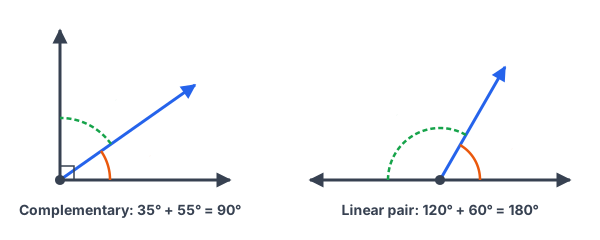
Angle pairs are two angles with a special relationship. Complementary angles add up to 90^\circ. Supplementary angles add up to 180^\circ. A linear pair is two adjacent angles that form a straight line, and vertical angles are the opposite angles made by two crossing lines. Vertical angles are always congruent.
Before this lesson: You should know Measuring and Classifying Angles and how to solve multi-step equations.
The Four Main Angle Pairs
Some pairs of angles show up again and again in geometry. Once you spot the pair, you know an equation to write. That equation lets you find a missing angle.
| Pair | What it means | Equation |
|---|---|---|
| Complementary | Two angles whose measures add up to 90^\circ | m\angle 1 + m\angle 2 = 90^\circ |
| Supplementary | Two angles whose measures add up to 180^\circ | m\angle 1 + m\angle 2 = 180^\circ |
| Linear pair | Two adjacent angles whose outer sides form a straight line | m\angle 1 + m\angle 2 = 180^\circ |
| Vertical angles | Opposite angles formed by two crossing lines | m\angle 1 = m\angle 3 |
Adjacent angles share a vertex and a side, and they don’t overlap. Complementary and supplementary angles can be adjacent, but they don’t have to be. A linear pair is always adjacent.
Vertical Angles Theorem
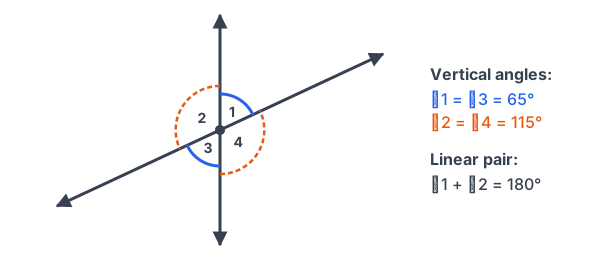
When two lines cross, they make four angles. The angles across from each other are vertical angles. The vertical angles theorem says vertical angles are congruent. For a full two-column proof, see proving angle relationships.
Here is why. In the picture below, \angle 1 and \angle 2 form a linear pair, so they add up to 180^\circ. So do \angle 2 and \angle 3. Both \angle 1 and \angle 3 are what is left after taking m\angle 2 away from 180^\circ. So they are equal.
Steps to solve an angle pair problem
- Name the pair: complementary, supplementary, linear pair or vertical.
- Write the equation: sum = 90^\circ, sum = 180^\circ, or the two angles are equal.
- Solve the equation.
- Put x back in to find each angle.
- Check the sum or the match.
Worked Examples
Example 1: Complement and supplement
Find the complement and the supplement of a 34^\circ angle.
Step 1: The complement adds to 90^\circ. Subtract.
90 - 34 = 56
Step 2: The supplement adds to 180^\circ. Subtract.
180 - 34 = 146
The complement is 56^\circ and the supplement is 146^\circ.
Example 2: Angles made by two crossing lines
Two lines cross. One of the angles is 65^\circ. Find the other three angles.
Step 1: The angle across from it is a vertical angle, so it is congruent.
m\angle 3 = 65^\circ
Step 2: The angle next to it forms a linear pair with it. Subtract from 180^\circ.
m\angle 2 = 180 - 65 = 115^\circ
Step 3: The last angle is vertical to \angle 2.
m\angle 4 = 115^\circ
Step 4: Check: all four angles go all the way around the point.
65 + 115 + 65 + 115 = 360
The angles are 65^\circ, 115^\circ, 65^\circ and 115^\circ, as in the picture above.
Example 3: Complementary angles with x
\angle A and \angle B are complementary. m\angle A = (2x + 8)^\circ and m\angle B = (3x - 3)^\circ. Find both angles.
Step 1: Complementary angles add up to 90^\circ.
(2x + 8) + (3x - 3) = 90
Step 2: Combine like terms (see combining like terms).
5x + 5 = 90
Step 3: Subtract 5 from both sides.
5x = 85
Step 4: Divide both sides by 5.
x = 17
Step 5: Find m\angle A.
2(17) + 8 = 34 + 8 = 42
Step 6: Find m\angle B.
3(17) - 3 = 51 - 3 = 48
Step 7: Check the sum.
42 + 48 = 90
So m\angle A = 42^\circ and m\angle B = 48^\circ.
Example 4: Vertical angles with x
Two lines cross. Two vertical angles measure (5x - 12)^\circ and (3x + 20)^\circ. Find x, the vertical angles, and the angle next to them.
Step 1: Vertical angles are congruent. Set them equal.
5x - 12 = 3x + 20
Step 2: Subtract 3x from both sides (see equations with variables on both sides).
2x - 12 = 20
Step 3: Add 12 to both sides.
2x = 32
Step 4: Divide both sides by 2.
x = 16
Step 5: Find one vertical angle.
5(16) - 12 = 80 - 12 = 68
Step 6: Check with the other.
3(16) + 20 = 48 + 20 = 68
Step 7: The angle next to them forms a linear pair. Subtract from 180^\circ.
180 - 68 = 112
So x = 16, the vertical angles are 68^\circ, and the angle next to them is 112^\circ.
Example 5: Word problem
A ladder leans against a wall. The angle the ladder makes with the ground and the angle it makes with the wall are complementary. The ground angle is 4 times the wall angle. Find both angles.
Step 1: Let the wall angle be x degrees. The ground angle is 4x.
Step 2: Complementary angles add up to 90^\circ.
x + 4x = 90
Step 3: Combine like terms.
5x = 90
Step 4: Divide both sides by 5.
x = 18
Step 5: Find the ground angle.
4(18) = 72
Step 6: Check the sum.
18 + 72 = 90
The wall angle is 18^\circ and the ground angle is 72^\circ.
Common Mistakes
| Mistake | Example of the error | Fix |
|---|---|---|
| Mixing up complementary and supplementary | Saying the complement of 34^\circ is 146^\circ | Complementary is 90^\circ, supplementary is 180^\circ. Memory trick: C comes before S, and 90 comes before 180. |
| Adding vertical angles to 180 | Writing (5x - 12) + (3x + 20) = 180 for vertical angles | Vertical angles are equal. Set them equal to each other. |
| Calling any two angles next to each other a linear pair | Two adjacent angles of 40^\circ and 70^\circ | A linear pair must form a straight line, so the angles add to 180^\circ. |
| Stopping at x | Answering x = 16 in Example 4 | Put x back in: the angles are 68^\circ. |
| Thinking vertical means up and down | Looking for angles that stand upright | Vertical angles share a vertex and sit across from each other, in any direction. |
More Angle Pair Facts
- Two acute angles can be complementary, but never supplementary. Each is less than 90^\circ, so the sum is less than 180^\circ.
- If two angles are supplementary and congruent, each is 90^\circ. So when two lines cross and one angle is right, all four angles are right. The lines are perpendicular, like in parallel and perpendicular lines.
- The four angles around a point add up to 360^\circ.
- Some problems say “an angle is 20° more than 3 times its supplement.” Write the supplement as 180 - x and solve.
Practice Problems
- Find the complement of a 27^\circ angle.
- Find the supplement of a 104^\circ angle.
- An angle is twice its complement. Find the angle.
- \angle 1 and \angle 2 form a linear pair. m\angle 1 = (6x + 4)^\circ and m\angle 2 = (4x - 4)^\circ. Find both angles.
- Two vertical angles measure (7x - 9)^\circ and (4x + 21)^\circ. Find their measure.
- Two lines cross, and one angle is 128^\circ. Find the other three angles.
- \angle P and \angle Q are complementary. m\angle P = (x + 15)^\circ and m\angle Q = 2x^\circ. Find both angles.
- An angle is 20^\circ more than 3 times its supplement. Find the angle and its supplement.
- Can two acute angles be supplementary? Explain.
- The blades of open scissors cross like two lines. The angle between the blades is 38^\circ. Find the other three angles where they cross.
Show answers
- Subtract from 90: 90 - 27 = 63. The complement is 63^\circ.
- Subtract from 180: 180 - 104 = 76. The supplement is 76^\circ.
- Let the angle be x. Its complement is 90 − x. Write the equation: x = 2(90 - x). Distribute the 2 (see distributive property): x = 180 - 2x. Add 2x to both sides: 3x = 180. Divide both sides by 3: x = 60. The angle is 60^\circ. Check: its complement is 30^\circ, and 2 \cdot 30 = 60.
- A linear pair adds to 180: (6x + 4) + (4x - 4) = 180. Combine like terms: 10x = 180. Divide both sides by 10: x = 18. Find the first angle: 6(18) + 4 = 112. Find the second angle: 4(18) - 4 = 68. Check: 112 + 68 = 180. So m\angle 1 = 112^\circ and m\angle 2 = 68^\circ.
- Vertical angles are equal: 7x - 9 = 4x + 21. Subtract 4x from both sides: 3x - 9 = 21. Add 9 to both sides: 3x = 30. Divide both sides by 3: x = 10. Find the angle: 7(10) - 9 = 61. Check: 4(10) + 21 = 61. Each angle is 61^\circ.
- The vertical angle matches: 128. The angles next to it form linear pairs: 180 - 128 = 52. The other angles are 52^\circ, 128^\circ and 52^\circ.
- Complementary angles add to 90: (x + 15) + 2x = 90. Combine like terms: 3x + 15 = 90. Subtract 15 from both sides: 3x = 75. Divide both sides by 3: x = 25. Find each angle: 25 + 15 = 40 \text{ and } 2(25) = 50. Check: 40 + 50 = 90. So m\angle P = 40^\circ and m\angle Q = 50^\circ.
- Let the angle be x. Its supplement is 180 − x. Write the equation: x = 3(180 - x) + 20. Distribute the 3: x = 540 - 3x + 20. Combine the numbers: x = 560 - 3x. Add 3x to both sides: 4x = 560. Divide both sides by 4: x = 140. Find the supplement: 180 - 140 = 40. The angle is 140^\circ and its supplement is 40^\circ. Check: 3 \cdot 40 + 20 = 140.
- No. An acute angle is less than 90°. Two of them add up to less than 180°, so they can never be supplementary.
- The vertical angle matches: 38. The angles next to it form linear pairs: 180 - 38 = 142. The other angles are 142^\circ, 38^\circ and 142^\circ.
FAQ
What is the difference between complementary and supplementary angles?
Complementary angles add up to 90^\circ. Supplementary angles add up to 180^\circ.
Are vertical angles always congruent?
Yes. That is the vertical angles theorem. Each one forms a linear pair with the same angle between them, so they must be equal.
Is a linear pair always supplementary?
Yes. The two angles form a straight line, which is 180^\circ. But supplementary angles don’t have to be a linear pair. They can be far apart.
Do complementary angles have to be next to each other?
No. Any two angles that add up to 90^\circ are complementary, even in different places.
Summary
- Complementary angles add to 90^\circ. Supplementary angles add to 180^\circ.
- A linear pair is two adjacent angles that form a straight line, so they are supplementary.
- Vertical angles are the opposite angles made by two crossing lines. They are congruent.
- Name the pair, write its equation, solve for x, then find each angle.
- The four angles around a point add up to 360^\circ.
Previous lesson: Measuring and Classifying Angles
Next lesson: Basic Constructions
Back to the Geometry Index