
Inductive and Deductive Reasoning
Inductive reasoning looks at examples or a pattern and makes a general guess, called a conjecture. Deductive reasoning starts from facts, definitions and rules that are already accepted and uses logic to reach a conclusion that must be true. Inductive reasoning suggests what is true. Deductive reasoning proves it.
Before this lesson: You should know Conditional Statements.
Inductive vs. Deductive Reasoning
Say the last three Mondays, your school served pizza. You guess pizza will be served next Monday too. That is inductive reasoning. It is a good guess, but it could be wrong.
Now say the school handbook says, “If it is Monday, then pizza is served.” Today is Monday. So pizza is served today. That is deductive reasoning. If the rule is true, the conclusion has to be true.
| Inductive reasoning | Deductive reasoning | |
|---|---|---|
| Starts with | Examples and patterns | Facts, definitions, postulates and theorems |
| Ends with | A conjecture (a likely guess) | A conclusion that must be true |
| Can be wrong? | Yes. One counterexample breaks it. | No, if the starting facts are true and the logic is valid |
| Used for | Finding patterns and ideas to test | Proving that those ideas are always true |
Laws of Deductive Reasoning
Deductive reasoning in geometry uses conditionals, like the ones in conditional statements. Two laws tell you which conclusions are valid.
| Law | Rule | Example |
|---|---|---|
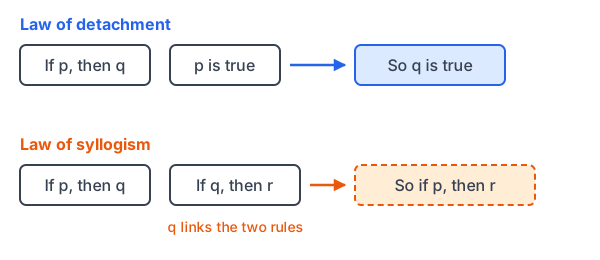
| Law of detachment | If p \rightarrow q is true and p is true, then q is true. | If two angles form a linear pair, they are supplementary. \angle 1 and \angle 2 form a linear pair. So they are supplementary. |
| Law of syllogism | If p \rightarrow q and q \rightarrow r are true, then p \rightarrow r is true. | If it snows, school closes. If school closes, the game is moved. So if it snows, the game is moved. |
Watch out: knowing q is true does not tell you p is true. That would be using the converse, which may be false.
Steps to reason deductively
- Write each given rule as a conditional, p \rightarrow q.
- Look for a given fact that matches a hypothesis exactly. If it does, use the law of detachment.
- Look for two rules where the conclusion of one is the hypothesis of the other. If so, use the law of syllogism.
- If the given fact only matches a conclusion, no valid conclusion follows.
Worked Examples
Example 1: Make a conjecture from a pattern
Look at the numbers 3, 7, 11, 15, … Make a conjecture about the next two numbers and the rule.
Step 1: Find the change from each number to the next.
7 - 3 = 4,\quad 11 - 7 = 4,\quad 15 - 11 = 4
Step 2: The pattern adds 4 each time. Add 4 to 15.
15 + 4 = 19
Step 3: Add 4 again.
19 + 4 = 23
Step 4: Write a rule for the nth number. It starts at 3 and adds 4 each step (see arithmetic sequences).
3 + 4(n - 1) = 4n - 1
Step 5: Test the rule with n = 3.
4(3) - 1 = 12 - 1 = 11
Conjecture: the next numbers are 19 and 23, and the nth number is 4n - 1.
Example 2: Test a conjecture, then prove it
Conjecture: the sum of any two odd numbers is even. Test it, then prove it with deductive reasoning.
Step 1: Test some examples.
3 + 5 = 8,\quad 7 + 11 = 18,\quad 13 + 21 = 34
Step 2: All the sums are even. That supports the conjecture, but examples can’t prove it.
Step 3: Deductive step: by definition, an odd number can be written as 2a + 1 for a whole number a. Write two odd numbers.
(2a + 1) + (2b + 1)
Step 4: Combine like terms (see combining like terms).
2a + 2b + 2
Step 5: Factor out 2 (see factoring out the GCF).
2(a + b + 1)
Step 6: Two times a whole number is even, by the definition of even.
So the sum of any two odd numbers is even. Now the conjecture is proved, not just guessed.
Example 3: Find a counterexample to a conjecture
Conjecture: the square of a number is always greater than the number. Is it true?
Step 1: Test some numbers greater than 1.
2^2 = 4 \gt 2,\quad 5^2 = 25 \gt 5
Step 2: Try a fraction between 0 and 1 (see multiplying fractions).
\left(\frac{1}{2}\right)^2 = \frac{1}{2} \cdot \frac{1}{2} = \frac{1}{4}Step 3: Compare.
\frac{1}{4} \lt \frac{1}{2}The conjecture is false. The counterexample \frac{1}{2} has a square that is smaller than the number.
Example 4: Law of detachment
Given: If two angles are vertical angles, then they are congruent. \angle 1 and \angle 3 are vertical angles, and m\angle 1 = 72^\circ. What can you conclude?
Step 1: The rule is p \rightarrow q. p: two angles are vertical angles. q: they are congruent.
Step 2: The given fact matches p exactly: \angle 1 and \angle 3 are vertical angles.
Step 3: By the law of detachment, q is true.
\angle 1 \cong \angle 3
Step 4: Congruent angles have equal measures.
m\angle 3 = m\angle 1 = 72^\circ
So m\angle 3 = 72^\circ. This uses the vertical angles theorem from angle pairs.
Example 5: Word problem with the law of syllogism
A ski resort posts three rules. If it snows more than 6 inches, the top lift opens. If the top lift opens, the expert trail opens. If the expert trail opens, the resort hires extra patrollers. Last night it snowed 9 inches. What can you conclude?
Step 1: Name the parts. p: more than 6 inches of snow. q: the top lift opens. r: the expert trail opens. s: extra patrollers are hired.
Step 2: The rules are p \rightarrow q, q \rightarrow r and r \rightarrow s.
Step 3: Chain the first two with the law of syllogism.
p \rightarrow r
Step 4: Chain that with the third rule.
p \rightarrow s
Step 5: 9 inches is more than 6 inches, so p is true.
9 \gt 6
Step 6: By the law of detachment, s is true.
The resort hires extra patrollers. Along the way, the top lift and the expert trail also open.
Common Mistakes
| Mistake | Example of the error | Fix |
|---|---|---|
| Treating a conjecture as proved | “It worked for 5 examples, so it is always true.” | Examples support a conjecture. Only deductive reasoning proves it. |
| Reasoning backward from the conclusion | “If it rains, the game is canceled. The game was canceled, so it rained.” | That uses the converse. The game could be canceled for another reason. |
| Chaining rules with no shared link | “If A, then B. If C, then D. So if A, then D.” | The law of syllogism needs the conclusion of one rule to be the hypothesis of the next. |
| Testing only easy numbers | Testing only whole numbers for “a square is bigger than the number” | Also try 0, 1, negatives and fractions when you look for counterexamples. |
| Missing a pattern’s real rule | Guessing 2, 4, 8 continues 10, 12 | Check both adding and multiplying. 2, 4, 8 could double to 16. |
Reasoning in Proofs
Geometry proofs are deductive reasoning written out step by step. Each step uses a given fact, a definition, a postulate or a theorem. Inductive reasoning still helps: it suggests what you might try to prove.
- Inductive: measure the angles in a few triangles and notice they add up to about 180^\circ.
- Deductive: prove that the angles of every triangle add up to 180^\circ. You will do this in Unit 5.
- Algebra is deductive too: each step of solving multi-step equations follows from a property of equality. The next lesson, algebraic proofs, names those properties.
Practice Problems
- Find the next two numbers and describe the pattern: 2, 6, 18, 54, …
- Find the next two numbers: 1, 4, 9, 16, …
- Test this conjecture with three examples: the product of two odd numbers is odd.
- Find a counterexample: “For every number x, x^2 \gt 0.”
- Find a counterexample: “The difference of two positive numbers is positive.”
- Given: If an angle is obtuse, then its measure is more than 90^\circ. \angle A is obtuse. What can you conclude? Which law did you use?
- Given: If a figure is a square, then it is a rectangle. If a figure is a rectangle, then it has four right angles. What conclusion follows? Which law did you use?
- Is this inductive or deductive? “The last five buses were late, so the next bus will be late.”
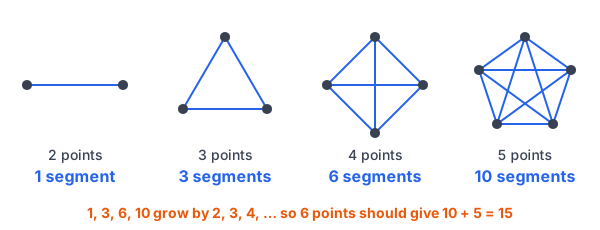
- Points are placed so no three are in a line, and every pair is joined by a segment. 2 points give 1 segment, 3 give 3, 4 give 6 and 5 give 10. Make a conjecture for 6 points.
- Given: If the temperature drops below 32^\circF, the pond freezes. If the pond freezes, the town opens skating. Today it is 25^\circF. What can you conclude?
Show answers
- Each number is 3 times the one before: 54 \cdot 3 = 162. Multiply by 3 again: 162 \cdot 3 = 486. The next numbers are 162 and 486.
- These are square numbers: 1², 2², 3², 4²: 5^2 = 25. Next square: 6^2 = 36. The next numbers are 25 and 36.
- Example 1: 3 \cdot 5 = 15. Example 2: 7 \cdot 9 = 63. Example 3: 11 \cdot 13 = 143. All three products are odd, so the examples support the conjecture.
- Try 0: 0^2 = 0. Since 0 is not greater than 0, x = 0 is a counterexample.
- Try 3 and 8: 3 - 8 = -5. Both numbers are positive, but the difference is negative. So the statement is false.
- The hypothesis “\angle A is obtuse” is true, so by the law of detachment, m\angle A \gt 90^\circ.
- By the law of syllogism: if a figure is a square, then it has four right angles.
- Inductive. It uses past examples to guess about the future, so it could be wrong.
- Find the changes: 3 - 1 = 2,\quad 6 - 3 = 3,\quad 10 - 6 = 4. The next change should be 5: 10 + 5 = 15. Conjecture: 6 points give 15 segments. (This matches the counting in points, lines and planes: 6 \cdot 5 \div 2 = 15.)
- 25 is less than 32: 25 \lt 32. By detachment, the pond freezes. By syllogism, if the temperature drops below 32°F, the town opens skating. So the town opens skating.
FAQ
What is the main difference between inductive and deductive reasoning?
Inductive reasoning goes from examples to a general guess. Deductive reasoning goes from general facts to a specific conclusion that must be true.
Can inductive reasoning be wrong?
Yes. A conjecture can fit every example you tried and still fail for one you didn’t. One counterexample shows it is false.
What is the law of detachment?
If a conditional p \rightarrow q is true and its hypothesis p is true, then the conclusion q is true.
What is the law of syllogism?
If p \rightarrow q and q \rightarrow r are both true, then p \rightarrow r is true. The rules chain together through q.
Summary
- Inductive reasoning finds a pattern and makes a conjecture. It can be wrong.
- A single counterexample shows a conjecture is false.
- Deductive reasoning uses accepted facts and logic. Its conclusions must be true.
- Law of detachment: p \rightarrow q and p give q.
- Law of syllogism: p \rightarrow q and q \rightarrow r give p \rightarrow r.
Previous lesson: Conditional Statements
Next lesson: Algebraic Proofs
Back to the Geometry Index