
Algebraic Proofs
An algebraic proof shows each step of solving an equation and gives a reason for every step. The reasons are the properties of equality, like the addition and division properties, plus the distributive property and substitution. Algebraic proofs are usually written as two-column proofs, with statements on the left and reasons on the right.
Before this lesson: You should know Inductive and Deductive Reasoning and how to solve multi-step equations.
Why Prove Algebra Steps?
When you solve 3x + 7 = 22, you already do deductive reasoning. You subtract 7 from both sides because the rule allows it. An algebraic proof just writes that reason down.
This is practice for geometry proofs. In a geometry proof, every statement also needs a reason: a given fact, a definition, a postulate, a property or a theorem.
Properties of Equality
These properties are accepted rules. For any numbers a, b and c:
| Property | Rule | Example |
|---|---|---|
| Addition property of equality | If a = b, then a + c = b + c. | If x - 4 = 9, then x = 13. |
| Subtraction property of equality | If a = b, then a - c = b - c. | If x + 7 = 22, then x = 15. |
| Multiplication property of equality | If a = b, then ac = bc. | If \frac{x}{3} = 5, then x = 15. |
| Division property of equality | If a = b and c \ne 0, then \frac{a}{c} = \frac{b}{c}. | If 3x = 15, then x = 5. |
| Substitution property | If a = b, then b can replace a in any expression. | If x = 5, then 2x + 1 = 2(5) + 1. |
| Distributive property | a(b + c) = ab + ac | 2(x - 4) = 2x - 8 |
| Reflexive property | a = a | AB = AB |
| Symmetric property | If a = b, then b = a. | If 15 = 3x, then 3x = 15. |
| Transitive property | If a = b and b = c, then a = c. | If m\angle 1 = m\angle 2 and m\angle 2 = 40^\circ, then m\angle 1 = 40^\circ. |
Some textbooks call combining like terms “simplify.” The reflexive, symmetric and transitive properties also work for congruence: \overline{AB} \cong \overline{AB}, and if \angle 1 \cong \angle 2 and \angle 2 \cong \angle 3, then \angle 1 \cong \angle 3.
Steps to write an algebraic proof
- Write the given equation as statement 1, with the reason “Given.”
- Do one step at a time. Write the new equation as the next statement.
- Next to it, name the property that allowed the step.
- Stop when the last statement matches what you were asked to prove.
Worked Examples
Example 1: A two-step equation
Given: 3x + 7 = 22 Prove: x = 5
| Statement | Reason |
|---|---|
| 3x + 7 = 22 | Given |
| 3x = 15 | Subtraction property of equality (subtract 7) |
| x = 5 | Division property of equality (divide by 3) |
Example 2: Using the distributive property
Given: 2(x - 4) = 10 Prove: x = 9
| Statement | Reason |
|---|---|
| 2(x - 4) = 10 | Given |
| 2x - 8 = 10 | Distributive property |
| 2x = 18 | Addition property of equality (add 8) |
| x = 9 | Division property of equality (divide by 2) |
The distributive step is the same move you learned in distributive property. Now it gets a name in the reason column.
Example 3: Variables on both sides
Given: 5x - 3 = 2x + 12 Prove: x = 5
| Statement | Reason |
|---|---|
| 5x - 3 = 2x + 12 | Given |
| 3x - 3 = 12 | Subtraction property of equality (subtract 2x) |
| 3x = 15 | Addition property of equality (add 3) |
| x = 5 | Division property of equality (divide by 3) |
To review the algebra, see equations with variables on both sides.
Example 4: A proof with a segment
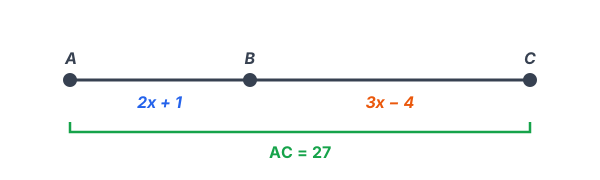
Given: Point B is between A and C. AB = 2x + 1, BC = 3x - 4 and AC = 27. Prove: x = 6
| Statement | Reason |
|---|---|
| B \text{ is between } A \text{ and } C | Given |
| AB + BC = AC | Segment addition postulate |
| (2x + 1) + (3x - 4) = 27 | Substitution property |
| 5x - 3 = 27 | Simplify (combine like terms) |
| 5x = 30 | Addition property of equality (add 3) |
| x = 6 | Division property of equality (divide by 5) |
The second reason is a postulate from geometry, the segment addition postulate. Mixing geometry reasons with algebra reasons is how most geometry proofs work.
Example 5: Word problem with a formula
Given: A thermometer reads 25 degrees Celsius. The formula C = \frac{5}{9}(F - 32) changes Fahrenheit to Celsius, so 25 = \frac{5}{9}(F - 32). Prove: F = 77, so it is 77 degrees Fahrenheit.
| Statement | Reason |
|---|---|
| 25 = \frac{5}{9}(F - 32) | Given |
| 45 = F - 32 | Multiplication property of equality (multiply by \frac{9}{5}) |
| 77 = F | Addition property of equality (add 32) |
| F = 77 | Symmetric property |
Multiplying by the reciprocal \frac{9}{5} undoes \frac{5}{9}: 25 \cdot \frac{9}{5} = \frac{225}{5} = 45 (see multiplying and dividing fractions). So 25°C is 77°F.
Common Mistakes
| Mistake | Example of the error | Fix |
|---|---|---|
| Doing two steps in one line | Going from 3x + 7 = 22 straight to x = 5 | One step per line, so each line gets its own reason. |
| Naming the wrong property | Writing “Addition property” after subtracting 7 | Name what you did: subtracting 7 is the subtraction property of equality. |
| Mixing up symmetric and transitive | Calling “if 77 = F, then F = 77” transitive | Flipping the sides is symmetric. Linking two equations through a shared middle is transitive. |
| Forgetting “Given” | Starting with the first step of solving | The first statement is the given information, with the reason “Given.” |
| Using “distributive” for combining like terms | Writing distributive for 2x + 3x = 5x | Use “simplify” or “combine like terms” for that step. |
Equality vs. Congruence Properties
Lengths and angle measures are numbers, so they use properties of equality. Segments and angles themselves use properties of congruence. The reflexive, symmetric and transitive properties work both ways.
| Property | Equality (numbers) | Congruence (figures) |
|---|---|---|
| Reflexive | AB = AB | \overline{AB} \cong \overline{AB} |
| Symmetric | If m\angle A = m\angle B, then m\angle B = m\angle A. | If \angle A \cong \angle B, then \angle B \cong \angle A. |
| Transitive | If AB = CD and CD = EF, then AB = EF. | If \overline{AB} \cong \overline{CD} and \overline{CD} \cong \overline{EF}, then \overline{AB} \cong \overline{EF}. |
The next lesson, two-column proofs, uses these properties to prove facts about segments and angles, like the ones in angle pairs.
Practice Problems
- Name the property: If x - 6 = 10, then x = 16.
- Name the property: If 4x = 28, then x = 7.
- Name the property: If 12 = y, then y = 12.
- Name the property: If AB = CD and CD = 9, then AB = 9.
- Name the property: \angle P \cong \angle P.
- Write an algebraic proof. Given: 4x - 9 = 23. Prove: x = 8.
- Write an algebraic proof. Given: 3(x + 2) = 27. Prove: x = 7.
- Complete the proof. Given: \frac{x}{4} + 3 = 8. Prove: x = 20. Statements: (1) \frac{x}{4} + 3 = 8 (2) \frac{x}{4} = 5 (3) x = 20. Give the three reasons.
- Complete the proof. Given: \angle ABD and \angle DBC form \angle ABC, with m\angle ABD = 2x, m\angle DBC = x + 15 and m\angle ABC = 90^\circ. Prove: x = 25. Fill in the missing reasons for: (1) m\angle ABD + m\angle DBC = m\angle ABC (2) 2x + (x + 15) = 90 (3) 3x + 15 = 90 (4) 3x = 75 (5) x = 25.
- A phone plan costs C = 15m + 20 dollars for m months. Prove that if C = 110, then m = 6.
Show answers
- Addition property of equality (add 6 to both sides).
- Division property of equality (divide both sides by 4).
- Symmetric property.
- Transitive property (or substitution).
- Reflexive property of congruence.
- Statement 1, Given: 4x - 9 = 23. Statement 2, Addition property of equality (add 9): 4x = 32. Statement 3, Division property of equality (divide by 4): x = 8. That completes the proof.
- Statement 1, Given: 3(x + 2) = 27. Statement 2, Distributive property: 3x + 6 = 27. Statement 3, Subtraction property of equality (subtract 6): 3x = 21. Statement 4, Division property of equality (divide by 3): x = 7. That completes the proof.
- (1) Given. (2) Subtraction property of equality (subtract 3). (3) Multiplication property of equality (multiply by 4).
- (1) Angle addition postulate. (2) Substitution property. (3) Simplify (combine like terms). (4) Subtraction property of equality (subtract 15). (5) Division property of equality (divide by 3).
- Statement 1, Given: C = 15m + 20 \text{ and } C = 110. Statement 2, Substitution property: 110 = 15m + 20. Statement 3, Subtraction property of equality (subtract 20): 90 = 15m. Statement 4, Division property of equality (divide by 15): 6 = m. Statement 5, Symmetric property: m = 6. So 6 months of the plan cost $110.
FAQ
What is an algebraic proof?
It is a list of the steps for solving an equation, with a reason for each step. The reasons are properties like the addition or division property of equality.
What is the difference between the substitution and transitive properties?
Substitution replaces a quantity with an equal one inside any expression. Transitive links two equations: if a = b and b = c, then a = c. They often do the same job, and many teachers accept either.
Do I have to write “subtract 7” in the reason?
Not always. The property name is the reason. Adding what you did, like “subtract 7,” makes the proof easier to check.
Is “simplify” a real reason?
Yes. Most textbooks accept “simplify” or “combine like terms” for steps that only rewrite one side, like 2x + 3x = 5x.
Summary
- An algebraic proof gives a reason for every step of solving an equation.
- Reasons include Given; the addition, subtraction, multiplication and division properties of equality; substitution; the distributive property; and simplify.
- The reflexive, symmetric and transitive properties work for equality and for congruence.
- Write one step per line, and start with the given statement.
- Geometry reasons, like the segment addition postulate, can mix with algebra reasons in the same proof.
Previous lesson: Inductive and Deductive Reasoning
Next lesson: Two-Column Proofs
Back to the Geometry Index