
Two-Column Proofs
A two-column proof is a numbered list of statements in the left column and the reason for each statement in the right column. It starts with the given facts and ends with the statement you want to prove. Each reason is a given fact, a definition, a postulate, a property or a theorem you already know.
Before this lesson: You should know Algebraic Proofs, the Segment Addition Postulate and Measuring and Classifying Angles (the angle addition postulate).
What Is a Two-Column Proof?
A proof is an argument that leaves no doubt. In a two-column proof, nothing is skipped. Every statement has to be backed up, so a reader can check each step on its own.
You already wrote two-column proofs for equations. Now the statements are about segments and angles. The reasons come from geometry too.
The reasons you can use
| Kind of reason | Examples |
|---|---|
| Given | The facts stated in the problem |
| Definitions | Definition of midpoint, of congruent segments, of congruent angles, of angle bisector, of right angle |
| Postulates | Segment addition postulate, angle addition postulate |
| Properties | Addition, subtraction, multiplication, division, substitution, reflexive, symmetric, transitive |
| Theorems | Facts already proved, like the vertical angles theorem |
Definitions work in both directions, because every definition is a biconditional (see conditional statements). For example, if M is the midpoint of \overline{AB}, then AM = MB. And if AM = MB with M on the segment, then M is the midpoint.
Steps to write a two-column proof
- Draw and mark a diagram from the given information.
- Write the given facts first, each with the reason “Given.”
- Plan backward: what do you need right before the last statement?
- Add one statement at a time, each with one reason.
- End with the exact statement you were asked to prove.
Worked Examples
Example 1: Half of a segment
Given: M is the midpoint of \overline{AB}. Prove: AM = \frac{1}{2}AB
| Statement | Reason |
|---|---|
| M \text{ is the midpoint of } \overline{AB} | Given |
| AM = MB | Definition of midpoint |
| AM + MB = AB | Segment addition postulate |
| AM + AM = AB | Substitution property (replace MB with AM) |
| 2AM = AB | Simplify (combine like terms) |
| AM = \frac{1}{2}AB | Division property of equality (divide by 2) |
Example 2: Adding the same piece
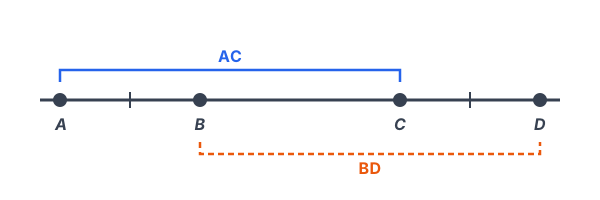
Given: Points A, B, C and D are on a line in that order, and AB = CD. Prove: AC = BD
| Statement | Reason |
|---|---|
| AB = CD | Given |
| AB + BC = BC + CD | Addition property of equality (add BC to both sides) |
| AB + BC = AC | Segment addition postulate |
| BC + CD = BD | Segment addition postulate |
| AC = BD | Substitution property (statements 3 and 4 into statement 2) |
Example 3: The same idea with angles
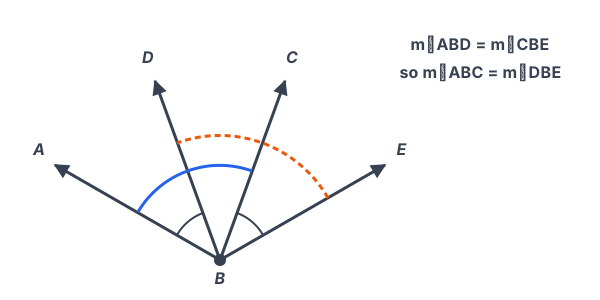
Given: Rays \overrightarrow{BA}, \overrightarrow{BD}, \overrightarrow{BC} and \overrightarrow{BE} come out of B in that order, and m\angle ABD = m\angle CBE. Prove: m\angle ABC = m\angle DBE
| Statement | Reason |
|---|---|
| m\angle ABD = m\angle CBE | Given |
| m\angle ABD + m\angle DBC = m\angle DBC + m\angle CBE | Addition property of equality (add m\angle DBC) |
| m\angle ABD + m\angle DBC = m\angle ABC | Angle addition postulate |
| m\angle DBC + m\angle CBE = m\angle DBE | Angle addition postulate |
| m\angle ABC = m\angle DBE | Substitution property |
This proof has the same shape as Example 2. Angles use the angle addition postulate where segments use the segment addition postulate.
Example 4: Congruent segments with algebra
Given: \overline{AB} \cong \overline{CD}, AB = 3x + 2 and CD = 5x - 10. Prove: x = 6
| Statement | Reason |
|---|---|
| \overline{AB} \cong \overline{CD} | Given |
| AB = CD | Definition of congruent segments |
| 3x + 2 = 5x - 10 | Substitution property |
| 2 = 2x - 10 | Subtraction property of equality (subtract 3x) |
| 12 = 2x | Addition property of equality (add 10) |
| 6 = x | Division property of equality (divide by 2) |
| x = 6 | Symmetric property |
Check: AB = 3(6) + 2 = 20 and CD = 5(6) - 10 = 20.
Example 5: Word problem
A proof can use numbers too.
Given: Four bus stops A, B, C and D are in that order on a straight road. The ride from A to B is as long as the ride from C to D, 12 miles each, and BC = 7 miles. Prove: AC = BD, and find both distances.
| Statement | Reason |
|---|---|
| AB = CD = 12, \; BC = 7 | Given |
| AC = AB + BC | Segment addition postulate |
| AC = 12 + 7 = 19 | Substitution property, then simplify |
| BD = BC + CD | Segment addition postulate |
| BD = 7 + 12 = 19 | Substitution property, then simplify |
| AC = BD | Transitive property (both equal 19) |
So AC = BD = 19 miles. Example 2 proves this works for any lengths, not just 12 and 7.
Common Mistakes
| Mistake | Example of the error | Fix |
|---|---|---|
| Skipping the reason for a step | Writing AM + AM = AB with no reason | Every statement needs a reason. Here it is substitution. |
| Using the diagram as a reason | “AM = MB because it looks that way” | Use the given facts and definitions, not how the picture looks. |
| Mixing up = and ≅ | Writing \overline{AB} = \overline{CD} | Segments are congruent: \overline{AB} \cong \overline{CD}. Their lengths are equal: AB = CD. |
| Using the statement you want to prove | Writing AC = BD early in Example 2 | The goal can only appear as the last statement. |
| Naming a postulate for a definition | “Segment addition postulate” for AM = MB | That step comes from the definition of midpoint. |
Paragraph Proofs and Flow Proofs
A paragraph proof gives the same statements and reasons in sentences. Here is Example 1 as a paragraph proof:
Since M is the midpoint of \overline{AB}, AM = MB by the definition of midpoint. By the segment addition postulate, AM + MB = AB. Substituting AM for MB gives AM + AM = AB, so 2AM = AB. Dividing both sides by 2 gives AM = \frac{1}{2}AB.
A flow proof puts each statement in a box with its reason under it, and arrows show which statements lead to which. All three styles need the same logic. Use the one your teacher asks for.
The next lesson, proving angle relationships, uses two-column proofs to prove theorems about the angle pairs from angle pairs.
Practice Problems
- Give the reason: If \overline{PQ} \cong \overline{RS}, then PQ = RS.
- Give the reason: If B is between A and C, then AB + BC = AC.
- Give the reason: If \overrightarrow{BD} bisects \angle ABC, then m\angle ABD = m\angle DBC.
- Give the reason: \overline{XY} \cong \overline{XY}.
- Complete the proof. Given: AB = CD (with A, B, C, D in order). Prove: AC = BD. Fill in the reasons: (1) AB = CD (2) AB + BC = BC + CD (3) AB + BC = AC (4) BC + CD = BD (5) AC = BD.
- Complete the proof. Given: \overrightarrow{BD} bisects \angle ABC. Prove: m\angle ABD = \frac{1}{2}m\angle ABC. Write the statements for these reasons: (1) Given (2) Definition of angle bisector (3) Angle addition postulate (4) Substitution (5) Simplify (6) Division property of equality.
- Write a two-column proof. Given: \angle 1 \cong \angle 2, m\angle 1 = (4x + 6)^\circ, m\angle 2 = (6x - 14)^\circ. Prove: x = 10.
- Write a two-column proof. Given: AC = BD (with A, B, C, D in order). Prove: AB = CD.
- Find the error: a student wrote “(2) AM = MB, Segment addition postulate” in a midpoint proof. What should the reason be?
- A straight shelf \overline{PS} has brackets at Q and R, in the order P, Q, R, S. PQ = RS = 10 inches and QR = 16 inches. Prove PR = QS and find the length.
Show answers
- Definition of congruent segments.
- Segment addition postulate.
- Definition of angle bisector.
- Reflexive property of congruence.
- (1) Given. (2) Addition property of equality. (3) Segment addition postulate. (4) Segment addition postulate. (5) Substitution property.
- (1) \overrightarrow{BD} \text{ bisects } \angle ABC. (2) m\angle ABD = m\angle DBC. (3) m\angle ABD + m\angle DBC = m\angle ABC. (4) m\angle ABD + m\angle ABD = m\angle ABC. (5) 2m\angle ABD = m\angle ABC. (6) m\angle ABD = \frac{1}{2}m\angle ABC.
- (1) \angle 1 \cong \angle 2, Given. (2) m\angle 1 = m\angle 2, Definition of congruent angles. (3) 4x + 6 = 6x - 14, Substitution property. (4) 6 = 2x - 14, Subtraction property of equality (subtract 4x). (5) 20 = 2x, Addition property of equality (add 14). (6) 10 = x, Division property of equality (divide by 2). (7) x = 10, Symmetric property.
- (1) AC = BD, Given. (2) AB + BC = AC, Segment addition postulate. (3) BC + CD = BD, Segment addition postulate. (4) AB + BC = BC + CD, Substitution property. (5) AB = CD, Subtraction property of equality (subtract BC).
- Definition of midpoint. The segment addition postulate gives AM + MB = AB, not AM = MB.
- (1) PQ = RS = 10, \; QR = 16, Given. (2) PR = PQ + QR, Segment addition postulate. (3) PR = 10 + 16 = 26, Substitution, then simplify. (4) QS = QR + RS, Segment addition postulate. (5) QS = 16 + 10 = 26, Substitution, then simplify. (6) PR = QS, Transitive property. Both are 26 inches.
FAQ
What goes in the first row of a two-column proof?
The given information, with the reason “Given.” If there is more than one given fact, each can get its own row.
Can I use a picture as a reason?
No. A diagram helps you plan, but you can’t assume lengths or angles are equal just because they look equal. Use only marked or given facts.
What is the difference between a postulate and a theorem?
A postulate is accepted without proof, like the segment addition postulate. A theorem is proved, like the vertical angles theorem. Both can be reasons.
How do I know which step comes next?
Work backward from the goal. Ask what statement would let you finish in one step, and then how to get that statement from what you know.
Summary
- A two-column proof lists statements on the left and reasons on the right.
- Start with the given facts and end with the statement to prove.
- Reasons can be given facts, definitions, postulates, properties or theorems.
- Definitions work both ways, like the definition of midpoint or of congruent segments.
- Plan backward from the goal, and never use the goal or the look of a diagram as a reason.
Previous lesson: Algebraic Proofs
Next lesson: Proving Angle Relationships
Back to the Geometry Index