
Parallel Lines and Transversals
Parallel lines and transversals make eight angles that follow simple rules. A transversal is a line that crosses two other lines. When those two lines are parallel, corresponding angles, alternate interior angles and alternate exterior angles are congruent, and same-side interior angles add up to 180^\circ. Know one angle, and you can find all eight.
Before this lesson: You should know Angle Pairs and Proving Angle Relationships.
What Is a Transversal?
Picture a road that crosses two straight railroad tracks. The tracks never meet, so they are parallel. The road cuts across both of them. In geometry, that road is called a transversal.
Parallel lines are lines in the same plane that never meet. We write m \parallel n and say “line m is parallel to line n.” In a diagram, matching arrow marks on two lines mean they are parallel.
A transversal is a line that crosses two or more lines in the same plane at different points. It makes four angles at each crossing, so eight angles in all.
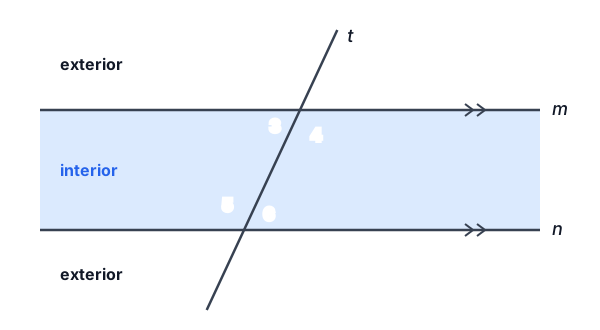
The space between the two lines is the interior. The space outside them is the exterior. These two words, plus which side of the transversal an angle is on, give each angle pair its name.
Angle Pairs Formed by a Transversal
| Pair name | Where the angles are | Pairs in the picture | If the lines are parallel |
|---|---|---|---|
| Corresponding angles | Same corner at each crossing | \angle 1 and \angle 5, \angle 2 and \angle 6, \angle 3 and \angle 7, \angle 4 and \angle 8 | Congruent |
| Alternate interior angles | Between the lines, on opposite sides of the transversal | \angle 3 and \angle 6, \angle 4 and \angle 5 | Congruent |
| Alternate exterior angles | Outside the lines, on opposite sides of the transversal | \angle 1 and \angle 8, \angle 2 and \angle 7 | Congruent |
| Same-side interior angles | Between the lines, on the same side of the transversal | \angle 3 and \angle 5, \angle 4 and \angle 6 | Supplementary (add to 180^\circ) |
Same-side interior angles are also called consecutive interior angles. The angle pairs from the angle pairs lesson still work here too. For example, \angle 1 and \angle 4 are vertical angles, and \angle 1 and \angle 2 form a linear pair.
Parallel Lines Theorems
These four rules only work when the two lines are parallel. The first one is a postulate, so it is accepted without proof. The other three are theorems, and you can prove them from the first one.
| Rule | What it says |
|---|---|
| Corresponding angles postulate | If two parallel lines are cut by a transversal, then corresponding angles are congruent. |
| Alternate interior angles theorem | If two parallel lines are cut by a transversal, then alternate interior angles are congruent. |
| Alternate exterior angles theorem | If two parallel lines are cut by a transversal, then alternate exterior angles are congruent. |
| Same-side interior angles theorem | If two parallel lines are cut by a transversal, then same-side interior angles are supplementary. |
m\angle 3 = m\angle 6 \qquad m\angle 3 + m\angle 5 = 180^\circ
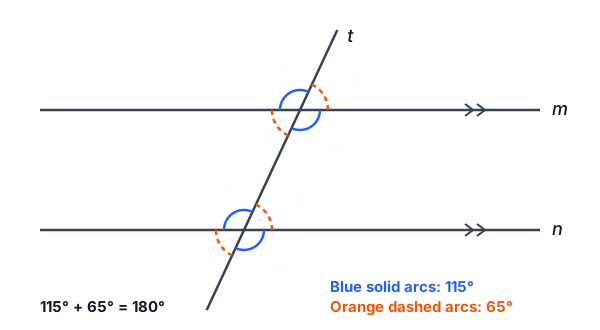
Here is a shortcut. With parallel lines, every one of the eight angles has one of only two sizes. All the acute angles match, and all the obtuse angles match. One acute angle and one obtuse angle always add up to 180^\circ.
Steps to find angles with parallel lines
- Check that the lines are parallel. Look for arrow marks or the words “given m \parallel n.”
- Find the angle you know and the angle you want.
- Name the pair: corresponding, alternate interior, alternate exterior, same-side interior, vertical or linear pair.
- Decide if the angles are congruent (equal) or supplementary (add to 180^\circ).
- Write an equation, solve it, and check that each acute angle plus each obtuse angle makes 180^\circ.
Worked Examples
Examples 1 to 4 use the numbered picture above, where m \parallel n.
Example 1: Name the angle pairs
Name each pair: (a) \angle 2 and \angle 6, (b) \angle 3 and \angle 6, (c) \angle 1 and \angle 8, (d) \angle 4 and \angle 6, (e) \angle 2 and \angle 3.
- \angle 2 and \angle 6: both are above their line and right of t. Same corner, so they are corresponding angles.
- \angle 3 and \angle 6: both are between the lines, on opposite sides of t. They are alternate interior angles.
- \angle 1 and \angle 8: both are outside the lines, on opposite sides of t. They are alternate exterior angles.
- \angle 4 and \angle 6: both are between the lines, on the right of t. They are same-side interior angles.
- \angle 2 and \angle 3: they are across from each other at the same crossing. They are vertical angles.
Example 2: Find all eight angles from one
Given m\angle 1 = 115^\circ, find the other seven angles.
- Linear pair (\angle 1 and \angle 2): m\angle 2 = 180^\circ - 115^\circ = 65^\circ.
- Vertical angles (\angle 1 and \angle 4): m\angle 4 = 115^\circ.
- Vertical angles (\angle 2 and \angle 3): m\angle 3 = 65^\circ.
- Corresponding angles (\angle 1 and \angle 5): m\angle 5 = 115^\circ.
- Corresponding angles (\angle 2 and \angle 6): m\angle 6 = 65^\circ.
- Corresponding angles (\angle 3 and \angle 7): m\angle 7 = 65^\circ.
- Corresponding angles (\angle 4 and \angle 8): m\angle 8 = 115^\circ.
Check: 115^\circ + 65^\circ = 180^\circ. Angles 1, 4, 5 and 8 are 115^\circ. Angles 2, 3, 6 and 7 are 65^\circ.
Example 3: Solve for x with alternate interior angles
m\angle 3 = (3x + 12)^\circ and m\angle 6 = (5x - 20)^\circ. Find x and the angle measure.
Alternate interior angles are congruent, so set them equal:
3x + 12 = 5x - 20
Subtract 3x from both sides (see equations with variables on both sides):
12 = 2x - 20
Add 20 to both sides:
32 = 2x
Divide both sides by 2:
x = 16
Substitute 16 into \angle 3:
3(16) + 12 = 48 + 12 = 60
Check with \angle 6: 5(16) - 20 = 80 - 20 = 60. Both angles are 60^\circ.
Example 4: Prove the alternate interior angles theorem
Given: m \parallel n, cut by transversal t, as in the numbered picture. Prove: \angle 3 \cong \angle 6
| Statement | Reason |
|---|---|
| m \parallel n | Given |
| \angle 2 \cong \angle 6 | Corresponding angles postulate |
| \angle 2 \cong \angle 3 | Vertical angles theorem |
| \angle 3 \cong \angle 6 | Transitive property of congruence |
The idea: \angle 3 matches \angle 2 because they are vertical. \angle 2 matches \angle 6 because they are corresponding. So \angle 3 matches \angle 6. This proof uses the two-column proof format.
Example 5: A brace between two parallel boards
A gate has two parallel boards joined by a slanted brace. The brace makes a (4x + 8)^\circ angle with the top board and a (2x + 22)^\circ angle with the bottom board. The two angles are same-side interior angles. Find each angle.
Same-side interior angles are supplementary, so they add to 180:
(4x + 8) + (2x + 22) = 180
Combine like terms (see combining like terms):
6x + 30 = 180
Subtract 30 from both sides (see two-step equations):
6x = 150
Divide both sides by 6:
x = 25
Substitute 25 into each angle:
4(25) + 8 = 100 + 8 = 108
2(25) + 22 = 50 + 22 = 72
Check: 108^\circ + 72^\circ = 180^\circ. The brace makes a 108^\circ angle with the top board and a 72^\circ angle with the bottom board.
Common Mistakes
| Mistake | Example of the error | Fix |
|---|---|---|
| Using the rules when the lines are not parallel | Saying \angle 3 \cong \angle 6 when the lines have no arrow marks | Check for arrow marks or “given m \parallel n” first. |
| Setting same-side interior angles equal | Writing 4x + 8 = 2x + 22 | Same-side interior angles add to 180^\circ. |
| Mixing up alternate and same-side | Calling \angle 3 and \angle 5 alternate interior angles | Alternate means opposite sides of the transversal. \angle 3 and \angle 5 are on the same side. |
| Mixing up interior and exterior | Calling \angle 1 and \angle 8 alternate interior angles | Interior means between the two lines. \angle 1 and \angle 8 are outside them. |
| Stopping at x | Answering “x = 16” when the question asks for the angle | Substitute x back in to get the angle measure. |
More About Parallel Lines and Transversals
- Perpendicular transversal: if a transversal is perpendicular to one of two parallel lines, it is perpendicular to the other one too. All eight angles are 90^\circ.
- Slopes: on a coordinate grid, parallel lines have the same slope. See parallel and perpendicular lines for the algebra side.
- Constructions: copying an angle at a second point on a transversal draws a parallel line. That is the parallel line step in basic constructions, and the corresponding angles postulate is why it works.
- Working backward: if corresponding angles are congruent, the lines must be parallel. That idea is the next lesson, Proving Lines Parallel.
- Same plane: all of these rules are about lines in one plane. Lines in different planes can miss each other without being parallel (see points, lines and planes).
Practice Problems
Problems 1 to 5 and 9 use the numbered picture above, where m \parallel n.
- Name the pair: \angle 4 and \angle 8.
- Name the pair: \angle 4 and \angle 5.
- Name the pair: \angle 2 and \angle 7.
- m\angle 7 = 58^\circ. Find m\angle 2 and m\angle 5.
- m\angle 3 = 47^\circ. Find the other seven angles.
- Corresponding angles measure (6x - 14)^\circ and (4x + 26)^\circ. Find x and the angle.
- Same-side interior angles \angle 3 and \angle 5 measure (x + 15)^\circ and (2x + 15)^\circ. Find x and both angles.
- Alternate exterior angles measure (7x + 4)^\circ and (9x - 12)^\circ. Find x and the angle.
- Complete the proof. Given: m \parallel n. Prove: \angle 4 and \angle 6 are supplementary. Statements: (1) m \parallel n; (2) \angle 2 \cong \angle 6; (3) m\angle 2 = m\angle 6; (4) m\angle 2 + m\angle 4 = 180^\circ; (5) m\angle 6 + m\angle 4 = 180^\circ; (6) \angle 4 and \angle 6 are supplementary. Give a reason for each statement.
- The lines in a parking lot are parallel, and the curb crosses all of them. At one line, the acute angle with the curb is 62^\circ. What are the acute and obtuse angles where the curb meets the next line? Which rules tell you?
Show answers
- Same corner at each crossing (below the line, right of t), so they are corresponding angles.
- Both are between the lines, on opposite sides of t, so they are alternate interior angles.
- Both are outside the lines, on opposite sides of t, so they are alternate exterior angles.
- Alternate exterior angles theorem: m\angle 2 = 58^\circ. Linear pair (\angle 5 and \angle 7): m\angle 5 = 180^\circ - 58^\circ = 122^\circ.
- Vertical angles: m\angle 2 = 47^\circ. Linear pair: m\angle 1 = 180^\circ - 47^\circ = 133^\circ. Vertical angles: m\angle 4 = 133^\circ. Corresponding angles: m\angle 5 = 133^\circ, m\angle 6 = 47^\circ, m\angle 7 = 47^\circ, m\angle 8 = 133^\circ.
- Corresponding angles are congruent: 6x - 14 = 4x + 26. Subtract 4x from both sides: 2x - 14 = 26. Add 14 to both sides: 2x = 40. Divide both sides by 2: x = 20. Substitute: 6(20) - 14 = 120 - 14 = 106. Check: 4(20) + 26 = 80 + 26 = 106. The angle is 106^\circ.
- Same-side interior angles are supplementary: (x + 15) + (2x + 15) = 180. Combine like terms: 3x + 30 = 180. Subtract 30 from both sides: 3x = 150. Divide both sides by 3: x = 50. Substitute: m\angle 3 = 50 + 15 = 65^\circ and m\angle 5 = 2(50) + 15 = 100 + 15 = 115^\circ. Check: 65 + 115 = 180.
- Alternate exterior angles are congruent: 7x + 4 = 9x - 12. Subtract 7x from both sides: 4 = 2x - 12. Add 12 to both sides: 16 = 2x. Divide both sides by 2: x = 8. Substitute: 7(8) + 4 = 56 + 4 = 60. Check: 9(8) - 12 = 72 - 12 = 60. The angle is 60^\circ.
- Reasons: (1) Given; (2) Corresponding angles postulate; (3) Definition of congruent angles; (4) Linear pair postulate (\angle 2 and \angle 4 form a linear pair); (5) Substitution property of equality (put m\angle 6 in for m\angle 2); (6) Definition of supplementary angles.
- Corresponding angles postulate: the acute angle at the next line is also 62^\circ. Linear pair: the obtuse angle is 180^\circ - 62^\circ = 118^\circ. So the angles are 62^\circ and 118^\circ.
FAQ
What is a transversal in geometry?
A transversal is a line that crosses two or more lines in the same plane at different points. With two lines, it makes eight angles.
Are alternate interior angles always congruent?
No. Alternate interior angles are congruent only when the two lines are parallel. If the lines are not parallel, the angles can have different sizes.
What is the difference between corresponding and alternate interior angles?
Corresponding angles sit in the same corner at each crossing, like \angle 1 and \angle 5. Alternate interior angles are both between the lines but on opposite sides of the transversal, like \angle 3 and \angle 6.
Do same-side interior angles add up to 180 degrees?
Yes, when the lines are parallel. Same-side interior angles, also called consecutive interior angles, are supplementary, so they add up to 180^\circ.
Summary
- A transversal crosses two lines and makes eight angles: four interior and four exterior.
- When the lines are parallel, corresponding, alternate interior and alternate exterior angles are congruent.
- When the lines are parallel, same-side interior angles are supplementary.
- Every angle is one of two sizes, and the two sizes add up to 180^\circ.
- Check that the lines are parallel before you use any of these rules.
Previous lesson: Proving Angle Relationships
Next lesson: Proving Lines Parallel (coming soon)
Back to the Geometry Index