
Proving Lines Parallel
Proving lines parallel means using angles to show that two lines never meet. When a transversal crosses two lines, the lines are parallel if corresponding angles are congruent, alternate interior or alternate exterior angles are congruent, or same-side interior angles add up to 180^\circ. These rules are the converses of the parallel lines theorems.
Before this lesson: You should know Parallel Lines and Transversals, Conditional Statements and Two-Column Proofs.
Working Backward: From Angles to Parallel Lines
In the last lesson, you started with parallel lines and found the angles. Now you go the other way. You start with the angles and decide if the lines are parallel.
Think of two train tracks crossed by a road. If the road meets both tracks at the same angle, the tracks lean the same way. They can never get closer, so they never meet. If the angles are different, one track tilts toward the other, and they cross somewhere.
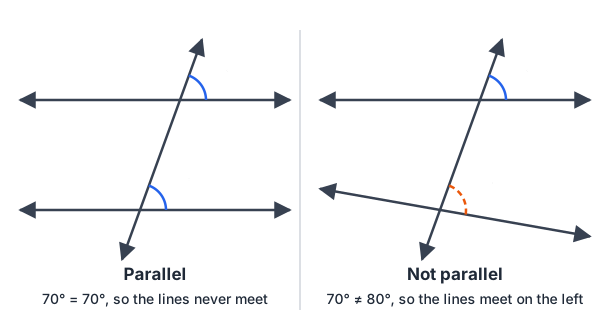
A converse swaps the hypothesis and the conclusion of an if-then statement. A converse is not always true. But the converses of the parallel lines rules are true, so you can use them as reasons in a proof.
How to Prove Lines Parallel: The Converse Theorems
Each rule below starts with the angles and ends with “the lines are parallel.” The first one is a postulate, so it is accepted without proof. The others are theorems.
| Rule | What it says |
|---|---|
| Corresponding angles converse | If two lines are cut by a transversal so that corresponding angles are congruent, then the lines are parallel. |
| Alternate interior angles converse | If two lines are cut by a transversal so that alternate interior angles are congruent, then the lines are parallel. |
| Alternate exterior angles converse | If two lines are cut by a transversal so that alternate exterior angles are congruent, then the lines are parallel. |
| Same-side interior angles converse | If two lines are cut by a transversal so that same-side interior angles are supplementary, then the lines are parallel. |
| Transitive property of parallel lines | If two lines are parallel to the same line, then they are parallel to each other. |
\angle 3 \cong \angle 6 \;\Rightarrow\; j \parallel k \qquad m\angle 3 + m\angle 5 = 180^\circ \;\Rightarrow\; j \parallel k
The examples below use this picture. Lines j and k have no arrow marks, so you can’t assume they are parallel. You have to prove it.
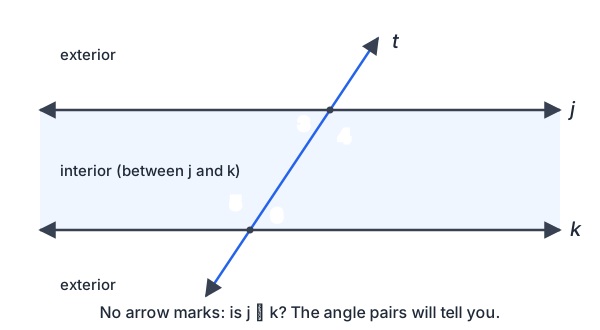
| Pair | Pairs in the picture | To prove j ∥ k, the angles must be |
|---|---|---|
| Corresponding | \angle 1 and \angle 5, \angle 2 and \angle 6, \angle 3 and \angle 7, \angle 4 and \angle 8 | Congruent |
| Alternate interior | \angle 3 and \angle 6, \angle 4 and \angle 5 | Congruent |
| Alternate exterior | \angle 1 and \angle 8, \angle 2 and \angle 7 | Congruent |
| Same-side interior | \angle 3 and \angle 5, \angle 4 and \angle 6 | Supplementary (add to 180^\circ) |
Steps to prove two lines are parallel
- Find the two lines you want to prove parallel and the transversal that crosses them.
- Pick two angles, one at each crossing. Angles at the same crossing, like vertical angles, can’t prove anything about parallel lines.
- Name the pair: corresponding, alternate interior, alternate exterior or same-side interior.
- Check the angles. The first three pairs must be congruent. Same-side interior angles must add up to 180^\circ.
- Write the conclusion, j \parallel k, and give the matching converse as the reason.
Worked Examples
Example 1: Decide if the lines are parallel
Use the numbered picture. For each set of angles, decide if j \parallel k. (a) m\angle 2 = 64^\circ and m\angle 6 = 64^\circ. (b) m\angle 4 = 110^\circ and m\angle 6 = 70^\circ. (c) m\angle 3 = 75^\circ and m\angle 6 = 80^\circ.
- (a) \angle 2 and \angle 6 are both above their line and right of t. They are corresponding angles. Both are 64^\circ, so they are congruent. By the corresponding angles converse, j \parallel k.
- (b) \angle 4 and \angle 6 are both between the lines and right of t. They are same-side interior angles. Add them: 110^\circ + 70^\circ = 180^\circ. They are supplementary, so by the same-side interior angles converse, j \parallel k.
- (c) \angle 3 and \angle 6 are between the lines, on opposite sides of t. They are alternate interior angles. But 75^\circ \neq 80^\circ, so they are not congruent. The lines are not parallel.
Example 2: Find x so the lines are parallel
m\angle 4 = (4x - 7)^\circ and m\angle 5 = (2x + 29)^\circ. Find the value of x that makes j \parallel k.
\angle 4 and \angle 5 are alternate interior angles. The lines are parallel when these angles are congruent, so set them equal:
4x - 7 = 2x + 29
Subtract 2x from both sides (see equations with variables on both sides):
2x - 7 = 29
Add 7 to both sides:
2x = 36
Divide both sides by 2:
x = 18
Substitute 18 into \angle 4:
4(18) - 7 = 72 - 7 = 65
Check with \angle 5: 2(18) + 29 = 36 + 29 = 65. Both angles are 65^\circ, so j \parallel k when x = 18.
Example 3: Use same-side interior angles
m\angle 3 = (3x + 10)^\circ and m\angle 5 = (5x - 6)^\circ. Find the value of x that makes j \parallel k, and find both angles.
\angle 3 and \angle 5 are same-side interior angles. The lines are parallel when these angles are supplementary, so they must add up to 180:
(3x + 10) + (5x - 6) = 180
Combine like terms (see combining like terms):
8x + 4 = 180
Subtract 4 from both sides (see two-step equations):
8x = 176
Divide both sides by 8:
x = 22
Substitute 22 into each angle:
3(22) + 10 = 66 + 10 = 76
5(22) - 6 = 110 - 6 = 104
Check: 76^\circ + 104^\circ = 180^\circ. When x = 22, the angles are 76^\circ and 104^\circ, and j \parallel k. Notice the angles are not equal. Same-side interior angles only need to add to 180^\circ.
Example 4: Prove the alternate interior angles converse
Given: \angle 3 \cong \angle 6, in the numbered picture. Prove: j \parallel k
| Statement | Reason |
|---|---|
| \angle 3 \cong \angle 6 | Given |
| \angle 2 \cong \angle 3 | Vertical angles theorem |
| \angle 2 \cong \angle 6 | Transitive property of congruence |
| j \parallel k | Corresponding angles converse |
The idea: \angle 2 matches \angle 3 because they are vertical angles. \angle 3 matches \angle 6 because it is given. So \angle 2 matches \angle 6. Those two are corresponding angles, so the lines are parallel. The vertical angles theorem comes from proving angle relationships.
Example 5: Are the shelves parallel?
A carpenter puts up two shelves and joins them with a slanted brace on the left. Under the top shelf, the brace makes a 58^\circ angle. Above the bottom shelf, it makes a 122^\circ angle. Both angles are between the shelves, on the same side of the brace. Are the shelves parallel?
The brace is the transversal, and the two angles are same-side interior angles. Add them:
58 + 122 = 180
The angles are supplementary. By the same-side interior angles converse, the shelves are parallel.
Now say the bottom angle were 120^\circ instead. Then 58^\circ + 120^\circ = 178^\circ, which is not 180^\circ, so the shelves would not be parallel. A sum less than 180^\circ means the shelves get closer on that side, the side with the brace.
Common Mistakes
| Mistake | Example of the error | Fix |
|---|---|---|
| Giving the theorem instead of the converse | Writing “corresponding angles postulate” as the reason for j \parallel k | The postulate starts with parallel lines. To prove lines parallel, use the corresponding angles converse. |
| Using two angles at the same crossing | Saying \angle 1 \cong \angle 4, so j \parallel k | Vertical angles are always congruent. Pick one angle at each line. |
| Setting same-side interior angles equal | Writing 3x + 10 = 5x - 6 in Example 3 | Same-side interior angles must add up to 180^\circ. |
| Assuming lines are parallel because they look it | Saying j \parallel k with no angle facts | A picture is not a reason. Show an angle pair that works. |
| Mixing up the lines | Using angles made by a different transversal or a third line | Both angles must be made by the same transversal crossing the two lines you want to prove parallel. |
Theorems or Converses: Which One Do You Need?
| You know… | You want… | Use |
|---|---|---|
| The lines are parallel | An angle measure | A parallel lines theorem from parallel lines and transversals |
| Two angle measures | To show the lines are parallel | A converse from this lesson |
| Two lines are each parallel to a third line | To show they are parallel to each other | The transitive property of parallel lines |
- Slopes: on a coordinate grid, you can also prove lines parallel by showing they have the same slope. See parallel and perpendicular lines.
- Constructions: to draw a parallel line, you copy an angle so the corresponding angles match. The corresponding angles converse is why the copy works. See basic constructions.
- Perpendicular lines: two lines perpendicular to the same line make 90^\circ corresponding angles, so they are parallel. The next lesson, Proofs with Perpendicular Lines, builds on this.
Practice Problems
Problems 1 to 9 use the numbered picture above.
- m\angle 1 = 115^\circ and m\angle 5 = 115^\circ. Is j \parallel k? Give the reason.
- m\angle 4 = 98^\circ and m\angle 5 = 98^\circ. Is j \parallel k? Give the reason.
- m\angle 2 = 61^\circ and m\angle 7 = 63^\circ. Is j \parallel k? Explain.
- m\angle 4 = 82^\circ and m\angle 6 = 98^\circ. Is j \parallel k? Give the reason.
- m\angle 3 = 90^\circ and m\angle 5 = 90^\circ. Is j \parallel k? Give the reason.
- m\angle 1 = (5x + 4)^\circ and m\angle 5 = (3x + 30)^\circ. Find x so that j \parallel k, and find the angle.
- m\angle 2 = (6x - 11)^\circ and m\angle 7 = (4x + 13)^\circ. Find x so that j \parallel k, and find the angle.
- m\angle 4 = (2x + 18)^\circ and m\angle 6 = (4x - 6)^\circ. Find x so that j \parallel k, and find both angles.
- Complete the proof. Given: \angle 1 \cong \angle 8. Prove: j \parallel k. Statements: (1) \angle 1 \cong \angle 8; (2) \angle 1 \cong \angle 4; (3) \angle 4 \cong \angle 8; (4) j \parallel k. Give a reason for each statement.
- River Road crosses Main Street and a planned new street. At Main Street, River Road makes a 74^\circ angle on one side. The planner measures the alternate interior angle at the new street. What must it be for the streets to be parallel? If it is 76^\circ, are the streets parallel?
Show answers
- Corresponding angles, and 115^\circ = 115^\circ. Yes, j \parallel k by the corresponding angles converse.
- Alternate interior angles, and 98^\circ = 98^\circ. Yes, j \parallel k by the alternate interior angles converse.
- Alternate exterior angles, but 61^\circ \neq 63^\circ. They are not congruent, so the lines are not parallel.
- Same-side interior angles: 82^\circ + 98^\circ = 180^\circ. They are supplementary, so j \parallel k by the same-side interior angles converse.
- Same-side interior angles: 90^\circ + 90^\circ = 180^\circ. They are supplementary, so j \parallel k by the same-side interior angles converse.
- Corresponding angles must be congruent: 5x + 4 = 3x + 30. Subtract 3x from both sides: 2x + 4 = 30. Subtract 4 from both sides: 2x = 26. Divide both sides by 2: x = 13. Substitute: 5(13) + 4 = 65 + 4 = 69. Check: 3(13) + 30 = 39 + 30 = 69. The angle is 69^\circ.
- Alternate exterior angles must be congruent: 6x - 11 = 4x + 13. Subtract 4x from both sides: 2x - 11 = 13. Add 11 to both sides: 2x = 24. Divide both sides by 2: x = 12. Substitute: 6(12) - 11 = 72 - 11 = 61. Check: 4(12) + 13 = 48 + 13 = 61. The angle is 61^\circ.
- Same-side interior angles must be supplementary: (2x + 18) + (4x - 6) = 180. Combine like terms: 6x + 12 = 180. Subtract 12 from both sides: 6x = 168. Divide both sides by 6: x = 28. Substitute: m\angle 4 = 2(28) + 18 = 56 + 18 = 74^\circ and m\angle 6 = 4(28) - 6 = 112 - 6 = 106^\circ. Check: 74 + 106 = 180.
- Reasons: (1) Given; (2) Vertical angles theorem; (3) Transitive property of congruence; (4) Corresponding angles converse (\angle 4 and \angle 8 are corresponding angles).
- Alternate interior angles must be congruent, so the angle at the new street must be 74^\circ. If it is 76^\circ, then 74^\circ \neq 76^\circ, so the streets are not parallel.
FAQ
What are the ways to prove lines are parallel?
Show that a transversal makes congruent corresponding angles, congruent alternate interior angles, congruent alternate exterior angles, or supplementary same-side interior angles. You can also show both lines are parallel to a third line, or on a graph, that they have the same slope.
What is the converse of the corresponding angles postulate?
It says: if two lines are cut by a transversal so that corresponding angles are congruent, then the lines are parallel. It is accepted as a postulate, and the other converses are proved from it.
Can vertical angles prove that lines are parallel?
No. Vertical angles are at the same crossing, and they are always congruent. To prove lines parallel, you need one angle at each of the two lines.
Are two lines parallel to the same line parallel to each other?
Yes. If a \parallel b and b \parallel c, then a \parallel c. This is the transitive property of parallel lines.
Summary
- To prove lines parallel, start with angle facts and use a converse.
- Congruent corresponding, alternate interior or alternate exterior angles mean the lines are parallel.
- Supplementary same-side interior angles mean the lines are parallel.
- Use one angle at each line. Vertical angles and linear pairs can’t prove lines parallel.
- When you solve for x, substitute back and check the angles.
Previous lesson: Parallel Lines and Transversals
Next lesson: Proofs with Perpendicular Lines (coming soon)
Back to the Geometry Index