
Proofs with Perpendicular Lines
Proofs with perpendicular lines use theorems about right angles to show that lines are perpendicular or parallel. Perpendicular lines meet at a 90^\circ angle. If a congruent linear pair forms, the lines are perpendicular. Two lines perpendicular to the same line are parallel. The shortest path from a point to a line is perpendicular.
Before this lesson: You should know Proving Lines Parallel, Proving Angle Relationships and Parallel and Perpendicular Lines.
What Makes Lines Perpendicular?
Think of the corner of a sheet of paper. The two edges meet in a perfect square corner. Lines that meet like that are perpendicular. The symbol is \perp, so \ell \perp m means line \ell is perpendicular to line m.
In a picture, a small square at the crossing marks the right angle. When two lines are perpendicular, all four angles at the crossing are right angles. That’s because the angles form vertical angles and linear pairs.
In the last lesson, you used angles to prove lines parallel. Here you add right angles to the toolbox. The picture shows the three theorems you will use most.
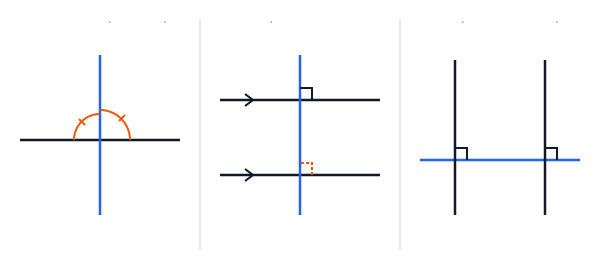
Theorems About Perpendicular Lines
These theorems all work for lines in the same plane. Each one is an if-then statement you can use as a reason in a proof.
| Theorem | If… | Then… |
|---|---|---|
| Linear pair perpendicular theorem | Two lines meet and form a linear pair of congruent angles | The lines are perpendicular |
| Perpendicular lines form right angles | \ell \perp m | The lines form four right angles |
| Perpendicular sides of adjacent angles | Two adjacent acute angles have outer sides that are perpendicular | The angles are complementary (they add to 90^\circ) |
| Perpendicular transversal theorem | a \parallel b and t \perp a | t \perp b |
| Lines perpendicular to a transversal theorem | m \perp t and n \perp t | m \parallel n |
Why does a congruent linear pair give a right angle? A linear pair adds to 180^\circ. If the two angles are equal, each one is half of 180^\circ, which is 90^\circ.
Distance from a point to a line
The distance from a point to a line is the length of the perpendicular segment from the point to the line. It is the shortest path. Any slanted path to the line is longer.
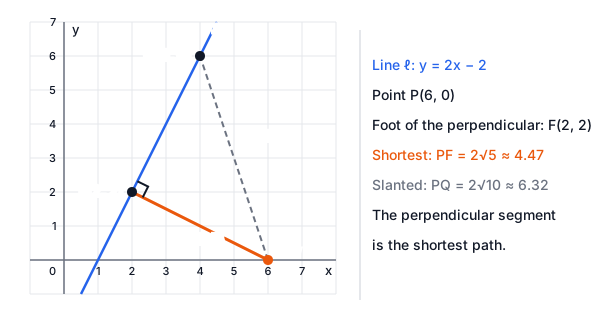
Steps for proofs with perpendicular lines
- Mark the diagram. Show right angles with a small square and parallel lines with arrows.
- Write what is given. Look for right angles, linear pairs and parallel lines.
- Pick the theorem that turns your facts into the goal. Check the table above.
- Write one statement and one reason per line. End with the statement you had to prove.
- For algebra problems, set up the equation from the theorem, solve it, and check the angles.
Worked Examples
Example 1: Adjacent angles with perpendicular sides
Ray \overrightarrow{BA} is perpendicular to ray \overrightarrow{BC}. Ray \overrightarrow{BD} is between them. Find x if m\angle ABD = (2x + 5)^\circ and m\angle DBC = (3x - 10)^\circ.
The outer sides are perpendicular, so the two angles are complementary. They add to 90^\circ.
- Write the equation: (2x + 5) + (3x - 10) = 90
- Combine like terms (see combining like terms): 5x - 5 = 90
- Add 5 to both sides: 5x = 95
- Divide both sides by 5: x = 19
Check: m\angle ABD = 2(19) + 5 = 43^\circ and m\angle DBC = 3(19) - 10 = 47^\circ. Since 43 + 47 = 90, the answer works.
Example 2: Is it a congruent linear pair?
Lines j and k cross. Two angles that form a linear pair measure (5x + 15)^\circ and (7x - 15)^\circ. Find x. Are the lines perpendicular?
A linear pair adds to 180^\circ.
- Write the equation: (5x + 15) + (7x - 15) = 180
- Combine like terms: 12x = 180
- Divide both sides by 12: x = 15
Substitute: 5(15) + 15 = 90 and 7(15) - 15 = 90. Both angles are 90^\circ, so they are a congruent linear pair. By the linear pair perpendicular theorem, j \perp k.
Example 3: Prove the perpendicular transversal theorem
Lines a and b are parallel, and transversal t crosses both. Use the numbering from parallel lines and transversals: \angle 1 is above line a on the left of t, and \angle 5 is above line b on the left of t.
Given: a \parallel b, t \perp a Prove: t \perp b
| Statement | Reason |
|---|---|
| a \parallel b | Given |
| t \perp a | Given |
| \angle 1 \text{ is a right angle} | Perpendicular lines form right angles |
| m\angle 1 = 90^\circ | Definition of a right angle |
| \angle 1 \cong \angle 5 | Corresponding angles postulate |
| m\angle 5 = m\angle 1 | Definition of congruent angles |
| m\angle 5 = 90^\circ | Substitution property of equality |
| \angle 5 \text{ is a right angle} | Definition of a right angle |
| t \perp b | Definition of perpendicular lines |
The idea: parallel lines copy every angle from one crossing to the other. A right angle at line a becomes a right angle at line b.
Example 4: Which lines are parallel?
All of these lines lie in one plane. Line m is perpendicular to line t. Line n is perpendicular to line t. Line p is perpendicular to line n. What can you say about each pair?
- m \parallel n: both are perpendicular to t. Reason: lines perpendicular to a transversal theorem.
- p \perp m: line p is perpendicular to n, and n \parallel m. Reason: perpendicular transversal theorem.
- p \parallel t: both are perpendicular to n. Reason: lines perpendicular to a transversal theorem. (They could also be the same line.)
Example 5: The shortest path to a trail
On a park map, a straight trail follows the line y = -x + 8. A fountain sits at (1, 1). Each grid unit is 10 meters. The park wants the shortest possible path from the fountain to the trail. Where should it meet the trail, and how long is it? Use \sqrt{2} \approx 1.41.
The shortest path is perpendicular to the trail. The trail’s slope is -1, so the path’s slope is the opposite reciprocal, 1 (see parallel and perpendicular lines).
- Write the path through (1, 1) with slope 1 (see point-slope form): y - 1 = 1(x - 1)
- Add 1 to both sides and simplify: y = x
- Set the two lines equal to find where they meet: x = -x + 8
- Add x to both sides (see equations with variables on both sides): 2x = 8
- Divide both sides by 2: x = 4
- Substitute into y = x: y = 4
The path meets the trail at (4, 4). Now find its length with the distance formula.
- Write the distance formula: d = \sqrt{(4 - 1)^2 + (4 - 1)^2}
- Subtract: d = \sqrt{3^2 + 3^2}
- Square each number: d = \sqrt{9 + 9}
- Add: d = \sqrt{18}
- Simplify the square root (see simplifying square roots): d = 3\sqrt{2}
So the path is 3\sqrt{2} \approx 3(1.41) = 4.23 units. Each unit is 10 meters, so the path is about 4.23 \cdot 10 = 42.3 meters long.
Common Mistakes
| Mistake | Example of the error | Fix |
|---|---|---|
| Calling any linear pair perpendicular | Angles of 80^\circ and 100^\circ form a linear pair, so j \perp k | The linear pair must be congruent. Only 90^\circ and 90^\circ work. |
| Using 180 for perpendicular sides | Writing (2x + 5) + (3x - 10) = 180 | Adjacent angles with perpendicular outer sides add to 90^\circ, not 180^\circ. |
| Measuring a slanted path as the distance | Using PQ instead of the perpendicular segment PF | The distance to a line is always along the perpendicular segment. |
| Using the wrong perpendicular slope | For slope -1, using slope -1 again for the path | Flip the slope and change its sign. The perpendicular slope to -1 is 1. |
| Forgetting the same-plane rule | Saying two lines perpendicular to one line must be parallel, for lines in space | The theorem only works when all the lines lie in one plane. |
Perpendicular Lines on the Coordinate Plane and with Constructions
On a grid, you can prove lines perpendicular with slopes. Two lines are perpendicular when their slopes multiply to -1. For example, slopes 2 and -\frac{1}{2} give 2 \cdot \left(-\frac{1}{2}\right) = -1.
To find the distance from a point to a line on a grid, follow the same steps as Example 5. Write the perpendicular line through the point. Find where the two lines meet. Then use the distance formula.
Horizontal and vertical lines are a special case. The distance from (-2, 4) to the line x = 5 is just 5 - (-2) = 7 units, since the shortest path is horizontal.
With a compass and straightedge, you can draw a perpendicular line through a point. That uses the same arcs as the perpendicular bisector in basic constructions.
Practice Problems
- Lines j and k are perpendicular. One angle where they cross measures (3x + 15)^\circ. Find x.
- Two lines cross and form a linear pair of angles, (8x - 6)^\circ and (5x + 30)^\circ. Find x. Are the lines perpendicular?
- Two lines cross and form a linear pair of angles, (4x + 10)^\circ and (6x - 10)^\circ. Find x. Are the lines perpendicular?
- Two adjacent acute angles have perpendicular outer sides. They measure (5x - 4)^\circ and (3x + 14)^\circ. Find both angles.
- Lines a and b are parallel. Line t is perpendicular to a. What can you conclude about t and b? Name the theorem.
- In a plane, line r is perpendicular to line s, and line q is perpendicular to line s. What can you conclude? Name the theorem.
- Complete the proof. Given: \angle 1 and \angle 2 are a linear pair formed by lines \ell and m, and \angle 1 \cong \angle 2. Prove: \ell \perp m. Give the reason for each statement: (a) m\angle 1 + m\angle 2 = 180^\circ; (b) m\angle 1 = m\angle 2; (c) m\angle 1 + m\angle 1 = 180^\circ; (d) 2(m\angle 1) = 180^\circ; (e) m\angle 1 = 90^\circ; (f) \angle 1 is a right angle; (g) \ell \perp m.
- Find the distance from the point (0, 5) to the line y = x - 1. Give an exact answer.
- Find the distance from the point (-3, 2) to the line y = -4.
- A builder nails two wall studs to a floor board. Both studs are perpendicular to the board. A slanted brace crosses both studs. It makes a 52^\circ angle with the first stud. Why are the studs parallel? What angle does the brace make with the second stud in the matching (corresponding) position?
Show answers
- Perpendicular lines form right angles. Write the equation: 3x + 15 = 90. Subtract 15 from both sides: 3x = 75. Divide both sides by 3 (see two-step equations): x = 25.
- A linear pair adds to 180^\circ: (8x - 6) + (5x + 30) = 180. Combine like terms: 13x + 24 = 180. Subtract 24 from both sides: 13x = 156. Divide both sides by 13: x = 12. The angles are 8(12) - 6 = 90^\circ and 5(12) + 30 = 90^\circ. They are a congruent linear pair, so the lines are perpendicular.
- (4x + 10) + (6x - 10) = 180. Combine like terms: 10x = 180. Divide both sides by 10: x = 18. The angles are 4(18) + 10 = 82^\circ and 6(18) - 10 = 98^\circ. They are not congruent, so the lines are not perpendicular.
- The angles are complementary: (5x - 4) + (3x + 14) = 90. Combine like terms: 8x + 10 = 90. Subtract 10 from both sides: 8x = 80. Divide both sides by 8: x = 10. The angles are 5(10) - 4 = 46^\circ and 3(10) + 14 = 44^\circ. Check: 46 + 44 = 90.
- t \perp b, by the perpendicular transversal theorem.
- r \parallel q, by the lines perpendicular to a transversal theorem.
- (a) Linear pair postulate. (b) Definition of congruent angles. (c) Substitution property of equality. (d) Simplify (combine like terms). (e) Division property of equality. (f) Definition of a right angle. (g) Definition of perpendicular lines.
- The line’s slope is 1, so the perpendicular slope is -1. The perpendicular line through (0, 5) is y = -x + 5. Set the lines equal: x - 1 = -x + 5. Add x to both sides: 2x - 1 = 5. Add 1 to both sides: 2x = 6. Divide both sides by 2: x = 3. Substitute: y = 3 - 1 = 2, so they meet at (3, 2). Distance: \sqrt{(3 - 0)^2 + (2 - 5)^2}. Square each part: \sqrt{9 + 9}. Add: \sqrt{18}. Simplify: 3\sqrt{2}.
- The line y = -4 is horizontal, so the shortest path is straight down. The distance is 2 - (-4) = 6 units.
- Both studs are perpendicular to the same board, so they are parallel by the lines perpendicular to a transversal theorem. The brace is a transversal of the parallel studs. By the corresponding angles postulate, it also makes a 52^\circ angle with the second stud.
FAQ
How do you prove two lines are perpendicular?
Show that they form a right angle, or a linear pair of congruent angles. On a grid, show that their slopes multiply to -1.
What is the perpendicular transversal theorem?
If a line is perpendicular to one of two parallel lines, it is perpendicular to the other one too. It comes from the corresponding angles postulate.
If two lines are perpendicular to the same line, are they parallel?
Yes, when all three lines lie in the same plane. In space, the two lines could point in different directions without meeting.
What is the shortest distance from a point to a line?
It is the length of the perpendicular segment from the point to the line. Every other segment from the point to the line is longer.
Summary
- Perpendicular lines meet at right angles and form four 90^\circ angles.
- A linear pair of congruent angles means the lines are perpendicular.
- Adjacent acute angles with perpendicular outer sides add to 90^\circ.
- A line perpendicular to one of two parallel lines is perpendicular to both.
- Two lines perpendicular to the same line are parallel, in a plane.
- The distance from a point to a line is measured along the perpendicular segment.
Previous lesson: Proving Lines Parallel
Next lesson: Translations (coming soon)
Back to the Geometry Index