
Translations
A translation slides every point of a figure the same distance in the same direction. On a coordinate grid, the rule (x, y) \to (x + a, y + b) moves each point a units left or right and b units up or down. The image has the same size and shape as the original figure.
Before this lesson: You should know the Coordinate Plane, Adding and Subtracting Integers and the Distance Formula.
What Is a Translation?
Picture a book on a desk. Push it across the desk without turning it. Every corner of the book moves the same way. That kind of move is a translation, or a slide.
A translation is one kind of transformation. A transformation is a rule that moves or changes a figure. The figure you start with is the pre-image. The figure you end with is the image.
We name image points with a prime mark. Point A moves to point A', read “A prime.” So triangle ABC moves to triangle A'B'C'.
A translation is a rigid motion. That means it keeps every length and every angle the same. The image is congruent to the pre-image. It also faces the same way, because nothing turns or flips.
Translation Rule
On a coordinate grid, a translation adds the same number to every x-coordinate. It also adds the same number to every y-coordinate.
(x, y) \to (x + a,\ y + b)
The number a moves points left or right. The number b moves points up or down. You can also write the move as a translation vector, \langle a, b \rangle. A vector is an arrow with a length and a direction.
| Words | Rule | Vector |
|---|---|---|
| 4 right | (x, y) \to (x + 4, y) | \langle 4, 0 \rangle |
| 3 left | (x, y) \to (x - 3, y) | \langle -3, 0 \rangle |
| 2 up | (x, y) \to (x, y + 2) | \langle 0, 2 \rangle |
| 5 right and 3 down | (x, y) \to (x + 5, y - 3) | \langle 5, -3 \rangle |
Right and up use plus signs. Left and down use minus signs.
How to Translate a Figure
- Find a and b from the rule, the vector or the words.
- Add a to the x-coordinate of each vertex.
- Add b to the y-coordinate of each vertex.
- Plot the new points. Connect them in the same order.
- Label the image with prime marks.
- Check: every vertex should move by the same arrow.
Worked Examples
Example 1: Translate a point
Translate P(2, -3) using the rule (x, y) \to (x - 6, y + 4).
- Read the rule: a = -6 and b = 4. That is 6 left and 4 up.
- Subtract 6 from the x-coordinate (see adding and subtracting integers): 2 - 6 = -4
- Add 4 to the y-coordinate: -3 + 4 = 1
- Write the image point: P'(-4, 1)
Answer: P'(-4, 1)
Example 2: Translate a triangle
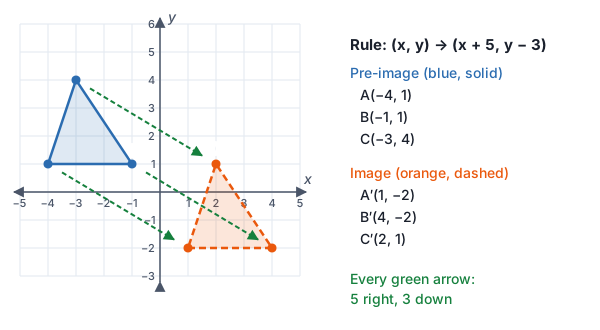
Triangle ABC has vertices A(-4, 1), B(-1, 1) and C(-3, 4). Translate it 5 units right and 3 units down. This is the triangle in the graph above.
Write the rule first. Right 5 means add 5 to x. Down 3 means subtract 3 from y. So the rule is (x, y) \to (x + 5, y - 3).
| Vertex | Add 5 to x | Subtract 3 from y | Image |
|---|---|---|---|
| A(-4, 1) | -4 + 5 = 1 | 1 - 3 = -2 | A'(1, -2) |
| B(-1, 1) | -1 + 5 = 4 | 1 - 3 = -2 | B'(4, -2) |
| C(-3, 4) | -3 + 5 = 2 | 4 - 3 = 1 | C'(2, 1) |
Plot A', B' and C' and connect them. Check one side. AB runs from x = −4 to x = −1, so AB = 3. A'B' runs from x = 1 to x = 4, so A'B' = 3. The length stayed the same.
Answer: A'(1, -2), B'(4, -2), C'(2, 1)
Example 3: Find the rule from a point and its image
Point Q(3, -2) is translated to Q'(-1, 5). Write the rule. Then use it to translate R(0, 6).
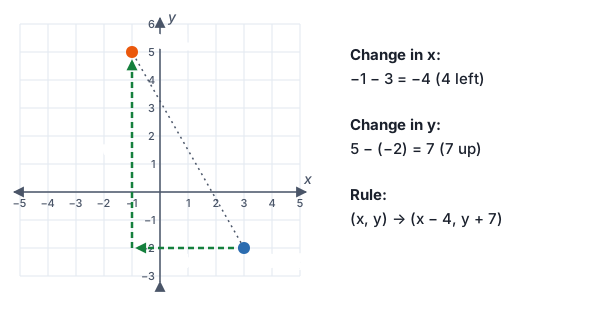
- Find a. Subtract the x-coordinates, image minus pre-image: a = -1 - 3 = -4
- Find b. Subtract the y-coordinates, image minus pre-image: b = 5 - (-2)
- Change subtracting a negative to adding: b = 5 + 2 = 7
- Write the rule: (x, y) \to (x - 4, y + 7). That is 4 left and 7 up.
- Translate R. Subtract 4 from the x-coordinate: 0 - 4 = -4
- Add 7 to the y-coordinate: 6 + 7 = 13
Answer: The rule is (x, y) \to (x - 4, y + 7), and R'(-4, 13).
Example 4: Work backward to the pre-image
After the translation (x, y) \to (x + 3, y - 4), the image is D'(2, -5). Find the pre-image D.
To undo a translation, do the opposite move. The rule added 3 to x, so subtract 3. The rule subtracted 4 from y, so add 4.
- Undo the x-move. Subtract 3: 2 - 3 = -1
- Undo the y-move. Add 4: -5 + 4 = -1
- Write the pre-image: D(-1, -1)
- Check. Add 3 to x: -1 + 3 = 2
- Check. Subtract 4 from y: -1 - 4 = -5. That gives D'(2, -5), so the answer works.
Answer: D(-1, -1)
Example 5: Word problem
A robot in a warehouse moves a shelf. On the floor plan, each grid unit is 1 meter. The shelf’s corners are at (1, 1), (3, 1), (3, 2) and (1, 2). The robot slides the shelf 6 meters east (right) and 8 meters north (up). Where are the new corners? How far does each corner travel?
The rule is (x, y) \to (x + 6, y + 8).
| Corner | Add 6 to x | Add 8 to y | New corner |
|---|---|---|---|
| (1, 1) | 1 + 6 = 7 | 1 + 8 = 9 | (7, 9) |
| (3, 1) | 3 + 6 = 9 | 1 + 8 = 9 | (9, 9) |
| (3, 2) | 3 + 6 = 9 | 2 + 8 = 10 | (9, 10) |
| (1, 2) | 1 + 6 = 7 | 2 + 8 = 10 | (7, 10) |
Every corner moves along the same arrow, so they all travel the same distance. Find the length of one arrow, from (1, 1) to (7, 9).
- Use the distance formula on the move of 6 across and 8 up (see distance formula): d = \sqrt{6^2 + 8^2}
- Square each number: d = \sqrt{36 + 64}
- Add: d = \sqrt{100}
- Take the square root: d = 10
Answer: The new corners are (7, 9), (9, 9), (9, 10) and (7, 10). Each corner travels 10 meters.
Common Mistakes
| Mistake | Example of the error | Fix |
|---|---|---|
| Adding a to the y-coordinate | “3 right” turns (2, 5) into (2, 8) | Left and right change x. Up and down change y. The answer is (5, 5). |
| Wrong sign for left or down | “4 left” written as x + 4 | Left and down subtract: x - 4 |
| Subtracting in the wrong order | Q(3, -2) to Q'(-1, 5) gives a = 3 - (-1) = 4 | Always do image minus pre-image: a = -1 - 3 = -4 |
| Moving only some vertices | Only A and B move, so the triangle changes shape | Apply the rule to every vertex. |
| Using the same move to undo | Undoing x + 3 by adding 3 again | Undo with the opposite move: subtract 3. |
| Thinking the image changes size | Saying A'B' is longer than AB | A translation is a rigid motion. Lengths and angles stay the same. |
What a Translation Keeps the Same
| Property | Same after a translation? |
|---|---|
| Side lengths | Yes |
| Angle measures | Yes |
| Parallel sides stay parallel | Yes |
| The way the figure faces | Yes (no turning or flipping) |
| Position on the grid | No, it moves |
Here are three more facts that help in later lessons.
- The arrows from each point to its image are all parallel and the same length. That is why one vector can describe the whole move.
- A translated line is parallel to the original line, or it is the same line. The slope does not change (see parallel and perpendicular lines).
- A translated angle has the same measure, so all the facts from measuring and classifying angles still hold.
- Graphs of functions can slide too. In Algebra 2, y = f(x - h) + k slides a parent function h units right and k units up.
Practice Problems
- Translate A(5, 2) using (x, y) \to (x + 3, y - 7).
- Translate B(-2, -6) using (x, y) \to (x - 4, y + 9).
- Write a rule for a translation 6 units left and 2 units up.
- Translate C(0, 4) by the vector \langle -1, -8 \rangle.
- Triangle JKL has vertices J(1, 2), K(4, 2) and L(1, 6). Translate it using (x, y) \to (x - 5, y - 3).
- Point M(-3, 4) is translated to M'(2, -1). Write the rule.
- Use your rule from problem 6 to translate N(6, 0).
- After (x, y) \to (x + 4, y - 6), the image is P'(-7, 2). Find the pre-image P.
- In problem 5, find the lengths of JK and J'K'. What do you notice?
- On a map, each grid unit is 1 kilometer. A ferry moves straight from (-2, -3) to (10, 2). Write the translation rule. Then find how far the ferry travels.
Show answers
- Add 3 to x: 5 + 3 = 8
Subtract 7 from y: 2 - 7 = -5
A'(8, -5) - Subtract 4 from x: -2 - 4 = -6
Add 9 to y: -6 + 9 = 3
B'(-6, 3) - Left 6 means subtract 6 from x
Up 2 means add 2 to y
(x, y) \to (x - 6, y + 2) - The vector means (x, y) \to (x - 1, y - 8)
Subtract 1 from x: 0 - 1 = -1
Subtract 8 from y: 4 - 8 = -4
C'(-1, -4) - J: 1 - 5 = -4 and 2 - 3 = -1, so J'(-4, -1)
K: 4 - 5 = -1 and 2 - 3 = -1, so K'(-1, -1)
L: 1 - 5 = -4 and 6 - 3 = 3, so L'(-4, 3) - Image minus pre-image for x: a = 2 - (-3)
Change to adding: a = 2 + 3 = 5
Image minus pre-image for y: b = -1 - 4 = -5
Rule: (x, y) \to (x + 5, y - 5) - Add 5 to x: 6 + 5 = 11
Subtract 5 from y: 0 - 5 = -5
N'(11, -5) - Undo the x-move. Subtract 4: -7 - 4 = -11
Undo the y-move. Add 6: 2 + 6 = 8
P(-11, 8)
Check: -11 + 4 = -7 and 8 - 6 = 2 - J and K have the same y-coordinate, so subtract the x-coordinates: JK = 4 - 1 = 3
J′ and K′ have the same y-coordinate: J'K' = -1 - (-4)
Change to adding: J'K' = -1 + 4 = 3
Both are 3. A translation keeps lengths the same. - Find a: 10 - (-2) = 10 + 2 = 12
Find b: 2 - (-3) = 2 + 3 = 5
Rule: (x, y) \to (x + 12, y + 5)
Distance: d = \sqrt{12^2 + 5^2}
Square: d = \sqrt{144 + 25}
Add: d = \sqrt{169}
Square root: d = 13
The ferry travels 13 km.
FAQ
What is a translation in geometry?
A translation is a slide. Every point of the figure moves the same distance in the same direction, with no turning or flipping.
What is the rule for a translation?
The rule is (x, y) \to (x + a, y + b). Add a to every x-coordinate and b to every y-coordinate.
Is a translation a rigid motion?
Yes. A translation keeps all lengths and angle measures, so the image is congruent to the pre-image.
How do you find the translation vector from two points?
Subtract the pre-image from the image. For Q(3, -2) and Q'(-1, 5), the vector is \langle -4, 7 \rangle.
Summary
- A translation slides every point the same distance in the same direction.
- The rule is (x, y) \to (x + a, y + b), or the vector \langle a, b \rangle.
- Right and up add. Left and down subtract.
- To find the rule, subtract: image minus pre-image.
- To undo a translation, use the opposite move.
- A translation is a rigid motion, so the image is congruent to the pre-image.
Previous lesson: Proofs with Perpendicular Lines
Next lesson: Reflections
Back to the Geometry Index