
Reflections
A reflection flips a figure over a line to make a mirror image. The line is called the line of reflection. Each point and its image are the same distance from the line, on opposite sides. Reflecting over the x-axis uses the rule (x, y) \to (x, -y), and over the y-axis (x, y) \to (-x, y).
Before this lesson: You should know Translations, the Coordinate Plane and Horizontal and Vertical Lines.
What Is a Reflection?
Stand in front of a mirror and raise your right hand. Your mirror image raises the hand on the other side. It looks the same size, but it is flipped. A reflection in geometry works the same way.
Think of folding a sheet of paper along a line. A point and its image would land on top of each other. That fold line is the line of reflection.
A reflection is a rigid motion, like a translation. Lengths and angles stay the same, so the image is congruent to the pre-image. One thing does change: the figure is flipped. If you read the vertices A, B, C in clockwise order, the image goes counterclockwise.
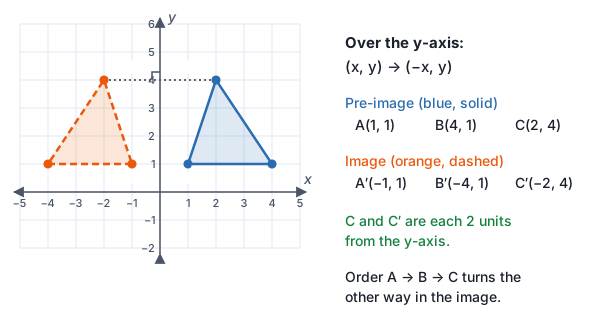
The segment from a point to its image always crosses the line of reflection at a right angle. The line cuts that segment exactly in half. So the line of reflection is the perpendicular bisector of the segment.
Reflection Rules
On a coordinate grid, these rules give the image of any point (x, y).
| Line of reflection | Rule | Example |
|---|---|---|
| x-axis | (x, y) \to (x, -y) | (2, 5) \to (2, -5) |
| y-axis | (x, y) \to (-x, y) | (2, 5) \to (-2, 5) |
| The line y = x | (x, y) \to (y, x) | (2, 5) \to (5, 2) |
| The line y = -x | (x, y) \to (-y, -x) | (2, 5) \to (-5, -2) |
| Vertical line x = h | (x, y) \to (2h - x, y) | Over x = 1: (2, 5) \to (0, 5) |
| Horizontal line y = k | (x, y) \to (x, 2k - y) | Over y = 1: (2, 5) \to (2, -3) |
A memory trick: reflecting over the x-axis changes the y-coordinate. The x-axis is the mirror, so x stays put. The same idea works for the y-axis.
How to Reflect a Figure
- Find the line of reflection.
- For each vertex, pick the matching rule from the table. For other lines, count the distance from the point straight to the line.
- Find the image of every vertex.
- Plot the image points and connect them in the same order.
- Label the image with prime marks.
- Check: each point and its image should be the same distance from the line, on opposite sides.
Worked Examples
Example 1: Reflect a point over each axis
Reflect P(3, -5) over the x-axis. Then reflect P over the y-axis.
- Over the x-axis, use (x, y) \to (x, -y). Keep x: 3
- Take the opposite of y: -(-5) = 5
- Image over the x-axis: (3, 5)
- Over the y-axis, use (x, y) \to (-x, y). Take the opposite of x: -(3) = -3
- Keep y: −5
- Image over the y-axis: (-3, -5)
Answer: Over the x-axis, (3, 5). Over the y-axis, (-3, -5).
Example 2: Reflect a triangle over the y-axis
Triangle ABC has vertices A(1, 1), B(4, 1) and C(2, 4). Reflect it over the y-axis. This is the triangle in the graph above.
| Vertex | Take the opposite of x | Keep y | Image |
|---|---|---|---|
| A(1, 1) | -(1) = -1 | 1 | A'(-1, 1) |
| B(4, 1) | -(4) = -4 | 1 | B'(-4, 1) |
| C(2, 4) | -(2) = -2 | 4 | C'(-2, 4) |
Check C. Point C is 2 units right of the y-axis. Point C' is 2 units left of it. They match. Also notice the order. Going A to B to C turns one way. Going A′ to B′ to C′ turns the other way, because the triangle flipped.
Answer: A'(-1, 1), B'(-4, 1), C'(-2, 4)
Example 3: Reflect over the line y = x
Triangle JKL has vertices J(-2, 5), K(3, 1) and L(0, -4). Reflect it over the line y = x.
The rule is (x, y) \to (y, x). Swap the two coordinates.
- Swap the coordinates of J: J(-2, 5) \to J'(5, -2)
- Swap the coordinates of K: K(3, 1) \to K'(1, 3)
- Swap the coordinates of L: L(0, -4) \to L'(-4, 0)
- Check J. Find the midpoint of JJ' (see midpoint formula): \left(\frac{-2 + 5}{2}, \frac{5 + (-2)}{2}\right)
- Add the numbers on top: \left(\frac{3}{2}, \frac{3}{2}\right)
- The two coordinates are equal, so the midpoint is on the line y = x. The check works.
Answer: J'(5, -2), K'(1, 3), L'(-4, 0)
Example 4: Reflect over a vertical line
Reflect M(5, 3) and N(-1, -2) over the line x = 2.
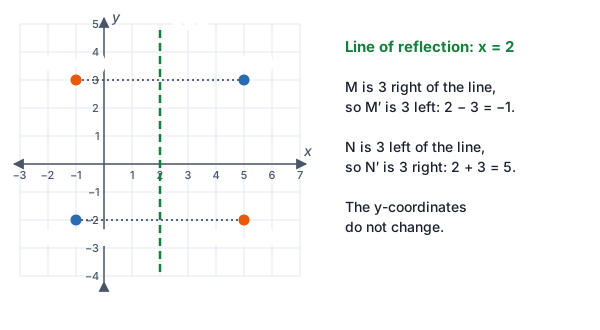
The line is vertical, so only the x-coordinate changes. Count across to the line, then the same distance past it.
- Distance from M to the line: 5 - 2 = 3. M is 3 units right of the line.
- Go 3 units left of the line: 2 - 3 = -1
- Keep y: 3. So M'(-1, 3).
- Distance from N to the line: 2 - (-1) = 2 + 1 = 3. N is 3 units left of the line.
- Go 3 units right of the line: 2 + 3 = 5
- Keep y: −2. So N'(5, -2).
You can also use the rule (x, y) \to (2h - x, y) with h = 2. For M: 2(2) - 5 = 4 - 5 = -1. It gives the same answer.
Answer: M'(-1, 3) and N'(5, -2)
Example 5: Word problem (shortest path)
A camper’s tent is at A(1, 4). A river runs along the x-axis. She walks from the tent to the river to fill a bucket. Then she walks to the campfire at B(7, 2). Where should she touch the river to make her walk as short as possible?
Here is the trick. Reflect B over the river. Any path to the river and then to B is just as long as the path to the river and then to B'. The shortest path to B' is a straight line. So find where segment AB' crosses the river.
- Reflect B over the x-axis: B(7, 2) \to B'(7, -2)
- Find the slope of AB' (see slope formula): m = \frac{-2 - 4}{7 - 1}
- Subtract: m = \frac{-6}{6}
- Divide: m = -1
- Write the line through A(1, 4) (see point-slope form): y - 4 = -1(x - 1)
- The river is where y = 0. Substitute 0 for y: 0 - 4 = -1(x - 1)
- Subtract on the left: -4 = -1(x - 1)
- Divide both sides by −1: 4 = x - 1
- Add 1 to both sides: 5 = x
She should touch the river at (5, 0). How long is the walk? It equals the length of AB'.
- Use the distance formula (see distance formula): AB' = \sqrt{(7 - 1)^2 + (-2 - 4)^2}
- Subtract inside the parentheses: AB' = \sqrt{6^2 + (-6)^2}
- Square: AB' = \sqrt{36 + 36}
- Add: AB' = \sqrt{72}
- Simplify (see simplifying square roots): \sqrt{72} = \sqrt{36 \cdot 2} = 6\sqrt{2}
- Estimate with \sqrt{2} \approx 1.41: 6 \times 1.41 = 8.46
Answer: She should touch the river at (5, 0). The shortest walk is 6\sqrt{2} \approx 8.46 units.
Common Mistakes
| Mistake | Example of the error | Fix |
|---|---|---|
| Changing the wrong coordinate | Over the x-axis, (3, -5) \to (-3, -5) | Over the x-axis, x stays and y flips: (3, 5) |
| Changing both signs over an axis | Over the y-axis, (2, 5) \to (-2, -5) | Only x changes: (-2, 5) |
| Mixing up y = x and y = -x | Over y = x, (2, 5) \to (-5, -2) | Over y = x, just swap: (5, 2) |
| Taking the opposite over x = h | Over x = 2, (5, 3) \to (-5, 3) | Count to the line and past it: (-1, 3) |
| Measuring at a slant | Counting a diagonal distance to the line | Measure straight across, at a right angle to the line. |
| Forgetting the flip | Labeling the image in the wrong order | Match each point to its own image: A to A′, B to B′. |
Finding the Line of Reflection
Sometimes you know a point and its image, and you need the line. The line of reflection is the perpendicular bisector of the segment between them. It goes through the midpoint.
- If the point and image have the same y-coordinate, the line is vertical. Average the x-coordinates. For (-4, 3) and (2, 3), the line is x = \frac{-4 + 2}{2} = -1.
- If they have the same x-coordinate, the line is horizontal. Average the y-coordinates.
- If the coordinates are swapped, like (6, -2) and (-2, 6), the line is y = x.
Reflections also explain why some figures look the same on both sides. A figure with a line of symmetry matches its own reflection. You will see this in the Symmetry lesson later in this unit.
Practice Problems
- Reflect (4, -7) over the x-axis.
- Reflect (-6, 2) over the y-axis.
- Reflect (-3, 8) over the line y = x.
- Reflect (5, -1) over the line y = -x.
- Triangle DEF has vertices D(2, 1), E(5, 3) and F(2, 6). Reflect it over the x-axis.
- Reflect (7, 4) over the line x = 3.
- Reflect (-2, 5) over the line y = 1.
- Point A(-4, 3) reflects to A'(2, 3). Find the line of reflection.
- The point (6, -2) maps to (-2, 6). Which line of reflection does this?
- A pool ball sits at (1, 2). It bounces off the bottom cushion, the x-axis, and rolls into a pocket at (9, 6). Where does it hit the cushion? How far does it roll?
Show answers
- Keep x: 4
Opposite of y: -(-7) = 7
Image: (4, 7) - Opposite of x: -(-6) = 6
Keep y: 2
Image: (6, 2) - Swap the coordinates: (8, -3)
- Use (x, y) \to (-y, -x)
New x is the opposite of y: -(-1) = 1
New y is the opposite of x: -(5) = -5
Image: (1, -5) - Keep each x and take the opposite of each y
D(2, 1) \to D'(2, -1)
E(5, 3) \to E'(5, -3)
F(2, 6) \to F'(2, -6) - Distance to the line: 7 - 3 = 4 (4 right)
Go 4 left of the line: 3 - 4 = -1
Keep y: (-1, 4) - Distance to the line: 5 - 1 = 4 (4 above)
Go 4 below the line: 1 - 4 = -3
Keep x: (-2, -3) - Same y-coordinate, so the line is vertical
Add the x-coordinates: -4 + 2 = -2
Divide by 2: -2 \div 2 = -1
Line: x = -1 - The coordinates are swapped, so the line is y = x
- Reflect the pocket over the x-axis: (9, -6)
Slope from (1, 2): m = \frac{-6 - 2}{9 - 1} = \frac{-8}{8} = -1
Line: y - 2 = -1(x - 1)
Set y = 0: 0 - 2 = -1(x - 1)
Subtract: -2 = -1(x - 1)
Divide by −1: 2 = x - 1
Add 1: x = 3, so it hits at (3, 0)
Distance: \sqrt{(9 - 1)^2 + (-6 - 2)^2} = \sqrt{8^2 + (-8)^2}
Square and add: \sqrt{64 + 64} = \sqrt{128}
Simplify: \sqrt{64 \cdot 2} = 8\sqrt{2} units
FAQ
What is a reflection in geometry?
A reflection flips a figure over a line to make a mirror image. Each point and its image are the same distance from the line.
What is the rule for a reflection over the x-axis?
The rule is (x, y) \to (x, -y). Keep x and take the opposite of y.
What is the rule for a reflection over y = x?
The rule is (x, y) \to (y, x). Swap the x- and y-coordinates.
Is a reflection a rigid motion?
Yes. It keeps all lengths and angle measures, so the image is congruent. It does reverse the order of the vertices.
Summary
- A reflection flips a figure over a line of reflection.
- Each point and its image are the same distance from the line, on opposite sides.
- Over the x-axis: (x, -y). Over the y-axis: (-x, y).
- Over y = x: (y, x). Over y = -x: (-y, -x).
- For other lines, count straight to the line, then the same distance past it.
- A reflection is a rigid motion, but it flips the order of the vertices.
Previous lesson: Translations
Next lesson: Rotations
Back to the Geometry Index