
Symmetry
A figure has symmetry when a rigid motion maps it exactly onto itself. It has line symmetry if a reflection over a line matches it with itself. It has rotational symmetry if a turn of less than 360° about its center matches it. A regular polygon with n sides has n lines of symmetry.
Before this lesson: You should know Reflections, Rotations and Measuring and Classifying Angles.
What Is Symmetry?
Fold a paper heart down the middle. The two halves land exactly on top of each other. Now spin a pinwheel a little. At some point, it looks just like it did before you spun it. Both are kinds of symmetry.
In geometry, symmetry means a transformation moves the figure, but the figure ends up covering the same spot. It looks like nothing happened.
Line Symmetry
A figure has line symmetry (also called reflection symmetry) when you can reflect it over a line and get the same figure. That line is a line of symmetry. Each point on one side matches a point on the other side, the same distance from the line.
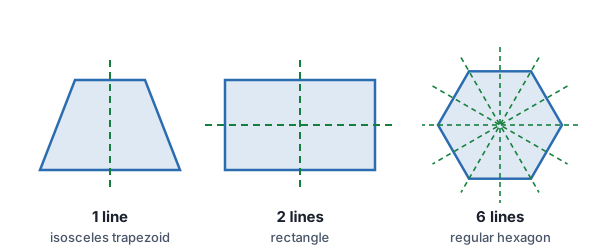
A rectangle that is not a square has only 2 lines of symmetry. Its diagonals are not lines of symmetry. If you fold a long rectangle along a diagonal, the corners don’t match.
Rotational Symmetry
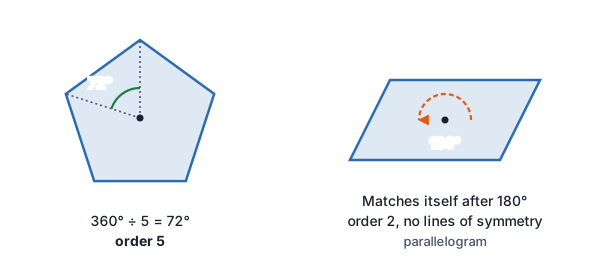
A figure has rotational symmetry when a turn of more than 0° and less than 360° about its center maps it onto itself. Every figure matches itself after a full 360° turn, so that one doesn’t count.
- The order is the number of times the figure matches itself during one full turn, counting the 360° turn.
- The angle of rotational symmetry is the smallest turn that works. It equals 360^\circ \div \text{order}.
- A figure with 180° rotational symmetry also has point symmetry. Each point has a partner straight through the center.
Symmetry Rules for Common Shapes
For a regular polygon with n sides, use these rules.
\text{lines of symmetry} = n \qquad \text{order} = n \qquad \text{smallest angle} = \frac{360^\circ}{n}| Shape | Lines of symmetry | Rotational symmetry | Smallest angle |
|---|---|---|---|
| Equilateral triangle | 3 | Order 3 | 120° |
| Square | 4 | Order 4 | 90° |
| Rectangle (not a square) | 2 | Order 2 | 180° |
| Rhombus (not a square) | 2 (the diagonals) | Order 2 | 180° |
| Parallelogram (not a rectangle or rhombus) | 0 | Order 2 | 180° |
| Isosceles trapezoid | 1 | None | — |
| Kite (not a rhombus) | 1 | None | — |
| Regular pentagon | 5 | Order 5 | 72° |
| Regular hexagon | 6 | Order 6 | 60° |
| Circle | Infinitely many | Any angle | Any angle |
How to Find the Symmetry of a Figure
- Look for a line that splits the figure into two mirror halves. Check each possible line by folding in your mind.
- Count every line that works.
- Find the center of the figure.
- Turn the figure in your mind. Note every angle less than 360° where it matches itself.
- The order is the number of matching turns, plus 1 for the full turn.
- On a grid, check with a rule. Reflect or rotate every vertex. If you get the same set of vertices back, the figure has that symmetry.
Worked Examples
Example 1: Compare three quadrilaterals
Find the lines of symmetry and the rotational symmetry of a square, a rectangle that is 6 by 4, and an isosceles trapezoid.
- Square: the two lines through the middles of opposite sides work. The two diagonals also work. That makes 4 lines.
- Square: it matches itself after 90°, 180°, 270° and 360°. That is order 4.
- Rectangle: only the two lines through the middles of opposite sides work. That makes 2 lines.
- Rectangle: it matches itself after 180° and 360°. That is order 2.
- Isosceles trapezoid: only the line through the middles of the two parallel sides works. That makes 1 line.
- Isosceles trapezoid: no turn less than 360° works, so it has no rotational symmetry.
Answer: square: 4 lines, order 4. Rectangle: 2 lines, order 2. Isosceles trapezoid: 1 line, no rotational symmetry.
Example 2: A regular octagon
A stop sign is a regular octagon, with 8 equal sides and 8 equal angles. Find its lines of symmetry, its order and every angle of rotational symmetry.
- A regular polygon with n sides has n lines of symmetry. Here n = 8, so it has 8 lines.
- The order equals n, so the order is 8.
- Find the smallest angle: 360^\circ \div 8 = 45^\circ
- List the multiples of 45° below 360°: 45°, 90°, 135°, 180°, 225°, 270°, 315°
Answer: 8 lines of symmetry, order 8. It matches itself after turns of 45°, 90°, 135°, 180°, 225°, 270° and 315°.
Example 3: Check line symmetry on a grid
A trapezoid has vertices A(-3, 1), B(3, 1), C(2, 4) and D(-2, 4). Is the y-axis a line of symmetry?
Reflect each vertex over the y-axis with (x, y) \to (-x, y). Then see if you get the same four vertices back.
| Vertex | Opposite of x | Image | Is it a vertex? |
|---|---|---|---|
| A(-3, 1) | -(-3) = 3 | (3, 1) | Yes, it is B |
| B(3, 1) | -(3) = -3 | (-3, 1) | Yes, it is A |
| C(2, 4) | -(2) = -2 | (-2, 4) | Yes, it is D |
| D(-2, 4) | -(-2) = 2 | (2, 4) | Yes, it is C |
Answer: Yes. The reflection swaps A with B and C with D, so the y-axis is a line of symmetry.
Example 4: Check point symmetry on a grid
A parallelogram has vertices P(1, 2), Q(4, 2), R(-1, -2) and S(-4, -2). Does it have 180° rotational symmetry about the origin?
Rotate each vertex 180° with (x, y) \to (-x, -y).
- P(1, 2) \to (-1, -2), which is R.
- Q(4, 2) \to (-4, -2), which is S.
- R(-1, -2) \to (1, 2), which is P.
- S(-4, -2) \to (4, 2), which is Q.
- Every image is a vertex of the same parallelogram.
Answer: Yes. It has rotational symmetry of order 2 (point symmetry) about the origin.
Example 5: Word problem (ceiling fan)
A ceiling fan has 5 identical blades, evenly spaced. What is the smallest turn that makes the fan look the same? Does it look the same after a 144° turn? After a 100° turn?
- The blades are evenly spaced, so the order is 5.
- Find the smallest angle: 360^\circ \div 5 = 72^\circ
- Check 144°: 144^\circ \div 72^\circ = 2. That is a whole number, so yes.
- Check 100°: 100^\circ \div 72^\circ is not a whole number, so no.
Answer: The smallest turn is 72°. The fan looks the same after 144° but not after 100°.
Common Mistakes
| Mistake | Example of the error | Fix |
|---|---|---|
| Counting a rectangle’s diagonals | Saying a 6 by 4 rectangle has 4 lines | Fold on a diagonal: the corners miss. It has 2 lines. |
| Counting the 360° turn as symmetry | Saying a kite has rotational symmetry | Only turns less than 360° count. |
| Mixing up order and angle | Saying a hexagon has order 60 | Order is a count (6). The angle is 360^\circ \div 6 = 60^\circ. |
| Giving a parallelogram a line of symmetry | Drawing a line through the middle of a slanted parallelogram | A general parallelogram has 0 lines, but order 2. |
| Missing half the lines of a regular polygon | Saying a regular hexagon has 3 lines | Count lines through vertices and through the middles of sides: 6. |
Symmetry in Letters and Graphs
Symmetry shows up in letters, logos and graphs.
- The letter H has 2 lines of symmetry and order 2. The letter N has no lines of symmetry but order 2. The letter A has 1 line and no rotational symmetry.
- The graph of y = x^2 is symmetric about the y-axis. The graph of y = x^3 has point symmetry about the origin. You can see both in the parent functions lesson.
- A figure with both a horizontal and a vertical line of symmetry always has 180° rotational symmetry. Two reflections over crossing lines make a rotation, as shown in compositions of transformations.
Practice Problems
- How many lines of symmetry does an equilateral triangle have?
- Find the order and the smallest angle of rotational symmetry of a regular hexagon.
- Find the smallest angle of rotational symmetry of a regular decagon (10 sides).
- Does a kite (not a rhombus) have rotational symmetry? How many lines of symmetry does it have?
- A regular polygon has a smallest angle of rotational symmetry of 40°. How many sides does it have?
- Describe the symmetry of the letters H, N and A.
- A rhombus has vertices (-4, 0), (0, 3), (4, 0) and (0, -3). Find its lines of symmetry. Does it have rotational symmetry?
- A rectangle has vertices (1, 1), (5, 1), (5, 3) and (1, 3). Is x = 3 a line of symmetry? Is y = 2?
- A regular polygon has rotational symmetry of order 12. Find its smallest angle and its number of lines of symmetry.
- A logo is a star with 8 identical points. What is the smallest turn that makes it look the same? How many times does it match itself in one full turn?
Show answers
- An equilateral triangle is a regular polygon with n = 3
It has 3 lines of symmetry, one from each vertex to the middle of the opposite side. - Order: n = 6
Smallest angle: 360^\circ \div 6 = 60^\circ - 360^\circ \div 10 = 36^\circ
- No rotational symmetry. Only the full 360° turn matches.
It has 1 line of symmetry, the line through the two vertices where the equal sides meet. - Use \text{angle} = 360^\circ \div n
So n = 360^\circ \div 40^\circ
Divide: n = 9
It has 9 sides. - H: 2 lines (vertical and horizontal), order 2
N: 0 lines, order 2
A: 1 line (vertical), no rotational symmetry - Reflect over the y-axis with (-x, y): (-4, 0) \leftrightarrow (4, 0), and (0, 3) and (0, -3) stay put. Yes.
Reflect over the x-axis with (x, -y): (0, 3) \leftrightarrow (0, -3), and (-4, 0) and (4, 0) stay put. Yes.
Lines of symmetry: the x-axis and the y-axis
Rotate 180° with (-x, -y): each vertex lands on the opposite vertex, so it has order 2. - Reflect over x = 3 with (6 - x, y): (1, 1) \to (5, 1) and (1, 3) \to (5, 3), so the vertices swap. Yes.
Reflect over y = 2 with (x, 4 - y): (1, 1) \to (1, 3) and (5, 1) \to (5, 3), so the vertices swap. Yes.
Both are lines of symmetry. - Smallest angle: 360^\circ \div 12 = 30^\circ
A regular polygon has as many lines as its order: 12 lines - Smallest turn: 360^\circ \div 8 = 45^\circ
It matches itself 8 times in one full turn (order 8).
FAQ
What is the difference between line symmetry and rotational symmetry?
Line symmetry means a reflection over a line maps the figure onto itself. Rotational symmetry means a turn of less than 360° does.
How do you find the order of rotational symmetry?
Count how many times the figure matches itself in one full turn, including the 360° turn. For a regular polygon, the order equals the number of sides.
How many lines of symmetry does a rectangle have?
A rectangle that is not a square has 2 lines of symmetry. A square has 4.
What is point symmetry?
Point symmetry is rotational symmetry of 180°. Every point has a matching point the same distance away on the opposite side of the center.
Summary
- A figure has symmetry when a rigid motion maps it onto itself.
- Line symmetry: a reflection over a line of symmetry matches the figure.
- Rotational symmetry: a turn of less than 360° matches the figure.
- Smallest angle of rotational symmetry = 360^\circ \div \text{order}.
- A regular polygon with n sides has n lines of symmetry and order n.
- On a grid, check symmetry by reflecting or rotating every vertex.
Previous lesson: Dilations
Next lesson: Triangle Angle Sum Theorem
Back to the Geometry Index