
Compositions of Transformations
A composition of transformations is two or more transformations done one after another. The image from the first step becomes the pre-image for the next step. The order can change the final answer. A glide reflection, a translation followed by a reflection over a parallel line, is a common example.
Before this lesson: You should know Translations, Reflections and Rotations.
What Is a Composition of Transformations?
Think about getting dressed. You put on socks, then shoes. Each step starts where the last one ended. A composition works the same way. You do one transformation, then do the next one to the result.
We use two prime marks for a point after two steps. Point A goes to A' after the first step and to A'' after the second. Read A'' as “A double prime.”
Translations, reflections and rotations are all rigid motions. When you combine rigid motions, the result is still a rigid motion. So the final image is always congruent to the original figure.
Composition Notation and Rules
Books often write a composition with a small circle, \circ. You read it from right to left, so the step on the right happens first.
r_{x\text{-axis}} \circ T_{\langle 4, 0 \rangle}This means: first translate by \langle 4, 0 \rangle, then reflect over the x-axis. Here T stands for a translation and r stands for a reflection.
| Composition | What you get |
|---|---|
| Translation, then another translation | One translation. Add the moves. |
| Reflection over a line, then a translation parallel to that line | A glide reflection |
| Reflections over two parallel lines | A translation, twice the distance between the lines |
| Reflections over two lines that cross | A rotation about the crossing point, twice the angle between the lines |
| Any rigid motions | A rigid motion. The image is congruent. |
How to Perform a Composition
- Write down each transformation in the order you must do it.
- Apply the first transformation to every vertex.
- Write the new points with one prime mark.
- Apply the second transformation to those new points, not to the original ones.
- Write the final points with two prime marks.
- Check: the final figure should be congruent to the original.
Worked Examples
Example 1: Translate, then reflect a point
Translate P(4, -1) using (x, y) \to (x - 2, y + 5). Then reflect the result over the y-axis.
- Step 1, translate. Subtract 2 from x (see adding and subtracting integers): 4 - 2 = 2
- Add 5 to y: -1 + 5 = 4. So P'(2, 4).
- Step 2, reflect P' over the y-axis with (x, y) \to (-x, y). Take the opposite of x: -(2) = -2
- Keep y: 4. So P''(-2, 4).
Answer: P''(-2, 4)
Example 2: A glide reflection
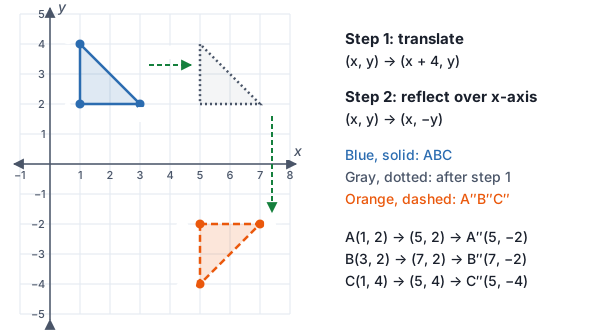
Triangle ABC has vertices A(1, 2), B(3, 2) and C(1, 4). Translate it 4 units right. Then reflect it over the x-axis. This is the picture above.
| Vertex | Step 1: add 4 to x | Step 2: opposite of y | Final image |
|---|---|---|---|
| A(1, 2) | 1 + 4 = 5, so (5, 2) | -(2) = -2 | A''(5, -2) |
| B(3, 2) | 3 + 4 = 7, so (7, 2) | -(2) = -2 | B''(7, -2) |
| C(1, 4) | 1 + 4 = 5, so (5, 4) | -(4) = -4 | C''(5, -4) |
The slide is to the right, which is parallel to the x-axis. Parallel lines never meet and point the same way (see parallel and perpendicular lines). So this is a glide reflection. For a glide reflection, you can do the two steps in either order and get the same image.
Answer: A''(5, -2), B''(7, -2), C''(5, -4)
Example 3: Does the order matter?
Start with P(2, 1). Path 1: translate up 3, then rotate 90° counterclockwise about the origin. Path 2: do the rotation first, then the translation. Compare the answers.
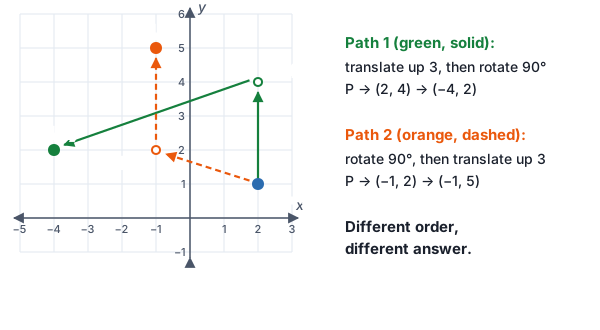
- Path 1, translate up 3. Add 3 to y: 1 + 3 = 4. So (2, 4).
- Path 1, rotate 90° with (x, y) \to (-y, x): (2, 4) \to (-4, 2)
- Path 2, rotate first: (2, 1) \to (-1, 2)
- Path 2, translate up 3. Add 3 to y: 2 + 3 = 5. So (-1, 5).
- Compare: (-4, 2) and (-1, 5) are different points.
Answer: Path 1 ends at (-4, 2) and Path 2 ends at (-1, 5). The order matters here.
Example 4: Two reflections over parallel lines
Reflect Q(2, 5) over the line x = 1. Then reflect the image over the line x = 4. What single transformation does the same thing?
- Step 1. Q is 2 - 1 = 1 unit right of x = 1.
- Go 1 unit left of the line: 1 - 1 = 0. So Q'(0, 5).
- Step 2. Q' is 4 - 0 = 4 units left of x = 4.
- Go 4 units right of the line: 4 + 4 = 8. So Q''(8, 5).
- Compare Q and Q″. x went from 2 to 8: 8 - 2 = 6. The y-coordinate stayed 5.
- The lines are 4 - 1 = 3 units apart, and the point moved 2 \times 3 = 6 units.
Answer: Q''(8, 5). The two reflections act like one translation, (x, y) \to (x + 6, y), which is twice the distance between the lines.
Example 5: Word problem (footprints)
Footprints in sand form a glide reflection. Put the path along the x-axis. The first footprint is at (0, 1). Each step moves 3 units forward and flips to the other side of the path. So each step is (x, y) \to (x + 3, -y). Where is the fifth footprint?
| Footprint | Add 3 to x | Opposite of y | Position |
|---|---|---|---|
| 1st | start | start | (0, 1) |
| 2nd | 0 + 3 = 3 | -(1) = -1 | (3, -1) |
| 3rd | 3 + 3 = 6 | -(-1) = 1 | (6, 1) |
| 4th | 6 + 3 = 9 | -(1) = -1 | (9, -1) |
| 5th | 9 + 3 = 12 | -(-1) = 1 | (12, 1) |
Answer: The fifth footprint is at (12, 1). Odd-numbered prints land on the same side as the first one.
Common Mistakes
| Mistake | Example of the error | Fix |
|---|---|---|
| Applying step 2 to the original figure | Reflecting P(4, -1) instead of P'(2, 4) | Always use the newest points for the next step. |
| Reading \circ notation left to right | Doing r first in r \circ T | The step on the right happens first. |
| Assuming order never matters | Swapping a translation and a rotation | Check. Many pairs give different answers. |
| Calling any slide plus flip a glide reflection | Sliding up, then reflecting over the x-axis | The slide must be parallel to the line of reflection. |
| Thinking the figure changes size | Expecting a bigger image after three moves | Rigid motions keep size and shape every time. |
Describing a Composition with One Transformation
Sometimes two moves add up to one simpler move. Look at where a point starts and where it ends.
- Two translations add up. (x + 2, y + 1) then (x - 5, y + 3) is (x - 3, y + 4).
- Two reflections over parallel lines make a translation, as in Example 4.
- Two reflections over crossing lines make a rotation. Reflecting over the x-axis and then y = x gives a 90° counterclockwise rotation. The lines meet at a 45° angle (see measuring and classifying angles), and the turn is twice that.
- A 180° rotation followed by a reflection over the y-axis is the same as one reflection over the x-axis.
Compositions also explain congruence. Two figures are congruent when a sequence of rigid motions maps one onto the other. That idea starts Unit 5 on triangle congruence.
Practice Problems
- Translate (3, 2) using (x, y) \to (x + 1, y - 4). Then reflect over the x-axis.
- Reflect (-5, 1) over the y-axis. Then translate using (x, y) \to (x - 3, y + 2).
- Rotate (2, -3) 90° counterclockwise about the origin. Then translate 4 units right.
- Rotate (1, 6) 180° about the origin. Then reflect over the y-axis. Which single transformation does the same thing?
- Triangle JKL has vertices J(0, 1), K(2, 1) and L(0, 3). Translate it 4 units down, then reflect it over the y-axis. Is this a glide reflection?
- Start with (1, 1). Path 1: reflect over the x-axis, then translate 2 units right. Path 2: translate first, then reflect. Does the order matter?
- Reflect (3, 4) over the x-axis, then over the line y = 2. What single transformation does the same thing?
- Reflect (5, 0) over the x-axis, then over the line y = x. What single rotation gives the same result?
- Write one rule for (x, y) \to (x + 2, y + 1) followed by (x, y) \to (x - 5, y + 3).
- Footprints along the x-axis start with a print at (2, -1). Each step is (x, y) \to (x + 4, -y). Where is the 4th print?
Show answers
- Translate. Add 1 to x: 3 + 1 = 4. Subtract 4 from y: 2 - 4 = -2
So (4, -2)
Reflect over the x-axis: (4, 2) - Reflect over the y-axis: (5, 1)
Subtract 3 from x: 5 - 3 = 2
Add 2 to y: 1 + 2 = 3
Final: (2, 3) - Rotate with (-y, x): (2, -3) \to (3, 2)
Add 4 to x: 3 + 4 = 7
Final: (7, 2) - Rotate 180°: (1, 6) \to (-1, -6)
Reflect over the y-axis: (-1, -6) \to (1, -6)
Start (1, 6), end (1, -6): a reflection over the x-axis - Subtract 4 from each y: (0, -3), (2, -3), (0, -1)
Reflect over the y-axis: J''(0, -3), K''(-2, -3), L''(0, -1)
The slide is down, parallel to the y-axis, so yes, it is a glide reflection. - Path 1: (1, 1) \to (1, -1) \to (3, -1)
Path 2: (1, 1) \to (3, 1) \to (3, -1)
Same answer. The slide is parallel to the line of reflection, so the order does not matter here. - Over the x-axis: (3, 4) \to (3, -4)
Distance to y = 2: 2 - (-4) = 6 (6 below)
Go 6 above: 2 + 6 = 8, so (3, 8)
Single move: 8 - 4 = 4, a translation 4 units up - Over the x-axis: (5, 0) \to (5, 0)
Over y = x, swap: (0, 5)
A 90° counterclockwise rotation sends (5, 0) to (0, 5), so it is the same. - Add the x-moves: 2 + (-5) = -3
Add the y-moves: 1 + 3 = 4
Rule: (x, y) \to (x - 3, y + 4) - 2nd: 2 + 4 = 6 and -(-1) = 1, so (6, 1)
3rd: 6 + 4 = 10 and -(1) = -1, so (10, -1)
4th: 10 + 4 = 14 and -(-1) = 1, so (14, 1)
FAQ
What is a composition of transformations?
It is two or more transformations done in a row. Each step uses the image from the step before it.
Does the order of transformations matter?
Often, yes. A translation and a rotation usually give different results in different orders. A glide reflection is one case where the order does not matter.
What is a glide reflection?
A glide reflection is a translation followed by a reflection over a line parallel to the translation. Footprints in sand are a common example.
Is a composition of rigid motions a rigid motion?
Yes. Each step keeps lengths and angles, so the whole sequence does too. The final image is congruent to the original.
Summary
- A composition is one transformation followed by another.
- Apply each step to the newest image, and use A' then A''.
- In \circ notation, the step on the right happens first.
- The order can change the answer.
- A glide reflection is a slide plus a flip over a parallel line.
- Two reflections make a translation (parallel lines) or a rotation (crossing lines).
Previous lesson: Rotations
Next lesson: Dilations
Back to the Geometry Index