
Congruent Figures
Congruent figures have exactly the same size and shape. You can move one onto the other with rigid motions: translations, reflections and rotations. In congruent figures, every pair of matching sides has the same length, and every pair of matching angles has the same measure.
Before this lesson: You should know Translations, Reflections, Rotations and the Triangle Angle Sum Theorem.
What Does Congruent Mean?
Think of two keys cut from the same pattern. Lay one on top of the other, and they match edge to edge. That is congruence. Position does not matter. One figure can be turned or flipped and still be congruent to the other.
A rigid motion moves a figure without changing its size or shape. Translations, reflections and rotations are rigid motions. Two figures are congruent if a rigid motion, or a sequence of them, maps one figure exactly onto the other. A dilation is not a rigid motion unless its scale factor is 1, because it changes the size.
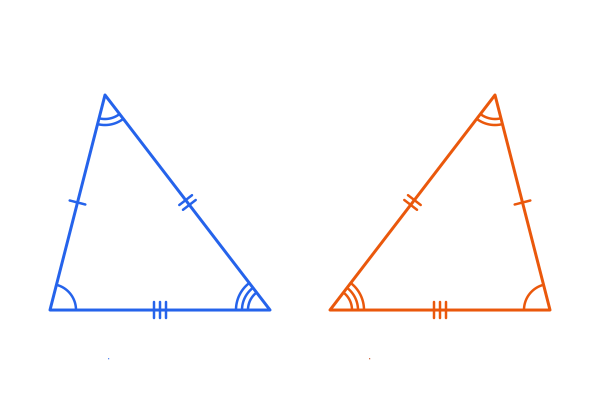
Parts that land on each other are corresponding parts. In the picture, tick marks show congruent sides and arcs show congruent angles. The same number of marks means the parts match.
Congruence Statements and Corresponding Parts
The symbol ≅ means “is congruent to.” A congruence statement lists the vertices of both figures in matching order.
\triangle ABC \cong \triangle DEF
This statement says A matches D, B matches E, and C matches F. So it gives six pairs of congruent parts.
| Corresponding angles | Corresponding sides |
|---|---|
| \angle A \cong \angle D | \overline{AB} \cong \overline{DE} |
| \angle B \cong \angle E | \overline{BC} \cong \overline{EF} |
| \angle C \cong \angle F | \overline{CA} \cong \overline{FD} |
Congruent segments have equal lengths, so you can also write AB = DE. Congruent angles have equal measures, so m\angle A = m\angle D. Use ≅ between figures and = between numbers.
Third Angles Theorem
If two angles of one triangle are congruent to two angles of another triangle, then the third angles are also congruent. Why? Each triangle’s angles add to 180°. Take away the same two angles from 180°, and you get the same third angle.
\text{If } \angle A \cong \angle D \text{ and } \angle B \cong \angle E, \text{ then } \angle C \cong \angle F.How to Use Congruent Figures
- Match the vertices by the order of the letters in the congruence statement, not by how the picture looks.
- List the pairs of corresponding sides and angles.
- Set corresponding lengths equal. Set corresponding angle measures equal.
- If there is a variable, solve the equation. Then substitute back.
- To show two figures are congruent, find a rigid motion that maps one onto the other.
Worked Examples
Example 1: Name the corresponding parts
Given \triangle PQR \cong \triangle XYZ, name all six pairs of corresponding parts.
- Match the first letters, P and X: \angle P \cong \angle X
- Match the second letters, Q and Y: \angle Q \cong \angle Y
- Match the third letters, R and Z: \angle R \cong \angle Z
- Match the first two letters for a side: \overline{PQ} \cong \overline{XY}
- Match the last two letters: \overline{QR} \cong \overline{YZ}
- Match the first and last letters: \overline{PR} \cong \overline{XZ}
Answer: \angle P \cong \angle X, \angle Q \cong \angle Y, \angle R \cong \angle Z, \overline{PQ} \cong \overline{XY}, \overline{QR} \cong \overline{YZ} and \overline{PR} \cong \overline{XZ}.
Example 2: Find missing measures
\triangle ABC \cong \triangle DEF. You know AB = 7, BC = 10, m\angle A = 48^\circ and m\angle E = 75^\circ. Find DE, EF, m\angle D, m\angle B and m\angle F.
- \overline{DE} matches \overline{AB}, so DE = 7.
- \overline{EF} matches \overline{BC}, so EF = 10.
- \angle D matches \angle A, so m\angle D = 48^\circ.
- \angle B matches \angle E, so m\angle B = 75^\circ.
- Add the two known angles of \triangle ABC: 48^\circ + 75^\circ = 123^\circ
- Subtract from 180° (see triangle angle sum theorem): 180^\circ - 123^\circ = 57^\circ, so m\angle C = 57^\circ.
- \angle F matches \angle C, so m\angle F = 57^\circ.
Answer: DE = 7, EF = 10, m\angle D = 48^\circ, m\angle B = 75^\circ and m\angle F = 57^\circ.
Example 3: Solve for x and y
\triangle JKL \cong \triangle MNP. JK = 3x + 4 and MN = 5x - 8. Also m\angle L = (4y - 10)^\circ and m\angle P = 70^\circ. Find x, y and JK.
- \overline{JK} and \overline{MN} are corresponding sides, so set them equal: 3x + 4 = 5x - 8
- Subtract 3x from both sides (see equations with variables on both sides): 4 = 2x - 8
- Add 8 to both sides: 12 = 2x
- Divide both sides by 2: x = 6
- Substitute to find JK: 3(6) + 4 = 18 + 4 = 22
- Check with MN: 5(6) - 8 = 30 - 8 = 22
- \angle L and \angle P are corresponding angles, so set them equal: 4y - 10 = 70
- Add 10 to both sides: 4y = 80
- Divide both sides by 4: y = 20
Answer: x = 6, y = 20 and JK = 22.
Example 4: Show congruence with a rigid motion
\triangle ABC has vertices A(1, 1), B(4, 1) and C(1, 3). \triangle DEF has vertices D(-1, 1), E(-4, 1) and F(-1, 3). Show that \triangle ABC \cong \triangle DEF.
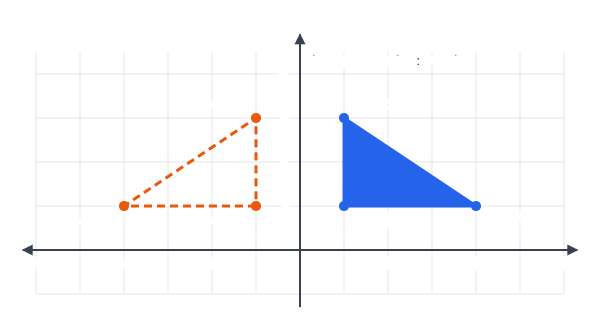
- Compare the points. Each x-coordinate changes sign, and each y-coordinate stays the same.
- That is the rule for a reflection over the y-axis (see reflections): (x, y) \to (-x, y)
- Apply the rule to A: (1, 1) \to (-1, 1), which is D.
- Apply the rule to B: (4, 1) \to (-4, 1), which is E.
- Apply the rule to C: (1, 3) \to (-1, 3), which is F.
- A reflection is a rigid motion, and it maps \triangle ABC exactly onto \triangle DEF.
- Check one pair of sides. AB runs from x = 1 to x = 4, so AB = 4 - 1 = 3. DE runs from x = −4 to x = −1, so DE = -1 - (-4) = 3.
Answer: A reflection over the y-axis maps \triangle ABC onto \triangle DEF, so \triangle ABC \cong \triangle DEF.
Example 5: Word problem with a bike frame
A bike frame has two congruent triangles, \triangle ABC \cong \triangle DEF. Tube AB is 42 cm long. Tube BC is (2x + 6) cm long, and tube EF is (3x - 9) cm long. The angle at A is 62°, and the angle at E is 58°. Find x, the length of BC, and all three angles of \triangle DEF.
- \overline{BC} and \overline{EF} correspond, so set them equal: 2x + 6 = 3x - 9
- Subtract 2x from both sides: 6 = x - 9
- Add 9 to both sides: 15 = x
- Find BC: 2(15) + 6 = 30 + 6 = 36
- Check with EF: 3(15) - 9 = 45 - 9 = 36
- \angle D matches \angle A, so m\angle D = 62^\circ.
- The angle at E is given: m\angle E = 58^\circ.
- Add the two known angles: 62^\circ + 58^\circ = 120^\circ
- Subtract from 180°: 180^\circ - 120^\circ = 60^\circ, so m\angle F = 60^\circ.
Answer: x = 15 and BC is 36 cm. The angles of \triangle DEF are 62°, 58° and 60°. Also, DE is 42 cm, because it matches AB.
Common Mistakes
| Mistake | Example of the error | Fix |
|---|---|---|
| Matching parts by how the picture looks | Pairing \angle A with the angle in the same spot on the page | Use the letter order. In \triangle ABC \cong \triangle DEF, A always matches D. |
| Writing the letters in the wrong order | A matches E, B matches F and C matches D, but the statement says \triangle ABC \cong \triangle DEF | Write \triangle ABC \cong \triangle EFD, so matching vertices are in the same spots. |
| Thinking the same shape is enough | Calling a figure and its dilation by 2 congruent | Congruent figures need the same size too. A dilation by 2 doubles every side. |
| Thinking equal angles prove congruence | Two triangles with angles of 50°, 60° and 70° must be congruent | One triangle can be larger. You also need facts about the sides. |
| Stopping after finding x | Giving x = 6 as the length of JK | Substitute: 3(6) + 4 = 22. |
Congruence for Other Figures
- Segments: two segments are congruent when they have the same length (see congruent segments).
- Angles: two angles are congruent when they have the same measure (see measuring angles).
- Polygons: all corresponding sides and all corresponding angles are congruent. A statement for quadrilaterals lists four vertices, like ABCD \cong WXYZ.
- Circles: two circles are congruent when they have the same radius.
- Sequences of moves: a figure may need more than one move, like a rotation and then a translation. Any such sequence keeps the size and shape (see compositions of transformations).
For triangles, you don’t need to check all six pairs. The next lessons show shortcuts that use only three pairs, such as SSS and SAS.
Practice Problems
- \triangle GHI \cong \triangle JKL. Name the angle that corresponds to \angle H and the side that corresponds to \overline{GI}.
- In two congruent triangles, \angle A \cong \angle Y, \angle B \cong \angle Z and \angle C \cong \angle X. Write a congruence statement that starts with \triangle ABC.
- \triangle MNO \cong \triangle PQR. MN = 11, NO = 8 and OM = 14. Find QR and the perimeter of \triangle PQR.
- \triangle ABC \cong \triangle DEF. m\angle A = 52^\circ and m\angle B = 71^\circ. Find m\angle F.
- \triangle STU \cong \triangle VWX. ST = 4x - 3 and VW = 2x + 9. Find x and ST.
- \triangle ABC \cong \triangle DEF. m\angle B = (5y + 5)^\circ and m\angle E = (7y - 19)^\circ. Find y and m\angle B.
- In \triangle JKL, m\angle J = 44^\circ and m\angle K = 90^\circ. In \triangle PQR, m\angle P = 44^\circ and m\angle Q = 90^\circ. Find m\angle R. Which theorem tells you that \angle L \cong \angle R?
- \triangle ABC has vertices A(2, 1), B(5, 1) and C(5, 3). Translate it with the rule (x, y) \to (x - 6, y + 2). Give the image vertices. Is the image congruent to \triangle ABC?
- Complete the proof of the third angles theorem. Given: \angle A \cong \angle D and \angle B \cong \angle E. Prove: \angle C \cong \angle F. Statements: (1) \angle A \cong \angle D and \angle B \cong \angle E. (2) m\angle A = m\angle D and m\angle B = m\angle E. (3) m\angle A + m\angle B + m\angle C = 180^\circ and m\angle D + m\angle E + m\angle F = 180^\circ. (4) m\angle A + m\angle B + m\angle C = m\angle D + m\angle E + m\angle F. (5) m\angle A + m\angle B + m\angle C = m\angle A + m\angle B + m\angle F. (6) m\angle C = m\angle F. (7) \angle C \cong \angle F. Give a reason for each statement.
- Two sails are congruent: \triangle ABC \cong \triangle DEF. Sail ABC has a right angle at C. BC is 4 m and CA is 3 m. Find EF, FD, m\angle F and the area of sail DEF.
Show answers
- \angle H matches \angle K (the second letters)
\overline{GI} matches \overline{JL} (the first and third letters) - A matches Y, B matches Z and C matches X
Write the matches in the same order: \triangle ABC \cong \triangle YZX - \overline{QR} matches \overline{NO}, so QR = 8
The sides of \triangle PQR are 11, 8 and 14
Add: 11 + 8 + 14 = 33
The perimeter is 33. - Add: 52 + 71 = 123
Subtract: 180 - 123 = 57, so m\angle C = 57^\circ
\angle F matches \angle C, so m\angle F = 57^\circ - Set the sides equal: 4x - 3 = 2x + 9
Subtract 2x: 2x - 3 = 9
Add 3: 2x = 12
Divide by 2: x = 6
Find ST: 4(6) - 3 = 24 - 3 = 21
Check: 2(6) + 9 = 12 + 9 = 21 - Set the angles equal: 5y + 5 = 7y - 19
Subtract 5y: 5 = 2y - 19
Add 19: 24 = 2y
Divide by 2: y = 12
Find the angle: 5(12) + 5 = 60 + 5 = 65, so m\angle B = 65^\circ
Check: 7(12) - 19 = 84 - 19 = 65 - Add: 44 + 90 = 134
Subtract: 180 - 134 = 46, so m\angle R = 46^\circ
The third angles theorem tells you that \angle L \cong \angle R. (So m\angle L = 46^\circ too.) - A: (2 - 6, 1 + 2) = (-4, 3)
B: (5 - 6, 1 + 2) = (-1, 3)
C: (5 - 6, 3 + 2) = (-1, 5)
Yes. A translation is a rigid motion, so the image is congruent to \triangle ABC. - (1) Given
(2) Definition of congruent angles
(3) Triangle angle sum theorem
(4) Transitive property of equality (both sums equal 180°)
(5) Substitution (step 2)
(6) Subtraction property of equality
(7) Definition of congruent angles - \overline{EF} matches \overline{BC}, so EF is 4 m
\overline{FD} matches \overline{CA}, so FD is 3 m
\angle F matches \angle C, so m\angle F = 90^\circ
EF and FD meet at the right angle, so use them as the base and height (see area of triangles): \text{Area} = \tfrac{1}{2}(4)(3)
Multiply: \tfrac{1}{2}(12) = 6
The area is 6 square meters.
FAQ
What does congruent mean in geometry?
Congruent means exactly the same size and shape. Congruent figures can be in different places or face different ways, but one fits exactly on top of the other.
What is the difference between congruent and similar figures?
Similar figures have the same shape but can be different sizes. Congruent figures have the same shape and the same size. Every pair of congruent figures is similar, but not every pair of similar figures is congruent.
Does the order of letters matter in a congruence statement?
Yes. The order tells you which vertices match. In \triangle ABC \cong \triangle DEF, A matches D, B matches E and C matches F.
Are reflected figures congruent?
Yes. A reflection is a rigid motion, so it keeps every length and angle. A figure and its mirror image are congruent, even though they face opposite ways.
Summary
- Congruent figures have the same size and the same shape.
- Rigid motions (translations, reflections and rotations) map a figure onto a congruent figure.
- In a congruence statement, matching vertices are listed in the same order.
- Corresponding sides have equal lengths, and corresponding angles have equal measures.
- Third angles theorem: if two pairs of angles are congruent, the third pair is too.
- To solve for x, set corresponding parts equal, solve, and substitute back.
Previous lesson: Triangle Angle Sum Theorem
Next lesson: SSS and SAS Congruence
Back to the Geometry Index