
Dilations
A dilation makes a figure bigger or smaller by a scale factor k from a fixed point called the center. About the origin, the rule is (x, y) \to (kx, ky). If k \gt 1, the figure grows. If 0 \lt k \lt 1, it shrinks. The image keeps its shape, but every length is multiplied by k.
Before this lesson: You should know Translations, Ratios and Multiplying and Dividing Fractions.
What Is a Dilation?
Think of zooming in on a photo. Everything gets bigger, but the shapes stay the same. A face doesn’t get wider without also getting taller. That kind of resize is a dilation.
A dilation has two parts.
- The center of dilation: the fixed point everything stretches away from or shrinks toward.
- The scale factor k: the number every distance from the center is multiplied by.
Each image point lies on the ray from the center through its pre-image. If k = 2, the image point is twice as far from the center.
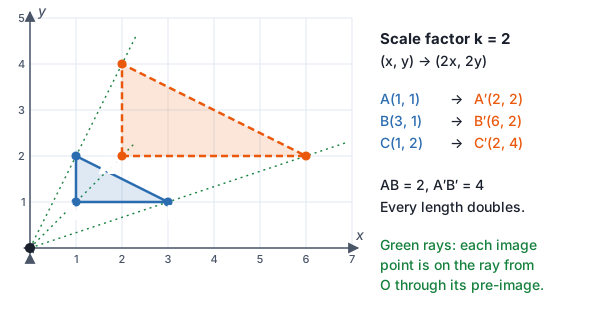
A dilation is not a rigid motion, because lengths change (unless k = 1). The angles stay the same, so the image is similar to the pre-image: same shape, maybe a different size.
Dilation Rule and Scale Factor
For a dilation centered at the origin, multiply both coordinates by k.
(x, y) \to (kx,\ ky)
| Scale factor | Type | What happens |
|---|---|---|
| k \gt 1 | Enlargement | The image is bigger. |
| k = 1 | No change | The image is the same figure. |
| 0 \lt k \lt 1 | Reduction | The image is smaller. |
To find the scale factor from a figure and its image, divide.
k = \frac{\text{image length}}{\text{pre-image length}}Every length is multiplied by k. Area works differently: it is multiplied by k^2, because both the length and the width are multiplied by k.
How to Dilate a Figure
- Find the center and the scale factor k.
- If the center is the origin, multiply each coordinate of each vertex by k.
- If the center is another point, subtract the center, multiply by k, then add the center back.
- Plot the image points and connect them in the same order.
- Label the image with prime marks.
- Check: each image length should be k times the matching pre-image length.
Worked Examples
Example 1: Shrink a point
Dilate P(4, -6) by a scale factor of \frac{1}{2}, centered at the origin.
- Use (x, y) \to (kx, ky) with k = \frac{1}{2}.
- Multiply x by \frac{1}{2}: \frac{1}{2} \cdot 4 = 2
- Multiply y by \frac{1}{2}: \frac{1}{2} \cdot (-6) = -3
- Write the image: P'(2, -3)
Answer: P'(2, -3). The point moved halfway toward the origin.
Example 2: Enlarge a triangle
Triangle ABC has vertices A(1, 1), B(3, 1) and C(1, 2). Dilate it by a scale factor of 2, centered at the origin. This is the picture above.
| Vertex | Multiply x by 2 | Multiply y by 2 | Image |
|---|---|---|---|
| A(1, 1) | 2 \cdot 1 = 2 | 2 \cdot 1 = 2 | A'(2, 2) |
| B(3, 1) | 2 \cdot 3 = 6 | 2 \cdot 1 = 2 | B'(6, 2) |
| C(1, 2) | 2 \cdot 1 = 2 | 2 \cdot 2 = 4 | C'(2, 4) |
- Check a side. AB is horizontal: AB = 3 - 1 = 2
- A'B' is horizontal too: A'B' = 6 - 2 = 4
- Compare: 4 = 2 \cdot 2. The side doubled, as it should.
Answer: A'(2, 2), B'(6, 2), C'(2, 4)
Example 3: Find the scale factor
A dilation centered at the origin maps P(6, 9) to P'(4, 6). Find the scale factor. Is it an enlargement or a reduction?
- Divide the image x by the pre-image x: k = \frac{4}{6}
- Simplify the fraction (see fractions): k = \frac{2}{3}
- Check with y. Multiply: \frac{2}{3} \cdot 9 = \frac{18}{3}
- Divide: \frac{18}{3} = 6. That matches P'.
- Compare: \frac{2}{3} is between 0 and 1.
Answer: k = \frac{2}{3}, a reduction.
Example 4: Center that is not the origin
Dilate P(3, 3) by a scale factor of 3 with center C(1, 2).
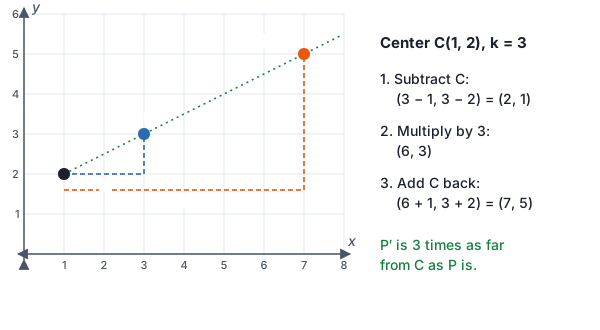
The rule (kx, ky) only works from the origin. So slide the center to the origin, multiply, and slide back.
- Subtract the center from P. x: 3 - 1 = 2
- y: 3 - 2 = 1. That is (2, 1).
- Multiply by 3. x: 3 \cdot 2 = 6
- y: 3 \cdot 1 = 3. That is (6, 3).
- Add the center back. x: 6 + 1 = 7
- y: 3 + 2 = 5. So P'(7, 5).
Check: from C to P is 2 right and 1 up. From C to P' is 6 right and 3 up. That is 3 times as far in the same direction.
Answer: P'(7, 5)
Example 5: Word problem (enlarging a photo)
A photo is 4 inches wide and 6 inches tall. A store enlarges it with a scale factor of 2.5. What are the new width and height? How do the perimeter and the area change?
- New width. Multiply by 2.5 (see operations with decimals): 2.5 \times 4 = 10 inches
- New height. Multiply by 2.5: 2.5 \times 6 = 15 inches
- Old perimeter: 2(4 + 6) = 2(10) = 20 inches
- New perimeter: 2(10 + 15) = 2(25) = 50 inches. Check: 2.5 \times 20 = 50.
- Old area: 4 \times 6 = 24 square inches
- New area: 10 \times 15 = 150 square inches
- Check the area with k^2. Square the scale factor: 2.5^2 = 6.25
- Multiply: 24 \times 6.25 = 150. It matches.
Answer: The new photo is 10 inches by 15 inches. The perimeter grows from 20 to 50 inches (times 2.5). The area grows from 24 to 150 square inches (times 6.25).
Common Mistakes
| Mistake | Example of the error | Fix |
|---|---|---|
| Adding the scale factor | k = 2 turns (3, 1) into (5, 3) | Multiply: (6, 2) |
| Using origin rules for another center | Multiplying P(3, 3) by 3 when the center is (1, 2) | Subtract the center, multiply, then add it back. |
| Flipping the scale factor | k = \frac{6}{4} for P(6, 9) \to P'(4, 6) | Image over pre-image: k = \frac{4}{6} = \frac{2}{3} |
| Thinking a fraction makes it bigger | Calling k = \frac{1}{2} an enlargement | If k is between 0 and 1, the image shrinks. |
| Multiplying area by k | A 24 in² photo with k = 2.5 becomes 60 in² | Area is multiplied by k^2: 150 in² |
| Calling a dilation a rigid motion | Saying the image is congruent | Lengths change, so the image is similar, not congruent. |
What a Dilation Keeps and Changes
| Property | After a dilation |
|---|---|
| Angle measures | Stay the same |
| Side lengths | Multiplied by k |
| Perimeter | Multiplied by k |
| Area | Multiplied by k^2 |
| A line through the center | Stays the same line |
| A line not through the center | Becomes a parallel line |
Because angles stay the same and sides grow by the same factor, a dilation is the key idea behind similar figures. You will use it in Unit 8 on similarity.
A dilation can be part of a sequence, just like the rigid motions in compositions of transformations. A negative scale factor also works: k = -1 sends every point to the opposite side of the center, which is the same as a 180° rotation.
Practice Problems
- Dilate (3, -5) by a scale factor of 4, centered at the origin.
- Dilate (-8, 10) by a scale factor of \frac{1}{2}, centered at the origin.
- Dilate (9, -6) by a scale factor of \frac{2}{3}, centered at the origin.
- Triangle DEF has vertices D(0, 2), E(4, 2) and F(0, 6). Dilate it by \frac{1}{2}, centered at the origin.
- A dilation centered at the origin maps (5, -2) to (15, -6). Find k. Is it an enlargement or a reduction?
- A dilation centered at the origin maps (-12, 8) to (-3, 2). Find k. Is it an enlargement or a reduction?
- Dilate (5, 3) by a scale factor of 2 with center (2, 1).
- Dilate (5, 3) by a scale factor of \frac{1}{2} with center (-1, -1).
- A segment is 7 cm long. Find its length after a dilation with k = 3. A square has area 16 cm². Find its area after the same dilation.
- A projector dilates a drawing by a scale factor of 40. The drawing is 2 cm by 3 cm. Find the size of the image on the screen and its area.
Show answers
- Multiply x by 4: 4 \cdot 3 = 12
Multiply y by 4: 4 \cdot (-5) = -20
Image: (12, -20) - Multiply x: \frac{1}{2} \cdot (-8) = -4
Multiply y: \frac{1}{2} \cdot 10 = 5
Image: (-4, 5) - Multiply x: \frac{2}{3} \cdot 9 = \frac{18}{3} = 6
Multiply y: \frac{2}{3} \cdot (-6) = -\frac{12}{3} = -4
Image: (6, -4) - Multiply each coordinate by \frac{1}{2}
D(0, 2) \to D'(0, 1)
E(4, 2) \to E'(2, 1)
F(0, 6) \to F'(0, 3) - Divide x: k = \frac{15}{5} = 3
Check y: 3 \cdot (-2) = -6
k = 3, an enlargement - Divide x: k = \frac{-3}{-12} = \frac{1}{4}
Check y: \frac{1}{4} \cdot 8 = 2
k = \frac{1}{4}, a reduction - Subtract the center: (5 - 2, 3 - 1) = (3, 2)
Multiply by 2: (6, 4)
Add the center back: (6 + 2, 4 + 1) = (8, 5) - Subtract the center: (5 - (-1), 3 - (-1)) = (6, 4)
Multiply by \frac{1}{2}: (3, 2)
Add the center back: (3 + (-1), 2 + (-1)) = (2, 1) - Length: 3 \cdot 7 = 21 cm
Square the scale factor: 3^2 = 9
Area: 16 \cdot 9 = 144 cm² - Width: 40 \cdot 2 = 80 cm
Height: 40 \cdot 3 = 120 cm
Area: 80 \cdot 120 = 9{,}600 cm²
Check: 2 \cdot 3 = 6 and 40^2 = 1{,}600, so 6 \cdot 1{,}600 = 9{,}600 cm²
FAQ
What is a dilation in geometry?
A dilation resizes a figure by a scale factor from a fixed center. The shape and angles stay the same, but the lengths change.
What is the rule for a dilation centered at the origin?
The rule is (x, y) \to (kx, ky). Multiply both coordinates by the scale factor k.
How do you find the scale factor of a dilation?
Divide an image length by the matching pre-image length. If the answer is greater than 1, it is an enlargement. If it is between 0 and 1, it is a reduction.
Is a dilation a rigid motion?
No. A dilation changes lengths, so the image is similar to the pre-image, not congruent. Only k = 1 keeps the same size.
Summary
- A dilation enlarges or shrinks a figure by a scale factor k from a center.
- About the origin: (x, y) \to (kx, ky).
- k \gt 1 enlarges. 0 \lt k \lt 1 reduces.
- Scale factor = image length ÷ pre-image length.
- Lengths and perimeter are multiplied by k. Area is multiplied by k^2.
- Angles stay the same, so the image is similar, not congruent.
Previous lesson: Compositions of Transformations
Next lesson: Symmetry
Back to the Geometry Index