
Similar Polygons
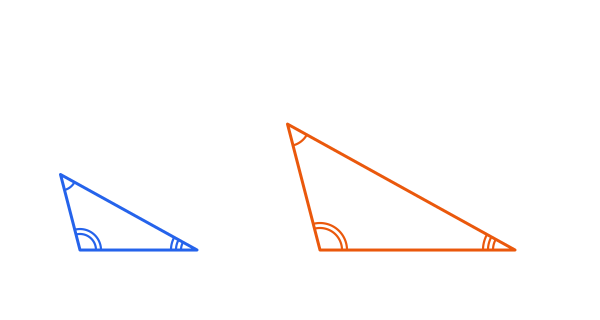
Similar polygons have the same shape but not always the same size. Their corresponding angles are congruent, and their corresponding sides are proportional. The ratio of corresponding sides is called the scale factor. A similarity statement like ABCD \sim EFGH lists the matching vertices in order.
Before this lesson: You should know Dilations, Congruent Figures and Proportions.
What Similar Means
Think of a photo and a bigger print of the same photo. Everything in the print is larger, but nothing is stretched or squished. The shapes match exactly; only the size changes. That is what similar means in geometry.
Two figures are similar if a dilation, possibly followed by rigid motions like a rotation or reflection, maps one onto the other. A dilation multiplies every length by the same number and keeps every angle the same.
The Definition of Similar Polygons
Two polygons are similar when both of these are true:
- Corresponding angles are congruent.
- Corresponding sides are proportional: each ratio of matching sides is the same number.
The symbol \sim means “is similar to.” For \triangle ABC \sim \triangle DEF:
\angle A \cong \angle D,\ \angle B \cong \angle E,\ \angle C \cong \angle F \quad \text{and} \quad \frac{DE}{AB} = \frac{EF}{BC} = \frac{DF}{AC} = kThe number k is the scale factor from the first figure to the second. If k \gt 1, the second figure is an enlargement. If k \lt 1, it is a reduction. If k = 1, the figures are congruent.
How to Work with Similar Polygons
- Match the vertices using the order in the similarity statement.
- Find the scale factor: divide a side of the second figure by the matching side of the first.
- To find a missing side, multiply by the scale factor, or set up a proportion.
- Corresponding angles have equal measures, so copy them across.
- Perimeters have the same ratio as the sides.
Worked Examples
Example 1: Are the rectangles similar?
(a) Is a 4 cm by 6 cm rectangle similar to a 6 cm by 9 cm rectangle? (b) Is a 4 cm by 6 cm rectangle similar to a 5 cm by 7 cm rectangle?
- All rectangles have four right angles, so the angles always match. Only the sides need checking.
- (a) Short sides: 6 \div 4 = 1.5. Long sides: 9 \div 6 = 1.5.
- The ratios are equal, so the rectangles are similar with scale factor 1.5.
- (b) Short sides: 5 \div 4 = 1.25. Long sides: 7 \div 6 \approx 1.17.
- The ratios are not equal, so these rectangles are not similar.
Answer: (a) Yes, with scale factor 1.5. (b) No.
Example 2: Find a missing side
\triangle ABC \sim \triangle DEF, with AB = 6, BC = 9 and DE = 10. Find EF. This is the first picture above.
- AB matches DE and BC matches EF. Write the proportion: \tfrac{AB}{DE} = \tfrac{BC}{EF}
- Substitute: \tfrac{6}{10} = \tfrac{9}{EF}
- Cross multiply (see proportions): 6 \cdot EF = 9 \cdot 10
- Multiply: 6 \cdot EF = 90
- Divide both sides by 6: EF = 15
- Check with the scale factor: k = \tfrac{10}{6} = \tfrac{5}{3}, and 9 \cdot \tfrac{5}{3} = 15.
Answer: EF = 15.
Example 3: Solve for x and an angle
Quadrilateral ABCD \sim PQRS. AB = 8, PQ = 12, BC = x + 2 and QR = 15. Also m\angle A = 70^\circ. Find x and m\angle P.
- Write the proportion of matching sides: \tfrac{AB}{PQ} = \tfrac{BC}{QR}
- Substitute: \tfrac{8}{12} = \tfrac{x + 2}{15}
- Cross multiply: 12(x + 2) = 8 \cdot 15
- Multiply on the right: 12(x + 2) = 120
- Divide both sides by 12: x + 2 = 10
- Subtract 2 from both sides: x = 8
- Angles A and P correspond, so they are congruent: m\angle P = 70^\circ.
Answer: x = 8 and m\angle P = 70^\circ. Check: BC = 10, and \tfrac{8}{12} = \tfrac{10}{15} = \tfrac{2}{3}.
Example 4: Perimeters of similar figures
Two triangles are similar, with a scale factor of \tfrac{3}{2} from the smaller to the larger. The smaller triangle has a perimeter of 24 cm. Find the perimeter of the larger triangle.
- Every side is multiplied by \tfrac{3}{2}, so the whole perimeter is multiplied by \tfrac{3}{2} too.
- Multiply: 24 \times \tfrac{3}{2} = \tfrac{72}{2} = 36
Answer: The larger triangle’s perimeter is 36 cm.
Example 5: Word problem with a photo
A 5-inch by 7-inch photo is enlarged so that its shorter side is 15 inches. The enlargement is similar to the original. How long is the longer side?
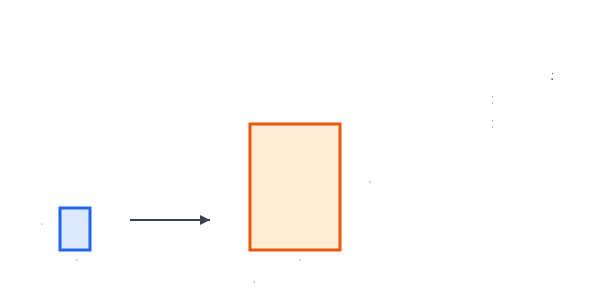
- Find the scale factor from the short sides: 15 \div 5 = 3
- Multiply the longer side by the scale factor: 7 \times 3 = 21
- Check the ratio: \tfrac{15}{5} = \tfrac{21}{7} = 3
Answer: The longer side is 21 inches.
Common Mistakes
| Mistake | Example of the error | Fix |
|---|---|---|
| Adding instead of multiplying | 5 in becomes 15 in, so “7 in becomes 17 in” | Similar figures are scaled by multiplying: 7 \times 3 = 21. |
| Mixing up the order in a proportion | \tfrac{6}{10} = \tfrac{EF}{9} | Keep the same order in both ratios: small over large, or large over small. |
| Matching the wrong sides | Pairing AB with EF in \triangle ABC \sim \triangle DEF | Use the letter order: AB matches DE. |
| Scaling the angles | Multiplying a 70° angle by the scale factor | Angles stay the same in similar figures. Only lengths change. |
| Thinking all rectangles are similar | Calling 4 by 6 and 5 by 7 similar | The angles match, but the side ratios must match too. |
Similarity and Congruence
- Congruent figures are similar figures with scale factor 1.
- All squares are similar, and so are all equilateral triangles and all circles.
- Not all rectangles, rhombuses or isosceles triangles are similar. Their shapes can differ.
- Similar figures can be turned or flipped. Use the similarity statement, not the picture, to match parts (see compositions of transformations).
For triangles, you don’t need to check every angle and side. The next lessons give shortcuts, starting with AA similarity.
Practice Problems
- \triangle JKL \sim \triangle MNO. Which angle corresponds to \angle K? Write a proportion that includes JK.
- Is a 3 by 5 rectangle similar to a 9 by 15 rectangle? If so, give the scale factor.
- Is a 2 by 5 rectangle similar to a 4 by 8 rectangle? Explain.
- \triangle ABC \sim \triangle DEF, with AB = 4, DE = 10 and AC = 6. Find DF.
- ABCD \sim WXYZ, with AB = 5, WX = 8 and BC = 10. Find the scale factor from ABCD to WXYZ, and find XY.
- \triangle PQR \sim \triangle STU, with PQ = 9, ST = 12, QR = x - 3 and TU = 8. Find x.
- Two similar pentagons have a scale factor of \tfrac{2}{5} from the larger to the smaller. The larger has a perimeter of 45 m. Find the perimeter of the smaller.
- Two pentagons are similar. In the first, m\angle B = 108^\circ. What is the measure of the corresponding angle in the second?
- On a map, 1 inch stands for 50 miles. Two towns are 3.5 inches apart on the map. How far apart are they?
- True or false: (a) All squares are similar. (b) All rectangles are similar. (c) Congruent figures are similar.
Show answers
- \angle N (the second letters match)
\tfrac{JK}{MN} = \tfrac{KL}{NO} (other correct proportions work too) - Short sides: 9 \div 3 = 3. Long sides: 15 \div 5 = 3
Yes, similar with scale factor 3. - Short sides: 4 \div 2 = 2. Long sides: 8 \div 5 = 1.6
The ratios differ, so they are not similar. - Scale factor: 10 \div 4 = 2.5
Multiply: 6 \times 2.5 = 15
DF = 15 - Scale factor: \tfrac{8}{5}
Multiply: 10 \times \tfrac{8}{5} = \tfrac{80}{5} = 16
XY = 16 - Proportion: \tfrac{9}{12} = \tfrac{x - 3}{8}
Cross multiply: 12(x - 3) = 72
Divide by 12: x - 3 = 6
Add 3: x = 9 - Multiply: 45 \times \tfrac{2}{5} = \tfrac{90}{5} = 18
The smaller perimeter is 18 m. - Corresponding angles are congruent, so it is 108°.
- Multiply: 3.5 \times 50 = 175
The towns are 175 miles apart. - (a) True (b) False (c) True
FAQ
What makes two polygons similar?
Their corresponding angles are congruent, and their corresponding sides are proportional. In other words, one is a scaled copy of the other.
What is a scale factor?
The scale factor is the number you multiply each length by to go from one similar figure to the other. You find it by dividing a side of the new figure by the matching side of the original.
What is the difference between similar and congruent?
Congruent figures have the same shape and size. Similar figures have the same shape but can be different sizes. Congruent figures are similar with a scale factor of 1.
Are all squares similar?
Yes. Every square has four right angles, and the ratio of any two squares’ sides is the same for all four sides.
Summary
- Similar polygons have congruent corresponding angles and proportional corresponding sides.
- The scale factor is the ratio of matching sides.
- Use the similarity statement to match vertices.
- Find missing sides with the scale factor or a proportion.
- Perimeters scale by the same factor as the sides; angles do not change.
Previous lesson: Coordinate Proofs
Next lesson: AA Similarity
Back to the Geometry Index