
Similar Solids
Similar solids have the same shape, with every length multiplied by the same scale factor k. When lengths are multiplied by k, surface areas are multiplied by k^2 and volumes by k^3. So doubling every length makes the area 4 times as large and the volume 8 times as large.
Before this lesson: You should know Similar Polygons, Volume of Prisms and Cylinders and Surface Area and Volume of Spheres.
What Are Similar Solids?
Two solids are similar if they are the same type and all their matching lengths have the same ratio. That ratio is the scale factor k. It works like the scale factor of similar polygons, but in three dimensions.
To test two cylinders, compare the radii and compare the heights. If both ratios are equal, the cylinders are similar. All spheres are similar to each other, and so are all cubes.
Area Grows by k² and Volume by k³
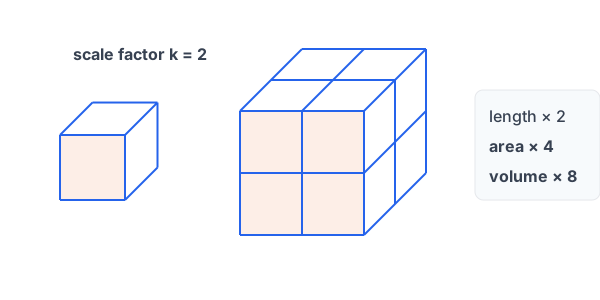
Area has two dimensions, so each one is multiplied by k, and the area by k \cdot k = k^2. Volume has three dimensions, so it is multiplied by k^3.
| If the scale factor is | Ratio of lengths | Ratio of surface areas | Ratio of volumes |
|---|---|---|---|
| a : b | a : b | a^2 : b^2 | a^3 : b^3 |
| 2 : 3 | 2 : 3 | 4 : 9 | 8 : 27 |
How to Solve Similar Solid Problems
- Find the scale factor from two matching lengths: k = \frac{\text{new length}}{\text{old length}}.
- For areas, multiply by k^2. For volumes, multiply by k^3.
- If you start from an area ratio, take the square root to get k. From a volume ratio, take the cube root.
- Check that a bigger solid gives a bigger answer.
Worked Examples
Example 1: Are the cylinders similar?
Cylinder A has radius 3 and height 8. Cylinder B has radius 4.5 and height 12. Are they similar? If so, find the scale factor.
- Compare the radii: \frac{4.5}{3} = 1.5
- Compare the heights: \frac{12}{8} = 1.5
- The ratios are equal, so the cylinders are similar.
Answer: Yes. The scale factor from A to B is 1.5, or \frac{3}{2}.
Example 2: Find a surface area
Two prisms are similar with scale factor 2 : 5. The smaller prism has surface area 48 cm². Find the surface area of the larger prism.
- Write the scale factor from small to large: k = \frac{5}{2}
- Square it for area: k^2 = \frac{25}{4}
- Multiply the small area: 48 \cdot \frac{25}{4}
- Simplify: 12 \cdot 25 = 300
Answer: 300 cm²
Example 3: Find a volume
Two cones are similar with scale factor 2 : 3. The smaller cone has volume 54 in³. Find the volume of the larger cone.
- Write the scale factor from small to large: k = \frac{3}{2}
- Cube it for volume: k^3 = \frac{27}{8}
- Multiply the small volume: 54 \cdot \frac{27}{8}
- Multiply: \frac{1458}{8} = 182.25
Answer: 182.25 in³
Example 4: Start from the volumes
Two similar solids have volumes 27 m³ and 125 m³. The smaller one has surface area 36 m². Find the surface area of the larger one.
- Write the volume ratio: \frac{125}{27}
- Take the cube root to get the scale factor (see cube roots): k = \frac{5}{3}
- Square it for area: k^2 = \frac{25}{9}
- Multiply the small area: 36 \cdot \frac{25}{9}
- Simplify: 4 \cdot 25 = 100
Answer: 100 m²
Example 5: Word problem with a model car
A model car is built at a 1 : 24 scale. Painting the model covers 50 in². How much area does painting the real car cover? How many times greater is the real car’s volume?
- The scale factor from model to real car is k = 24.
- Square it for area: 24^2 = 576
- Multiply the model’s area: 50 \cdot 576 = 28{,}800 in²
- Convert to square feet, since 1 ft² = 144 in² (see unit conversions): 28{,}800 \div 144 = 200 ft²
- Cube the scale factor for volume: 24^3 = 13{,}824
Answer: The real car’s paint covers 28,800 in² (200 ft²). Its volume is 13,824 times the model’s.
Common Mistakes
| Mistake | Example of the error | Fix |
|---|---|---|
| Using k for volume | Scale 2 : 3, so volume = 54 \cdot \frac{3}{2} = 81 | Volume uses k^3: 54 \cdot \frac{27}{8} = 182.25. |
| Using k^3 for area | Surface area \times \frac{125}{8} | Area uses k^2. |
| Flipping the scale factor | Multiplying a small solid by \frac{2}{5} to get a larger one | Write k as new over old. Going up, k \gt 1. |
| Calling solids similar from one ratio | Checking only the radii of two cylinders | Every matching length must have the same ratio. |
| Taking the square root of a volume ratio | \sqrt{\frac{125}{27}} | Use the cube root for volume ratios. |
Practice Problems
- Is a 2 × 3 × 5 box similar to a 6 × 9 × 15 box? If so, give the scale factor.
- Cylinder A has radius 2 and height 5. Cylinder B has radius 4 and height 8. Are they similar?
- Two similar pyramids have scale factor 1 : 3. The smaller one has surface area 20 cm². Find the surface area of the larger one.
- For the same pyramids, the smaller one has volume 20 cm³. Find the volume of the larger one.
- Two spheres have radii 4 and 6. Find the ratio of their surface areas and the ratio of their volumes.
- Two similar solids have volumes 8 and 64. Find the ratio of their surface areas.
- Two similar solids have surface areas 16 and 49. The smaller has volume 128. Find the volume of the larger.
- Two similar pyramids have heights 6 and 9. The smaller has volume 80. Find the volume of the larger.
- Two similar water bottles are 20 cm and 30 cm tall. The small bottle holds 500 mL. How much does the large bottle hold?
- A statue is 3 times as tall as a similar model made of the same material. The model weighs 2 kg. About how much does the statue weigh?
Show answers
- Compare the lengths: \frac{6}{2} = 3, \frac{9}{3} = 3, \frac{15}{5} = 3
All ratios are equal, so yes, with scale factor 3. - Compare the radii: \frac{4}{2} = 2
Compare the heights: \frac{8}{5} = 1.6
The ratios are different, so they are not similar. - Square the scale factor: 3^2 = 9
Multiply: 20 \cdot 9 = 180 cm² - Cube the scale factor: 3^3 = 27
Multiply: 20 \cdot 27 = 540 cm³ - Scale factor: 4 : 6 = 2 : 3
Surface areas: 2^2 : 3^2 = 4 : 9
Volumes: 2^3 : 3^3 = 8 : 27 - Volume ratio: 8 : 64 = 1 : 8
Take the cube root: scale factor 1 : 2
Square it: surface areas 1 : 4 - Area ratio: 16 : 49
Take the square root: scale factor 4 : 7
Cube it: volumes 64 : 343
Multiply: 128 \cdot \frac{343}{64} = 2 \cdot 343 = 686 - Scale factor: k = \frac{9}{6} = \frac{3}{2}
Cube it: k^3 = \frac{27}{8}
Multiply: 80 \cdot \frac{27}{8} = 10 \cdot 27 = 270 - Scale factor: k = \frac{30}{20} = \frac{3}{2}
Cube it: k^3 = \frac{27}{8}
Multiply: 500 \cdot \frac{27}{8} = \frac{13{,}500}{8} = 1687.5 mL - Weight depends on volume. Cube the scale factor: 3^3 = 27
Multiply: 2 \cdot 27 = 54 kg
FAQ
What makes two solids similar?
They are the same type of solid, and every pair of matching lengths has the same ratio, the scale factor.
How does the scale factor affect volume?
Volume is multiplied by the cube of the scale factor. If lengths triple, volume becomes 3^3 = 27 times as large.
How do you find the scale factor from a volume ratio?
Take the cube root of the volume ratio. For volumes 27 and 125, the scale factor is \sqrt[3]{27} : \sqrt[3]{125} = 3 : 5.
Are all spheres similar?
Yes. A sphere’s only measurement is its radius, so any two spheres have a single ratio of matching lengths.
Summary
- Similar solids have the same shape, and all matching lengths share one scale factor k.
- Surface areas are multiplied by k^2.
- Volumes (and weights of the same material) are multiplied by k^3.
- From an area ratio, take the square root to find k. From a volume ratio, take the cube root.
Previous lesson: Surface Area and Volume of Spheres
Next course: Algebra 2 Index
Back to the Geometry Index