
Parent Functions
A parent function is the simplest function in a family of functions. Every other function in the family is the parent shifted, stretched or flipped. For example, y = x^2 is the parent of every quadratic, such as y = (x - 3)^2 + 1. If you know each parent’s shape, you can sketch and recognize graphs fast.
Before this lesson: You should know Function Notation, Domain and Range and Key Features of Functions. It also helps to have graphed quadratic functions and exponential functions.
What Is a Parent Function?
Functions come in families. Every quadratic function makes a U-shaped graph. Every absolute value function makes a V. The parent function is the plainest member of a family, with no extra numbers added.
Think of a car model. The base model has no add-ons, and every other version is the base model with something changed. In the same way, y = 2(x + 1)^2 - 3 is the parent y = x^2 with changes. It is moved left 1, stretched by 2 and moved down 3.
Those changes are called transformations. The next lesson, Transformations of Functions, shows how each one moves a graph. This lesson covers the parents themselves: their equations, shapes, domains, ranges and key points.
The Parent Function Rule
Every function in a family can be written with its parent, f, and three numbers:
y = a \cdot f(x - h) + k
Here a stretches or flips the graph, h moves it left or right, and k moves it up or down. For the parent itself, a = 1, h = 0 and k = 0, so the equation is just y = f(x).
The Parent Functions
This table lists the ten parent functions you’ll see most. The domain is every input x you can use, and the range is every output y you can get. In interval notation, [0, \infty) means 0 and every number above it, and (0, \infty) means every number above 0.
| Family | Parent function | Shape |
|---|---|---|
| Constant | y = c | Horizontal line |
| Linear | y = x | Line through the origin |
| Quadratic | y = x^2 | U shape (parabola) |
| Cubic | y = x^3 | S shape |
| Absolute value | y = |x| | V shape |
| Square root | y = \sqrt{x} | Half of a sideways U |
| Cube root | y = \sqrt[3]{x} | Sideways S |
| Reciprocal | y = \frac{1}{x} | Two curves (hyperbola) |
| Exponential | y = 2^x | Rises from the x-axis |
| Logarithmic | y = \log_2 x | Rises slowly from the y-axis |
Here are the domain, range and three easy points for each one.
| Parent function | Domain | Range | Key points |
|---|---|---|---|
| y = c | All real numbers | Only c | (0, c) |
| y = x | All real numbers | All real numbers | (-1, -1), (0, 0), (1, 1) |
| y = x^2 | All real numbers | [0, \infty) | (-1, 1), (0, 0), (1, 1) |
| y = x^3 | All real numbers | All real numbers | (-1, -1), (0, 0), (1, 1) |
| y = |x| | All real numbers | [0, \infty) | (-1, 1), (0, 0), (1, 1) |
| y = \sqrt{x} | [0, \infty) | [0, \infty) | (0, 0), (1, 1), (4, 2) |
| y = \sqrt[3]{x} | All real numbers | All real numbers | (-1, -1), (0, 0), (1, 1) |
| y = \frac{1}{x} | All reals except 0 | All reals except 0 | (-1, -1), (1, 1) |
| y = 2^x | All real numbers | (0, \infty) | (0, 1), (1, 2), (2, 4) |
| y = \log_2 x | (0, \infty) | All real numbers | (1, 0), (2, 1), (4, 2) |
The exponential parent can use any base b with b \gt 0 and b \ne 1. This lesson uses base 2 because its points are easy to find by hand. The constant parent is a horizontal line, and the linear parent is the line y = mx + b with m = 1 and b = 0 (see slope-intercept form).
Graphs of the Parent Functions
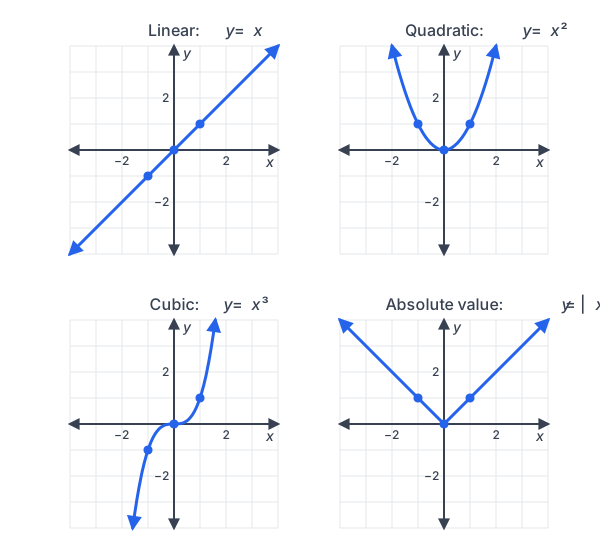
The first four parents all pass through (0, 0) and (1, 1). Their shapes are what tell them apart: a straight line, a U, an S and a V.
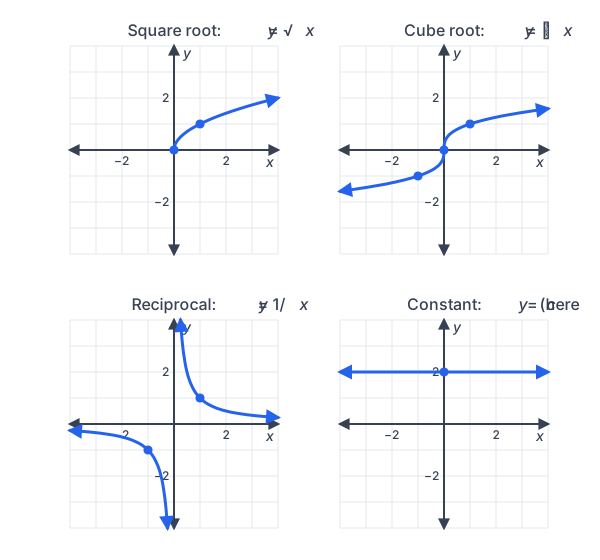
The next three have limits on their inputs or outputs. The square root graph starts at (0, 0) and only goes right. The reciprocal graph has two pieces. Each piece gets closer and closer to the x- and y-axes but never touches them. A line like that is called an asymptote.
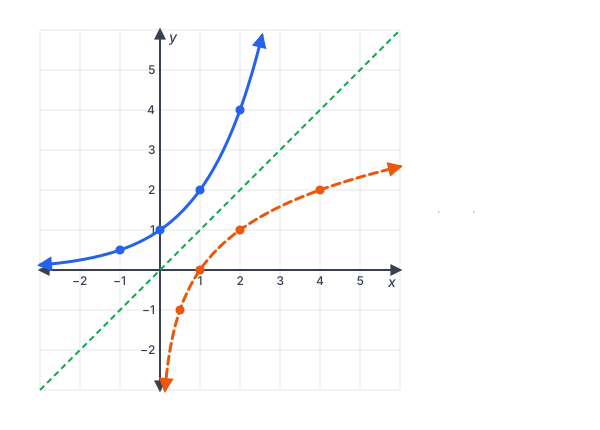
The exponential and logarithmic parents are mirror images of each other. Every point (a, b) on y = 2^x matches a point (b, a) on y = \log_2 x. The x-axis is an asymptote of y = 2^x, and the y-axis is an asymptote of y = \log_2 x. You will study logarithms in Algebra 2, Unit 7.
How to Identify a Parent Function
- Simplify the right side if you can.
- Find what happens to x. Is it squared, cubed, inside absolute value bars, under a root, in a denominator, in an exponent or inside a log?
- Ignore the numbers added, subtracted or multiplied outside that step. They are transformations.
- Match what happens to x with a family in the table.
- Check that a graph or a table of values has that family’s shape.
Worked Examples
Example 1: Name the parent function
Name the parent function of each: (a) f(x) = 3(x + 2)^2 - 5, (b) g(x) = -|x - 4| + 1, (c) h(x) = \sqrt{x + 7}.
(a)
Step 1. Find what happens to x. The expression x + 2 is squared.
Step 2. Ignore the 3 in front, the 2 inside and the −5 at the end. They are transformations.
Step 3. Squaring makes a quadratic. The parent function is y = x^2.
(b)
Step 1. Find what happens to x. The expression x - 4 is inside absolute value bars.
Step 2. Ignore the negative sign in front, the 4 inside and the +1 at the end.
Step 3. The parent function is y = |x|. The negative sign flips the V upside down, but the family is still absolute value.
(c)
Step 1. Find what happens to x. The expression x + 7 is under a square root.
Step 2. Ignore the 7 inside the root.
Step 3. The parent function is y = \sqrt{x}.
Example 2: Domain and range of two parents
Find the domain and range of y = \sqrt{x} and of y = \frac{1}{x}.
Square root.
Step 1. Find the inputs you can use. A negative number has no real square root (see square root), so x must be 0 or more.
x \ge 0
Step 2. Write the domain in interval notation.
[0, \infty)
Step 3. Find the outputs. A square root is never negative, and \sqrt{0} = 0, so y can be 0 or any positive number.
y \ge 0, \text{ or } [0, \infty)Reciprocal.
Step 1. Find the inputs you can use. You can’t divide by 0, so x can be any number except 0.
x \ne 0
Step 2. Write the domain in interval notation. The symbol \cup means “or”: the numbers below 0 or the numbers above 0.
(-\infty, 0) \cup (0, \infty)
Step 3. Find the outputs. A fraction with 1 on top can never equal 0, but it can equal any other number. For example, \frac{1}{x} = 5 when x = \frac{1}{5}.
y \ne 0, \text{ or } (-\infty, 0) \cup (0, \infty)Example 3: A table of values for the cube root parent
Make a table of values for y = \sqrt[3]{x} using x = -8, -1, 0, 1, 8. Then describe the graph.
Step 1. Find the cube root of −8 (see cube roots). It is −2, because (-2)^3 = -8.
\sqrt[3]{-8} = -2Step 2. Find the cube root of −1. It is −1, because (-1)^3 = -1.
\sqrt[3]{-1} = -1Step 3. Find the cube root of 0.
\sqrt[3]{0} = 0Step 4. Find the cube root of 1.
\sqrt[3]{1} = 1Step 5. Find the cube root of 8. It is 2, because 2^3 = 8.
\sqrt[3]{8} = 2Step 6. Put the results in a table.
| x | −8 | −1 | 0 | 1 | 8 |
|---|---|---|---|---|---|
| y = \sqrt[3]{x} | −2 | −1 | 0 | 1 | 2 |
Plot the points (-8, -2), (-1, -1), (0, 0), (1, 1) and (8, 2) and join them with a smooth curve. The graph is a sideways S through the origin. Unlike the square root, the cube root works for negative numbers, so the graph runs both left and right.
Example 4: Identify the parent from a table
Which parent function matches each table?
| x | −2 | −1 | 0 | 1 | 2 |
|---|---|---|---|---|---|
| Table A: y | \frac{1}{4} | \frac{1}{2} | 1 | 2 | 4 |
| Table B: y | −8 | −1 | 0 | 1 | 8 |
Table A.
Step 1. Divide each y by the one before it (see exponential functions).
\begin{aligned} \tfrac{1}{2} \div \tfrac{1}{4} &= 2 \\ 1 \div \tfrac{1}{2} &= 2 \\ 2 \div 1 &= 2 \\ 4 \div 2 &= 2 \end{aligned}Step 2. Every ratio is 2, so each output doubles. That is exponential growth with base 2.
Step 3. Check the point (0, 1): 2^0 = 1. The parent function is y = 2^x.
Step 4. Check a negative input (see zero and negative exponents).
2^{-2} = \frac{1}{2^2} = \frac{1}{4}Table B.
Step 1. Find the differences between the outputs. They are 7, 1, 1 and 7, so they are not the same. The table is not linear.
Step 2. Test y = x^3 with each input (see exponents).
\begin{aligned} (-2)^3 &= -8 \\ (-1)^3 &= -1 \\ 0^3 &= 0 \\ 1^3 &= 1 \\ 2^3 &= 8 \end{aligned}Step 3. Every output matches. The parent function is y = x^3.
Example 5: Word problems
Name the parent function for each situation, then answer the question.
(a) A square patio has an area of A square feet. Its side length is s = \sqrt{A}. How long is a side when A = 49?
Step 1. The input A is under a square root, so the parent function is y = \sqrt{x}.
Step 2. Substitute 49 for A.
s = \sqrt{49}Step 3. Find the square root.
s = 7
Each side is 7 feet long.
(b) A 120-mile trip at r miles per hour takes t = \frac{120}{r} hours. How long does the trip take at 40 mph and at 60 mph?
Step 1. The input r is in the denominator, so the parent function is y = \frac{1}{x}. The 120 stretches it.
Step 2. Substitute 40 for r and divide.
t = \frac{120}{40} = 3Step 3. Substitute 60 for r and divide.
t = \frac{120}{60} = 2The trip takes 3 hours at 40 mph and 2 hours at 60 mph. Going faster cuts the time, which matches the falling reciprocal curve.
(c) A box shaped like a cube has edges e inches long. Its volume is V = e^3. Find the volume when e = 4.
Step 1. The input e is cubed, so the parent function is y = x^3.
Step 2. Substitute 4 for e.
V = 4^3
Step 3. Multiply: 4 \cdot 4 \cdot 4 = 64.
V = 64
The volume is 64 cubic inches.
Common Mistakes
| Mistake | Example of the error | Fix |
|---|---|---|
| Mixing up x^2 and 2^x | Calling y = 2^x a quadratic | In x^2, x is the base. In 2^x, x is the exponent, so the function is exponential. |
| Giving the square root a negative domain | Saying y = \sqrt{x} works for all real numbers | A negative number has no real square root. The domain is x \ge 0. |
| Mixing up cube roots and square roots | Saying \sqrt[3]{-8} is undefined | Cube roots of negatives exist: \sqrt[3]{-8} = -2. |
| Drawing the reciprocal through the origin | Plotting (0, 0) on y = \frac{1}{x} | x = 0 is not in the domain and y is never 0. The graph gets close to both axes but never touches them. |
| Confusing the U and the V | Drawing y = |x| as a rounded curve | |x| makes a V with straight sides and a sharp corner. x^2 makes a rounded U. |
| Letting the log graph reach the y-axis | Plotting (0, 0) on y = \log_2 x | You can only take the log of a positive number, so x \gt 0. |
Patterns in the Parent Functions
Grouping the parents by their features makes them easier to remember.
| Feature | Parent functions |
|---|---|
| Pass through (0, 0) and (1, 1) | Linear, quadratic, cubic, absolute value, square root, cube root |
| Mirror image across the y-axis | Constant, quadratic, absolute value |
| Same after turning the graph halfway around the origin | Linear, cubic, cube root, reciprocal |
| Always rising from left to right | Linear, cubic, square root, cube root, exponential, logarithmic |
| Have an asymptote | Reciprocal (both axes), exponential (the x-axis), logarithmic (the y-axis) |
Some parents undo each other. Squaring undoes a square root when x \ge 0, cubing undoes a cube root, and y = 2^x undoes y = \log_2 x. Pairs like these are called inverse functions, which you will meet later in Algebra 2, Unit 1. The reciprocal undoes itself.
Trigonometry adds two more parents, y = \sin x and y = \cos x. Their wave-shaped graphs are in Trigonometry, Unit 4. To compare how fast a line and an exponential grow, see Linear vs. Exponential Functions.
Practice Problems
- Name the parent function of f(x) = -4x^3 + 2.
- Name the parent function of g(x) = \frac{2}{x - 1}.
- Name the parent function of h(x) = \log_2(x + 3).
- Name the parent function of p(x) = \sqrt[3]{x} + 6.
- Find the domain and range of y = |x|.
- Find the domain and range of y = 2^x.
- Evaluate: (a) \sqrt{81}, (b) \sqrt[3]{-27}, (c) |{-6}|, (d) 2^{-3}.
- Which parent function matches this table? x: −2, −1, 0, 1, 2. y: 4, 1, 0, 1, 4.
- Which of these pass through (1, 1): y = x^3, y = \sqrt{x}, y = 2^x, y = \log_2 x, y = \frac{1}{x}?
- A lab starts with 1 thousand bacteria, and the number doubles every hour. After t hours there are B = 2^t thousand bacteria. Name the parent function and find B after 5 hours.
Show answers
- Find what happens to x: it is cubed.
Ignore the −4 and the +2.
The parent function is y = x^3 (cubic). - Find what happens to x: x - 1 is in the denominator.
Ignore the 2 on top and the 1 being subtracted.
The parent function is y = \frac{1}{x} (reciprocal). - Find what happens to x: x + 3 is inside a log base 2.
Ignore the 3.
The parent function is y = \log_2 x (logarithmic). - Find what happens to x: it is under a cube root.
Ignore the +6.
The parent function is y = \sqrt[3]{x} (cube root). - Inputs: every number has an absolute value (see absolute value). Domain: all real numbers, (-\infty, \infty).
Outputs: an absolute value is never negative, and |0| = 0. Range: y \ge 0, or [0, \infty). - Inputs: 2 can be raised to any power. Domain: all real numbers, (-\infty, \infty).
Outputs: a power of 2 is always positive and never 0. Range: y \gt 0, or (0, \infty). - (a) 9 \cdot 9 = 81, so \sqrt{81} = 9.
(b) (-3)^3 = -27, so \sqrt[3]{-27} = -3.
(c) −6 is 6 units from 0, so |{-6}| = 6.
(d) Rewrite with a positive exponent: 2^{-3} = \frac{1}{2^3}.
Find the power: 2^3 = 8, so 2^{-3} = \frac{1}{8}. - Test y = x^2: (-2)^2 = 4, (-1)^2 = 1, 0^2 = 0, 1^2 = 1, 2^2 = 4.
Every output matches.
Check that it isn’t y = |x|: |{-2}| = 2, not 4.
The parent function is y = x^2. - y = x^3: 1^3 = 1. Yes.
y = \sqrt{x}: \sqrt{1} = 1. Yes.
y = 2^x: 2^1 = 2. No.
y = \log_2 x: \log_2 1 = 0, because 2^0 = 1. No.
y = \frac{1}{x}: \frac{1}{1} = 1. Yes.
So y = x^3, y = \sqrt{x} and y = \frac{1}{x} pass through (1, 1). - The input t is an exponent, so the parent function is y = 2^x (exponential).
Substitute 5 for t: B = 2^5.
Multiply: 2 \cdot 2 \cdot 2 \cdot 2 \cdot 2 = 32.
There are 32 thousand bacteria after 5 hours.
FAQ
What are the parent functions?
The common parent functions are constant, linear, quadratic, cubic, absolute value, square root, cube root, reciprocal, exponential and logarithmic. Trigonometry adds sine and cosine.
What is the parent function of a quadratic?
It is y = x^2. Every quadratic, like y = -2(x - 1)^2 + 5, is a transformation of that U-shaped graph.
Is y = 2^x a parent function?
Yes. It is a common parent for exponential functions. Any base b with b \gt 0 and b \ne 1 gives the same basic shape, and many books also use y = e^x.
What is the difference between a parent function and a transformation?
A parent function is the simplest form of a family. A transformation shifts, stretches, shrinks or flips the parent’s graph to make another member of the family.
Summary
- A parent function is the simplest function in a family. Every other member is a transformation of it.
- The ten common parents are constant, linear, quadratic, cubic, absolute value, square root, cube root, reciprocal, exponential and logarithmic.
- To name the parent, find what happens to x and ignore the numbers outside that step.
- Watch the domains: the square root needs x \ge 0, the reciprocal needs x \ne 0, and the log needs x \gt 0.
- The exponential parent y = 2^x and the log parent y = \log_2 x are mirror images across y = x.
Also listed in: the Algebra 1, Trigonometry, Precalculus and Calculus 1 indexes
Previous course: Geometry Index
Next lesson: Transformations of Functions (coming soon)
Back to the Algebra 2 Index