
Volume of Prisms and Cylinders
The volume of prisms and cylinders is the area of the base times the height: V = Bh. For a cylinder, the base is a circle, so V = \pi r^2 h. Volume measures the space inside a solid, in cubic units such as cm³ or ft³.
Before this lesson: You should know Surface Area of Prisms and Cylinders, Area of Triangles and Circumference and Area of Circles.
Volume as Stacked Layers
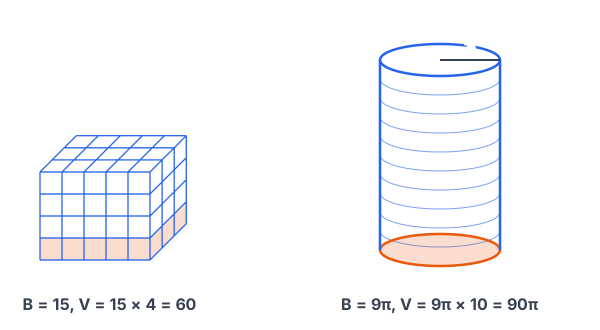
Think of a prism as a stack of identical layers, each one a copy of the base. One layer that is 1 unit thick holds B cubic units, where B is the area of the base. A prism h units tall has h layers. So the volume is B \cdot h.
Volume Formulas
\text{Prism: } V = Bh \qquad \text{Cylinder: } V = \pi r^2 hFor a rectangular prism, B = \ell w, so V = \ell wh. For a cube with edge s, V = s^3.
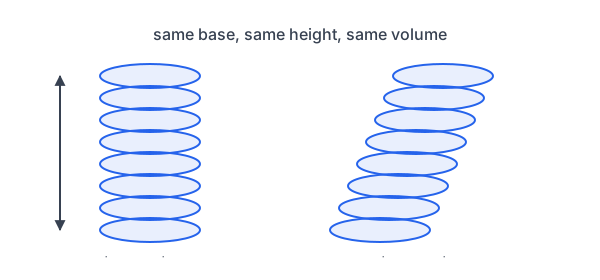
Cavalieri’s principle: If two solids have the same height and the same cross-section area at every level, they have the same volume. So V = Bh also works for oblique (slanted) prisms and cylinders. Use the straight-up height, not the slanted edge.
How to Find Volume
- Identify the base. It is the face that repeats through the solid, not always the bottom.
- Find the area of the base, B. For a cylinder, B = \pi r^2.
- Find the height h, the perpendicular distance between the two bases.
- Multiply: V = Bh. Give the answer in cubic units.
Worked Examples
Example 1: A rectangular prism
Find the volume of a box 5 cm long, 3 cm wide and 4 cm tall.
- Find the base area: B = 5 \cdot 3 = 15
- Multiply by the height: V = 15 \cdot 4
- Multiply: V = 60
Answer: 60 cm³
Example 2: A triangular prism
The bases of a prism are right triangles with legs 6 and 8. The prism is 12 units long. Find its volume.
- Find the base area (see area of triangles): B = \tfrac{1}{2} \cdot 6 \cdot 8
- Multiply: B = 24
- Multiply by the length between the bases: V = 24 \cdot 12
- Multiply: V = 288
Answer: 288 cubic units. The prism lies on its side, but the bases are still the triangles.
Example 3: A cylinder
Find the volume of a cylinder with radius 3 and height 10.
- Write the formula: V = \pi r^2 h
- Substitute: V = \pi(3)^2(10)
- Square: V = \pi(9)(10)
- Multiply: V = 90\pi
- Use a calculator: V \approx 282.74
Answer: 90\pi \approx 282.74 cubic units
Example 4: Find the height
A cylinder has radius 4 in and volume 200\pi in³. Find its height.
- Write the formula: 200\pi = \pi(4)^2 h
- Square: 200\pi = 16\pi h
- Divide both sides by 16\pi: h = \frac{200}{16}
- Divide: h = 12.5
Answer: 12.5 in
Example 5: Word problem with a fish tank
A fish tank is 24 in long, 12 in wide and 16 in tall. How many cubic inches of water does it hold when full? One gallon is 231 in³. About how many gallons is that?
- Find the base area: B = 24 \cdot 12 = 288
- Multiply by the height: V = 288 \cdot 16
- Multiply: V = 4608
- Convert to gallons by dividing by 231 (see unit conversions): 4608 \div 231 \approx 19.95
Answer: 4,608 in³, or about 19.95 gallons
Common Mistakes
| Mistake | Example of the error | Fix |
|---|---|---|
| Using the diameter in \pi r^2 h | \pi(12)^2(5) for a cylinder 12 across | Halve the diameter first: \pi(6)^2(5). |
| Using the slanted edge as the height | Using 9 as the height of an oblique cylinder that is 7 tall | The height is the perpendicular distance between the bases. |
| Mixing up volume and surface area | Answering a “how much water” question with 2\pi rh + 2\pi r^2 | Capacity is volume: \pi r^2 h. |
| Writing square units | V = 60 cm² | Volume uses cubic units: 60 cm³. |
| Picking the wrong face as the base | Multiplying the 6 by 12 face by 8 for a triangular prism | The base is the face that repeats: the triangle. |
Practice Problems
Give answers with \pi exactly, then rounded to the nearest hundredth.
- Find the volume of a cube with edge 7 cm.
- Find the volume of a box 10 in by 4 in by 2.5 in.
- A prism has equilateral triangle bases with side 6 and area 9\sqrt{3}. It is 10 units long. Find its volume.
- Find the volume of a cylinder with radius 5 and height 8.
- Find the volume of a cylinder with diameter 12 and height 5.
- An oblique cylinder has radius 3 and height 7. Its slanted side is 9 units long. Find its volume.
- A cylinder has height 3 and volume 147\pi. Find its radius.
- A prism has a regular hexagon base with side 4 and apothem 2\sqrt{3}. It is 10 units tall. Find its volume.
- A pool is 20 ft long, 10 ft wide and 5 ft deep everywhere. How many cubic feet of water does it hold? One cubic foot is about 7.48 gallons. How many gallons is that?
- A can has radius 3.5 cm and height 12 cm. Find its volume. (1 cm³ = 1 mL)
Show answers
- Write the formula: V = s^3
Cube: V = 7^3 = 343 cm³ - Multiply: V = 10 \cdot 4 \cdot 2.5
Multiply: V = 100 in³ - Multiply the base area by the length: V = 9\sqrt{3} \cdot 10
Multiply: V = 90\sqrt{3}
Use a calculator: V \approx 155.88 - Substitute: V = \pi(5)^2(8)
Square: V = \pi(25)(8)
Multiply: V = 200\pi
Use a calculator: V \approx 628.32 - Find the radius: r = 12 \div 2 = 6
Substitute: V = \pi(6)^2(5)
Square: V = \pi(36)(5)
Multiply: V = 180\pi
Use a calculator: V \approx 565.49 - By Cavalieri’s principle, use the height 7, not the slanted side: V = \pi(3)^2(7)
Square: V = \pi(9)(7)
Multiply: V = 63\pi
Use a calculator: V \approx 197.92 - Write the formula: 147\pi = \pi r^2(3)
Divide both sides by 3\pi: 49 = r^2
Take the positive square root: r = 7 - Find the base area (see area of regular polygons): B = \tfrac{1}{2}(2\sqrt{3})(24)
Multiply: B = 24\sqrt{3}
Multiply by the height: V = 24\sqrt{3} \cdot 10 = 240\sqrt{3}
Use a calculator: V \approx 415.69 - Multiply: V = 20 \cdot 10 \cdot 5
Multiply: V = 1000 ft³
Convert: 1000 \cdot 7.48 = 7480 gallons - Substitute: V = \pi(3.5)^2(12)
Square: V = \pi(12.25)(12)
Multiply: V = 147\pi
Use a calculator: V \approx 461.81 cm³, or about 461.81 mL
FAQ
What is the formula for the volume of a prism?
V = Bh, where B is the area of the base and h is the height. For a box, that is length × width × height.
What is the volume formula for a cylinder?
V = \pi r^2 h. It is the area of the circular base times the height.
What is Cavalieri’s principle?
Two solids with the same height and the same cross-section area at every level have the same volume. That is why slanted prisms and cylinders use V = Bh too.
What is the difference between volume and surface area?
Volume measures the space inside, in cubic units. Surface area measures the outside covering, in square units.
Summary
- Volume is the space inside a solid, measured in cubic units.
- Prism: V = Bh. Rectangular prism: V = \ell wh. Cube: V = s^3.
- Cylinder: V = \pi r^2 h.
- The base is the face that repeats, and the height is perpendicular to the bases.
- Cavalieri’s principle: oblique solids use the same formulas.
Previous lesson: Surface Area of Pyramids and Cones
Next lesson: Volume of Pyramids and Cones
Back to the Geometry Index