
Volume of Pyramids and Cones
The volume of pyramids and cones is one third of the base area times the height: V = \tfrac{1}{3}Bh. For a cone, the base is a circle, so V = \tfrac{1}{3}\pi r^2 h. A pyramid or cone holds exactly one third as much as a prism or cylinder with the same base and height.
Before this lesson: You should know Volume of Prisms and Cylinders, Surface Area of Pyramids and Cones and the Pythagorean Theorem.
Why One Third?
Take a cylinder and a cone with the same base and the same height. Fill the cone with water and pour it into the cylinder. It takes exactly three cones to fill the cylinder. The same is true for a pyramid and a prism with the same base and height.
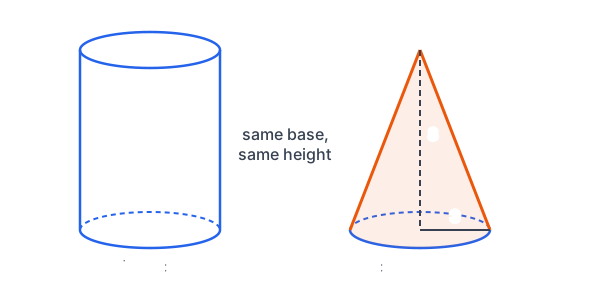
A cone narrows to a point, so its cross sections shrink as you go up. That is why it holds less. The exact fraction, one third, can be proved by cutting a cube into three equal pyramids, or with calculus.
Volume Formulas
\text{Pyramid: } V = \tfrac{1}{3}Bh \qquad \text{Cone: } V = \tfrac{1}{3}\pi r^2 hHere B is the area of the base and h is the height, the straight-up distance from the base to the vertex. Do not use the slant height. If you only know the slant height, use the Pythagorean theorem to find h first. Like prisms, these formulas also work for oblique pyramids and cones (Cavalieri’s principle).
How to Find the Volume
- Find the area of the base, B. For a cone, B = \pi r^2.
- Find the height h. If you are given the slant height, use the Pythagorean theorem.
- Multiply: V = \tfrac{1}{3}Bh.
- Give the answer in cubic units, exactly in terms of \pi and rounded if asked.
Worked Examples
Example 1: A square pyramid
A square pyramid has base edge 9 m and height 10 m. Find its volume.
- Find the base area: B = 9^2 = 81
- Write the formula: V = \tfrac{1}{3}Bh
- Substitute: V = \tfrac{1}{3}(81)(10)
- Multiply ⅓ by 81: V = 27(10)
- Multiply: V = 270
Answer: 270 m³
Example 2: A cone
Find the volume of a cone with radius 4 and height 9.
- Write the formula: V = \tfrac{1}{3}\pi r^2 h
- Substitute: V = \tfrac{1}{3}\pi(4)^2(9)
- Square: V = \tfrac{1}{3}\pi(16)(9)
- Multiply ⅓ by 9: V = \pi(16)(3)
- Multiply: V = 48\pi
- Use a calculator: V \approx 150.80
Answer: 48\pi \approx 150.80 cubic units
Example 3: A cone with the slant height given
A cone has radius 6 cm and slant height 10 cm. Find its volume.
- The height, radius and slant height form a right triangle. Write the Pythagorean theorem: h^2 + 6^2 = 10^2
- Square: h^2 + 36 = 100
- Subtract 36 from both sides: h^2 = 64
- Take the positive square root: h = 8
- Substitute into the formula: V = \tfrac{1}{3}\pi(6)^2(8)
- Square: V = \tfrac{1}{3}\pi(36)(8)
- Multiply ⅓ by 36: V = \pi(12)(8)
- Multiply: V = 96\pi
- Use a calculator: V \approx 301.59
Answer: 96\pi \approx 301.59 cm³
Example 4: Find the height
A square pyramid has base edge 6 in and volume 96 in³. Find its height.
- Find the base area: B = 6^2 = 36
- Write the formula: 96 = \tfrac{1}{3}(36)h
- Multiply ⅓ by 36: 96 = 12h
- Divide both sides by 12: h = 8
Answer: 8 in
Example 5: Word problem with a paper cup
A cone-shaped paper cup has radius 3 cm and height 8 cm. How much water does it hold? Compare it with a cylinder cup with the same radius and height.
- Write the cone formula: V = \tfrac{1}{3}\pi(3)^2(8)
- Square: V = \tfrac{1}{3}\pi(9)(8)
- Multiply ⅓ by 9: V = \pi(3)(8)
- Multiply: V = 24\pi \approx 75.40
- Find the cylinder’s volume: \pi(3)^2(8) = 72\pi
- Compare: 72\pi \div 24\pi = 3
Answer: The cone cup holds about 75.40 cm³ (75.40 mL). The cylinder cup holds 3 times as much.
Common Mistakes
| Mistake | Example of the error | Fix |
|---|---|---|
| Forgetting the ⅓ | V = \pi(4)^2(9) = 144\pi | Pyramids and cones use ⅓: 48\pi. |
| Using the slant height as the height | \tfrac{1}{3}\pi(6)^2(10) | Find the height first: h = 8. |
| Using the diameter | \tfrac{1}{3}\pi(10)^2(12) for a cone 10 across | Use the radius: r = 5. |
| Using the base edge instead of the base area | \tfrac{1}{3}(9)(10) = 30 | B is an area: 9^2 = 81. |
| Writing square units | 270 m² | Volume is in cubic units: m³. |
Practice Problems
Give answers with \pi exactly, then rounded to the nearest hundredth.
- A square pyramid has base edge 12 and height 7. Find its volume.
- A pyramid has a rectangular base 8 by 5 and height 9. Find its volume.
- A cone has radius 3 and height 7. Find its volume.
- A cone has diameter 10 and height 12. Find its volume.
- A cone has radius 8 and slant height 17. Find its volume.
- A square pyramid has base edge 10 and slant height 13. Find its volume.
- A cone has radius 5 and volume 50\pi. Find its height.
- A pyramid’s base is a right triangle with legs 6 and 8. The pyramid is 10 units tall. Find its volume.
- A pile of sand is shaped like a cone with radius 4 ft and height 3 ft. How much sand is in the pile?
- A cylinder holds 90 cm³. A cone has the same base and height. How much does the cone hold?
Show answers
- Find the base: B = 12^2 = 144
Substitute: V = \tfrac{1}{3}(144)(7)
Multiply ⅓ by 144: V = 48(7)
Multiply: V = 336 - Find the base: B = 8 \cdot 5 = 40
Substitute: V = \tfrac{1}{3}(40)(9)
Multiply ⅓ by 9: V = 40(3)
Multiply: V = 120 - Substitute: V = \tfrac{1}{3}\pi(3)^2(7)
Square: V = \tfrac{1}{3}\pi(9)(7)
Multiply ⅓ by 9: V = \pi(3)(7)
Multiply: V = 21\pi \approx 65.97 - Find the radius: r = 10 \div 2 = 5
Substitute: V = \tfrac{1}{3}\pi(5)^2(12)
Square: V = \tfrac{1}{3}\pi(25)(12)
Multiply ⅓ by 12: V = \pi(25)(4)
Multiply: V = 100\pi \approx 314.16 - Write the Pythagorean theorem: h^2 + 8^2 = 17^2
Square: h^2 + 64 = 289
Subtract 64 from both sides: h^2 = 225
Take the square root: h = 15
Substitute: V = \tfrac{1}{3}\pi(8)^2(15)
Square: V = \tfrac{1}{3}\pi(64)(15)
Multiply ⅓ by 15: V = \pi(64)(5)
Multiply: V = 320\pi \approx 1005.31 - Half the base edge is 5. Write the Pythagorean theorem: h^2 + 5^2 = 13^2
Square: h^2 + 25 = 169
Subtract 25 from both sides: h^2 = 144
Take the square root: h = 12
Find the base: B = 10^2 = 100
Substitute: V = \tfrac{1}{3}(100)(12)
Multiply ⅓ by 12: V = 100(4)
Multiply: V = 400 - Write the formula: 50\pi = \tfrac{1}{3}\pi(5)^2 h
Square: 50\pi = \tfrac{1}{3}\pi(25)h
Multiply both sides by 3: 150\pi = 25\pi h
Divide both sides by 25\pi: h = 6 - Find the base: B = \tfrac{1}{2}(6)(8) = 24
Substitute: V = \tfrac{1}{3}(24)(10)
Multiply ⅓ by 24: V = 8(10)
Multiply: V = 80 - Substitute: V = \tfrac{1}{3}\pi(4)^2(3)
Square: V = \tfrac{1}{3}\pi(16)(3)
Multiply ⅓ by 3: V = 16\pi
Use a calculator: V \approx 50.27 ft³ - The cone holds one third of the cylinder: \tfrac{1}{3}(90) = 30 cm³
FAQ
Why is the volume of a cone one third of a cylinder?
A cone narrows to a point, so it holds less. Experiments and proofs show it holds exactly one third of a cylinder with the same base and height.
What is the formula for the volume of a pyramid?
V = \tfrac{1}{3}Bh, where B is the area of the base and h is the height from the base to the vertex.
Do you use the slant height for volume?
No. Volume uses the straight-up height. Use the slant height only for surface area, or to find the height with the Pythagorean theorem.
How do you find the height of a cone from its volume?
Put the volume and radius into V = \tfrac{1}{3}\pi r^2 h, multiply both sides by 3, and divide by \pi r^2.
Summary
- Pyramid: V = \tfrac{1}{3}Bh. Cone: V = \tfrac{1}{3}\pi r^2 h.
- A pyramid or cone holds one third of the prism or cylinder with the same base and height.
- Use the height, not the slant height. Find h with the Pythagorean theorem if needed.
- B is an area, and volume is in cubic units.
Previous lesson: Volume of Prisms and Cylinders
Next lesson: Surface Area and Volume of Spheres
Back to the Geometry Index