
Cross Sections
A cross section is the flat shape you get when a plane slices through a solid. Slicing a cylinder parallel to its base gives a circle, and slicing a cube parallel to a face gives a square. Cross sections also work in reverse: spinning a flat shape around a line sweeps out a solid.
Before this lesson: You should know Points, Lines and Planes, Circumference and Area of Circles and Similar Polygons.
What Is a Cross Section?
Think of slicing a loaf of bread. Each slice shows a flat face. In geometry, the knife is a plane, a flat surface that goes on forever. The shape where the plane meets the solid is the cross section.
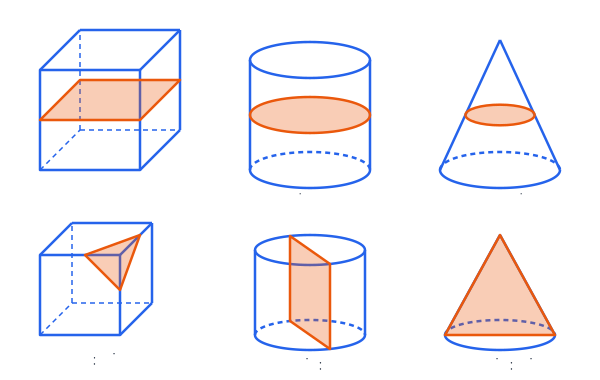
The shape depends on two things: the solid, and the direction of the cut. A cut parallel to the base usually copies the base. A perpendicular cut, straight up and down, often gives a rectangle or a triangle. A slanted cut can give other shapes.
Common Cross Sections
| Solid | Cut parallel to the base | Cut perpendicular to the base | Slanted cut |
|---|---|---|---|
| Cube or rectangular prism | Rectangle (square for a cube) | Rectangle | Triangle (at a corner), rectangle, or a shape with up to 6 sides |
| Cylinder | Circle, same size as the base | Rectangle | Ellipse (an oval) |
| Cone | Circle, smaller near the tip | Triangle (through the tip) | Ellipse or a curved shape |
| Square pyramid | Square, smaller near the tip | Triangle (through the tip) | Quadrilateral or triangle |
| Sphere | Circle (every cut) | Circle | Circle |
A cut through a sphere is always a circle. The biggest circle comes from a cut through the center. It is called a great circle.
Solids of Rotation
Spin a flat shape around a line, called the axis, and it sweeps out a solid. This is a solid of revolution.
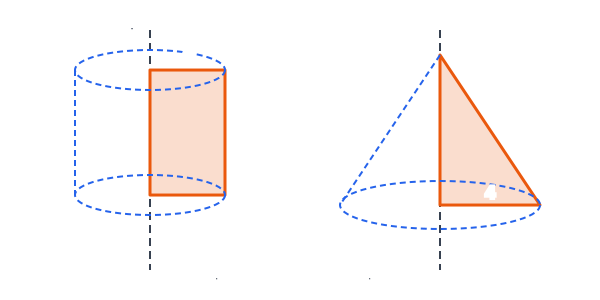
- A rectangle spun around one side makes a cylinder. The side on the axis is the height, and the other side is the radius.
- A right triangle spun around a leg makes a cone. The leg on the axis is the height, and the other leg is the radius.
- A semicircle spun around its diameter makes a sphere.
How to Find a Cross Section
- Picture the solid and the direction of the plane: parallel, perpendicular or slanted.
- Name the shape of the cut, using the table above.
- Find its dimensions. A cut parallel to a cylinder’s base matches the base. For a cone or pyramid, use similar triangles.
- If asked, find the area of that shape.
Worked Examples
Example 1: Name the cross sections of a cube
Name the cross section of a cube for each cut: (a) parallel to a face, (b) perpendicular to the top through two opposite edges, (c) a slanted cut that cuts off one corner.
- Part (a). A cut parallel to a face makes a copy of that face: a square.
- Part (b). The cut goes straight down through two opposite edges, so it has two edges of the cube and two face diagonals as sides: a rectangle.
- Part (c). Cutting off one corner meets three faces near that corner, so the cut has three sides: a triangle.
Answer: (a) square (b) rectangle (c) triangle
Example 2: Area of cylinder cross sections
A cylinder has radius 4 cm and height 10 cm. Find the area of (a) a cut parallel to the base and (b) a vertical cut through the center (the axis).
- Part (a). The cut is a circle with the same radius as the base: A = \pi(4)^2
- Square: A = 16\pi
- Use a calculator: A \approx 50.27 cm²
- Part (b). The cut is a rectangle. Its width is the diameter: 2 \cdot 4 = 8
- Its height is the cylinder’s height, 10. Multiply: A = 8 \cdot 10 = 80 cm²
Answer: (a) 16\pi \approx 50.27 cm² (b) 80 cm²
Example 3: Name a solid of revolution
A right triangle has legs 4 and 6. It spins around the leg of length 6. Describe the solid.
- The leg on the axis becomes the height: h = 6
- The other leg sweeps out the base, so it is the radius: r = 4
- The hypotenuse sweeps out the slanted side.
Answer: A cone with radius 4 and height 6.
Example 4: Cross section of a sphere
A sphere has radius 10 in. A plane cuts it 6 in from the center. Find the area of the cross section.
- The cut is a circle. Its radius x, the 6 in distance and the sphere’s radius 10 form a right triangle with hypotenuse 10: x^2 + 6^2 = 10^2
- Square: x^2 + 36 = 100
- Subtract 36 from both sides: x^2 = 64
- Take the positive square root (see the Pythagorean theorem): x = 8
- Find the area of the circle: A = \pi(8)^2 = 64\pi
- Use a calculator: A \approx 201.06
Answer: 64\pi \approx 201.06 in²
Example 5: Word problem with a traffic cone
A traffic cone is 60 cm tall and has a base radius of 15 cm. It is cut parallel to the base, 20 cm above the base. What is the area of the cross section?
- The cut is 20 cm above the base, so it is 60 - 20 = 40 cm below the tip.
- The small cone above the cut is similar to the whole cone (see similar polygons). Set up a proportion: \frac{r}{15} = \frac{40}{60}
- Multiply both sides by 15: r = 15 \cdot \frac{40}{60}
- Simplify: r = 10
- Find the area of the circle: A = \pi(10)^2 = 100\pi
- Use a calculator: A \approx 314.16
Answer: 100\pi \approx 314.16 cm²
Common Mistakes
| Mistake | Example of the error | Fix |
|---|---|---|
| Thinking every cut of a cylinder is a circle | Saying a vertical cut through a can is a circle | Only cuts parallel to the base are circles. A vertical cut is a rectangle. |
| Using the radius as the width of the rectangle | Width 4 for a cylinder with radius 4 | A cut through the axis is as wide as the diameter, 8. |
| Using the full base for every cone cut | Radius 15 at any height | Cone cuts shrink toward the tip. Use similar triangles. |
| Mixing up the height and radius when spinning | Spinning around the 6-unit leg and calling 6 the radius | The side on the axis is the height. |
| Measuring from the wrong end | Using 20 cm from the tip instead of the base | Find the distance from the tip: 60 - 20 = 40. |
Practice Problems
- A square pyramid is cut parallel to its base. What shape is the cross section?
- A square pyramid is cut by a vertical plane through its tip and the midpoints of two opposite base edges. What shape is the cross section?
- What shape is every cross section of a sphere? Where is the largest one?
- A cylinder has radius 5 m and height 12 m. Find the area of a cross section parallel to the base.
- For the same cylinder, find the area of a vertical cross section through the axis.
- A rectangle that is 2 units by 7 units spins around its 7-unit side. Describe the solid.
- A right triangle with legs 5 and 12 spins around the leg of length 12. Describe the solid. What if it spins around the leg of length 5?
- A semicircle spins around its diameter. What solid does it make?
- A sphere has radius 13. A plane cuts it 5 units from the center. Find the radius and the area of the cross section.
- A cone is 9 cm tall with base radius 6 cm. It is cut parallel to the base, 3 cm below the tip. Find the area of the cross section.
Show answers
- A cut parallel to the base copies the base, so it is a smaller square.
- The cut passes through the tip and splits the base along a middle line, so it is a triangle.
- Every cross section of a sphere is a circle. The largest, a great circle, comes from a cut through the center.
- The cut is a circle with radius 5: A = \pi(5)^2
Square: A = 25\pi
Use a calculator: A \approx 78.54 m² - The cut is a rectangle. Its width is the diameter: 2 \cdot 5 = 10
Multiply by the height: A = 10 \cdot 12 = 120 m² - The 7-unit side is on the axis, so it is the height. The 2-unit side is the radius. The solid is a cylinder with radius 2 and height 7.
- Around the leg of 12: a cone with height 12 and radius 5.
Around the leg of 5: a cone with height 5 and radius 12. - A sphere.
- Write the Pythagorean theorem: x^2 + 5^2 = 13^2
Square: x^2 + 25 = 169
Subtract 25 from both sides: x^2 = 144
Take the positive square root: x = 12
Find the area: A = \pi(12)^2 = 144\pi
Use a calculator: A \approx 452.39 - The small cone above the cut is similar to the whole cone: \frac{r}{6} = \frac{3}{9}
Multiply both sides by 6: r = 6 \cdot \frac{3}{9}
Simplify: r = 2
Find the area: A = \pi(2)^2 = 4\pi
Use a calculator: A \approx 12.57 cm²
FAQ
What is a cross section in geometry?
It is the two-dimensional shape you see where a plane cuts through a three-dimensional solid.
What are the cross sections of a cylinder?
A cut parallel to the base is a circle. A vertical cut is a rectangle. A slanted cut that doesn’t touch the bases is an ellipse.
What solid do you get when you rotate a rectangle?
Spinning a rectangle around one of its sides makes a cylinder. The side on the axis is the height and the other side is the radius.
Can a cross section of a cube be a hexagon?
Yes. A slanted cut through the middle of the cube that crosses all six faces makes a hexagon. With the right angle, it is a regular hexagon.
Summary
- A cross section is the shape where a plane cuts a solid.
- Cuts parallel to the base copy the base (smaller for cones and pyramids). Vertical cuts are often rectangles or triangles.
- Every cross section of a sphere is a circle.
- Spinning a rectangle makes a cylinder, a right triangle makes a cone, and a semicircle makes a sphere.
- Use similar triangles for cone and pyramid cuts, and the Pythagorean theorem for sphere cuts.
Previous lesson: Area of Regular Polygons
Next lesson: Surface Area of Prisms and Cylinders
Back to the Geometry Index