
Surface Area of Prisms and Cylinders
The surface area of prisms and cylinders is the total area of all their outside faces and curved surfaces, measured in square units. Add the lateral area (the sides) to the area of the two bases: S = Ph + 2B. For a cylinder, this becomes S = 2\pi rh + 2\pi r^2.
Before this lesson: You should know Area of Rectangles and Parallelograms, Area of Triangles and Circumference and Area of Circles.
What Is Surface Area?
Surface area is the area of the outside of a solid. Picture the wrapping paper needed to cover a box with no overlap. It is measured in square units, like cm².
A prism has two congruent, parallel bases joined by rectangles. A cylinder has two congruent circles as bases, joined by one curved surface. The sides (not the bases) make up the lateral area.
Using a Net
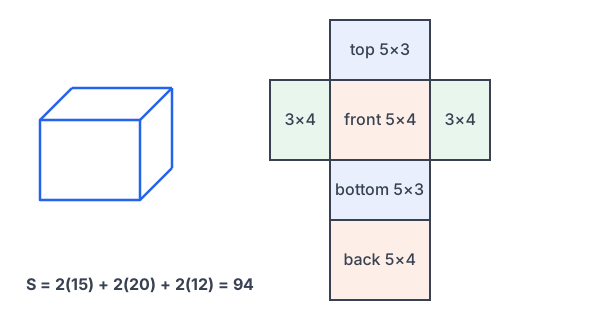
A net is the flat pattern you get by unfolding a solid. The area of the net equals the surface area.
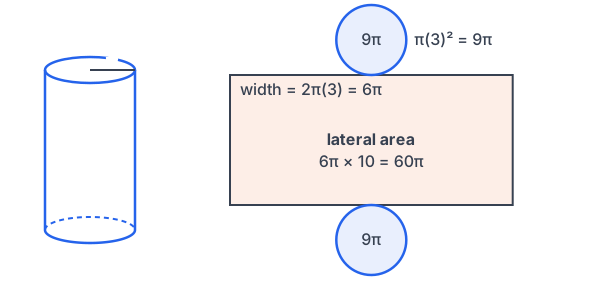
Unroll the curved side of a cylinder and you get a rectangle. Its height is the cylinder’s height. Its width is the distance around the base, the circumference 2\pi r.
Surface Area Formulas
For any prism, the lateral faces line up into one long rectangle with width equal to the perimeter of the base P and height h. Add the two bases, each with area B.
\text{Prism: } L = Ph \qquad S = Ph + 2B\text{Cylinder: } L = 2\pi rh \qquad S = 2\pi rh + 2\pi r^2For a rectangular prism with length \ell, width w and height h, the formula becomes S = 2(\ell w + \ell h + wh). For a cube with edge s, it is S = 6s^2.
How to Find Surface Area
- Identify the bases and find the area of one base, B.
- Find the perimeter of the base P (or the circumference 2\pi r for a cylinder).
- Multiply by the height to get the lateral area.
- Add two bases. Leave out a base if the solid is open, like a box with no lid.
- Give the answer in square units, exactly in terms of \pi and rounded if asked.
Worked Examples
Example 1: A rectangular prism
Find the surface area of a box 5 cm long, 3 cm wide and 4 cm tall.
- Write the formula: S = 2(\ell w + \ell h + wh)
- Substitute: S = 2(5 \cdot 3 + 5 \cdot 4 + 3 \cdot 4)
- Multiply inside: S = 2(15 + 20 + 12)
- Add inside: S = 2(47)
- Multiply: S = 94
Answer: 94 cm²
Example 2: A triangular prism
The bases of a prism are right triangles with legs 6 and 8 and hypotenuse 10. The prism is 12 units long. Find its surface area.
- Find the perimeter of the base: P = 6 + 8 + 10 = 24
- Find the lateral area: L = Ph = 24 \cdot 12 = 288
- Find the area of one base (see area of triangles): B = \tfrac{1}{2} \cdot 6 \cdot 8 = 24
- Add two bases: S = 288 + 2(24)
- Multiply: S = 288 + 48
- Add: S = 336
Answer: 336 square units
Example 3: A cylinder
Find the surface area of a cylinder with radius 3 and height 10.
- Find the lateral area: L = 2\pi(3)(10) = 60\pi
- Find one base: B = \pi(3)^2 = 9\pi
- Add two bases: S = 60\pi + 2(9\pi)
- Multiply: S = 60\pi + 18\pi
- Combine like terms: S = 78\pi
- Use a calculator: S \approx 245.04
Answer: 78\pi \approx 245.04 square units
Example 4: Find the height
A cylinder has radius 5 cm and surface area 150\pi cm². Find its height.
- Write the formula: 150\pi = 2\pi(5)h + 2\pi(5)^2
- Multiply: 150\pi = 10\pi h + 50\pi
- Subtract 50\pi from both sides: 100\pi = 10\pi h
- Divide both sides by 10\pi: h = 10
Answer: The height is 10 cm.
Example 5: Word problem with a can label
A soup can is 7.5 cm across and 11 cm tall. The label covers the curved side only. How much paper is in the label?
- The label is the lateral area. Find the radius: r = 7.5 \div 2 = 3.75
- Write the lateral area formula: L = 2\pi rh
- Substitute: L = 2\pi(3.75)(11)
- Multiply: L = 82.5\pi
- Use a calculator: L \approx 259.18
Answer: about 259.18 cm² of paper
Common Mistakes
| Mistake | Example of the error | Fix |
|---|---|---|
| Adding only one base | S = 60\pi + 9\pi | A closed cylinder has two bases: 60\pi + 18\pi. |
| Using the diameter in 2\pi r | L = 2\pi(7.5)(11) for a can 7.5 cm across | Halve the diameter first: r = 3.75. |
| Mixing up surface area and volume | S = \pi r^2 h | That is volume. Surface area adds areas of faces. |
| Adding a lid to an open box | Using 6 faces for a box with no top | Leave out the missing face. |
| Using \pi r^2 for the curved side | L = \pi(3)^2(10) | The curved side unrolls into a rectangle: 2\pi rh. |
Practice Problems
Give answers with \pi exactly, then rounded to the nearest hundredth.
- Find the surface area of a cube with edge 6 in.
- Find the surface area of a rectangular prism 10 cm by 4 cm by 2 cm.
- A prism has equilateral triangle bases with side 4 and is 9 units long. Each base has area 4\sqrt{3}. Find the surface area.
- Find the surface area of a cylinder with radius 4 and height 7.
- Find the surface area of a cylinder with diameter 10 and height 3.
- A prism has a regular hexagon base with side 5 and height 8. Find its lateral area.
- A cylinder has radius 6 and surface area 168\pi. Find its height.
- An open box (no top) is 8 in long, 5 in wide and 3 in tall. Find the area of cardboard needed.
- A cylindrical water tank has radius 2 m and height 5 m. Find the area to paint if you paint the curved side and the top, but not the bottom.
- A gift box is 12 in by 10 in by 4 in. What is the least amount of wrapping paper that covers it?
Show answers
- Write the formula: S = 6s^2
Square: S = 6(36)
Multiply: S = 216 in² - Substitute: S = 2(10 \cdot 4 + 10 \cdot 2 + 4 \cdot 2)
Multiply inside: S = 2(40 + 20 + 8)
Add inside: S = 2(68)
Multiply: S = 136 cm² - Find the perimeter: P = 3 \cdot 4 = 12
Find the lateral area: L = 12 \cdot 9 = 108
Add two bases: S = 108 + 2(4\sqrt{3})
Multiply: S = 108 + 8\sqrt{3}
Use a calculator: S \approx 121.86 - Lateral area: 2\pi(4)(7) = 56\pi
Two bases: 2\pi(4)^2 = 32\pi
Add: S = 88\pi
Use a calculator: S \approx 276.46 - Find the radius: r = 10 \div 2 = 5
Lateral area: 2\pi(5)(3) = 30\pi
Two bases: 2\pi(5)^2 = 50\pi
Add: S = 80\pi
Use a calculator: S \approx 251.33 - Find the perimeter: P = 6 \cdot 5 = 30
Multiply by the height: L = 30 \cdot 8 = 240 - Write the formula: 168\pi = 2\pi(6)h + 2\pi(6)^2
Multiply: 168\pi = 12\pi h + 72\pi
Subtract 72\pi from both sides: 96\pi = 12\pi h
Divide both sides by 12\pi: h = 8 - Bottom: 8 \cdot 5 = 40
Front and back: 2(8 \cdot 3) = 48
Two sides: 2(5 \cdot 3) = 30
Add: 40 + 48 + 30 = 118 in² - Curved side: 2\pi(2)(5) = 20\pi
Top only: \pi(2)^2 = 4\pi
Add: 24\pi
Use a calculator: 24\pi \approx 75.40 m² - Substitute: S = 2(12 \cdot 10 + 12 \cdot 4 + 10 \cdot 4)
Multiply inside: S = 2(120 + 48 + 40)
Add inside: S = 2(208)
Multiply: S = 416 in²
FAQ
What is the formula for the surface area of a prism?
S = Ph + 2B, where P is the perimeter of the base, h is the height of the prism and B is the area of one base.
What is the surface area formula for a cylinder?
S = 2\pi rh + 2\pi r^2. The first part is the curved side and the second part is the two circles.
What is the difference between lateral area and surface area?
Lateral area counts only the sides. Surface area adds the bases too.
How is surface area different from volume?
Surface area measures the outside, in square units. Volume measures the space inside, in cubic units. You will find volume in the volume of prisms and cylinders lesson.
Summary
- Surface area is the total area of the outside of a solid, in square units.
- Prism: lateral area L = Ph, surface area S = Ph + 2B.
- Cylinder: lateral area L = 2\pi rh, surface area S = 2\pi rh + 2\pi r^2.
- A net shows every face, so its area is the surface area.
- Leave out any face that is open, and use the radius, not the diameter.
Previous lesson: Cross Sections
Next lesson: Surface Area of Pyramids and Cones
Back to the Geometry Index