
Surface Area of Pyramids and Cones
The surface area of pyramids and cones is the lateral area plus the area of the base. For a regular pyramid, S = \tfrac{1}{2}P\ell + B. For a cone, S = \pi r\ell + \pi r^2. Both use the slant height \ell, the distance measured down the outside surface, not straight down.
Before this lesson: You should know Surface Area of Prisms and Cylinders, the Pythagorean Theorem and Area of Regular Polygons.
Height vs. Slant Height
A pyramid has one polygon base and triangular faces that meet at a point, the vertex. In a regular pyramid, the base is a regular polygon and the vertex sits right above its center. A cone has a circular base and a curved surface that rises to a vertex.
- The height h goes straight down from the vertex to the center of the base.
- The slant height \ell goes down the outside: down the middle of a triangular face of a pyramid, or along the curved side of a cone to the edge of the base.
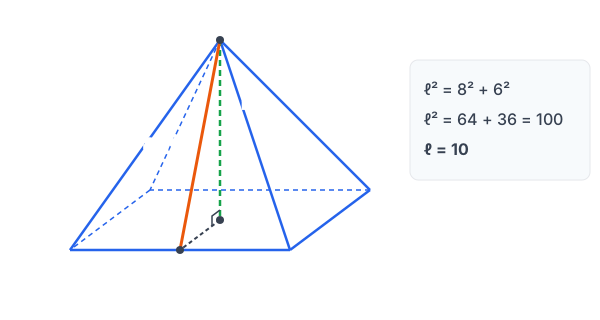
The height, the slant height and a segment in the base form a right triangle, with the slant height as the hypotenuse. For a square pyramid the base segment is half a side. For a cone it is the radius. So you can find a missing length with the Pythagorean theorem.
Surface Area Formulas
Each triangular face of a regular pyramid has base s and height \ell, so its area is \tfrac{1}{2}s\ell. Adding all the faces gives \tfrac{1}{2}(\text{perimeter})\ell.
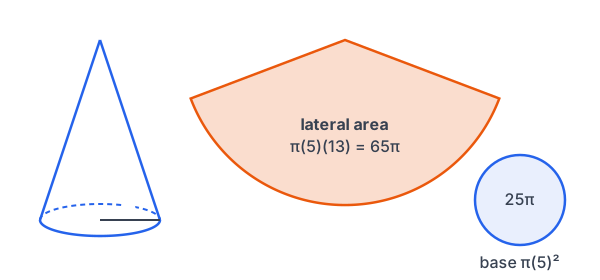
\text{Regular pyramid: } L = \tfrac{1}{2}P\ell \qquad S = \tfrac{1}{2}P\ell + B\text{Cone: } L = \pi r\ell \qquad S = \pi r\ell + \pi r^2There is only one base this time, not two. The cone’s lateral area unrolls into a sector of a circle with radius \ell (see area of a sector).
How to Find the Surface Area
- Find the slant height. If you only know the height, use the Pythagorean theorem.
- Find the lateral area: \tfrac{1}{2}P\ell for a pyramid or \pi r\ell for a cone.
- Find the area of the one base, B.
- Add. Leave out the base if the solid is open, like an ice cream cone.
Worked Examples
Example 1: A square pyramid with the slant height given
A square pyramid has base edge 10 m and slant height 13 m. Find its surface area.
- Find the perimeter of the base: P = 4 \cdot 10 = 40
- Find the lateral area: L = \tfrac{1}{2}(40)(13)
- Multiply: L = 260
- Find the base: B = 10^2 = 100
- Add: S = 260 + 100 = 360
Answer: 360 m²
Example 2: A square pyramid with the height given
A square pyramid has base edge 12 and height 8. Find its surface area.
- Half the base edge is 12 \div 2 = 6. Write the Pythagorean theorem: \ell^2 = 8^2 + 6^2
- Square: \ell^2 = 64 + 36
- Add: \ell^2 = 100
- Take the positive square root: \ell = 10
- Find the perimeter: P = 4 \cdot 12 = 48
- Find the lateral area: L = \tfrac{1}{2}(48)(10) = 240
- Find the base: B = 12^2 = 144
- Add: S = 240 + 144 = 384
Answer: 384 square units
Example 3: A cone with the slant height given
A cone has radius 5 cm and slant height 13 cm. Find its surface area.
- Find the lateral area: L = \pi(5)(13) = 65\pi
- Find the base: B = \pi(5)^2 = 25\pi
- Add: S = 65\pi + 25\pi
- Combine like terms: S = 90\pi
- Use a calculator: S \approx 282.74
Answer: 90\pi \approx 282.74 cm²
Example 4: A cone with the height given
A cone has radius 6 and height 8. Find its surface area.
- Write the Pythagorean theorem: \ell^2 = 8^2 + 6^2
- Square: \ell^2 = 64 + 36
- Add: \ell^2 = 100
- Take the positive square root: \ell = 10
- Find the lateral area: L = \pi(6)(10) = 60\pi
- Find the base: B = \pi(6)^2 = 36\pi
- Add: S = 60\pi + 36\pi = 96\pi
- Use a calculator: S \approx 301.59
Answer: 96\pi \approx 301.59 square units
Example 5: Word problem with a tent
A tent is a square pyramid with no floor. The base is 6 ft on each side, and the slant height is 5 ft. How much fabric covers the tent?
- There is no floor, so find only the lateral area. Find the perimeter: P = 4 \cdot 6 = 24
- Write the lateral area formula: L = \tfrac{1}{2}P\ell
- Substitute: L = \tfrac{1}{2}(24)(5)
- Multiply: L = 60
Answer: 60 ft² of fabric
Common Mistakes
| Mistake | Example of the error | Fix |
|---|---|---|
| Using the height instead of the slant height | L = \tfrac{1}{2}(48)(8) | Find \ell first: \ell = 10, so L = \tfrac{1}{2}(48)(10). |
| Using the full base edge in the right triangle | \ell^2 = 8^2 + 12^2 | Use half the edge: \ell^2 = 8^2 + 6^2. |
| Adding two bases | S = 65\pi + 2(25\pi) | A pyramid or cone has only one base. |
| Forgetting the ½ for a pyramid | L = P\ell = 480 | Each face is a triangle: L = \tfrac{1}{2}P\ell = 240. |
| Counting the bottom of an open shape | Adding a base for a tent with no floor | Use only the lateral area. |
Practice Problems
Give answers with \pi exactly, then rounded to the nearest hundredth.
- A square pyramid has base edge 8 and slant height 7. Find its surface area.
- A square pyramid has base edge 6 and height 4. Find its surface area.
- A pyramid has four faces, and every face is an equilateral triangle with side 6. Each face has area 9\sqrt{3}. Find the surface area.
- A cone has radius 4 and slant height 9. Find its surface area.
- A cone has diameter 14 and height 24. Find its surface area.
- A cone has radius 3 and surface area 24\pi. Find its slant height.
- An ice cream cone (open at the top) has radius 3 cm and slant height 12 cm. Find the area of the cone itself.
- A regular hexagonal pyramid has base side 4, base apothem 2\sqrt{3} and slant height 9. Find its surface area.
- A square pyramid has base edge 18 and height 12. Find its lateral area.
- A cone-shaped roof has radius 10 ft and height 7.5 ft. How many square feet of shingles cover it?
Show answers
- Find the perimeter: P = 4 \cdot 8 = 32
Find the lateral area: L = \tfrac{1}{2}(32)(7) = 112
Find the base: B = 8^2 = 64
Add: S = 112 + 64 = 176 - Half the edge is 3. Write the Pythagorean theorem: \ell^2 = 4^2 + 3^2
Square: \ell^2 = 16 + 9
Add: \ell^2 = 25
Take the square root: \ell = 5
Find the perimeter: P = 24
Find the lateral area: L = \tfrac{1}{2}(24)(5) = 60
Find the base: B = 6^2 = 36
Add: S = 60 + 36 = 96 - Four congruent faces: S = 4 \cdot 9\sqrt{3}
Multiply: S = 36\sqrt{3}
Use a calculator: S \approx 62.35 - Lateral area: L = \pi(4)(9) = 36\pi
Base: B = \pi(4)^2 = 16\pi
Add: S = 52\pi
Use a calculator: S \approx 163.36 - Find the radius: r = 14 \div 2 = 7
Write the Pythagorean theorem: \ell^2 = 24^2 + 7^2
Square: \ell^2 = 576 + 49
Add: \ell^2 = 625
Take the square root: \ell = 25
Lateral area: L = \pi(7)(25) = 175\pi
Base: B = \pi(7)^2 = 49\pi
Add: S = 224\pi
Use a calculator: S \approx 703.72 - Write the formula: 24\pi = \pi(3)\ell + \pi(3)^2
Multiply: 24\pi = 3\pi\ell + 9\pi
Subtract 9\pi from both sides: 15\pi = 3\pi\ell
Divide both sides by 3\pi: \ell = 5 - The cone is open, so use only the lateral area: L = \pi(3)(12)
Multiply: L = 36\pi
Use a calculator: L \approx 113.10 cm² - Find the perimeter: P = 6 \cdot 4 = 24
Find the lateral area: L = \tfrac{1}{2}(24)(9) = 108
Find the base (see area of regular polygons): B = \tfrac{1}{2}(2\sqrt{3})(24) = 24\sqrt{3}
Add: S = 108 + 24\sqrt{3}
Use a calculator: S \approx 149.57 - Half the edge is 9. Write the Pythagorean theorem: \ell^2 = 12^2 + 9^2
Square: \ell^2 = 144 + 81
Add: \ell^2 = 225
Take the square root: \ell = 15
Find the perimeter: P = 4 \cdot 18 = 72
Find the lateral area: L = \tfrac{1}{2}(72)(15) = 540 - The roof is the lateral area. Write the Pythagorean theorem: \ell^2 = 7.5^2 + 10^2
Square: \ell^2 = 56.25 + 100
Add: \ell^2 = 156.25
Take the square root: \ell = 12.5
Find the lateral area: L = \pi(10)(12.5) = 125\pi
Use a calculator: L \approx 392.70 ft²
FAQ
What is the slant height of a pyramid?
It is the height of one triangular face, measured from the vertex down the middle of the face to the base edge. It is longer than the pyramid’s height.
What is the formula for the surface area of a cone?
S = \pi r\ell + \pi r^2, where r is the radius and \ell is the slant height.
How do you find the slant height of a cone?
Use the Pythagorean theorem with the height and the radius as legs: \ell = \sqrt{h^2 + r^2}.
Why does a pyramid have ½ in its lateral area formula?
Each side face is a triangle, and the area of a triangle is half of base times height.
Summary
- Slant height \ell runs down the outside surface. Height h goes straight down to the center of the base.
- Regular pyramid: S = \tfrac{1}{2}P\ell + B.
- Cone: S = \pi r\ell + \pi r^2.
- Use the Pythagorean theorem to find \ell from h and half the base edge (pyramid) or the radius (cone).
- There is only one base. Leave it out for open shapes.
Previous lesson: Surface Area of Prisms and Cylinders
Next lesson: Volume of Prisms and Cylinders
Back to the Geometry Index