
Area of Regular Polygons
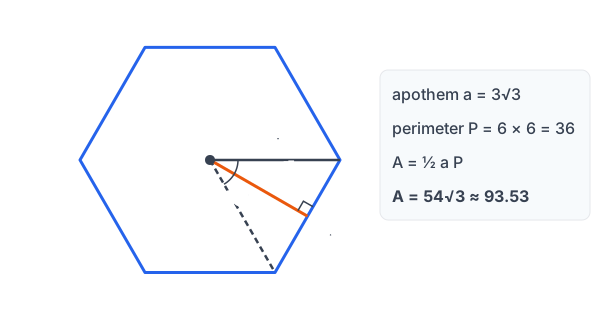
The area of a regular polygon is half the apothem times the perimeter: A = \tfrac{1}{2}aP. The apothem a is the distance from the center to the middle of a side. A regular polygon has all sides equal and all angles equal, like a stop sign or a honeycomb cell.
Before this lesson: You should know Interior and Exterior Angles of Polygons, Special Right Triangles and Trigonometric Ratios.
Parts of a Regular Polygon
A regular polygon has all sides congruent and all angles congruent. Every regular polygon has a center, the point that is the same distance from every vertex.
- The radius goes from the center to a vertex.
- The apothem goes from the center to the midpoint of a side. It is perpendicular to that side.
- A central angle is formed by two radii drawn to neighboring vertices. For a regular polygon with n sides, it measures \frac{360^\circ}{n}.
The Area Formula
Draw a radius to every vertex. This cuts a regular n-gon into n congruent triangles. Each triangle has base s (one side) and height a (the apothem). So each one has area \tfrac{1}{2}as (see area of triangles).
A = n \cdot \tfrac{1}{2}as = \tfrac{1}{2}a(ns) = \tfrac{1}{2}aPHere P = ns is the perimeter. The formula works for every regular polygon. For a square with side s, the apothem is \frac{s}{2} and P = 4s, so A = \tfrac{1}{2} \cdot \frac{s}{2} \cdot 4s = s^2, as expected.
How to Find the Area of a Regular Polygon
- Find the perimeter: number of sides times side length.
- Find the apothem. If it is not given, draw the right triangle made by the apothem, half a side and a radius.
- In that triangle, the angle at the center is half the central angle, \frac{180^\circ}{n}. Use special right triangles or trig to find the apothem.
- Use A = \tfrac{1}{2}aP. Keep exact values or full calculator values until the end.
Calculator note: For polygons other than triangles, squares and hexagons, use the tangent ratio in degree mode. Type the whole expression, like 0.5 × (2.5 ÷ tan(22.5)) × 40, so you round only once.
Worked Examples
Example 1: Apothem given
A regular hexagon has side length 6 and apothem 3\sqrt{3}. Find its area.
- Find the perimeter: P = 6 \cdot 6 = 36
- Write the formula: A = \tfrac{1}{2}aP
- Substitute: A = \tfrac{1}{2}(3\sqrt{3})(36)
- Multiply: A = 54\sqrt{3}
- Use a calculator: A \approx 93.53
Answer: 54\sqrt{3} square units, or about 93.53
Example 2: A pentagon
A regular pentagon has side length 10 cm and apothem 6.88 cm. Find its area.
- Find the perimeter: P = 5 \cdot 10 = 50
- Substitute into A = \tfrac{1}{2}aP: A = \tfrac{1}{2}(6.88)(50)
- Multiply: A = 172
Answer: about 172 cm² (the apothem was already rounded)
Example 3: Find the apothem with special right triangles
A regular hexagon has side length 8. Find its area.
- A hexagon’s central angle is 360^\circ \div 6 = 60^\circ. The apothem splits it into two 30° angles, so the right triangle is a 30-60-90 triangle.
- The short leg is half a side: 8 \div 2 = 4
- The apothem is the long leg, \sqrt{3} times the short leg (see special right triangles): a = 4\sqrt{3}
- Find the perimeter: P = 6 \cdot 8 = 48
- Substitute: A = \tfrac{1}{2}(4\sqrt{3})(48)
- Multiply: A = 96\sqrt{3}
- Use a calculator: A \approx 166.28
Answer: 96\sqrt{3} \approx 166.28 square units
Example 4: Find the apothem with trig
A regular octagon has side length 5. Find its area to the nearest hundredth.
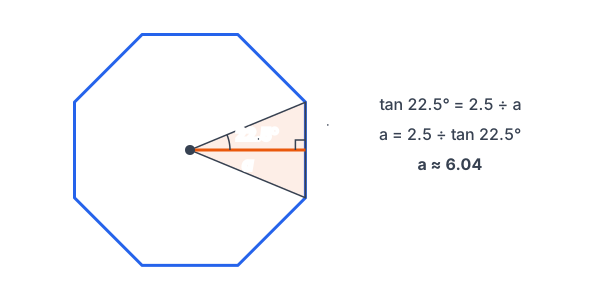
- Find the central angle: 360^\circ \div 8 = 45^\circ
- Halve it for the right triangle: 45^\circ \div 2 = 22.5^\circ
- The half side, 2.5, is opposite 22.5° and the apothem is adjacent, so use tangent: \tan 22.5^\circ = \frac{2.5}{a}
- Solve for the apothem: a = \frac{2.5}{\tan 22.5^\circ} \approx 6.04
- Find the perimeter: P = 8 \cdot 5 = 40
- Substitute the exact apothem: A = \tfrac{1}{2} \cdot \frac{2.5}{\tan 22.5^\circ} \cdot 40
- Use a calculator: A \approx 120.71
Answer: about 120.71 square units. Using the rounded apothem 6.04 would give 120.80, which is slightly off.
Example 5: Word problem with a gazebo
A gazebo floor is a regular hexagon with sides 4 ft long. How much floor area is there?
- The short leg of the 30-60-90 triangle is half a side: 4 \div 2 = 2
- The apothem is the long leg: a = 2\sqrt{3}
- Find the perimeter: P = 6 \cdot 4 = 24
- Substitute: A = \tfrac{1}{2}(2\sqrt{3})(24)
- Multiply: A = 24\sqrt{3}
- Use a calculator: A \approx 41.57
Answer: about 41.57 ft²
Common Mistakes
| Mistake | Example of the error | Fix |
|---|---|---|
| Using the radius as the apothem | Using 6 (the radius of a hexagon with side 6) for a | The apothem goes to the middle of a side: a = 3\sqrt{3}. |
| Forgetting the ½ | A = aP = 108\sqrt{3} | A = \tfrac{1}{2}aP = 54\sqrt{3}. |
| Using the full central angle in the right triangle | \tan 45^\circ = \frac{2.5}{a} for an octagon | The apothem halves the central angle: use 22.5°. |
| Using a whole side in the right triangle | \tan 22.5^\circ = \frac{5}{a} | The apothem halves the side: use 2.5. |
| Rounding the apothem too early | \tfrac{1}{2}(6.04)(40) = 120.80 | Keep the full value: 120.71. |
Related Idea: Regular Polygons and Circles
As the number of sides grows, a regular polygon looks more and more like a circle. The apothem gets close to the radius, and the perimeter gets close to the circumference. Then \tfrac{1}{2}aP becomes \tfrac{1}{2} \cdot r \cdot 2\pi r = \pi r^2, the area of a circle.
Practice Problems
Round decimal answers to the nearest hundredth.
- A regular hexagon has side 10 and apothem 5\sqrt{3}. Find its area.
- A regular pentagon has perimeter 40 in and apothem 5.5 in. Find its area.
- A regular decagon has side 4 cm and apothem 6.16 cm. Find its area.
- An equilateral triangle has side 12. Its apothem is 2\sqrt{3}. Find its area.
- A regular hexagon has apothem 6. Find its side length and area.
- Find the central angle of a regular nonagon (9 sides).
- A regular octagon has side 10. Find its area.
- A regular pentagon has side 6. Find its area.
- A square has apothem 7. Find its area two ways.
- A stop sign is a regular octagon that is 30 in across from one flat side to the opposite side. Find its area.
Show answers
- Find the perimeter: P = 6 \cdot 10 = 60
Substitute: A = \tfrac{1}{2}(5\sqrt{3})(60)
Multiply: A = 150\sqrt{3}
Use a calculator: A \approx 259.81 - Substitute: A = \tfrac{1}{2}(5.5)(40)
Multiply: A = 110 in² - Find the perimeter: P = 10 \cdot 4 = 40
Substitute: A = \tfrac{1}{2}(6.16)(40)
Multiply: A = 123.2 cm² - Find the perimeter: P = 3 \cdot 12 = 36
Substitute: A = \tfrac{1}{2}(2\sqrt{3})(36)
Multiply: A = 36\sqrt{3}
Use a calculator: A \approx 62.35. This matches \frac{\sqrt{3}}{4}(12)^2 = 36\sqrt{3}. - The apothem is the long leg of a 30-60-90 triangle, so the short leg is \frac{6}{\sqrt{3}} = 2\sqrt{3}
A side is twice the short leg: s = 4\sqrt{3}
Find the perimeter: P = 6 \cdot 4\sqrt{3} = 24\sqrt{3}
Substitute: A = \tfrac{1}{2}(6)(24\sqrt{3})
Multiply: A = 72\sqrt{3}
Use a calculator: A \approx 124.71 - Divide: 360^\circ \div 9 = 40^\circ
- Central angle: 360^\circ \div 8 = 45^\circ, half is 22.5°
Half a side is 5: \tan 22.5^\circ = \frac{5}{a}
Solve: a = \frac{5}{\tan 22.5^\circ}
Find the perimeter: P = 8 \cdot 10 = 80
Substitute: A = \tfrac{1}{2} \cdot \frac{5}{\tan 22.5^\circ} \cdot 80
Use a calculator: A \approx 482.84 - Central angle: 360^\circ \div 5 = 72^\circ, half is 36°
Half a side is 3: \tan 36^\circ = \frac{3}{a}
Solve: a = \frac{3}{\tan 36^\circ}
Find the perimeter: P = 5 \cdot 6 = 30
Substitute: A = \tfrac{1}{2} \cdot \frac{3}{\tan 36^\circ} \cdot 30
Use a calculator: A \approx 61.94 - The side is twice the apothem: s = 14
Way 1: A = s^2 = 14^2 = 196
Way 2: P = 4 \cdot 14 = 56, so A = \tfrac{1}{2}(7)(56) = 196 - The distance across from side to side is two apothems: a = 30 \div 2 = 15
Half the central angle is 22.5°, so half a side is 15 \tan 22.5^\circ
A side is s = 30 \tan 22.5^\circ
Find the perimeter: P = 8 \cdot 30 \tan 22.5^\circ = 240 \tan 22.5^\circ
Substitute: A = \tfrac{1}{2}(15)(240 \tan 22.5^\circ) = 1800 \tan 22.5^\circ
Use a calculator: A \approx 745.58 in²
FAQ
What is the apothem of a regular polygon?
It is the segment from the center to the midpoint of a side. It meets the side at a right angle, so it is the height of each triangle in the polygon.
What is the formula for the area of a regular polygon?
A = \tfrac{1}{2}aP, where a is the apothem and P is the perimeter.
How do you find the apothem if it is not given?
Draw the right triangle made by the apothem, half a side and a radius. The angle at the center is \frac{180^\circ}{n}. Use special right triangles for 3, 4 or 6 sides, or the tangent ratio for others.
What is the difference between the apothem and the radius?
The radius goes from the center to a vertex. The apothem goes from the center to the middle of a side, so it is shorter.
Summary
- A regular polygon has equal sides and equal angles. Its central angle is \frac{360^\circ}{n}.
- The apothem goes from the center to the midpoint of a side, at a right angle.
- Area: A = \tfrac{1}{2}aP, where P is the perimeter.
- Find a missing apothem with a right triangle whose center angle is \frac{180^\circ}{n}.
- Round only at the end.
Previous lesson: Equation of a Circle
Next lesson: Cross Sections
Back to the Geometry Index