
Interior and Exterior Angles of Polygons
The interior angles of a polygon with n sides add up to (n - 2) \cdot 180^\circ. The exterior angles, one at each vertex, always add up to 360°. In a regular polygon, all angles are equal, so each interior angle is the sum divided by n, and each exterior angle is 360^\circ \div n.
Before this lesson: You should know the Triangle Angle Sum Theorem, Angle Pairs and Measuring and Classifying Angles.
Polygons and Their Angles
A polygon is a closed flat figure made of straight sides. A polygon with n sides also has n vertices and n interior angles. In a regular polygon, every side is the same length and every angle is the same size. A convex polygon has no dents: every interior angle is less than 180°.
Here is the key idea. Pick one vertex and draw every diagonal you can from it. The diagonals cut the polygon into triangles. There are always 2 fewer triangles than sides, and each triangle’s angles add to 180°.
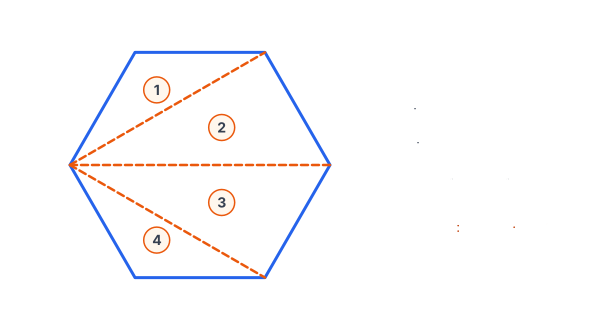
Polygon Angle Formulas
| What you want | Formula |
|---|---|
| Sum of the interior angles | S = (n - 2) \cdot 180^\circ |
| One interior angle of a regular polygon | \dfrac{(n - 2) \cdot 180^\circ}{n} |
| Sum of the exterior angles (one per vertex) | 360^\circ |
| One exterior angle of a regular polygon | \dfrac{360^\circ}{n} |
| Interior and exterior angle at the same vertex | They add to 180^\circ |
An exterior angle is formed by one side and the extension of the next side. It forms a linear pair with the interior angle at that vertex. Walk all the way around a polygon, turning at each corner: you make one full turn, 360°. That is why the exterior angles always add to 360°, no matter how many sides there are.
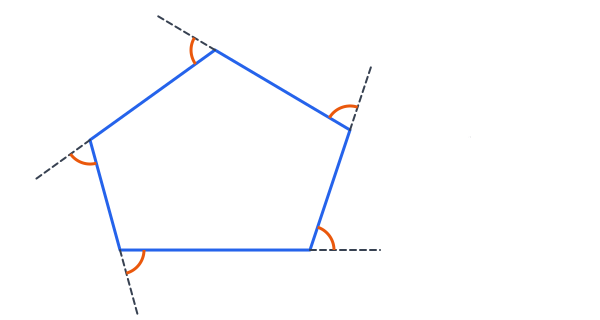
How to Find Polygon Angles
- Count the sides, n.
- For the interior angle sum, subtract 2 and multiply by 180°.
- For a regular polygon, divide the sum by n to get one interior angle.
- For one exterior angle of a regular polygon, divide 360° by n.
- To find n from a regular polygon’s angle, find the exterior angle and divide it into 360°.
Worked Examples
Example 1: Interior angle sums
Find the sum of the interior angles of a hexagon (6 sides) and of an octagon (8 sides).
- Hexagon: subtract 2 from the number of sides: 6 - 2 = 4
- Multiply by 180°: 4 \times 180^\circ = 720^\circ
- Octagon: subtract 2: 8 - 2 = 6
- Multiply by 180°: 6 \times 180^\circ = 1080^\circ
Answer: A hexagon’s angles add to 720°, and an octagon’s add to 1080°.
Example 2: One angle of a regular polygon
Find each interior angle and each exterior angle of a regular decagon (10 sides).
- Find the sum: (10 - 2) \times 180^\circ = 8 \times 180^\circ = 1440^\circ
- Divide by 10 for one interior angle: 1440^\circ \div 10 = 144^\circ
- Divide 360° by 10 for one exterior angle: 360^\circ \div 10 = 36^\circ
- Check: the interior and exterior angles add to 180°: 144^\circ + 36^\circ = 180^\circ
Answer: Each interior angle is 144°, and each exterior angle is 36°.
Example 3: Find the number of sides
Each interior angle of a regular polygon measures 156°. How many sides does it have?
- The interior and exterior angles at a vertex add to 180°, so subtract: 180^\circ - 156^\circ = 24^\circ
- The exterior angles add to 360°, and each is 24°. Divide: 360^\circ \div 24^\circ = 15
- Check with the sum formula: (15 - 2) \times 180^\circ = 13 \times 180^\circ = 2340^\circ, and 2340^\circ \div 15 = 156^\circ.
Answer: The polygon has 15 sides.
Example 4: A missing angle
A pentagon has angles of 100°, 110°, 95°, 120° and x°. Find x.
- Find the angle sum of a pentagon: (5 - 2) \times 180^\circ = 3 \times 180^\circ = 540^\circ
- Add the four known angles: 100 + 110 + 95 + 120 = 425
- Subtract from the sum: 540 - 425 = 115
- Check: 425 + 115 = 540
Answer: x = 115.
Example 5: Word problem with floor tiles
A tile store sells regular hexagons and regular pentagons. To cover a floor with no gaps, the angles that meet at each corner must add to exactly 360°. Which shape works?
- Hexagon: one interior angle is \tfrac{(6 - 2) \times 180^\circ}{6} = \tfrac{720^\circ}{6} = 120^\circ
- Divide into 360°: 360^\circ \div 120^\circ = 3. Exactly 3 hexagons fit around a point.
- Pentagon: one interior angle is \tfrac{(5 - 2) \times 180^\circ}{5} = \tfrac{540^\circ}{5} = 108^\circ
- Divide into 360°: 360 \div 108 = 3.\overline{3}. That is not a whole number, so pentagons leave gaps.
Answer: The regular hexagons work, three at each corner. Regular pentagons can’t cover the floor without gaps.
Common Mistakes
| Mistake | Example of the error | Fix |
|---|---|---|
| Multiplying n by 180° | Hexagon sum: 6 \times 180^\circ = 1080^\circ | Subtract 2 first: (6 - 2) \times 180^\circ = 720^\circ. |
| Thinking the exterior sum grows with n | “An octagon’s exterior angles add to 720°” | The exterior angles of any convex polygon add to 360°. |
| Dividing the sum when the polygon isn’t regular | Saying each angle of an irregular pentagon is 108° | Only regular polygons have equal angles. |
| Using the interior angle to find n | 360 \div 156 | Use the exterior angle: 180 - 156 = 24, then 360 \div 24 = 15. |
| Counting vertices wrong | Calling an 8-sided figure a hexagon | Hexagon: 6 sides. Heptagon: 7. Octagon: 8. Nonagon: 9. Decagon: 10. |
Angle Measures of Common Regular Polygons
| Polygon | Sides | Interior sum | Each interior angle | Each exterior angle |
|---|---|---|---|---|
| Triangle | 3 | 180° | 60° | 120° |
| Square | 4 | 360° | 90° | 90° |
| Pentagon | 5 | 540° | 108° | 72° |
| Hexagon | 6 | 720° | 120° | 60° |
| Octagon | 8 | 1080° | 135° | 45° |
| Decagon | 10 | 1440° | 144° | 36° |
A stop sign is a regular octagon, so each of its corners measures 135°. The 3-side row matches the equilateral triangle, with 60° angles.
Practice Problems
- Find the sum of the interior angles of a nonagon (9 sides).
- Find the sum of the interior angles of a 12-sided polygon.
- Find the measure of each interior angle of a regular pentagon.
- Find each exterior angle and each interior angle of a regular 12-sided polygon.
- Each exterior angle of a regular polygon is 40°. How many sides does it have?
- Each interior angle of a regular polygon is 162°. How many sides does it have?
- A quadrilateral has angles of 85°, 95°, 110° and x°. Find x.
- The exterior angles of a quadrilateral are x°, 2x°, 3x° and 4x°. Find x and each exterior angle.
- The interior angles of a polygon add to 2340°. How many sides does it have?
- Can a regular polygon have an interior angle of 130°? Explain.
Show answers
- Subtract 2: 9 - 2 = 7
Multiply: 7 \times 180 = 1260
The sum is 1260°. - Subtract 2: 12 - 2 = 10
Multiply: 10 \times 180 = 1800
The sum is 1800°. - Sum: (5 - 2) \times 180 = 3 \times 180 = 540
Divide by 5: 540 \div 5 = 108
Each interior angle is 108°. - Exterior: 360 \div 12 = 30, so 30°
Interior: 180 - 30 = 150, so 150° - Divide: 360 \div 40 = 9
The polygon has 9 sides. - Exterior angle: 180 - 162 = 18
Divide: 360 \div 18 = 20
The polygon has 20 sides. - A quadrilateral’s angles add to (4 - 2) \times 180 = 360
Add the known angles: 85 + 95 + 110 = 290
Subtract: 360 - 290 = 70
x = 70 - The exterior angles add to 360°: x + 2x + 3x + 4x = 360
Combine like terms (see combining like terms): 10x = 360
Divide by 10: x = 36
The exterior angles are 36°, 72°, 108° and 144°. - Set the formula equal to the sum: (n - 2) \times 180 = 2340
Divide both sides by 180: n - 2 = 13
Add 2: n = 15
The polygon has 15 sides. - Exterior angle: 180 - 130 = 50
Divide: 360 \div 50 = 7.2
The number of sides must be a whole number, so no regular polygon has a 130° angle.
FAQ
What is the formula for the sum of interior angles of a polygon?
The sum is (n - 2) \cdot 180^\circ, where n is the number of sides. For example, a pentagon’s angles add to 3 \cdot 180^\circ = 540^\circ.
Why do exterior angles always add up to 360°?
If you walk around the polygon and turn at each corner, you end up facing the way you started. That is one full turn, which is 360°.
How do you find one interior angle of a regular polygon?
Find the interior angle sum with (n - 2) \cdot 180^\circ, then divide by n. Or find the exterior angle, 360^\circ \div n, and subtract it from 180°.
How many sides does a polygon have if its angles add to 1080°?
Solve (n - 2) \cdot 180 = 1080. Divide by 180 to get n - 2 = 6, so n = 8. It is an octagon.
Summary
- Interior angle sum: (n - 2) \cdot 180^\circ.
- One interior angle of a regular polygon: the sum divided by n.
- The exterior angles of any convex polygon add to 360°.
- One exterior angle of a regular polygon: 360^\circ \div n.
- An interior angle and its exterior angle add to 180°.
- To find n, divide 360° by one exterior angle.
Previous lesson: Hinge Theorem
Next lesson: Properties of Parallelograms
Back to the Geometry Index