
Hinge Theorem
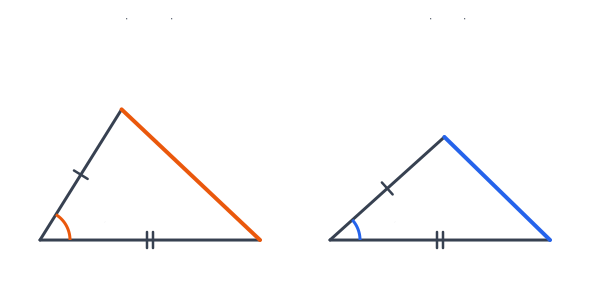
The hinge theorem compares two triangles that have two pairs of congruent sides. If the included angle in the first triangle is larger, then the third side across from it is longer. The converse also works: the longer third side is across from the larger included angle. Think of a door opening wider.
Before this lesson: You should know the Triangle Inequality Theorem, SSS and SAS Congruence and Compound Inequalities.
The Idea Behind the Hinge Theorem
Picture two sticks joined by a hinge, like the arms of a drawing compass. The arms never change length. When you open the hinge wider, the tips move farther apart. When you close it, the tips move closer together.
Now picture two triangles with the same two side lengths. The triangle with the wider angle between those sides has the longer third side. This is like SAS, but with an inequality: if the angles don’t match, the third sides don’t match either.
The Hinge Theorem and Its Converse
- Hinge theorem (SAS inequality): If two sides of one triangle are congruent to two sides of another triangle, and the included angle of the first is larger, then the third side of the first is longer.
- Converse of the hinge theorem (SSS inequality): If two sides of one triangle are congruent to two sides of another triangle, and the third side of the first is longer, then the included angle of the first is larger.
\text{If } AB = DE,\ AC = DF \text{ and } m\angle A \gt m\angle D, \text{ then } BC \gt EF.Both triangles must have two pairs of congruent sides. The angle you compare must be the included angle, the one between those two sides.
How to Use the Hinge Theorem
- Check that the two triangles have two pairs of congruent sides.
- Find the included angle in each triangle and the third side across from it.
- If you know the angles, the larger angle is across from the longer third side.
- If you know the third sides, the longer side is across from the larger angle.
- With a variable angle, write an inequality. Remember that an angle is also greater than 0° and less than 180°.
Worked Examples
Example 1: Compare the third sides
In \triangle ABC and \triangle DEF, AB = DE = 7 and AC = DF = 10. Also m\angle A = 58^\circ and m\angle D = 42^\circ. Which is longer, BC or EF?
- Two pairs of sides match: AB with DE, and AC with DF.
- Angle A is between AB and AC, so it is the included angle. Angle D is between DE and DF.
- Compare the included angles: 58^\circ \gt 42^\circ.
- By the hinge theorem, the side across from the larger angle is longer. BC is across from angle A.
Answer: BC \gt EF. This is the first picture above.
Example 2: Compare the included angles
Two triangles each have sides of 9 cm and 12 cm. In the first triangle, the third side is 15 cm. In the second triangle, the third side is 13 cm. In which triangle is the angle between the 9 cm and 12 cm sides larger?
- Two pairs of sides match: 9 cm and 12 cm.
- Compare the third sides: 15 \gt 13.
- By the converse of the hinge theorem, the longer third side is across from the larger included angle.
Answer: The included angle is larger in the first triangle, the one with the 15 cm side.
Example 3: Find the range of x
In \triangle ABC and \triangle DEF, AB = DE and AC = DF. Also BC \gt EF, m\angle A = (2x - 6)^\circ and m\angle D = 48^\circ. Find the possible values of x.
- BC is longer, so by the converse of the hinge theorem, angle A is larger: 2x - 6 \gt 48
- Add 6 to both sides (see two-step inequalities): 2x \gt 54
- Divide both sides by 2: x \gt 27
- An angle of a triangle is also less than 180°: 2x - 6 \lt 180
- Add 6 to both sides: 2x \lt 186
- Divide both sides by 2: x \lt 93
- Put the two together (see compound inequalities): 27 \lt x \lt 93
Answer: 27 \lt x \lt 93.
Example 4: Word problem with two hiking groups
Two hiking groups leave camp. Group A walks 3 km east, turns 40° to the north, and walks 4 km. Group B walks 3 km west, turns 55° to the south, and walks 4 km. Which group ends up farther from camp?
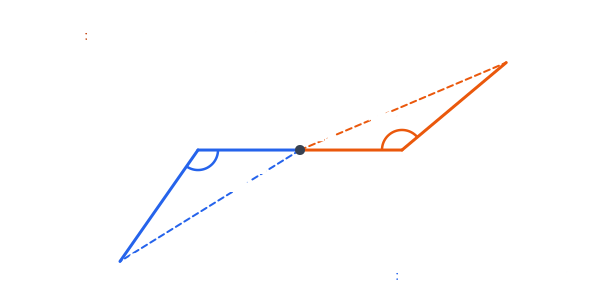
- Each group’s path and its straight line back to camp form a triangle with sides of 3 km and 4 km.
- The angle inside each triangle at the turn forms a linear pair with the turning angle (see angle pairs).
- Group A’s angle at the turn: 180^\circ - 40^\circ = 140^\circ
- Group B’s angle at the turn: 180^\circ - 55^\circ = 125^\circ
- Compare: 140^\circ \gt 125^\circ. These are the included angles between the 3 km and 4 km sides.
- By the hinge theorem, group A’s third side, the distance back to camp, is longer.
Answer: Group A is farther from camp. A smaller turn keeps a hiker going more nearly straight, so the angle at the turn is wider.
Example 5: Triangles that share a side
In \triangle ABC, D is a point on \overline{AC}, and \overline{AB} \cong \overline{CB}. Also AD = 7 and DC = 5. Compare m\angle ABD and m\angle CBD.
- Look at \triangle ABD and \triangle CBD.
- \overline{AB} \cong \overline{CB} is given.
- \overline{BD} \cong \overline{BD} by the reflexive property. So two pairs of sides match.
- The third sides are AD and CD. Compare them: 7 \gt 5.
- Angle ABD is across from AD, and angle CBD is across from CD.
- By the converse of the hinge theorem, the angle across from the longer side is larger.
Answer: m\angle ABD \gt m\angle CBD.
Common Mistakes
| Mistake | Example of the error | Fix |
|---|---|---|
| Using the theorem without two pairs of congruent sides | Comparing triangles with sides 5, 8 and 6, 9 | Both pairs of sides must match before you compare angles or third sides. |
| Comparing an angle that isn’t included | Using an angle next to only one of the matching sides | Use the angle between the two matching sides. |
| Mixing up the direction | Larger angle, so “shorter third side” | Larger included angle means longer third side, like a hinge opening. |
| Forgetting the 180° limit | Answering only x \gt 27 | The angle must also be less than 180°, so x \lt 93 too. |
| Using the turning angle as the triangle’s angle | Comparing 40° and 55° directly in the hiking problem | The triangle’s angle is 180^\circ minus the turn. |
Hinge Theorem vs. Other Triangle Tools
| Tool | What it compares |
|---|---|
| SAS congruence | Two sides and the included angle equal, so the third sides are equal |
| Hinge theorem | Two sides equal and one included angle larger, so that third side is longer |
| Triangle inequality theorem | Sides within one triangle: any two add to more than the third |
| Sides and angles in one triangle | The longest side is across from the largest angle |
The hinge theorem works across two triangles. The triangle inequality theorem works inside one triangle.
Practice Problems
- Two triangles each have sides of 6 and 8. The included angle is 70° in the first and 50° in the second. Which triangle has the longer third side?
- Two triangles each have sides of 10 and 10. The third side is 11 in the first triangle and 14 in the second. Which triangle has the larger included angle?
- In \triangle ABC and \triangle DEF, AB = DE, AC = DF and BC \lt EF. Also m\angle A = (3x + 9)^\circ and m\angle D = 75^\circ. Find the possible values of x.
- In \triangle PQR and \triangle STU, PQ = ST = 10 and QR = TU = 7. Also m\angle Q = 95^\circ and m\angle T = 85^\circ. Which is longer, PR or SU?
- A drawing compass is opened to 30° and then to 45°. Its arms stay the same length. Which setting draws the larger circle? Explain.
- In two triangles, two sides are 5 and 5. In the first triangle, the included angle is (2x + 10)^\circ and the third side is longer than in the second triangle, whose included angle is 70°. Find the possible values of x.
- Two triangles have sides of 4 and 9 in common, and their third sides are both 7. What can you say about their included angles?
- In \triangle ABC, D is on \overline{AC}, \overline{AB} \cong \overline{CB}, and m\angle ABD = 32^\circ while m\angle CBD = 25^\circ. Compare AD and CD.
- Complete the proof. Given: \overline{AB} \cong \overline{DE}, \overline{BC} \cong \overline{EF} and AC \gt DF. Prove: m\angle B \gt m\angle E. Statements: (1) \overline{AB} \cong \overline{DE}. (2) \overline{BC} \cong \overline{EF}. (3) AC \gt DF. (4) m\angle B \gt m\angle E. Give a reason for each statement.
- Can you use the hinge theorem if only one pair of sides is congruent? Explain.
Show answers
- The sides match, and 70^\circ \gt 50^\circ
By the hinge theorem, the first triangle has the longer third side. - The sides match, and 14 \gt 11
By the converse of the hinge theorem, the second triangle has the larger included angle. - BC is shorter, so angle A is smaller: 3x + 9 \lt 75
Subtract 9: 3x \lt 66
Divide by 3: x \lt 22
The angle is also greater than 0: 3x + 9 \gt 0
Subtract 9: 3x \gt -9
Divide by 3: x \gt -3
Together: -3 \lt x \lt 22 - PR is across from angle Q, and SU is across from angle T
95^\circ \gt 85^\circ
By the hinge theorem, PR is longer. - The 45° setting. The arms are the same length, and the wider angle puts the tips farther apart, so the radius is larger.
- The first third side is longer, so its angle is larger: 2x + 10 \gt 70
Subtract 10: 2x \gt 60
Divide by 2: x \gt 30
The angle is less than 180°: 2x + 10 \lt 180
Subtract 10: 2x \lt 170
Divide by 2: x \lt 85
Together: 30 \lt x \lt 85 - All three pairs of sides match, so the triangles are congruent by SSS
The included angles are congruent (CPCTC). - \triangle ABD and \triangle CBD share BD, and AB = CB
32^\circ \gt 25^\circ, and AD is across from angle ABD
By the hinge theorem, AD \gt CD - (1) Given
(2) Given
(3) Given
(4) Converse of the hinge theorem (steps 1, 2 and 3) - No. The hinge theorem needs two pairs of congruent sides. With only one pair, a larger angle does not guarantee a longer third side.
FAQ
What is the hinge theorem?
If two triangles have two pairs of congruent sides, the triangle with the larger included angle has the longer third side. It is also called the SAS inequality theorem.
What is the converse of the hinge theorem?
If two triangles have two pairs of congruent sides, the triangle with the longer third side has the larger included angle. It is also called the SSS inequality theorem.
Why is it called the hinge theorem?
The two matching sides act like the arms of a hinge. Opening the hinge wider moves the ends farther apart, which makes the third side longer.
How is the hinge theorem different from the triangle inequality theorem?
The hinge theorem compares two different triangles. The triangle inequality theorem compares the three sides of one triangle.
Summary
- The hinge theorem compares two triangles with two pairs of congruent sides.
- A larger included angle means a longer third side.
- Converse: a longer third side means a larger included angle.
- Always use the angle between the two matching sides.
- With variables, remember the angle is also between 0° and 180°.
- This finishes the unit on relationships within triangles.
Previous lesson: Triangle Inequality Theorem
Next lesson: Interior and Exterior Angles of Polygons, the first lesson of Unit 7
Back to the Geometry Index