
Properties of Parallelograms
A parallelogram is a quadrilateral with both pairs of opposite sides parallel. In every parallelogram, opposite sides are congruent, opposite angles are congruent, consecutive angles add to 180°, and the diagonals bisect each other. These four properties let you find missing sides, angles and diagonal lengths.
Before this lesson: You should know Interior and Exterior Angles of Polygons, Parallel Lines and Transversals and CPCTC.
What Makes a Parallelogram
Think of a rectangle that has been pushed sideways, like a cardboard box squashed at an angle. The top and bottom stay parallel, and so do the two sides. That shape is a parallelogram. Rectangles, rhombuses and squares are special parallelograms.
A quadrilateral’s angles add to 360°. In a parallelogram, the angles come in two matching pairs, and any two angles next to each other add to 180°. Angles next to each other are called consecutive angles.
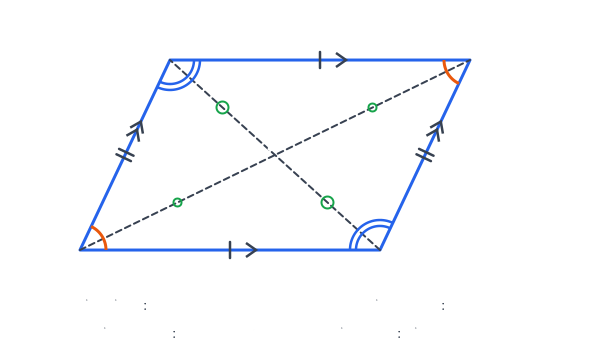
Properties of Parallelograms
In parallelogram ABCD with diagonals meeting at E:
| Property | In symbols |
|---|---|
| Opposite sides are parallel | \overline{AB} \parallel \overline{DC} and \overline{AD} \parallel \overline{BC} |
| Opposite sides are congruent | AB = DC and AD = BC |
| Opposite angles are congruent | m\angle A = m\angle C and m\angle B = m\angle D |
| Consecutive angles are supplementary | m\angle A + m\angle B = 180^\circ |
| The diagonals bisect each other | AE = EC and BE = ED |
Why are consecutive angles supplementary? Sides AD and BC are parallel, and AB is a transversal. Angles A and B are same-side interior angles, so they add to 180°.
How to Use Parallelogram Properties
- Label the parallelogram in order around the shape, like ABCD.
- For sides, set opposite sides equal.
- For angles, set opposite angles equal, or make consecutive angles add to 180°.
- For diagonals, set the two halves of each diagonal equal. The full diagonal is twice one half.
- Solve, then substitute back to find the measures.
Worked Examples
Example 1: Word problem with a garden bed
A garden bed is shaped like a parallelogram ABCD. Side AB is 12 ft, side BC is 7 ft, and the angle at A is 65°. Find the other sides, the other angles and the perimeter.
- Opposite sides are congruent: CD = AB = 12 ft and AD = BC = 7 ft.
- Opposite angles are congruent: m\angle C = m\angle A = 65^\circ.
- Consecutive angles add to 180°: m\angle B = 180^\circ - 65^\circ = 115^\circ.
- Angle D is opposite angle B: m\angle D = 115^\circ.
- Add the four sides: 12 + 7 + 12 + 7 = 38
- Check the angles: 65 + 115 + 65 + 115 = 360
Answer: CD = 12 ft and AD = 7 ft. The angles are 65°, 115°, 65° and 115°. The perimeter is 38 ft.
Example 2: Solve for x with opposite sides
In parallelogram ABCD, AB = 3x + 2 and CD = 5x - 10. Find x and AB.
- Opposite sides are congruent: 3x + 2 = 5x - 10
- Subtract 3x from both sides (see equations with variables on both sides): 2 = 2x - 10
- Add 10 to both sides: 12 = 2x
- Divide both sides by 2: 6 = x
- Find AB: 3(6) + 2 = 18 + 2 = 20
- Check with CD: 5(6) - 10 = 30 - 10 = 20
Answer: x = 6 and AB = 20.
Example 3: Solve for y with consecutive angles
In parallelogram ABCD, m\angle A = (2y + 10)^\circ and m\angle B = (3y + 20)^\circ. Find y and each angle of the parallelogram.
- Angles A and B are consecutive, so they add to 180°: (2y + 10) + (3y + 20) = 180
- Combine like terms (see combining like terms): 5y + 30 = 180
- Subtract 30 from both sides: 5y = 150
- Divide both sides by 5: y = 30
- Find angle A: 2(30) + 10 = 60 + 10 = 70
- Find angle B: 3(30) + 20 = 90 + 20 = 110
- Opposite angles match: m\angle C = 70^\circ and m\angle D = 110^\circ.
Answer: y = 30. The angles are 70°, 110°, 70° and 110°.
Example 4: Diagonals that bisect each other
The diagonals of parallelogram ABCD meet at E. AE = 2z + 1 and EC = 4z - 9. Also BE = 7. Find z, AC and BD.
- The diagonals bisect each other, so AE = EC: 2z + 1 = 4z - 9
- Subtract 2z from both sides: 1 = 2z - 9
- Add 9 to both sides: 10 = 2z
- Divide both sides by 2: 5 = z
- Find AE: 2(5) + 1 = 10 + 1 = 11
- AC is twice AE: AC = 2 \times 11 = 22
- BD is twice BE: BD = 2 \times 7 = 14
Answer: z = 5, AC = 22 and BD = 14.
Example 5: Prove that opposite sides are congruent
Given: ABCD is a parallelogram. Draw diagonal AC.
Prove: \overline{AB} \cong \overline{CD} and \overline{BC} \cong \overline{DA}
| Statements | Reasons |
|---|---|
| 1. ABCD is a parallelogram | Given |
| 2. \overline{AB} \parallel \overline{DC} and \overline{AD} \parallel \overline{BC} | Definition of a parallelogram |
| 3. \angle BAC \cong \angle DCA | Alternate interior angles theorem (AB ∥ DC) |
| 4. \angle BCA \cong \angle DAC | Alternate interior angles theorem (AD ∥ BC) |
| 5. \overline{AC} \cong \overline{AC} | Reflexive property of congruence |
| 6. \triangle ABC \cong \triangle CDA | ASA (steps 3, 5 and 4) |
| 7. \overline{AB} \cong \overline{CD} and \overline{BC} \cong \overline{DA} | CPCTC |
The same pair of triangles also gives \angle B \cong \angle D by CPCTC. That is why opposite angles are congruent too.
Common Mistakes
| Mistake | Example of the error | Fix |
|---|---|---|
| Setting consecutive angles equal | 2y + 10 = 3y + 20 for angles A and B | Consecutive angles add to 180°. Only opposite angles are equal. |
| Setting next-door sides equal | AB = BC in any parallelogram | Only opposite sides are congruent. Adjacent sides match only in a rhombus. |
| Thinking the diagonals are congruent | AC = BD in every parallelogram | The diagonals bisect each other, but they are equal only in a rectangle. |
| Using half a diagonal as the whole | AE = 11, so “AC = 11” | AE is half of AC, so AC = 22. |
| Labeling vertices out of order | Calling a parallelogram ACBD | Name the vertices in order around the shape, so opposite sides are AB and CD. |
Parallelograms on the Coordinate Plane
- Opposite sides have equal slopes, because they are parallel (see slope formula).
- Opposite sides have equal lengths (see distance formula).
- Both diagonals have the same midpoint (see midpoint formula).
- The next lesson turns these properties around to prove that a shape is a parallelogram.
Practice Problems
- In parallelogram ABCD, AB = 15. Find CD.
- In parallelogram ABCD, m\angle B = 108^\circ. Find m\angle D and m\angle A.
- In parallelogram ABCD, AD = 4x - 3 and BC = 2x + 7. Find x and AD.
- In parallelogram ABCD, m\angle A = (5x)^\circ and m\angle C = (3x + 40)^\circ. Find x and m\angle A.
- In parallelogram ABCD, m\angle A = (4y - 6)^\circ and m\angle D = (2y + 18)^\circ. Find y and both angles.
- The diagonals of parallelogram ABCD meet at E. AE = 9. Find AC. Also, BE = x + 3 and ED = 2x - 5. Find x and BD.
- Parallelogram ABCD has vertices A(1, 1), B(6, 1), C(8, 4) and D(3, 4). Show that its diagonals bisect each other.
- A parallelogram has sides of 9 cm and 14 cm. Find its perimeter.
- Complete the proof. Given: ABCD is a parallelogram with diagonals meeting at E. Prove: the diagonals bisect each other. Statements: (1) ABCD is a parallelogram. (2) \overline{AB} \parallel \overline{DC}. (3) \angle ABE \cong \angle CDE. (4) \angle BAE \cong \angle DCE. (5) \overline{AB} \cong \overline{CD}. (6) \triangle ABE \cong \triangle CDE. (7) \overline{AE} \cong \overline{CE} and \overline{BE} \cong \overline{DE}. (8) The diagonals bisect each other. Give a reason for each statement.
- Can a parallelogram have two consecutive angles of 70° and 120°? Explain.
Show answers
- Opposite sides are congruent
CD = 15 - Opposite angles are congruent: m\angle D = 108^\circ
Consecutive angles add to 180: 180 - 108 = 72, so m\angle A = 72^\circ - Opposite sides are equal: 4x - 3 = 2x + 7
Subtract 2x: 2x - 3 = 7
Add 3: 2x = 10
Divide by 2: x = 5
Find AD: 4(5) - 3 = 20 - 3 = 17 - Opposite angles are equal: 5x = 3x + 40
Subtract 3x: 2x = 40
Divide by 2: x = 20
Find the angle: 5(20) = 100, so m\angle A = 100^\circ - Consecutive angles add to 180: (4y - 6) + (2y + 18) = 180
Combine like terms: 6y + 12 = 180
Subtract 12: 6y = 168
Divide by 6: y = 28
Angle A: 4(28) - 6 = 112 - 6 = 106, so 106°
Angle D: 2(28) + 18 = 56 + 18 = 74, so 74° - AC is twice AE: 2 \times 9 = 18
The halves of BD are equal: x + 3 = 2x - 5
Subtract x: 3 = x - 5
Add 5: x = 8
BE: 8 + 3 = 11
BD: 2 \times 11 = 22 - Midpoint of AC: \left(\tfrac{1 + 8}{2}, \tfrac{1 + 4}{2}\right) = (4.5, 2.5)
Midpoint of BD: \left(\tfrac{6 + 3}{2}, \tfrac{1 + 4}{2}\right) = (4.5, 2.5)
The midpoints are the same point, so the diagonals bisect each other. - Opposite sides are equal, so add 9 + 14 + 9 + 14 = 46
The perimeter is 46 cm. - (1) Given
(2) Definition of a parallelogram
(3) Alternate interior angles theorem
(4) Alternate interior angles theorem
(5) Opposite sides of a parallelogram are congruent
(6) ASA (steps 4, 5 and 3)
(7) CPCTC
(8) Definition of segment bisector (E is the midpoint of both diagonals) - No. Consecutive angles of a parallelogram add to 180°, but 70 + 120 = 190.
FAQ
What are the properties of a parallelogram?
Opposite sides are parallel and congruent, opposite angles are congruent, consecutive angles are supplementary, and the diagonals bisect each other.
Do the diagonals of a parallelogram bisect the angles?
Not usually. They bisect each other, which means they cut each other in half. They bisect the angles only in a rhombus or a square.
Are the diagonals of a parallelogram equal?
Only when the parallelogram is a rectangle. In other parallelograms, one diagonal is longer than the other.
What do the angles of a parallelogram add up to?
All four angles add to 360°, like any quadrilateral. Any two consecutive angles add to 180°.
Summary
- A parallelogram has two pairs of parallel opposite sides.
- Opposite sides are congruent.
- Opposite angles are congruent, and consecutive angles add to 180°.
- The diagonals bisect each other, so each half of a diagonal is equal.
- The properties come from congruent triangles made by a diagonal.
Previous lesson: Interior and Exterior Angles of Polygons
Next lesson: Proving a Quadrilateral Is a Parallelogram
Back to the Geometry Index