
Proving a Quadrilateral Is a Parallelogram
To prove a quadrilateral is a parallelogram, show any one of these: both pairs of opposite sides are parallel, both pairs of opposite sides are congruent, both pairs of opposite angles are congruent, the diagonals bisect each other, or one pair of opposite sides is both parallel and congruent.
Before this lesson: You should know Properties of Parallelograms, SSS and SAS Congruence and the Slope Formula.
Turning the Properties Around
In the last lesson, you started with a parallelogram and found its properties. Now the direction flips. You start with a four-sided shape and ask: is it really a parallelogram?
The properties work as tests, because their converses are true. For example, if both pairs of opposite sides are congruent, the shape must be a parallelogram. You don’t have to check everything. One test is enough.
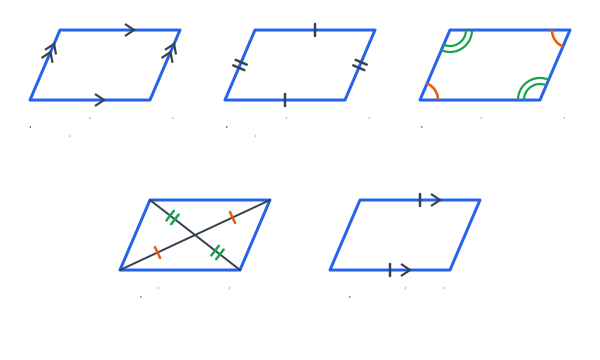
Parallelogram Tests
- Definition: both pairs of opposite sides are parallel.
- Opposite sides theorem converse: both pairs of opposite sides are congruent.
- Opposite angles theorem converse: both pairs of opposite angles are congruent.
- Diagonals theorem converse: the diagonals bisect each other.
- Parallel and congruent pair: one pair of opposite sides is both parallel and congruent.
Be careful with mixed facts. One pair of parallel sides plus one pair of congruent sides is not enough. An isosceles trapezoid has exactly that, and it is not a parallelogram.
How to Prove a Quadrilateral Is a Parallelogram
- List what you know about the sides, angles and diagonals.
- Match the facts to one of the five tests.
- With variables, set the matching parts equal and solve.
- On a grid, use slopes for parallel sides, the distance formula for congruent sides, or midpoints for the diagonals.
- State which test you used.
Worked Examples
Example 1: Word problem with a gate frame
A carpenter builds a gate frame from four boards. The top and bottom boards are each 120 cm long. The two side boards are each 90 cm long. She joins them in order, top, side, bottom, side. Must the frame be a parallelogram?
- The top and bottom are opposite sides, and both are 120 cm. So that pair is congruent.
- The two sides are opposite sides, and both are 90 cm. So that pair is congruent too.
- Both pairs of opposite sides are congruent.
- By the converse of the opposite sides theorem, the frame is a parallelogram.
Answer: Yes, the frame must be a parallelogram. It is not necessarily a rectangle, though. A gate can lean and still have equal opposite sides. The next lesson shows how to check for a rectangle.
Example 2: Is it enough?
For each quadrilateral ABCD, decide whether the facts prove it is a parallelogram. (a) \overline{AB} \parallel \overline{DC} and \overline{AD} \cong \overline{BC}. (b) \angle A \cong \angle C and \angle B \cong \angle D. (c) The diagonals meet at E, with AE = EC and BE = ED.
- (a) One pair is parallel and the other pair is congruent. These are different pairs, so no test matches. An isosceles trapezoid fits these facts. Not enough.
- (b) Both pairs of opposite angles are congruent. This matches the opposite angles test. It is a parallelogram.
- (c) E is the midpoint of both diagonals, so the diagonals bisect each other. It is a parallelogram.
Answer: (a) Not enough. (b) Yes. (c) Yes.
Example 3: Find x and y
In quadrilateral ABCD, AB = 2x + 3, CD = x + 9, AD = 3y - 1 and BC = y + 7. Find the values of x and y that make ABCD a parallelogram.
- Set one pair of opposite sides equal: 2x + 3 = x + 9
- Subtract x from both sides (see equations with variables on both sides): x + 3 = 9
- Subtract 3 from both sides: x = 6
- Set the other pair equal: 3y - 1 = y + 7
- Subtract y from both sides: 2y - 1 = 7
- Add 1 to both sides: 2y = 8
- Divide both sides by 2: y = 4
- Check: AB = 2(6) + 3 = 15 and CD = 6 + 9 = 15. AD = 3(4) - 1 = 11 and BC = 4 + 7 = 11.
Answer: x = 6 and y = 4. Both pairs of opposite sides are then congruent, so ABCD is a parallelogram.
Example 4: Prove it on a grid
Show that ABCD with A(-2, 1), B(3, 2), C(5, 6) and D(0, 5) is a parallelogram.
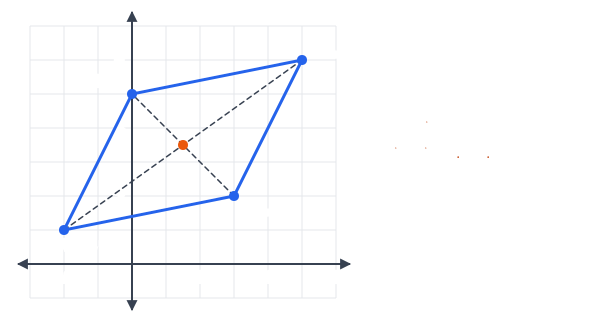
- Slope of AB: \tfrac{2 - 1}{3 - (-2)} = \tfrac{1}{5}
- Slope of DC: \tfrac{6 - 5}{5 - 0} = \tfrac{1}{5}. AB and DC are parallel.
- Slope of AD: \tfrac{5 - 1}{0 - (-2)} = \tfrac{4}{2} = 2
- Slope of BC: \tfrac{6 - 2}{5 - 3} = \tfrac{4}{2} = 2. AD and BC are parallel.
- Both pairs of opposite sides are parallel, so ABCD is a parallelogram by definition.
- Another check: midpoint of AC (see midpoint formula) is \left(\tfrac{-2 + 5}{2}, \tfrac{1 + 6}{2}\right) = (1.5, 3.5). Midpoint of BD is \left(\tfrac{3 + 0}{2}, \tfrac{2 + 5}{2}\right) = (1.5, 3.5). The diagonals bisect each other too.
Answer: ABCD is a parallelogram, because both pairs of opposite sides have equal slopes.
Example 5: Two-column proof with one pair of sides
Given: In quadrilateral ABCD, \overline{AB} \parallel \overline{DC} and \overline{AB} \cong \overline{DC}. Draw diagonal AC.
Prove: ABCD is a parallelogram.
| Statements | Reasons |
|---|---|
| 1. \overline{AB} \parallel \overline{DC} | Given |
| 2. \angle BAC \cong \angle DCA | Alternate interior angles theorem |
| 3. \overline{AB} \cong \overline{DC} | Given |
| 4. \overline{AC} \cong \overline{AC} | Reflexive property of congruence |
| 5. \triangle BAC \cong \triangle DCA | SAS (steps 3, 2 and 4) |
| 6. \angle BCA \cong \angle DAC | CPCTC |
| 7. \overline{AD} \parallel \overline{BC} | Converse of the alternate interior angles theorem |
| 8. ABCD is a parallelogram | Definition of a parallelogram (steps 1 and 7) |
Step 7 uses proving lines parallel: congruent alternate interior angles mean the lines are parallel.
Common Mistakes
| Mistake | Example of the error | Fix |
|---|---|---|
| Mixing pairs | One pair parallel and the other pair congruent, so “parallelogram” | The parallel pair and the congruent pair must be the same pair. |
| Checking only one pair of sides | AB = CD, so “it’s a parallelogram” | Show both pairs of opposite sides are congruent, or use another full test. |
| Using consecutive angles | \angle A \cong \angle B, so “parallelogram” | The test uses opposite angles: \angle A \cong \angle C and \angle B \cong \angle D. |
| Comparing the wrong slopes | Comparing slope AB with slope BC | Compare opposite sides: AB with DC, and AD with BC. |
| Thinking equal diagonals prove a parallelogram | AC = BD, so “parallelogram” | Equal diagonals alone don’t work (an isosceles trapezoid has them). The diagonals must bisect each other. |
Choosing a Test on a Grid
| Test | Tool to use |
|---|---|
| Opposite sides parallel | Slope formula: equal slopes |
| Opposite sides congruent | Distance formula: equal lengths |
| Diagonals bisect each other | Midpoint formula: same midpoint |
| One pair parallel and congruent | Slope and distance for the same pair |
Practice Problems
- Both pairs of opposite angles of a quadrilateral are congruent. Is it a parallelogram?
- In quadrilateral ABCD, \overline{AB} \parallel \overline{DC} and \overline{AD} \cong \overline{BC}. Is that enough to prove a parallelogram? Explain.
- The diagonals of quadrilateral ABCD meet at E. AE = 6, EC = 6, BE = 4 and ED = 5. Is ABCD a parallelogram?
- In quadrilateral ABCD, AB = 4x - 1, CD = 2x + 9, AD = y + 6 and BC = 3y - 4. Find x and y so that ABCD is a parallelogram.
- In quadrilateral ABCD, m\angle A = (5x - 8)^\circ, m\angle C = (3x + 20)^\circ, m\angle B = (2y + 8)^\circ and m\angle D = (3y - 47)^\circ. Find x and y so that ABCD is a parallelogram.
- The diagonals of quadrilateral ABCD meet at E. AE = x + 4, EC = 3x - 6, BE = 2y and ED = y + 7. Find x and y so that ABCD is a parallelogram.
- Show that A(0, 0), B(4, 1), C(6, 5) and D(2, 4) form a parallelogram.
- Is ABCD with A(0, 0), B(5, 0), C(6, 3) and D(0, 3) a parallelogram? Explain.
- Complete the proof. Given: the diagonals of quadrilateral ABCD bisect each other at E. Prove: ABCD is a parallelogram. Statements: (1) E is the midpoint of \overline{AC} and of \overline{BD}. (2) \overline{AE} \cong \overline{CE} and \overline{BE} \cong \overline{DE}. (3) \angle AEB \cong \angle CED. (4) \triangle AEB \cong \triangle CED. (5) \overline{AB} \cong \overline{CD}. (6) \angle AED \cong \angle CEB. (7) \triangle AED \cong \triangle CEB. (8) \overline{AD} \cong \overline{CB}. (9) ABCD is a parallelogram. Give a reason for each statement.
- A tabletop has four straight edges. The front and back edges are parallel and are each 1.5 m long. Must the tabletop be a parallelogram?
Show answers
- Yes, by the converse of the opposite angles theorem.
- No. The parallel pair and the congruent pair are different pairs. An isosceles trapezoid fits these facts.
- No. BE \ne ED, so E is not the midpoint of BD. The diagonals do not bisect each other.
- Opposite sides: 4x - 1 = 2x + 9
Subtract 2x: 2x - 1 = 9
Add 1: 2x = 10
Divide by 2: x = 5
Other pair: y + 6 = 3y - 4
Subtract y: 6 = 2y - 4
Add 4: 10 = 2y
Divide by 2: y = 5
Check: AB = CD = 19 and AD = BC = 11 - Opposite angles: 5x - 8 = 3x + 20
Subtract 3x: 2x - 8 = 20
Add 8: 2x = 28
Divide by 2: x = 14
Other pair: 2y + 8 = 3y - 47
Subtract 2y: 8 = y - 47
Add 47: y = 55
Check: m\angle A = 62^\circ and m\angle B = 118^\circ, and 62 + 118 = 180 - Halves of AC: x + 4 = 3x - 6
Subtract x: 4 = 2x - 6
Add 6: 10 = 2x
Divide by 2: x = 5
Halves of BD: 2y = y + 7
Subtract y: y = 7 - Slope AB: \tfrac{1 - 0}{4 - 0} = \tfrac{1}{4}; slope DC: \tfrac{5 - 4}{6 - 2} = \tfrac{1}{4}
Slope AD: \tfrac{4 - 0}{2 - 0} = 2; slope BC: \tfrac{5 - 1}{6 - 4} = 2
Both pairs of opposite sides are parallel, so it is a parallelogram. - Slope AB: 0 and slope DC: 0, so AB is parallel to DC
AB has length 5, but DC has length 6 - 0 = 6
Slope BC: \tfrac{3 - 0}{6 - 5} = 3, but AD is vertical, so they are not parallel
No, it is not a parallelogram (it is a trapezoid). - (1) Given
(2) Definition of midpoint
(3) Vertical angles theorem
(4) SAS
(5) CPCTC
(6) Vertical angles theorem
(7) SAS
(8) CPCTC
(9) Both pairs of opposite sides are congruent (converse of the opposite sides theorem) - Yes. One pair of opposite sides is both parallel and congruent, so the tabletop is a parallelogram.
FAQ
How do you prove a quadrilateral is a parallelogram?
Show one of five things: both pairs of opposite sides parallel, both pairs congruent, both pairs of opposite angles congruent, diagonals that bisect each other, or one pair of sides both parallel and congruent.
Is one pair of parallel sides enough?
No. A trapezoid has one pair of parallel sides. You need both pairs parallel, or one pair that is parallel and congruent.
How do you prove a parallelogram with coordinates?
Find the slopes of opposite sides and show they are equal. You can also show the diagonals share a midpoint, or that opposite sides have equal lengths.
Do equal diagonals prove a parallelogram?
No. An isosceles trapezoid has equal diagonals but is not a parallelogram. The diagonals must bisect each other.
Summary
- Any one of five tests proves a quadrilateral is a parallelogram.
- Both pairs of opposite sides parallel, or both pairs congruent.
- Both pairs of opposite angles congruent.
- Diagonals that bisect each other.
- One pair of opposite sides both parallel and congruent.
- On a grid, use slopes, distances or midpoints.
Previous lesson: Properties of Parallelograms
Next lesson: Rectangles, Rhombuses and Squares
Back to the Geometry Index