
Rectangles, Rhombuses and Squares
Rectangles, rhombuses and squares are special parallelograms. A rectangle has four right angles, and its diagonals are congruent. A rhombus has four congruent sides, and its diagonals are perpendicular and bisect its angles. A square is both a rectangle and a rhombus, so it has all of these properties.
Before this lesson: You should know Properties of Parallelograms, Proving a Quadrilateral Is a Parallelogram and the Distance Formula.
The Special Parallelograms
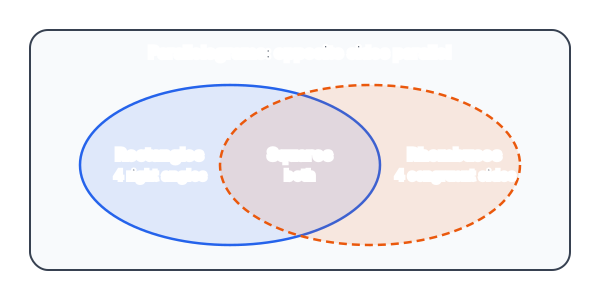
Every rectangle, rhombus and square is a parallelogram. So each one has all the parallelogram properties: opposite sides parallel and congruent, opposite angles congruent, and diagonals that bisect each other. Each special shape adds something more.
- A rectangle is a parallelogram with four right angles.
- A rhombus is a parallelogram with four congruent sides.
- A square is a parallelogram with four right angles and four congruent sides.
Diagonal Properties
The biggest differences show up in the diagonals.
| Property | Parallelogram | Rectangle | Rhombus | Square |
|---|---|---|---|---|
| Diagonals bisect each other | Yes | Yes | Yes | Yes |
| Diagonals are congruent | No | Yes | No | Yes |
| Diagonals are perpendicular | No | No | Yes | Yes |
| Diagonals bisect the angles | No | No | Yes | Yes |
| Four right angles | No | Yes | No | Yes |
| Four congruent sides | No | No | Yes | Yes |
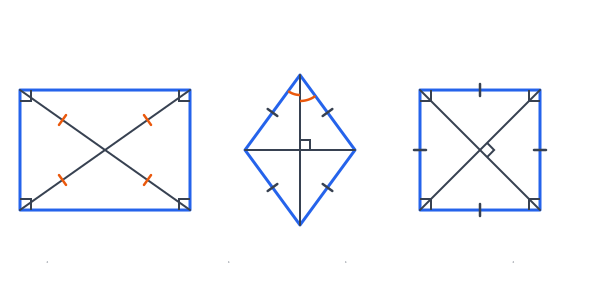
These also work as tests. A parallelogram with congruent diagonals is a rectangle. A parallelogram with perpendicular diagonals is a rhombus. A parallelogram with both is a square.
How to Solve Problems with Special Parallelograms
- Name the shape and list its properties from the table.
- Rectangle: set the two diagonals equal. Each half is half a diagonal.
- Rhombus: set sides equal, use 90° where the diagonals cross, and split each corner angle in half.
- Square: use all of the rectangle and rhombus facts. Each diagonal makes a 45° angle with the sides.
- Solve, then substitute back.
Worked Examples
Example 1: Diagonals of a rectangle
ABCD is a rectangle. Diagonal AC = 3x + 4 and diagonal BD = 5x - 10. Find x, AC and the length from A to the point E where the diagonals cross.
- The diagonals of a rectangle are congruent: 3x + 4 = 5x - 10
- Subtract 3x from both sides (see equations with variables on both sides): 4 = 2x - 10
- Add 10 to both sides: 14 = 2x
- Divide both sides by 2: 7 = x
- Find AC: 3(7) + 4 = 21 + 4 = 25
- Check with BD: 5(7) - 10 = 35 - 10 = 25
- The diagonals bisect each other, so AE is half of AC: 25 \div 2 = 12.5
Answer: x = 7, AC = 25 and AE = 12.5.
Example 2: Angles in a rhombus
ABCD is a rhombus, and its diagonals meet at E. m\angle ABD = 32^\circ. Find m\angle ABC, m\angle BAD, m\angle AEB and m\angle BAE.
- A rhombus’s diagonals bisect its angles, so BD splits angle B in half. Double it: 2 \times 32^\circ = 64^\circ. So m\angle ABC = 64^\circ.
- Consecutive angles add to 180°: 180^\circ - 64^\circ = 116^\circ. So m\angle BAD = 116^\circ.
- The diagonals are perpendicular: m\angle AEB = 90^\circ.
- In right triangle AEB, the acute angles add to 90° (see triangle angle sum theorem): 90^\circ - 32^\circ = 58^\circ.
- Check: AC bisects angle A, and 116^\circ \div 2 = 58^\circ. It matches.
Answer: m\angle ABC = 64^\circ, m\angle BAD = 116^\circ, m\angle AEB = 90^\circ and m\angle BAE = 58^\circ.
Example 3: Sides of a rhombus
ABCD is a rhombus with AB = 2y + 5 and BC = 4y - 3. Find y, the side length and the perimeter.
- All four sides of a rhombus are congruent: 2y + 5 = 4y - 3
- Subtract 2y from both sides: 5 = 2y - 3
- Add 3 to both sides: 8 = 2y
- Divide both sides by 2: 4 = y
- Find the side: 2(4) + 5 = 8 + 5 = 13
- Multiply by 4 for the perimeter: 4 \times 13 = 52
Answer: y = 4, each side is 13, and the perimeter is 52.
Example 4: Classify a shape on a grid
Quadrilateral ABCD has vertices A(-3, 0), B(0, 4), C(3, 0) and D(0, -4). Is it a rectangle, a rhombus, a square or none of these?
- Find AB (see distance formula): \sqrt{(0 + 3)^2 + (4 - 0)^2} = \sqrt{9 + 16} = \sqrt{25} = 5
- By the same steps, BC, CD and DA are also 5. All four sides are congruent, so ABCD is a rhombus.
- Diagonal AC runs from (−3, 0) to (3, 0), so AC = 6. Diagonal BD runs from (0, 4) to (0, −4), so BD = 8.
- The diagonals are not congruent (6 ≠ 8), so ABCD is not a rectangle.
- AC is horizontal and BD is vertical, so the diagonals are perpendicular, as a rhombus needs.
Answer: ABCD is a rhombus but not a rectangle, so it is not a square.
Example 5: Word problem with a gate frame
A carpenter builds a gate frame with top and bottom boards of 120 cm and side boards of 90 cm. Because opposite sides match, the frame is a parallelogram. She measures both diagonals and gets 150 cm each time. Is the frame a rectangle?
- The frame is a parallelogram, because both pairs of opposite sides are congruent.
- Both diagonals measure 150 cm, so the diagonals are congruent.
- A parallelogram with congruent diagonals is a rectangle.
Answer: Yes, the frame is a rectangle, so its corners are square. Builders use this diagonal check all the time.
Common Mistakes
| Mistake | Example of the error | Fix |
|---|---|---|
| Giving every parallelogram congruent diagonals | Setting the diagonals of a rhombus equal | Only rectangles (and squares) have congruent diagonals. |
| Forgetting the diagonals of a rhombus are perpendicular | Not using 90° where they cross | In a rhombus, the diagonals always meet at a right angle. |
| Not halving the angle | m\angle ABD = 32^\circ, so “m\angle ABC = 32^\circ” | The diagonal splits the angle in half, so m\angle ABC = 64^\circ. |
| Thinking a square isn’t a rectangle | “A square has equal sides, so it can’t be a rectangle” | A square has four right angles, so it is a rectangle and a rhombus. |
| Using one diagonal fact to call a shape a square | Congruent diagonals, so “square” | Congruent diagonals give a rectangle. A square also needs perpendicular diagonals or equal sides. |
Is Every Square a Rhombus?
- Every square is a rectangle and a rhombus. Every rectangle and every rhombus is a parallelogram.
- Not every rectangle is a square: a rectangle’s sides can have two different lengths.
- Not every rhombus is a square: a rhombus can lean, with no right angles.
- A kite also has perpendicular diagonals, but it is not a parallelogram. Kites come in the next lesson.
Practice Problems
- One diagonal of a rectangle is 18 cm. How long is the other diagonal?
- ABCD is a rectangle with diagonals AC = 4x - 2 and BD = 2x + 12. Find x and AC.
- A rhombus has a perimeter of 60 in. How long is each side?
- ABCD is a rhombus, and m\angle BAC = 35^\circ. Find m\angle BAD and m\angle ABC.
- The diagonals of a rhombus meet at E, and m\angle AEB = (5x + 15)^\circ. Find x.
- What angle does a diagonal of a square make with each side?
- A parallelogram has diagonals that are congruent and perpendicular. What is the most specific name for it?
- Show that A(1, 1), B(5, 1), C(5, 5) and D(1, 5) form a square.
- True or false: (a) Every square is a rhombus. (b) Every rhombus is a square. (c) Every rectangle is a parallelogram.
- A floor tile is a rhombus with one angle of 60°. Find its other three angles.
Show answers
- The diagonals of a rectangle are congruent
The other diagonal is 18 cm. - Set the diagonals equal: 4x - 2 = 2x + 12
Subtract 2x: 2x - 2 = 12
Add 2: 2x = 14
Divide by 2: x = 7
Find AC: 4(7) - 2 = 28 - 2 = 26 - All four sides are equal, so divide: 60 \div 4 = 15
Each side is 15 in. - AC bisects angle A: 2 \times 35 = 70, so m\angle BAD = 70^\circ
Consecutive angles add to 180: 180 - 70 = 110, so m\angle ABC = 110^\circ - The diagonals of a rhombus are perpendicular: 5x + 15 = 90
Subtract 15: 5x = 75
Divide by 5: x = 15 - The diagonal bisects a 90° corner: 90 \div 2 = 45
It makes a 45° angle with each side. - A square (congruent diagonals make a rectangle, perpendicular diagonals make a rhombus, and both make a square).
- Each side: AB is 5 - 1 = 4, BC is 5 - 1 = 4, CD is 5 - 1 = 4 and DA is 5 - 1 = 4
AB is horizontal and BC is vertical, so angle B is a right angle (the same is true at each corner)
Four congruent sides and four right angles make a square. - (a) True (b) False (c) True
- Opposite angles are equal, so the angle across from 60° is 60°
Consecutive angles add to 180: 180 - 60 = 120
The angles are 60°, 120°, 60° and 120°.
FAQ
What is the difference between a rhombus and a square?
Both have four congruent sides. A square also has four right angles, while a rhombus can have angles that aren’t 90°.
Are the diagonals of a rectangle perpendicular?
Only if the rectangle is a square. In other rectangles, the diagonals are congruent but do not meet at right angles.
Is a square a rectangle?
Yes. A square has four right angles, which is all a rectangle needs. A square is also a rhombus.
How do you prove a parallelogram is a rectangle?
Show that it has one right angle, or that its diagonals are congruent. Either fact makes it a rectangle.
Summary
- Rectangles, rhombuses and squares are special parallelograms.
- A rectangle has four right angles and congruent diagonals.
- A rhombus has four congruent sides, and its diagonals are perpendicular and bisect its angles.
- A square has all of these properties.
- A parallelogram with congruent diagonals is a rectangle; with perpendicular diagonals, it is a rhombus.
Previous lesson: Proving a Quadrilateral Is a Parallelogram
Next lesson: Trapezoids and Kites
Back to the Geometry Index