
Triangle Angle Sum Theorem
The triangle angle sum theorem says the three interior angles of any triangle add up to 180°. If you know two angles, subtract their sum from 180° to find the third. A related fact, the exterior angle theorem, says an exterior angle equals the sum of the two interior angles that are not next to it.
Before this lesson: You should know Parallel Lines and Transversals, Angle Pairs and Two-Column Proofs.
Why Do a Triangle’s Angles Add to 180°?
Cut a triangle out of paper. Tear off its three corners. Now set the corners side by side, tips touching. They always form a straight line, which is 180°. It works for every triangle, big or small, skinny or wide.
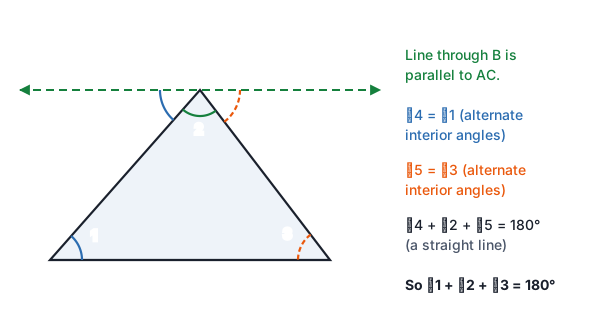
Tearing paper shows the idea, but it is not a proof. A proof uses a line through one vertex, parallel to the opposite side. The picture shows how.
Triangle Angle Sum Theorem
m\angle A + m\angle B + m\angle C = 180^\circ
Here m\angle A means “the measure of angle A.” The theorem works for every triangle: acute, right or obtuse.
An exterior angle is formed when you extend one side of a triangle past a vertex. It forms a linear pair with the interior angle at that vertex. The two interior angles at the other vertices are the remote interior angles.
Exterior Angle Theorem
m\angle(\text{exterior}) = m\angle(\text{remote 1}) + m\angle(\text{remote 2})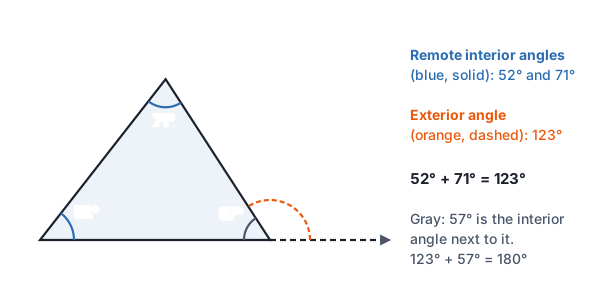
Two quick facts follow from the triangle angle sum theorem. These are called corollaries, results that follow right away from a theorem.
- The two acute angles of a right triangle are complementary. They add to 90°.
- A triangle can have at most one right angle or one obtuse angle.
- Each angle of an equiangular triangle measures 180^\circ \div 3 = 60^\circ.
How to Find a Missing Angle in a Triangle
- Label what you know. Mark each angle as interior or exterior.
- For a missing interior angle, add the two known interior angles.
- Subtract that sum from 180°.
- For an exterior angle, add the two remote interior angles.
- If the angles have variables, write an equation, solve for x, and substitute back.
- Check: the three interior angles should add to exactly 180°.
Worked Examples
Example 1: Find the third angle
A triangle has angles of 48° and 67°. Find the third angle.
- Add the two known angles: 48^\circ + 67^\circ = 115^\circ
- Subtract from 180°: 180^\circ - 115^\circ = 65^\circ
- Check: 48^\circ + 67^\circ + 65^\circ = 180^\circ
Answer: The third angle is 65°.
Example 2: Word problem with a variable
A triangular garden bed has three corners. The middle-sized angle is twice the smallest angle. The largest angle is 3 times the smallest. Find all three angles.
- Let the smallest angle be x. Then the others are 2x and 3x.
- Write the equation: x + 2x + 3x = 180
- Combine like terms (see combining like terms): 6x = 180
- Divide both sides by 6: x = 30
- Find the middle angle: 2(30) = 60
- Find the largest angle: 3(30) = 90
- Check: 30 + 60 + 90 = 180
Answer: The angles are 30°, 60° and 90°. The garden bed is a right triangle.
Example 3: Use the exterior angle theorem
In triangle ABC, side AC is extended past C to point D. The remote interior angles measure 52° and 71°. Find the exterior angle \angle BCD and the interior angle at C. This is the second picture above.
- Add the remote interior angles: 52^\circ + 71^\circ = 123^\circ. So m\angle BCD = 123^\circ.
- The interior angle at C and the exterior angle form a linear pair. Subtract from 180°: 180^\circ - 123^\circ = 57^\circ
- Check the triangle: 52^\circ + 71^\circ + 57^\circ = 180^\circ
Answer: The exterior angle is 123° and the interior angle at C is 57°.
Example 4: Exterior angle with algebra
An exterior angle of a triangle measures (5x - 10)^\circ. The remote interior angles measure (2x + 15)^\circ and (x + 25)^\circ. Find x and each angle.
- Use the exterior angle theorem: 5x - 10 = (2x + 15) + (x + 25)
- Combine like terms on the right: 5x - 10 = 3x + 40
- Subtract 3x from both sides (see equations with variables on both sides): 2x - 10 = 40
- Add 10 to both sides: 2x = 50
- Divide both sides by 2: x = 25
- Exterior angle: 5(25) - 10 = 125 - 10 = 115
- First remote angle: 2(25) + 15 = 50 + 15 = 65
- Second remote angle: 25 + 25 = 50
- Check: 65 + 50 = 115
Answer: x = 25. The exterior angle is 115°, and the remote interior angles are 65° and 50°.
Example 5: Prove the exterior angle theorem
Given: In triangle ABC, \angle 1 is at A, \angle 2 is at B and \angle 3 is at C. \angle 4 is the exterior angle at C, so \angle 3 and \angle 4 form a linear pair.
Prove: m\angle 4 = m\angle 1 + m\angle 2
| Statements | Reasons |
|---|---|
| 1. m\angle 1 + m\angle 2 + m\angle 3 = 180^\circ | Triangle angle sum theorem |
| 2. \angle 3 and \angle 4 form a linear pair | Given |
| 3. m\angle 3 + m\angle 4 = 180^\circ | Linear pair postulate (see proving angle relationships) |
| 4. m\angle 1 + m\angle 2 + m\angle 3 = m\angle 3 + m\angle 4 | Substitution (steps 1 and 3) |
| 5. m\angle 1 + m\angle 2 = m\angle 4 | Subtraction property of equality |
The proof of the triangle angle sum theorem itself follows the first picture. Draw a line through B parallel to \overline{AC}. Then \angle 4 \cong \angle 1 and \angle 5 \cong \angle 3 by the alternate interior angles theorem. Angles 4, 2 and 5 form a straight angle, so m\angle 4 + m\angle 2 + m\angle 5 = 180^\circ. Substitute to get m\angle 1 + m\angle 2 + m\angle 3 = 180^\circ.
Common Mistakes
| Mistake | Example of the error | Fix |
|---|---|---|
| Using 360° for a triangle | 360 - (48 + 67) = 245 | A triangle’s angles add to 180°. The 360° total is for quadrilaterals. |
| Adding the wrong angles for an exterior angle | Adding 57°, the angle next to it, to 52° | Add only the two remote angles: 52 + 71 = 123 |
| Stopping at x | Giving x = 25 as the angle | Substitute x back into each expression. |
| Thinking a triangle can have two obtuse angles | Angles of 100° and 95° in one triangle | 100 + 95 = 195, which is more than 180°, so it is impossible. |
| Mixing up exterior and interior angles | Setting the exterior angle equal to the interior angle next to it | They form a linear pair, so they add to 180°. |
Using the Theorem with Other Figures
- Right triangles: once you know one acute angle, subtract it from 90° to get the other.
- Isosceles triangles: the two base angles are equal. You will use this with the angle sum in Isosceles and Equilateral Triangles, later in this unit.
- Polygons: a polygon can be split into triangles from one vertex. Each triangle adds 180°. That idea gives the angle sum of any polygon in Unit 7.
- Parallel lines: the proof uses the alternate interior angles from parallel lines and transversals, so this theorem is true in flat (Euclidean) geometry.
Practice Problems
- A triangle has angles of 35° and 90°. Find the third angle.
- A triangle has angles of 112° and 29°. Find the third angle.
- One acute angle of a right triangle measures 41°. Find the other acute angle.
- Find the measure of each angle of an equiangular triangle.
- The angles of a triangle measure (x + 10)^\circ, (2x)^\circ and (3x - 10)^\circ. Find each angle.
- The remote interior angles of an exterior angle measure 38° and 64°. Find the exterior angle.
- An exterior angle measures 140°. One remote interior angle measures 85°. Find the other remote interior angle.
- An exterior angle measures (4x + 6)^\circ. Its remote interior angles measure (x + 20)^\circ and (2x + 11)^\circ. Find x and the exterior angle.
- Complete the proof. Given: Triangle ABC with a right angle at C. Prove: \angle A and \angle B are complementary. Statements: (1) \angle C is a right angle. (2) m\angle C = 90^\circ. (3) m\angle A + m\angle B + m\angle C = 180^\circ. (4) m\angle A + m\angle B + 90^\circ = 180^\circ. (5) m\angle A + m\angle B = 90^\circ. (6) \angle A and \angle B are complementary. Give a reason for each statement.
- A ladder leans against a vertical wall. It makes a 66° angle with the level ground. What angle does it make with the wall?
Show answers
- Add: 35 + 90 = 125
Subtract: 180 - 125 = 55
The third angle is 55°. - Add: 112 + 29 = 141
Subtract: 180 - 141 = 39
The third angle is 39°. - The acute angles add to 90°
Subtract: 90 - 41 = 49
The other angle is 49°. - All three angles are equal
Divide: 180 \div 3 = 60
Each angle is 60°. - Write the equation: (x + 10) + 2x + (3x - 10) = 180
Combine like terms: 6x = 180
Divide by 6: x = 30
Angles: 30 + 10 = 40, 2(30) = 60, 3(30) - 10 = 80
Check: 40 + 60 + 80 = 180 - Add the remote angles: 38 + 64 = 102
The exterior angle is 102°. - Exterior angle = sum of the remote angles, so subtract: 140 - 85 = 55
The other remote angle is 55°. - Write the equation: 4x + 6 = (x + 20) + (2x + 11)
Combine like terms: 4x + 6 = 3x + 31
Subtract 3x: x + 6 = 31
Subtract 6: x = 25
Exterior angle: 4(25) + 6 = 106
Check: (25 + 20) + (2(25) + 11) = 45 + 61 = 106 - (1) Given
(2) Definition of a right angle
(3) Triangle angle sum theorem
(4) Substitution property of equality
(5) Subtraction property of equality
(6) Definition of complementary angles - The wall and the ground meet at a right angle, so the triangle has a 90° angle
The acute angles add to 90°
Subtract: 90 - 66 = 24
The ladder makes a 24° angle with the wall.
FAQ
What is the triangle angle sum theorem?
It says the interior angles of every triangle add up to 180°. It is also called the triangle sum theorem.
What is the exterior angle theorem?
An exterior angle of a triangle equals the sum of the two remote interior angles. The remote interior angles are the two angles not next to the exterior angle.
Can a triangle have two right angles?
No. Two right angles already add to 180°, leaving 0° for the third angle. A triangle can have at most one right angle or one obtuse angle.
How do you find the third angle of a triangle?
Add the two angles you know, then subtract the sum from 180°.
Summary
- The interior angles of a triangle add to 180°.
- Missing angle = 180° minus the sum of the other two.
- An exterior angle equals the sum of the two remote interior angles.
- An exterior angle and the interior angle next to it add to 180°.
- The acute angles of a right triangle add to 90°.
- With variables, write an equation, solve, and substitute back.
Previous lesson: Symmetry
Next lesson: Congruent Figures (coming soon)
Back to the Geometry Index