
Isosceles and Equilateral Triangles
An isosceles triangle has at least two congruent sides, called legs. The base angles theorem says the angles opposite those sides are congruent. Its converse says two congruent angles mean the opposite sides are congruent. An equilateral triangle has three congruent sides, so all three of its angles measure 60°.
Before this lesson: You should know the Triangle Angle Sum Theorem, SSS and SAS Congruence and CPCTC.
Parts of an Isosceles Triangle
Picture the letter A or the gable of a house. The two slanted sides have the same length. Those equal sides are the legs. The third side is the base.
The angle between the two legs is the vertex angle. The two angles that touch the base are the base angles. Each base angle sits across from one leg.
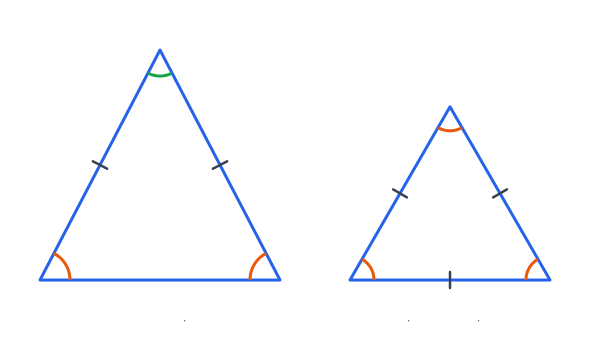
An equilateral triangle has three congruent sides. It is also isosceles, because it has at least two congruent sides.
The Base Angles Theorem and Its Converse
- Base angles theorem (isosceles triangle theorem): If two sides of a triangle are congruent, then the angles opposite them are congruent.
- Converse of the base angles theorem: If two angles of a triangle are congruent, then the sides opposite them are congruent.
- Equilateral triangles: a triangle is equilateral if and only if it is equiangular. Each angle measures 60°.
\text{If } \overline{AB} \cong \overline{CB}, \text{ then } \angle A \cong \angle C.Why is each angle of an equilateral triangle 60°? The three angles are equal, and they add to 180°. So each one is 180^\circ \div 3 = 60^\circ.
How to Find Angles and Sides in Isosceles Triangles
- Find the legs. The base angles are the angles across from the legs.
- Set the base angles equal to each other, or set the legs equal to each other.
- Use the angle sum: vertex angle + 2 × base angle = 180°.
- Vertex angle known: base angle = (180° − vertex angle) ÷ 2.
- Base angle known: vertex angle = 180° − 2 × base angle.
- With variables, write an equation, solve, and substitute back.
Worked Examples
Example 1: Word problem with an A-frame roof
An A-frame cabin has two roof rafters of equal length. They meet at the peak at a 110° angle. What angle does each rafter make with the floor of the attic?
- The rafters are the legs of an isosceles triangle, and the attic floor is the base.
- The peak angle is the vertex angle: 110°.
- Subtract the vertex angle from 180° (see triangle angle sum theorem): 180^\circ - 110^\circ = 70^\circ
- The two base angles share this 70° equally. Divide by 2: 70^\circ \div 2 = 35^\circ
- Check: 35^\circ + 35^\circ + 110^\circ = 180^\circ
Answer: Each rafter makes a 35° angle with the attic floor.
Example 2: Find the vertex angle
One base angle of an isosceles triangle measures 52°. Find the vertex angle.
- The base angles are congruent, so the other base angle is also 52°.
- Add the base angles: 52^\circ + 52^\circ = 104^\circ
- Subtract from 180°: 180^\circ - 104^\circ = 76^\circ
- Check: 52^\circ + 52^\circ + 76^\circ = 180^\circ
Answer: The vertex angle is 76°.
Example 3: Use the converse to find a side
In \triangle ABC, \angle A \cong \angle C. Side AB = 3x - 7 and side CB = x + 9. Find x and AB.
- Angle A is across from side CB. Angle C is across from side AB.
- By the converse of the base angles theorem, \overline{AB} \cong \overline{CB}.
- Set the sides equal: 3x - 7 = x + 9
- Subtract x from both sides (see equations with variables on both sides): 2x - 7 = 9
- Add 7 to both sides: 2x = 16
- Divide both sides by 2: x = 8
- Find AB: 3(8) - 7 = 24 - 7 = 17
- Check with CB: 8 + 9 = 17
Answer: x = 8 and AB = 17.
Example 4: An equilateral triangle
\triangle PQR is equilateral. PQ = 4x + 1 and QR = 6x - 9. Also m\angle P = (5y)^\circ. Find x, the perimeter and y.
- All sides of an equilateral triangle are congruent, so 4x + 1 = 6x - 9.
- Subtract 4x from both sides: 1 = 2x - 9
- Add 9 to both sides: 10 = 2x
- Divide both sides by 2: 5 = x
- Find one side: 4(5) + 1 = 20 + 1 = 21
- Check with QR: 6(5) - 9 = 30 - 9 = 21
- Multiply to get the perimeter: 3 \times 21 = 63
- Every angle is 60°, so 5y = 60.
- Divide both sides by 5: y = 12
Answer: x = 5, the perimeter is 63, and y = 12.
Example 5: Prove the base angles theorem
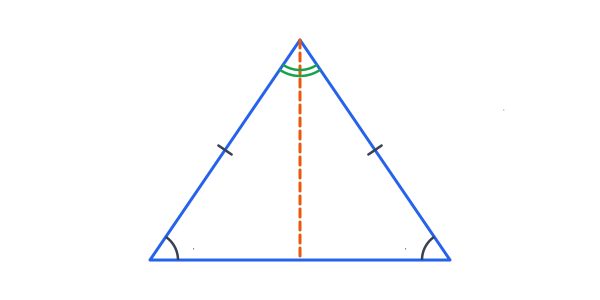
Given: \overline{AB} \cong \overline{CB}
Prove: \angle A \cong \angle C
| Statements | Reasons |
|---|---|
| 1. \overline{AB} \cong \overline{CB} | Given |
| 2. Draw \overline{BD}, the bisector of \angle ABC | Every angle has exactly one bisector |
| 3. \angle ABD \cong \angle CBD | Definition of angle bisector |
| 4. \overline{BD} \cong \overline{BD} | Reflexive property of congruence |
| 5. \triangle ABD \cong \triangle CBD | SAS (steps 1, 3 and 4) |
| 6. \angle A \cong \angle C | CPCTC |
The bisector is an auxiliary line, a line you add to a figure to help with a proof. You can draw it with a compass (see basic constructions).
Common Mistakes
| Mistake | Example of the error | Fix |
|---|---|---|
| Treating the vertex angle as a base angle | Vertex angle 110°, so “each base angle is 110°” | The base angles are the two angles that touch the base: (180 - 110) \div 2 = 35. |
| Matching the wrong angle to a side | Saying the angle next to a leg matches that leg | Each base angle is across from a leg. Look at the side opposite the angle. |
| Dividing before subtracting | 180 \div 2 - 110 | Subtract the vertex angle first, then divide by 2. |
| Assuming a triangle is isosceles from a picture | Two sides look equal, so the base angles are used as equal | Use only marked or given facts: tick marks, given lengths or given angles. |
| Forgetting equilateral triangles have 60° angles | Solving for side lengths but leaving the angles unknown | Every angle of an equilateral triangle is 60°. |
Isosceles Triangles in Other Topics
- Isosceles right triangles: the vertex angle is 90°, so each base angle is 45°. These are the 45-45-90 triangles you’ll study in special right triangles.
- Exterior angles: an exterior angle at the vertex equals the sum of the two equal base angles, or twice one base angle.
- Regular polygons: lines from the center to the vertices of a regular polygon cut it into congruent isosceles triangles.
- Symmetry: an isosceles triangle has a line of symmetry through the vertex angle (see symmetry).
Practice Problems
- The vertex angle of an isosceles triangle measures 28°. Find each base angle.
- One base angle of an isosceles triangle measures 67°. Find the vertex angle.
- An isosceles right triangle has a 90° vertex angle. Find each base angle.
- The legs of an isosceles triangle measure 2x + 3 and 5x - 12. Find x and the length of each leg.
- In \triangle DEF, \angle D \cong \angle F and DE is 9 cm. Find EF.
- An equilateral triangle has sides of 3y - 2 and 2y + 5. Find y and the side length.
- The base angles of an isosceles triangle measure (3x + 5)^\circ and (4x - 10)^\circ. Find x, each base angle and the vertex angle.
- An isosceles triangle has a vertex angle of (2x)^\circ, and each base angle measures (x + 10)^\circ. Find all three angles.
- Complete the proof of the converse. Given: \angle A \cong \angle C, and \overline{BD} bisects \angle ABC. Prove: \overline{AB} \cong \overline{CB}. Statements: (1) \angle A \cong \angle C. (2) \overline{BD} bisects \angle ABC. (3) \angle ABD \cong \angle CBD. (4) \overline{BD} \cong \overline{BD}. (5) \triangle ABD \cong \triangle CBD. (6) \overline{AB} \cong \overline{CB}. Give a reason for each statement.
- A yield sign is shaped like an equilateral triangle. Its perimeter is 108 in. Find the length of each side and the measure of each angle.
Show answers
- Subtract: 180 - 28 = 152
Divide by 2: 152 \div 2 = 76
Each base angle is 76°. - Add the base angles: 67 + 67 = 134
Subtract: 180 - 134 = 46
The vertex angle is 46°. - Subtract: 180 - 90 = 90
Divide by 2: 90 \div 2 = 45
Each base angle is 45°. - The legs are congruent: 2x + 3 = 5x - 12
Subtract 2x: 3 = 3x - 12
Add 12: 15 = 3x
Divide by 3: x = 5
Find a leg: 2(5) + 3 = 10 + 3 = 13
Check: 5(5) - 12 = 25 - 12 = 13
Each leg is 13. - Angle D is across from EF, and angle F is across from DE
By the converse of the base angles theorem, \overline{EF} \cong \overline{DE}
EF is 9 cm. - The sides are congruent: 3y - 2 = 2y + 5
Subtract 2y: y - 2 = 5
Add 2: y = 7
Find the side: 3(7) - 2 = 21 - 2 = 19
Check: 2(7) + 5 = 14 + 5 = 19 - The base angles are congruent: 3x + 5 = 4x - 10
Subtract 3x: 5 = x - 10
Add 10: 15 = x
Base angle: 3(15) + 5 = 45 + 5 = 50, so each base angle is 50°
Add the base angles: 50 + 50 = 100
Vertex angle: 180 - 100 = 80, so it is 80° - Write the angle sum: 2x + (x + 10) + (x + 10) = 180
Combine like terms (see combining like terms): 4x + 20 = 180
Subtract 20: 4x = 160
Divide by 4: x = 40
Vertex angle: 2(40) = 80, so 80°
Base angles: 40 + 10 = 50, so 50° each
Check: 80 + 50 + 50 = 180 - (1) Given
(2) Given
(3) Definition of angle bisector
(4) Reflexive property of congruence
(5) AAS (steps 1, 3 and 4)
(6) CPCTC - All three sides are equal, so divide: 108 \div 3 = 36
Each side is 36 in.
Each angle of an equilateral triangle is 60°.
FAQ
What is the isosceles triangle theorem?
It is another name for the base angles theorem. If two sides of a triangle are congruent, the angles opposite those sides are congruent.
What is the converse of the base angles theorem?
If two angles of a triangle are congruent, then the sides opposite those angles are congruent. So the triangle is isosceles.
Are all equilateral triangles isosceles?
Yes. An isosceles triangle needs at least two congruent sides, and an equilateral triangle has three. Not every isosceles triangle is equilateral, though.
What are the angles of an isosceles right triangle?
The angles are 90°, 45° and 45°. The right angle is the vertex angle, and the two base angles split the other 90° equally.
Summary
- An isosceles triangle has two congruent legs, a base, a vertex angle and two base angles.
- Base angles theorem: congruent sides mean the angles opposite them are congruent.
- Converse: congruent angles mean the sides opposite them are congruent.
- Base angle = (180° − vertex angle) ÷ 2.
- An equilateral triangle is also equiangular, with three 60° angles.
- The base angles theorem is proved with an angle bisector, SAS and CPCTC.
Previous lesson: CPCTC
Next lesson: Perpendicular and Angle Bisectors, the first lesson of Unit 6
Back to the Geometry Index