
CPCTC
CPCTC stands for “corresponding parts of congruent triangles are congruent.” Once you prove two triangles congruent with SSS, SAS, ASA, AAS or HL, every pair of matching sides and angles is congruent too. In a proof, CPCTC is the reason you give right after the triangles are proved congruent.
Before this lesson: You should know Congruent Figures, SSS and SAS Congruence and ASA, AAS and HL Congruence.
What CPCTC Means
Congruent triangles are exact copies. If one copy fits on top of the other, every side and every angle lines up. So when you know the triangles are congruent, you know all six pairs of parts match.
The congruence tests use only three pairs of parts. CPCTC gives you the other three. That is why it is so useful: it turns a triangle proof into a proof about a single segment or angle.
Here is the big idea. You can’t use CPCTC until the triangles are proved congruent. The order is always: first prove the triangles congruent, then use CPCTC.
The CPCTC Rule
\text{If } \triangle ABC \cong \triangle DEF, \text{ then } \overline{AB} \cong \overline{DE},\ \angle C \cong \angle F, \text{ and so on.}CPCTC comes straight from the definition of congruent figures. It is not a congruence test. It never proves triangles congruent. It only uses triangles that are already congruent.
How to Use CPCTC in a Proof
- Find the segment or angle you need to prove congruent.
- Find two triangles that contain those parts.
- Prove the triangles congruent with SSS, SAS, ASA, AAS or HL.
- Write the parts you need as congruent, with the reason CPCTC.
- If the goal is more than a congruence, like a midpoint or perpendicular lines, add one more step that uses a definition or theorem.
Worked Examples
Example 1: What does CPCTC give you?
You know \triangle JKL \cong \triangle XYZ by SSS. Which angles can you now say are congruent?
- The SSS test used the three pairs of sides. The angles have not been used yet.
- Match the first letters: \angle J \cong \angle X by CPCTC.
- Match the second letters: \angle K \cong \angle Y by CPCTC.
- Match the third letters: \angle L \cong \angle Z by CPCTC.
Answer: \angle J \cong \angle X, \angle K \cong \angle Y and \angle L \cong \angle Z, all by CPCTC.
Example 2: Use CPCTC to solve for x
\triangle PQR \cong \triangle STU by ASA. m\angle R = (4x + 6)^\circ and m\angle U = (6x - 18)^\circ. Find m\angle R.
- \angle R and \angle U are corresponding angles, so they are congruent by CPCTC.
- Set the measures equal: 4x + 6 = 6x - 18
- Subtract 4x from both sides (see equations with variables on both sides): 6 = 2x - 18
- Add 18 to both sides: 24 = 2x
- Divide both sides by 2: 12 = x
- Find the angle: 4(12) + 6 = 48 + 6 = 54
- Check with \angle U: 6(12) - 18 = 72 - 18 = 54
Answer: m\angle R = 54^\circ.
Example 3: Word problem with tent ropes
A tent pole BD stands straight up from level ground. Two guy ropes run from the top of the pole, B, to stakes at A and C. Each stake is 2 m from the base of the pole, D. Rope BA is 3.5 m long. Prove that the ropes are the same length, and find the length of rope BC.
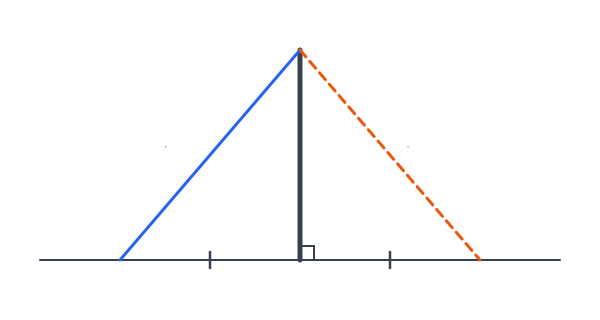
- The stakes are each 2 m from D, so \overline{AD} \cong \overline{CD}.
- The pole is straight up, so \angle ADB and \angle CDB are right angles. All right angles are congruent.
- The pole is a side of both triangles: \overline{BD} \cong \overline{BD} (reflexive property).
- The right angle is between sides AD and BD, and between CD and BD. So by SAS, \triangle ADB \cong \triangle CDB.
- BA and BC are corresponding sides, so \overline{BA} \cong \overline{BC} by CPCTC.
- So BC has the same length as BA: 3.5 m.
Answer: The triangles are congruent by SAS, so the ropes are congruent by CPCTC. Rope BC is 3.5 m long.
Example 4: Prove a midpoint with CPCTC
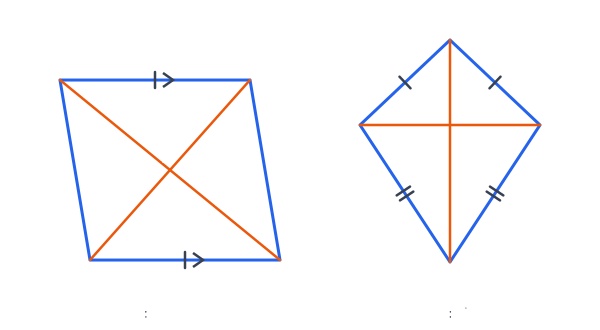
Given: \overline{AB} \parallel \overline{DC} and \overline{AB} \cong \overline{DC}. Diagonals AC and BD meet at E.
Prove: E is the midpoint of \overline{AC}.
| Statements | Reasons |
|---|---|
| 1. \overline{AB} \parallel \overline{DC} | Given |
| 2. \angle BAE \cong \angle DCE | Alternate interior angles theorem (transversal AC) |
| 3. \angle ABE \cong \angle CDE | Alternate interior angles theorem (transversal BD) |
| 4. \overline{AB} \cong \overline{DC} | Given |
| 5. \triangle ABE \cong \triangle CDE | ASA (steps 2, 4 and 3) |
| 6. \overline{AE} \cong \overline{CE} | CPCTC |
| 7. E is the midpoint of \overline{AC} | Definition of midpoint |
The alternate interior angles come from parallel lines and transversals. Side AB is between angles BAE and ABE, so the side is included and ASA applies.
Example 5: A two-stage proof
Some proofs need CPCTC twice. Use the kite on the right of the figure above.
Given: \overline{AB} \cong \overline{CB} and \overline{AD} \cong \overline{CD}. Diagonals BD and AC meet at E.
Prove: \overline{BD} \perp \overline{AC}
| Statements | Reasons |
|---|---|
| 1. \overline{AB} \cong \overline{CB} | Given |
| 2. \overline{AD} \cong \overline{CD} | Given |
| 3. \overline{BD} \cong \overline{BD} | Reflexive property of congruence |
| 4. \triangle ABD \cong \triangle CBD | SSS (steps 1, 2 and 3) |
| 5. \angle ABE \cong \angle CBE | CPCTC |
| 6. \overline{BE} \cong \overline{BE} | Reflexive property of congruence |
| 7. \triangle ABE \cong \triangle CBE | SAS (steps 1, 5 and 6) |
| 8. \angle AEB \cong \angle CEB | CPCTC |
| 9. \angle AEB and \angle CEB form a linear pair | Definition of a linear pair |
| 10. \overline{BD} \perp \overline{AC} | Two congruent angles in a linear pair make perpendicular lines |
The first CPCTC gives an angle for the second pair of triangles. The second CPCTC gives two congruent angles that add to 180°, so each is 90°. See proofs with perpendicular lines for that last theorem.
Common Mistakes
| Mistake | Example of the error | Fix |
|---|---|---|
| Using CPCTC before the triangles are proved congruent | Step 2 says \overline{AE} \cong \overline{CE} by CPCTC, and the triangles come later | Prove the triangles congruent first. CPCTC always comes after. |
| Using CPCTC to prove triangles congruent | “\triangle ABC \cong \triangle DEF by CPCTC” | CPCTC is not a test. Use SSS, SAS, ASA, AAS or HL. |
| Matching the wrong parts | From \triangle ABC \cong \triangle DEF, writing \overline{AB} \cong \overline{EF} | Follow the letter order: AB matches DE. |
| Using parts outside the triangles | Using CPCTC for a segment that is not a side of either triangle | Pick triangles that contain the parts you need. |
| Stopping one step early | Ending with \overline{AE} \cong \overline{CE} when the goal is a midpoint | Add the last step: E is the midpoint by the definition of midpoint. |
What CPCTC Can Lead To
- Midpoints: two congruent segments that share an endpoint on a line give a midpoint.
- Angle bisectors: two congruent angles that share a ray give an angle bisector.
- Parallel lines: congruent alternate interior angles prove lines parallel (see proving lines parallel).
- Perpendicular lines: congruent angles in a linear pair are right angles, as in Example 5.
- Isosceles triangles: CPCTC is how the base angles theorem is proved in the next lesson.
Practice Problems
- \triangle ABC \cong \triangle FGH by SAS. Which angle matches \angle C? What reason do you give?
- \triangle MNP \cong \triangle QRS by ASA, and MP = 12. Find QS.
- \triangle ABC \cong \triangle DEF, AB = 2x + 5 and DE = 4x - 9. Find x and AB.
- \triangle JKL \cong \triangle MNO, m\angle K = (7y - 4)^\circ and m\angle N = (5y + 20)^\circ. Find y and m\angle K.
- A student writes CPCTC as the reason in step 2 of a proof and proves the triangles congruent in step 5. What is wrong?
- Complete the proof. Given: \overline{AB} \cong \overline{CB}, and \overline{BD} bisects \angle ABC. Prove: \overline{AD} \cong \overline{CD}. Statements: (1) \overline{AB} \cong \overline{CB}. (2) \overline{BD} bisects \angle ABC. (3) \angle ABD \cong \angle CBD. (4) \overline{BD} \cong \overline{BD}. (5) \triangle ABD \cong \triangle CBD. (6) \overline{AD} \cong \overline{CD}. Give a reason for each statement.
- Segments AE and BD cross at C, and C is the midpoint of both. Explain how to prove \overline{AB} \parallel \overline{DE}.
- Two support wires run from the top of a vertical pole to stakes on level ground. Each stake is 6 m from the base of the pole. One wire is 10 m long. How long is the other wire? Name the test and the reason.
- In the Example 4 figure, which two triangles would you prove congruent to show \overline{BE} \cong \overline{DE}? Which reason gives the last step?
- In the Example 5 kite, a student wants to prove that BD bisects \angle ABC. Which steps of Example 5 are enough, and what is the last reason?
Show answers
- \angle H, because C and H are the third letters
Reason: CPCTC - \overline{QS} matches \overline{MP}
By CPCTC, QS = 12 - Set the sides equal by CPCTC: 2x + 5 = 4x - 9
Subtract 2x: 5 = 2x - 9
Add 9: 14 = 2x
Divide by 2: x = 7
Find AB: 2(7) + 5 = 14 + 5 = 19
Check: 4(7) - 9 = 28 - 9 = 19 - Set the angles equal by CPCTC: 7y - 4 = 5y + 20
Subtract 5y: 2y - 4 = 20
Add 4: 2y = 24
Divide by 2: y = 12
Find the angle: 7(12) - 4 = 84 - 4 = 80, so m\angle K = 80^\circ
Check: 5(12) + 20 = 60 + 20 = 80 - CPCTC can only be used after the triangles are proved congruent. The congruence must come first, then CPCTC.
- (1) Given
(2) Given
(3) Definition of angle bisector
(4) Reflexive property of congruence
(5) SAS (steps 1, 3 and 4)
(6) CPCTC - \overline{AC} \cong \overline{EC} and \overline{BC} \cong \overline{DC} (definition of midpoint)
\angle ACB \cong \angle ECD (vertical angles theorem)
\triangle ABC \cong \triangle EDC (SAS)
\angle A \cong \angle E (CPCTC)
These are congruent alternate interior angles, so \overline{AB} \parallel \overline{DE} (alternate interior angles converse) - The stakes are both 6 m from the base, and the pole makes right angles with the ground
The pole is a shared side
By SAS, the two triangles are congruent
By CPCTC, the wires are congruent
The other wire is 10 m long. - \triangle ABE and \triangle CDE, which are congruent by ASA (steps 1–5 of Example 4)
Then \overline{BE} \cong \overline{DE} by CPCTC - Steps 1–5 are enough. Step 5 gives \angle ABE \cong \angle CBE by CPCTC
Last reason: definition of angle bisector, so BD bisects \angle ABC
FAQ
What does CPCTC stand for?
CPCTC stands for “corresponding parts of congruent triangles are congruent.” It means that matching sides and matching angles of congruent triangles are congruent.
When can you use CPCTC in a proof?
Only after you have proved two triangles congruent with SSS, SAS, ASA, AAS or HL. CPCTC then lets you state that any pair of matching parts is congruent.
Is CPCTC a postulate or a theorem?
Neither, strictly. It follows directly from the definition of congruent figures, where all matching parts are congruent. Most textbooks still accept “CPCTC” as a reason in proofs.
Can you use CPCTC to prove triangles are congruent?
No. CPCTC works the other way. It starts with congruent triangles and gives you their matching parts.
Summary
- CPCTC: corresponding parts of congruent triangles are congruent.
- First prove the triangles congruent, then use CPCTC.
- CPCTC is not a congruence test.
- Match parts by the letter order in the congruence statement.
- CPCTC often leads to one more step: a midpoint, a bisector, parallel lines or perpendicular lines.
- Some proofs use two pairs of triangles and CPCTC twice.
Previous lesson: ASA, AAS and HL Congruence
Next lesson: Isosceles and Equilateral Triangles
Back to the Geometry Index