
Trapezoids and Kites
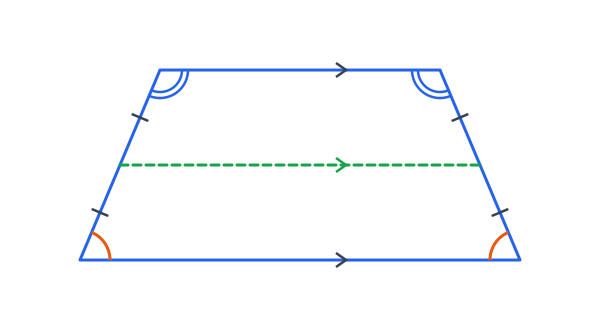
A trapezoid is a quadrilateral with exactly one pair of parallel sides, called the bases. Its midsegment is parallel to the bases and equal to half their sum. An isosceles trapezoid has congruent legs, base angles and diagonals. A kite has two pairs of congruent sides next to each other, and its diagonals are perpendicular.
Before this lesson: You should know Properties of Parallelograms, the Triangle Midsegment Theorem and Isosceles and Equilateral Triangles.
Trapezoids and Kites
Not every quadrilateral is a parallelogram. A trapezoid has only one pair of parallel sides, like the shape of a bucket seen from the side. The parallel sides are the bases, and the other two sides are the legs. The angles at the ends of a base are a pair of base angles.
An isosceles trapezoid has congruent legs, so it is balanced from left to right. The midsegment of a trapezoid joins the midpoints of the two legs.
A kite looks like the toy. It has two pairs of congruent sides, and each pair shares a vertex. A kite is not a parallelogram, because its opposite sides are not congruent.
Properties of Trapezoids and Kites
| Shape | Properties |
|---|---|
| Any trapezoid | Exactly one pair of parallel sides. Angles along each leg add to 180°. |
| Trapezoid midsegment | Parallel to the bases, and MN = \tfrac{1}{2}(b_1 + b_2) |
| Isosceles trapezoid | Legs congruent; each pair of base angles congruent; diagonals congruent |
| Kite | Two pairs of congruent consecutive sides; diagonals perpendicular; one pair of opposite angles congruent |
In a kite, the congruent opposite angles are the two angles between the unequal sides. The other two angles are usually different from each other.
How to Solve Trapezoid and Kite Problems
- Identify the shape and its parallel sides or congruent sides.
- For a midsegment, add the bases and divide by 2.
- For an isosceles trapezoid, match base angles, and remember that angles along a leg add to 180°.
- For a kite, use the 90° angle where the diagonals cross, and the pair of congruent opposite angles.
- Use 360° for the angle sum of any quadrilateral.
Worked Examples
Example 1: Word problem with a garden path
A garden bed is a trapezoid. Its parallel sides are 8 m and 14 m long. A straight path runs across the bed from the midpoint of one leg to the midpoint of the other. How long is the path?
- The path joins the midpoints of the legs, so it is the midsegment.
- Add the bases: 8 + 14 = 22
- Divide by 2: 22 \div 2 = 11
Answer: The path is 11 m long.
Example 2: Midsegment with algebra
A trapezoid has bases of 3x + 1 and 5x + 7, and its midsegment is 20. Find x and each base.
- Write the midsegment formula: \tfrac{1}{2}\big((3x + 1) + (5x + 7)\big) = 20
- Multiply both sides by 2: (3x + 1) + (5x + 7) = 40
- Combine like terms (see combining like terms): 8x + 8 = 40
- Subtract 8 from both sides: 8x = 32
- Divide both sides by 8: x = 4
- First base: 3(4) + 1 = 12 + 1 = 13
- Second base: 5(4) + 7 = 20 + 7 = 27
- Check: (13 + 27) \div 2 = 40 \div 2 = 20
Answer: x = 4, and the bases are 13 and 27.
Example 3: Angles of an isosceles trapezoid
In isosceles trapezoid ABCD, AB and DC are the bases, and m\angle A = 68^\circ. Find the other three angles.
- Base angles of an isosceles trapezoid are congruent. Angles A and B share base AB, so m\angle B = 68^\circ.
- Angles A and D are along leg AD, between parallel lines, so they add to 180° (see parallel lines and transversals): 180^\circ - 68^\circ = 112^\circ
- So m\angle D = 112^\circ, and its base partner is m\angle C = 112^\circ.
- Check: 68 + 68 + 112 + 112 = 360
Answer: m\angle B = 68^\circ, m\angle C = 112^\circ and m\angle D = 112^\circ.
Example 4: Angles of a kite
In kite ABCD, \overline{AB} \cong \overline{AD} and \overline{CB} \cong \overline{CD}. m\angle A = 110^\circ and m\angle C = 50^\circ. Find m\angle B and m\angle D.
- Angles B and D are between the unequal sides, so they are the congruent pair.
- The angles of a quadrilateral add to 360°. Subtract the known angles: 360 - 110 - 50 = 200
- Split the rest equally between B and D: 200 \div 2 = 100
- Check: 110 + 100 + 50 + 100 = 360
Answer: m\angle B = m\angle D = 100^\circ.
Example 5: A kite on a grid
Show that ABCD with A(0, 3), B(2, 0), C(0, -5) and D(-2, 0) is a kite, and that its diagonals are perpendicular.
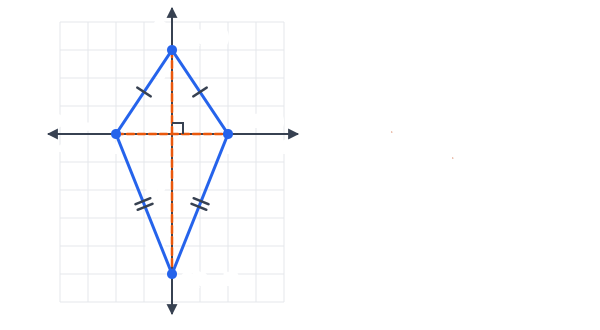
- Find AB (see distance formula): \sqrt{(2 - 0)^2 + (0 - 3)^2} = \sqrt{4 + 9} = \sqrt{13}
- Find AD: \sqrt{(-2 - 0)^2 + (0 - 3)^2} = \sqrt{4 + 9} = \sqrt{13}
- Find CB: \sqrt{(2 - 0)^2 + (0 + 5)^2} = \sqrt{4 + 25} = \sqrt{29}
- Find CD: \sqrt{(-2 - 0)^2 + (0 + 5)^2} = \sqrt{4 + 25} = \sqrt{29}
- AB = AD and CB = CD, two pairs of congruent sides that each share a vertex. So ABCD is a kite. It is not a parallelogram, because \sqrt{13} \ne \sqrt{29}.
- Diagonal AC lies on the y-axis and BD lies on the x-axis, so they are perpendicular.
Answer: ABCD is a kite, and its diagonals meet at a right angle at the origin.
Common Mistakes
| Mistake | Example of the error | Fix |
|---|---|---|
| Adding the bases without halving | Midsegment of bases 8 and 14 is 22 | Divide the sum by 2: 11. |
| Matching base angles on different bases | Setting angle A equal to angle D in an isosceles trapezoid | Base angles share a base. A and D are along a leg, so they add to 180°. |
| Using isosceles facts on any trapezoid | Saying any trapezoid has congruent diagonals | Only isosceles trapezoids have congruent legs, base angles and diagonals. |
| Picking the wrong pair of kite angles | Setting the angles between the equal sides equal | The congruent pair is between the unequal sides. |
| Calling a kite a parallelogram | “A kite has congruent sides, so it’s a parallelogram” | A kite’s congruent sides are next to each other, not opposite. |
The Quadrilateral Family
- Parallelograms have two pairs of parallel sides. Rectangles, rhombuses and squares are special parallelograms (see rectangles, rhombuses and squares).
- Trapezoids have exactly one pair of parallel sides. Isosceles trapezoids are special trapezoids.
- Kites have two pairs of congruent consecutive sides and no parallel sides in general.
- The trapezoid midsegment works like the triangle midsegment: shrink the top base to a point, and the formula becomes half the other base.
Practice Problems
- A trapezoid has bases of 9 cm and 17 cm. Find the length of its midsegment.
- A trapezoid’s midsegment is 12, and one base is 7. Find the other base.
- In isosceles trapezoid ABCD with bases AB and DC, m\angle A = 73^\circ. Find the other three angles.
- In isosceles trapezoid ABCD, diagonal AC = 2x + 5 and diagonal BD = 4x - 9. Find x and AC.
- In trapezoid ABCD with bases AB and DC, m\angle A = 64^\circ. Find m\angle D.
- In kite ABCD with \overline{AB} \cong \overline{AD} and \overline{CB} \cong \overline{CD}, m\angle A = 120^\circ and m\angle C = 60^\circ. Find m\angle B and m\angle D.
- The diagonals of a kite meet at E. Find m\angle AEB.
- A trapezoid has bases of x + 4 and 3x - 2, and its midsegment is 13. Find x and each base.
- Is ABCD with A(0, 0), B(6, 0), C(4, 3) and D(2, 3) an isosceles trapezoid? Explain.
- Is every kite a parallelogram? Explain.
Show answers
- Add the bases: 9 + 17 = 26
Divide by 2: 26 \div 2 = 13
The midsegment is 13 cm. - The sum of the bases is twice the midsegment: 2 \times 12 = 24
Subtract the known base: 24 - 7 = 17
The other base is 17. - \angle B shares base AB with \angle A: m\angle B = 73^\circ
Along a leg, angles add to 180: 180 - 73 = 107
m\angle C = m\angle D = 107^\circ - The diagonals are congruent: 2x + 5 = 4x - 9
Subtract 2x: 5 = 2x - 9
Add 9: 14 = 2x
Divide by 2: x = 7
Find AC: 2(7) + 5 = 14 + 5 = 19 - Angles A and D are along leg AD, so they add to 180: 180 - 64 = 116
m\angle D = 116^\circ - Subtract the known angles from 360: 360 - 120 - 60 = 180
B and D are congruent: 180 \div 2 = 90
m\angle B = m\angle D = 90^\circ - The diagonals of a kite are perpendicular, so m\angle AEB = 90^\circ.
- Multiply the midsegment by 2: (x + 4) + (3x - 2) = 26
Combine like terms: 4x + 2 = 26
Subtract 2: 4x = 24
Divide by 4: x = 6
Bases: 6 + 4 = 10 and 3(6) - 2 = 16
Check: (10 + 16) \div 2 = 13 - AB and DC are both horizontal, so they are parallel; AB = 6 and DC = 2, so the other sides are not parallel
AD: \sqrt{(2 - 0)^2 + (3 - 0)^2} = \sqrt{13}
BC: \sqrt{(4 - 6)^2 + (3 - 0)^2} = \sqrt{13}
The legs are congruent, so yes, it is an isosceles trapezoid. - No. A kite’s congruent sides are next to each other, so its opposite sides are usually not congruent or parallel. Only a rhombus is both a kite and a parallelogram.
FAQ
What is the midsegment of a trapezoid?
It is the segment joining the midpoints of the two legs. It is parallel to the bases, and its length is half the sum of the bases.
What are the properties of an isosceles trapezoid?
Its legs are congruent, each pair of base angles is congruent, and its diagonals are congruent.
Are the diagonals of a kite perpendicular?
Yes. The diagonals of every kite meet at a right angle. One diagonal also cuts the other in half.
Is a square a kite?
Yes. A square has two pairs of congruent consecutive sides, so it fits the definition of a kite. A rhombus is also a kite.
Summary
- A trapezoid has exactly one pair of parallel sides, called the bases.
- The trapezoid midsegment is half the sum of the bases.
- An isosceles trapezoid has congruent legs, congruent base angles and congruent diagonals.
- A kite has two pairs of congruent consecutive sides and perpendicular diagonals.
- In a kite, the angles between the unequal sides are congruent.
Previous lesson: Rectangles, Rhombuses and Squares
Next lesson: Coordinate Proofs
Back to the Geometry Index