
Trigonometric Ratios
Trigonometric ratios compare two sides of a right triangle. Sine is opposite over hypotenuse, cosine is adjacent over hypotenuse, and tangent is opposite over adjacent. The memory trick SOH CAH TOA keeps them straight. You use these ratios to find missing sides of right triangles.
Before this lesson: You should know the Pythagorean Theorem, AA Similarity and Special Right Triangles.
Naming the Sides of a Right Triangle
In a right triangle, the longest side is across from the right angle. It is called the hypotenuse. The other two sides are the legs.
Now pick one of the acute angles. Call it angle A. The leg across from angle A is the opposite side. The leg that touches angle A is the adjacent side. “Adjacent” means “next to.”
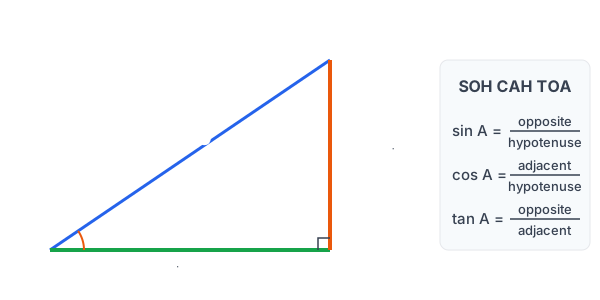
The names depend on the angle you pick. From angle B, the opposite and adjacent sides switch. The hypotenuse never changes.
Why the Ratios Work
Draw two right triangles with the same acute angle A. They also share the right angle. So they are similar by AA similarity. Similar triangles have equal side ratios (see similar polygons).
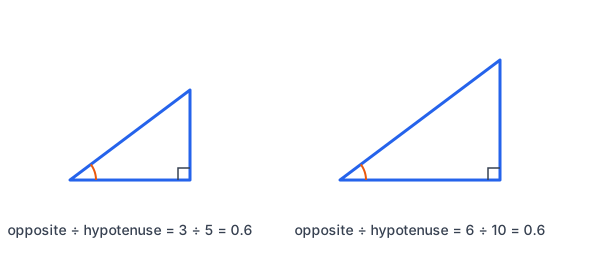
This means a ratio like opposite ÷ hypotenuse depends only on the angle. It does not depend on the size of the triangle. Each ratio gets a name.
The Three Trigonometric Ratios
For an acute angle A in a right triangle:
\sin A = \frac{\text{opposite}}{\text{hypotenuse}} \qquad \cos A = \frac{\text{adjacent}}{\text{hypotenuse}} \qquad \tan A = \frac{\text{opposite}}{\text{adjacent}}Read \sin A as “sine of A,” \cos A as “cosine of A,” and \tan A as “tangent of A.” Remember them with SOH CAH TOA:
- SOH: Sine is Opposite over Hypotenuse.
- CAH: Cosine is Adjacent over Hypotenuse.
- TOA: Tangent is Opposite over Adjacent.
Calculator note: Set your calculator to degree mode. To find 12 \sin 40^\circ, type 12 × sin(40) and press Enter. Round only at the end.
How to Use Trigonometric Ratios
- Mark the angle you are working with.
- Label the sides as opposite, adjacent and hypotenuse from that angle.
- Choose the ratio that uses the side you know and the side you want.
- Write the equation, then solve it.
- Use a calculator for the trig value, and round at the end.
Worked Examples
Example 1: Write the three ratios
Right △ABC has a right angle at C. The sides are BC = 8, AC = 15 and AB = 17. Find \sin A, \cos A and \tan A.
- From angle A, name the sides: opposite BC = 8, adjacent AC = 15, hypotenuse AB = 17
- Write sine as opposite over hypotenuse: \sin A = \frac{8}{17}
- Write cosine as adjacent over hypotenuse: \cos A = \frac{15}{17}
- Write tangent as opposite over adjacent: \tan A = \frac{8}{15}
Answer: \sin A = \frac{8}{17}, \cos A = \frac{15}{17} and \tan A = \frac{8}{15}
Example 2: Find the hypotenuse first
Right △PQR has a right angle at R. The legs are PR = 24 and QR = 7. Find the sine, cosine and tangent of angle P and of angle Q.
- Write the Pythagorean theorem: PQ^2 = 24^2 + 7^2
- Square each leg: PQ^2 = 576 + 49
- Add: PQ^2 = 625
- Take the positive square root: PQ = 25
- From angle P, name the sides: opposite QR = 7, adjacent PR = 24, hypotenuse 25
- Write the ratios for P: \sin P = \frac{7}{25}, \cos P = \frac{24}{25}, \tan P = \frac{7}{24}
- From angle Q, name the sides: opposite PR = 24, adjacent QR = 7, hypotenuse 25
- Write the ratios for Q: \sin Q = \frac{24}{25}, \cos Q = \frac{7}{25}, \tan Q = \frac{24}{7}
Answer: \sin P = \frac{7}{25}, \cos P = \frac{24}{25}, \tan P = \frac{7}{24}, \sin Q = \frac{24}{25}, \cos Q = \frac{7}{25}, \tan Q = \frac{24}{7}. Notice that \sin P = \cos Q.
Example 3: Find a side with sine
In a right triangle, one acute angle is 40°. The hypotenuse is 12. Find the side x opposite the 40° angle. Round to the nearest hundredth.
- The side you want is opposite, and you know the hypotenuse, so use sine: \sin 40^\circ = \frac{x}{12}
- Multiply both sides by 12: 12 \sin 40^\circ = x
- Use a calculator: x \approx 7.71
Answer: x \approx 7.71
Example 4: The unknown is on the bottom
In a right triangle, one acute angle is 28°. The side opposite that angle is 9. Find the adjacent side x. Round to the nearest hundredth.
- You know the opposite side and want the adjacent side, so use tangent: \tan 28^\circ = \frac{9}{x}
- Multiply both sides by x: x \tan 28^\circ = 9
- Divide both sides by \tan 28^\circ: x = \frac{9}{\tan 28^\circ}
- Use a calculator: x \approx 16.93
Answer: x \approx 16.93. The variable was in the denominator, so you divide by the trig value instead of multiplying.
Example 5: Word problem with a ladder
A 16-foot ladder leans against a wall. It makes a 72° angle with the ground. How high up the wall does the ladder reach? How far is its base from the wall? Round to the nearest tenth of a foot.
- The ladder is the hypotenuse. The height is opposite the 72° angle, so use sine: \sin 72^\circ = \frac{h}{16}
- Multiply both sides by 16: h = 16 \sin 72^\circ
- Use a calculator: h \approx 15.2
- The distance on the ground is adjacent to the 72° angle, so use cosine: \cos 72^\circ = \frac{d}{16}
- Multiply both sides by 16: d = 16 \cos 72^\circ
- Use a calculator: d \approx 4.9
- Check with the Pythagorean theorem: 15.2^2 + 4.9^2 = 231.04 + 24.01 = 255.05 \approx 256 = 16^2
Answer: The ladder reaches about 15.2 ft up the wall. Its base is about 4.9 ft from the wall.
Common Mistakes
| Mistake | Example of the error | Fix |
|---|---|---|
| Calling the hypotenuse the adjacent side | \cos A = \frac{\text{hypotenuse}}{\text{opposite}} | The adjacent side is the leg next to the angle. The hypotenuse is never adjacent or opposite. |
| Labeling sides from the wrong angle | Using the side next to angle B as “adjacent” for angle A | Mark the angle first, then label opposite and adjacent from that angle. |
| Calculator in radian mode | \sin 40 \approx 0.745 | Switch to degree mode: \sin 40^\circ \approx 0.643. |
| Multiplying when the variable is on the bottom | \tan 28^\circ = \frac{9}{x} so x = 9 \tan 28^\circ | Multiply by x first, then divide: x = \frac{9}{\tan 28^\circ}. |
| Rounding the trig value too early | Using \sin 72^\circ \approx 0.9 gives h = 14.4 | Keep the full calculator value and round only the final answer. |
Related Ideas: Special Angles and Complementary Angles
For 30°, 45° and 60°, you can find exact values from special right triangles. A 45-45-90 triangle has sides 1, 1 and \sqrt{2}. A 30-60-90 triangle has sides 1, \sqrt{3} and 2.
| Angle | sin | cos | tan |
|---|---|---|---|
| 30° | \frac{1}{2} | \frac{\sqrt{3}}{2} | \frac{\sqrt{3}}{3} |
| 45° | \frac{\sqrt{2}}{2} | \frac{\sqrt{2}}{2} | 1 |
| 60° | \frac{\sqrt{3}}{2} | \frac{1}{2} | \sqrt{3} |
The two acute angles of a right triangle add to 90°, so they are complementary (see angle pairs and the triangle angle sum theorem). The side opposite one angle is adjacent to the other. That gives a useful rule:
\sin A = \cos(90^\circ - A) \qquad \cos A = \sin(90^\circ - A)
For example, \sin 30^\circ = \cos 60^\circ = \frac{1}{2}.
Practice Problems
Round answers to the nearest hundredth unless the problem says otherwise.
- Right △ABC has a right angle at C, with BC = 9, AC = 40 and AB = 41. Find \sin A, \cos A and \tan A.
- A right triangle has legs 6 and 8. Find the sine, cosine and tangent of the angle opposite the leg of length 8. Simplify each fraction.
- One acute angle of a right triangle is 35°, and the hypotenuse is 20. Find the side opposite the 35° angle.
- One acute angle of a right triangle is 50°, and the side adjacent to it is 15. Find the side opposite the 50° angle.
- One acute angle of a right triangle is 62°, and the hypotenuse is 25. Find the side adjacent to the 62° angle.
- One acute angle of a right triangle is 24°, and the side opposite it is 11. Find the hypotenuse.
- \sin 32^\circ \approx 0.53. Without a calculator, find \cos 58^\circ. Explain.
- Give the exact values of \sin 30^\circ, \cos 45^\circ and \tan 60^\circ.
- A ramp is 24 ft long and makes a 5° angle with the ground. How high does the ramp rise?
- The diagonal of a rectangle is 30 cm long. It makes a 33° angle with the longer side. Find the length and width of the rectangle.
Show answers
- From angle A: opposite BC = 9, adjacent AC = 40, hypotenuse AB = 41
Sine is opposite over hypotenuse: \sin A = \frac{9}{41}
Cosine is adjacent over hypotenuse: \cos A = \frac{40}{41}
Tangent is opposite over adjacent: \tan A = \frac{9}{40} - Write the Pythagorean theorem: c^2 = 6^2 + 8^2
Square each leg: c^2 = 36 + 64
Add: c^2 = 100
Take the positive square root: c = 10
From the angle, opposite = 8, adjacent = 6, hypotenuse = 10
Write sine: \sin = \frac{8}{10}
Simplify (see fractions): \sin = \frac{4}{5}
Write cosine: \cos = \frac{6}{10}
Simplify: \cos = \frac{3}{5}
Write tangent: \tan = \frac{8}{6}
Simplify: \tan = \frac{4}{3} - Opposite and hypotenuse, so use sine: \sin 35^\circ = \frac{x}{20}
Multiply both sides by 20: x = 20 \sin 35^\circ
Use a calculator: x \approx 11.47 - Opposite and adjacent, so use tangent: \tan 50^\circ = \frac{x}{15}
Multiply both sides by 15: x = 15 \tan 50^\circ
Use a calculator: x \approx 17.88 - Adjacent and hypotenuse, so use cosine: \cos 62^\circ = \frac{x}{25}
Multiply both sides by 25: x = 25 \cos 62^\circ
Use a calculator: x \approx 11.74 - Opposite and hypotenuse, so use sine: \sin 24^\circ = \frac{11}{x}
Multiply both sides by x: x \sin 24^\circ = 11
Divide both sides by \sin 24^\circ: x = \frac{11}{\sin 24^\circ}
Use a calculator: x \approx 27.04 - Subtract to find the complement: 90^\circ - 32^\circ = 58^\circ
Use the complement rule: \cos 58^\circ = \sin 32^\circ
So \cos 58^\circ \approx 0.53. The side opposite the 32° angle is adjacent to the 58° angle. - From the 30-60-90 triangle: \sin 30^\circ = \frac{1}{2}
From the 45-45-90 triangle: \cos 45^\circ = \frac{1}{\sqrt{2}} = \frac{\sqrt{2}}{2}
From the 30-60-90 triangle: \tan 60^\circ = \frac{\sqrt{3}}{1} = \sqrt{3} - The ramp is the hypotenuse, and the rise is opposite the 5° angle, so use sine: \sin 5^\circ = \frac{h}{24}
Multiply both sides by 24: h = 24 \sin 5^\circ
Use a calculator: h \approx 2.09 ft - The diagonal is the hypotenuse. The length is adjacent to the 33° angle, so use cosine: \cos 33^\circ = \frac{L}{30}
Multiply both sides by 30: L = 30 \cos 33^\circ
Use a calculator: L \approx 25.16 cm
The width is opposite the 33° angle, so use sine: \sin 33^\circ = \frac{W}{30}
Multiply both sides by 30: W = 30 \sin 33^\circ
Use a calculator: W \approx 16.34 cm
FAQ
What does SOH CAH TOA stand for?
It stands for Sine = Opposite over Hypotenuse, Cosine = Adjacent over Hypotenuse, and Tangent = Opposite over Adjacent. It is a memory trick for the three trigonometric ratios.
How do I know whether to use sine, cosine or tangent?
Look at the side you know and the side you want, measured from the given angle. Opposite and hypotenuse means sine. Adjacent and hypotenuse means cosine. Opposite and adjacent means tangent.
Do trig ratios change if the triangle gets bigger?
No. Right triangles with the same acute angle are similar, so their side ratios are equal. The sine, cosine and tangent depend only on the angle.
Can sine or cosine be greater than 1?
Not in a right triangle. The hypotenuse is the longest side, so opposite ÷ hypotenuse and adjacent ÷ hypotenuse are always less than 1. Tangent can be any positive number.
Summary
- The hypotenuse is across from the right angle. The opposite and adjacent sides depend on which acute angle you pick.
- \sin A = \frac{\text{opposite}}{\text{hypotenuse}}, \cos A = \frac{\text{adjacent}}{\text{hypotenuse}}, \tan A = \frac{\text{opposite}}{\text{adjacent}} (SOH CAH TOA).
- The ratios depend only on the angle, because right triangles with the same acute angle are similar.
- If the variable is in the denominator, multiply by it, then divide by the trig value.
- \sin A = \cos(90^\circ - A). Use degree mode, and round only at the end.
Previous lesson: Similar Right Triangles
Next lesson: Solving Right Triangles
Back to the Geometry Index